Deepfakes at schools overwhelmingly target girls and women – and most involve explicit content
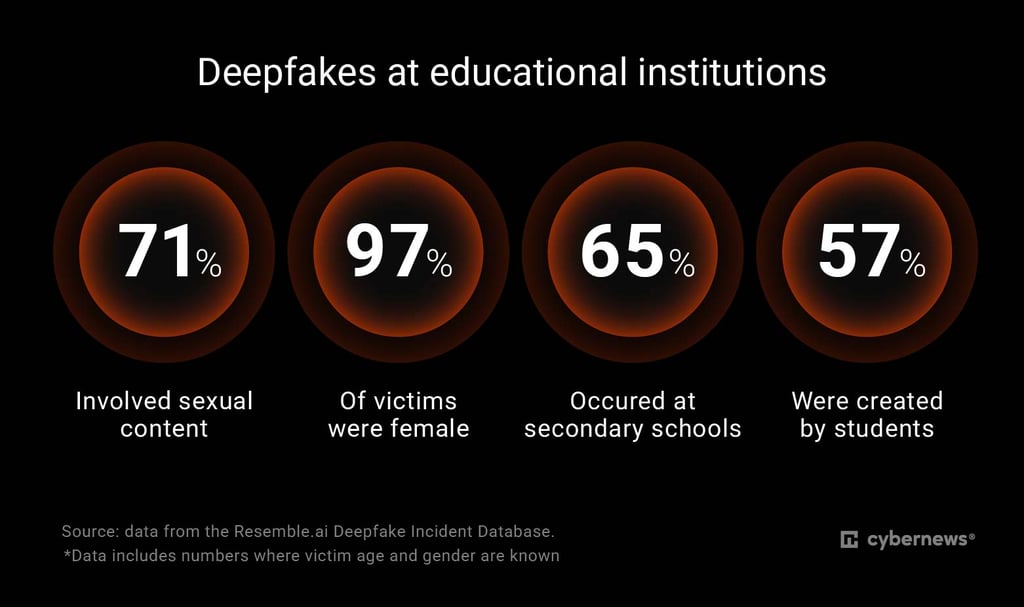
71% of recorded deepfakes at educational institutions involved sexual content
Image by Cybernews

 Follow us
- 83 deepfake incidents have been recorded at educational institutions since the start of 2025.
- 97% of victims were female.
- 65% of deepfake incidents at educational institutions happened at secondary schools.
- Students themselves were the perpetrators in 57% of cases, while teachers/staff were the perpetrators in 18% of cases.
AI image and video generation tools are making it increasingly easy to create convincing fake content of real people. In schools, this is particularly troubling: students are frequently being targeted by other students and staff, with simple pictures or videos being turned into AI-generated explicit content.
Cybernews analyzed education-related incidents recorded in Resemble AI’s Global Deepfake Incident Database to understand who is being targeted, who is creating the content, and where these cases are happening.
The research reveals 83 instances of deepfakes at educational institutions since the start of 2025, 71% of which involved sexual content. The findings also reveal that girls and women are being disproportionately targeted by deepfakes: 97% of victims were female (among cases where victim gender was known), and 72% of victims were minors (among cases where victim age was known).






Secondary schools account for nearly two-thirds of incidents
Secondary schools accounted for 65% of the deepfake incidents analyzed, while universities and colleges accounted for 19%.
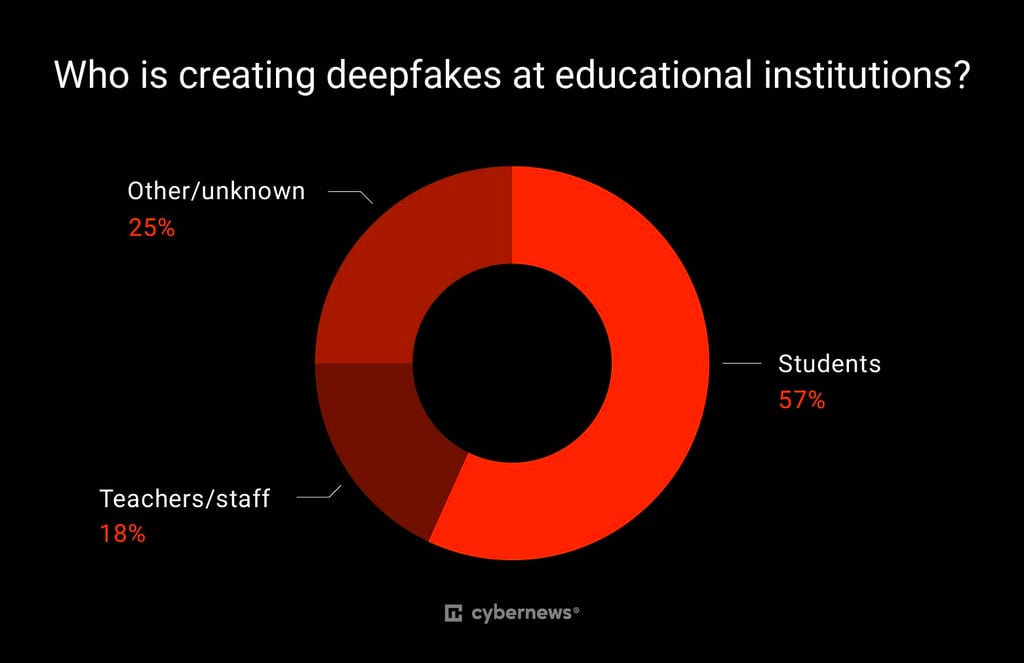
Students themselves were the most frequently identified creators of deepfakes at educational institutions, responsible for 57% of cases. Examples span the globe: while most cases involved US students (like this example of Illinois students targeting their fellow students), there were also cases of Canadian students deepfaking their classmates as well as Australian students targeting their classmates.
Teachers or other staff were identified as creators in 18% of cases. In one recent case, a former teacher from Australia faced child exploitation charges, having allegedly used his work laptop to generate explicit images of staff and students. Another recent case involved an Illinois teacher who was accused of creating explicit images of students after taking videos of them at school. There have also been cases of the reverse – students creating explicit deepfake images of their teachers.
The findings show just how easy it is to leverage everyday AI tools for nefarious purposes, and how urgently we need more guardrails in these tools to protect everyone, especially children, from being targeted with abusive content.
More than half of known-country cases were recorded in the US
The incidents spanned at least 14 countries, but the United States accounted for the majority of cases for which a location was known. The analysis identified 49 US incidents, representing 68% of education-related incidents with a known country.
Have thoughts about this topic? Others do, too. Join them in the discussion.
This does not necessarily mean deepfake abuse is more common in US educational institutions than in other countries. It may be due to differences in news coverage, reporting practices, awareness, and the sources captured by the database.
Bottom line
The Resemble AI database recorded 41 education-related incidents in 2025. In 2026, there have already been 42 cases as of September 16. While not a major increase from last year, 2026 has already surpassed 2025 in the number of deepfake incidents at educational institutions.
The cases show just how big a problem AI-generated deepfakes have become at schools, and how vulnerable children are. Creating a convincing fake no longer requires advanced technical skills, which is why prevention, clear school policies, and effective guardrails on AI platforms are as important as ever.
Methodology:
Cybernews analyzed education-related incidents in Resemble AI’s Deepfake Incident Database as of September 16th, 2026. Relevant cases were identified, categorized, manually reviewed, and deduplicated. Where information such as gender, age, institution, or location was unknown, those cases were excluded from calculations involving that characteristic. The findings reflect reported incidents captured by the database, not the overall prevalence of deepfakes in education.