Best antivirus for iPhone and iPad in 2026
Backed by leading cybersecurity experts and investigative journalists, we deliver independent, real-world antivirus testing and analysis, guaranteeing objective evaluations without undue influence or bias from outside parties.
Our transparent and consistent methodologies ensure objective, up-to-date reviews, empowering readers to make well-informed decisions.
Learn more
As of Sep 2026, Norton, Bitdefender, and McAfee are the best antivirus apps for iPhone we've tested. Norton takes the best overall spot, Bitdefender is the best choice for strong protection with low battery impact, and McAfee is the best option for families. The Cybernews research team has tested more than 35 antivirus products and, for this update, put 10 iPhone security apps through hands-on testing on an iPhone 17, checking phishing and malicious URL blocking, unsafe Wi-Fi detection, battery impact, iOS-specific features, pricing, and ease of use.
Traditional antivirus software doesn't work on iPhone the way it does on Windows or macOS. Apple designs iOS with strict app sandboxing, which prevents security apps from scanning other apps or system files in the same way antivirus software can on desktop operating systems.
Instead, iPhone security apps deal with other threats, such as phishing websites, scam messages, unsafe Wi-Fi networks, or exposed personal data. They add useful extras like VPNs, breach monitoring, and privacy tools, giving you another layer of protection alongside Apple’s built-in security.
Our testing revealed clear differences in protection, performance, and features. Read on to see how the top performers compare and which option best fits your needs.
Top 5 best antivirus for iPhone in 2026
- Norton Antivirus – best antivirus for iPhone overall
- Bitdefender Antivirus – best iPhone antivirus for strong protection with low battery impact
- McAfee Mobile Security – iPhone antivirus for families
- TotalAV – best iOS antivirus for security and cleanup tools
- Trend Micro Mobile Security – best iPhone antivirus for checking suspicious messages




Our team of researchers thoroughly tests antivirus software following a well-established testing process. In unison, our experts combine in-house and independent testing lab findings with first-hand experience to help you make informed decisions about each product. Learn how we test antivirus software.
How we tested and ranked iPhone antivirus software
At Cybernews, we use a rigorous antivirus testing methodology to evaluate each application. For this update, together with the Cybernews research team, I tested 10 iPhone security apps on an iPhone 17 running the latest stable iOS version available at the time of testing.
We tested each app against recent phishing and malicious URLs, checked unsafe Wi-Fi detection, and measured battery impact during regular use. We also compared iOS-specific security features, pricing, and how easy each app was to use. The final ranking reflects how well each provider performed across all areas.
Check out the full testing results and a detailed breakdown of how each iPhone antivirus performed in our dedicated analysis.
When creating this list, we evaluated each iPhone antivirus based on the following criteria:
- Performance (30%). Together with the research team, we tested each provider’s phishing and malicious URL blocking, unsafe Wi-Fi detection, battery impact, and overall performance during everyday use.
- Features (30%). We evaluated what unique features each provider offers, such as breach monitoring, phishing protection, VPN services, identity protection tools, scam detection, and other privacy-focused features designed specifically for iOS users.
- Pricing (20%). We analyzed subscription plans, considered the availability of free versions or trials, and reviewed money-back guarantee policies.
- Usability (20%). We tested setup, navigation, alerts, and how easy each app was to use day to day.
Is antivirus needed on an iPhone?
You do not strictly need antivirus software on an iPhone, but a reputable security app can add useful protection. While iOS devices like iPhones and iPads benefit from robust built-in protections and a strict App Store review process, users can still encounter phishing websites, scam messages, unsafe links, and other online threats, so installing reputable security software adds extra protection for your data and privacy on your device.
iOS security apps offer features that help detect and block cyberthreats, particularly when browsing, opening links, or checking suspicious messages. However, because of iOS’s strong security model, antivirus apps cannot intervene directly or patch system-level vulnerabilities. These are managed exclusively by Apple through regular software updates, which is why it’s so crucial to keep your OS up to date.
Even the US Cybersecurity and Infrastructure Security Agency advises using antivirus and anti-malware protections for added security. Antivirus apps provide valuable additional layers of defense, such as phishing detection, spam filtering, and privacy protections that complement the iPhone’s built-in security. Overall, iPhone security apps are best viewed as an extra layer of protection rather than a replacement for Apple’s built-in security.
Best iPhone antivirus apps compared
If you want a quick snapshot before diving into the detailed reviews, here’s a side-by-side overview of the top iPhone antivirus apps:
| Norton | Bitdefender | McAfee | |
| Our rating | |||
| App Store rating | 4.7⭐ | 4.7⭐ | 4.7⭐ |
| Price | $29.99/year | $17.99/year | $39.99/year |
| Maximum number of devices | 10 | 10 | 5 |
| System impact (background) | Light | Light | Moderate |
| Safari web protection | ✅ Yes | ✅ Yes | ✅ Yes |
| Wi-Fi security | ✅ Yes | ✅ Yes | ✅ Yes |
| Malicious URL blocking | ✅ Yes | ✅ Yes | ✅ Yes |
| Free version | ❌ No | ✅ Yes | ✅ Yes |
Recent Updates
Best antivirus for iPhone in 2026 – detailed list
To uncover the best iOS antivirus services, we stress-tested 10 antivirus apps on the iPhone 17, comparing their performance, features, and overall value. My final selections cover a range of user needs, helping you choose the right protection for your iPhone.
Norton Mobile Security for iOS – best antivirus for iPhone overall

| Free trial: | 7-day trial |
| App Store rating: | 4.7⭐ |
| Key features: | Scam Protection, Dark Web Monitoring, and Secure VPN |
| Current deal: | Get up to 60% OFF Norton Antivirus |
Norton stands out as the best iPhone antivirus overall after delivering the strongest protection in our latest tests. It was the only provider to catch 100% of the malicious URLs we tested, while also offering one of the strongest feature sets on this list.
I particularly liked Norton’s Safe SMS feature, which uses AI to spot and block spam and phishing texts. For me, this was a lifesaver when I got a convincing “USPS delivery failed” text right as I was expecting a package. I almost clicked it out of panic, but Norton flagged it instantly.
Norton also keeps an eye out for unsecured Wi-Fi networks, which is great if you’re someone who’s always on the go and connects to different hotspots. Plus, it provides alerts if your OS is outdated, so you’re not left exposed to potential threats.
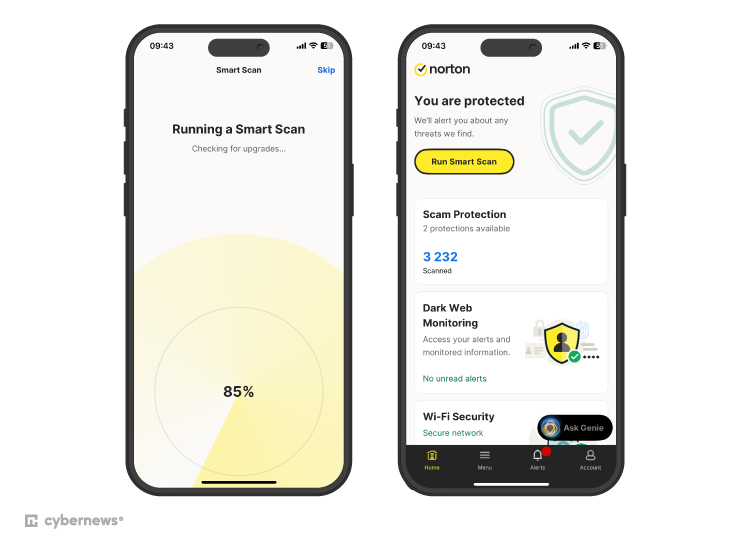
While testing Norton, I found its Safe Web protection to be the main reason I consider it the best antivirus for iPhone. It blocked 9/10 phishing URLs and caught 100% malicious URLs I tried, warning me before I opened fake login pages, scam sites, and other unsafe links.
If you’re concerned about your personal information getting leaked online, Norton’s Dark Web Monitoring sends live alerts if your data shows up where it shouldn’t. In addition, Norton’s AntiTrack feature helps lighten your digital footprint by blocking trackers that try to collect your browsing habits.
Another big win for Norton is that it comes with a built-in VPN. While it’s not available in some countries, this feature was one of the main reasons I picked Norton as a top choice for iPhone security. The VPN keeps your browsing private and secure, which is especially important if you’re using public Wi-Fi.
However, during Norton’s testing, its protection had the highest battery impact, which peaked at 40%, compared to McAfee’s 31% and Bitdefender’s 17%. I did not notice slower page loads or lag while using the app, but the heavier battery use may be a concern if your iPhone already struggles to last through the day.
Price-wise, Norton Mobile Security for iOS is pretty reasonable at $29.99 for the first year. You also get a free 7-day trial and a 60-day money-back guarantee for annual subscriptions, so you have plenty of time to test it out and see if it’s right for you.
Norton is a great fit for anyone who values simplicity and strong protection without having to deal with complicated settings. It’s especially suited for iPhone users who want an all-in-one solution with extra privacy features like a VPN and Dark Web Monitoring. Whether you’re a casual user, frequent traveller, or someone handling sensitive personal data, Norton provides reliable security tailored to your needs.
Bitdefender Mobile Security for iOS – best lightweight iPhone antivirus with strong protection

| Free trial: | 7-day trial |
| App Store rating: | 4.8⭐ |
| Key features: | Web Protection, built-in VPN, Scam Alert |
| Current deal: | Get Bitdefender for up to 78% OFF |
Bitdefender is one of the best all-around iPhone antiviruses if you want strong protection without hammering your battery. It performed well across our latest tests and covers the things that matter most on iOS, including malicious websites, scam messages, unsafe Wi-Fi, and exposed accounts. After another strong round of testing, I moved Bitdefender up again, this time into second place.
Even the free version of Bitdefender is handy. It scans your network connections and blocks anything that seems off, which is great for basic security. But if you want the full experience, I recommend going for the premium version.
Like Norton, Bitdefender also includes a VPN, but it comes with a 200MB daily data limit, which I found annoyingly small after I hit the cap just 20 minutes into my morning commute while scrolling social media. Still, this can be resolved by purchasing a higher-tier plan.
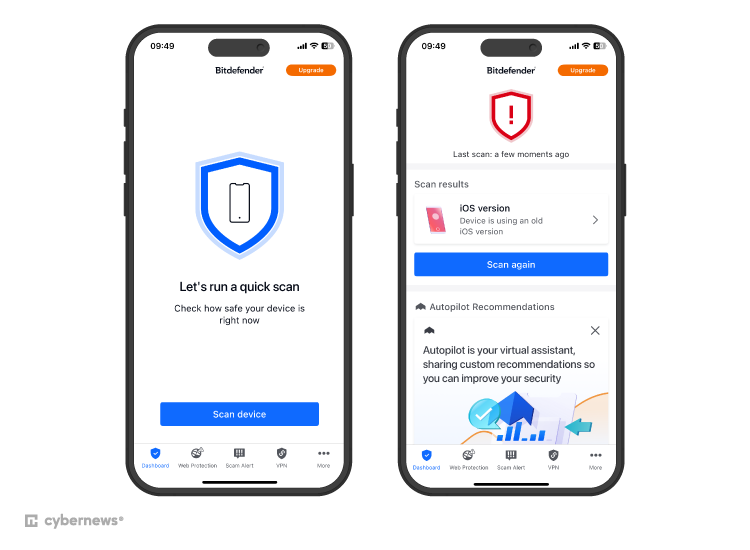
Bitdefender performed well in our phishing protection tests, blocking 8/10 phishing URLs and 9/10 malicious URLs. We used recent, active threats, making the results more representative of current attacks. In comparison, Trend Micro detected only 4/10 malicious URLs.
Even better, Bitdefender managed those results without chewing through the iPhone’s battery. It had a 17% battery impact, matching Trend Micro for the lowest in the lineup and staying well below McAfee’s 31% and Norton’s 40%. I also noticed no real slowdown while browsing.
As for the pricing, Bitdefender Mobile Security starts at $17.99/year and comes with a 7-day premium trial that does not require a credit card. Plus, there’s a 30-day money-back guarantee, so if you decide it’s not for you, you can get a refund within the first month.
I especially recommend Bitdefender for users who want straightforward, no-fuss protection without extra features. It’s also a good fit for light users who don’t need a lot of VPN data and budget-conscious individuals who still want to stay secure online.
McAfee Mobile Security – best iPhone antivirus for families

| Free trial: | 7-day trial |
| App Store rating: | 4.7⭐ |
| Key features: | Scam Detector, Safe Browsing, Secure VPN |
| Current deal: | Get McAfee, save up to 67% |
McAfee offers the most well-rounded family protection in this lineup, with its Family plan covering unlimited devices and adding parental controls alongside scam detection, web protection, a VPN, and breach alerts. It is a good choice for households that want to protect several iPhones and every single device at home through one subscription.
McAfee’s iOS app is easy to navigate, with Secure VPN, Safe Browsing, Wi-Fi Scan, and Scam Detector available from the main dashboard. I particularly liked its auto-VPN triggers, which can secure the connection when the iPhone joins public Wi-Fi. However, quite aggressive and frequent upsell pop-ups made the app feel less polished than Norton or Bitdefender.
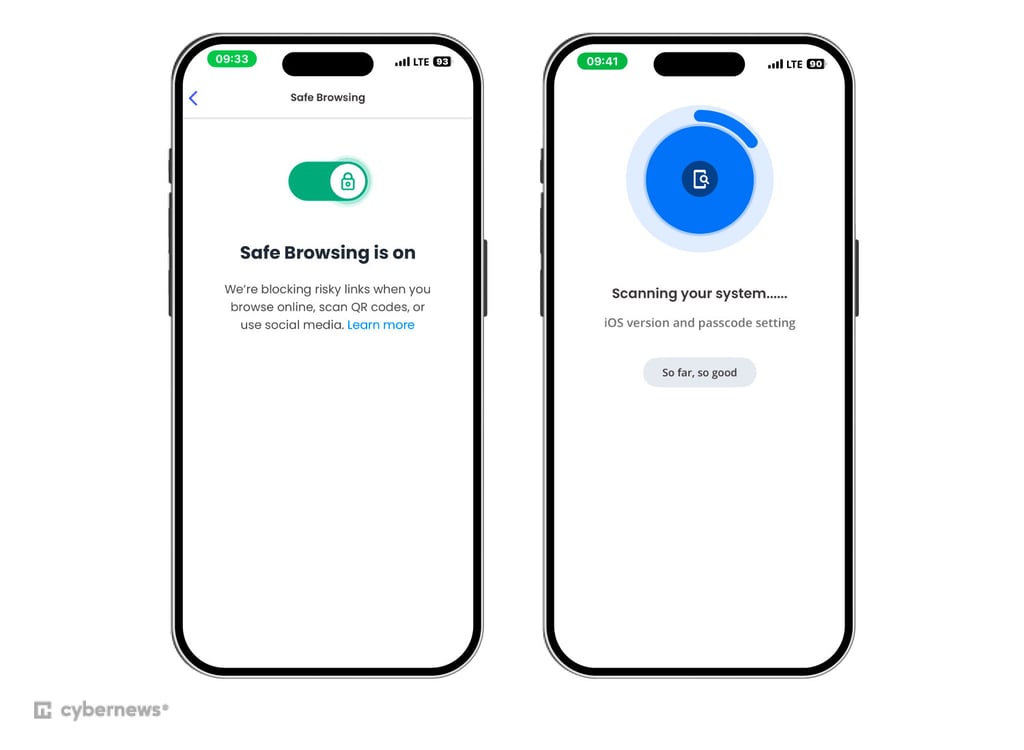
Nonetheless, McAfee is one of the most recent additions to this list, having performed well across nearly every category in our latest iOS tests. During them, McAfee blocked 8/10 phishing URLs and 8/10 malicious URLs. Norton achieved slightly better URL-blocking results, but McAfee still provided reliable protection against the threats iPhone users encounter most often.
Throughout McAfee testing, it had a 31% battery impact. That is noticeably higher than Bitdefender and Trend Micro, both at 17%, but I did not experience major slowdowns, though that may still not be ideal for some.
While McAfee’s individual plans aren’t the cheapest ones, starting at $39.99/year, its family plans offer really good value, starting at $69.99/year and covering 6 family members across all their devices, including iPhones, tablets, and computers. Family plan adds parental controls and personal info scans to its essential bundle of scam detection, a VPN, and identity monitoring. All plans include a 30-day money-back guarantee, although renewal prices rise sharply after the first year.
Overall, I highly recommend McAfee for families that want one subscription to protect every device at home against privacy, identity, browsing, and scam threats. It is not the lightest iPhone antivirus, but few competitors cover as many everyday security needs in one package.
TotalAV Mobile Security – best iPhone antivirus for cleanup

| Free trial: | 7-day trial |
| App Store rating: | 4.6⭐ |
| Key features: | Smart Scan, WebShield, Photos and Video Cleanup |
| Current deal: | Get TotalAV, now 80% OFF |
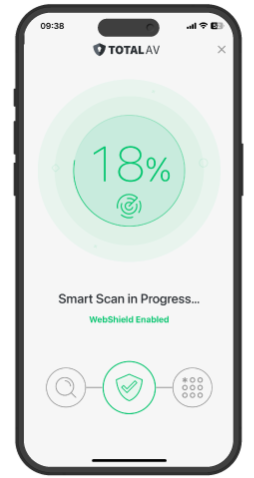
TotalAV is the best iPhone antivirus here if you want security tools and storage cleanup in the same app. While its protection was less impressive in our latest tests, its photo and video cleanup features are genuinely useful, while WebShield, breach monitoring, scam detection, and the built-in VPN round out the package.
For iOS users, it packs features like Breach Scan and Smart Scan. Breach Scan checks whether your information has appeared in known leaks, while Smart Scan shows security and storage issues. I particularly liked the photo and video cleanup tools, which helped clear duplicate and unnecessary files without needing another app.
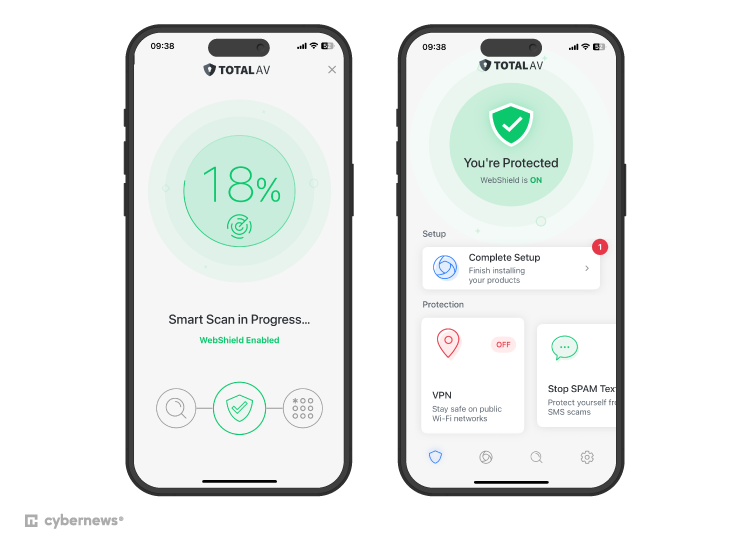
WebShield gave mixed results in our latest tests. TotalAV blocked 6/10 phishing URLs and 5/10 malicious URLs, while a few other threats were stopped by iOS before TotalAV had a chance to react. It’s harder to judge its web protection in isolation, but Norton, Bitdefender, and McAfee were still more consistent overall.
The battery results did not help either. TotalAV had a 37% battery impact, almost matching Norton’s 40%, despite delivering much weaker protection. I did not notice any major slowdown while browsing, but that is still a pretty heavy hit for an iPhone security app.
One feature I found completely missing from TotalAV was a proper iOS Wi-Fi scanner, especially since every single competitor in my article includes one. Another thing is that while TotalAV does offer a VPN, it's only included with higher-tier plans. That makes Bitdefender’s limited 200MB/day VPN easier to access, even if TotalAV’s paid VPN is less restrictive once included.
On the bright side, TotalAV offers a free version on the Apple App Store that’s pretty solid for basic protection. But if you’re like me and want the full package, the premium version of TotalAV costs just $19.00/year. It has a 30-day money-back guarantee, so there’s no risk in giving it a shot.
Overall, I recommend TotalAV if you want iPhone security with genuinely useful cleanup tools on the side. Its threat protection is not as strong as competitors', but Breach Scan, scam protection, and photo cleanup still make the app useful day-to-day.
Trend Micro Mobile Security – best iPhone antivirus for detecting text and screenshot scams

| Free trial: | Yes |
| App Store rating: | 4.7⭐ |
| Key features: | Fraud Buster, Web Guard, Pay Guard Mobile |
| Current deal: | Get Trend Micro, now 50% OFF |
Trend Micro is the best iPhone antivirus on this list for scanning threats if your inbox starts looking suspicious. After I enabled Fraud Buster, it could filter incoming messages with risky links and offer to scan new screenshots. It’s a really practical tool these days to catch fake delivery updates, bank alerts, and similar scams.
I liked that, unlike a lot of such services, Trend Micro does not make me copy every suspicious link into a separate checker. Fraud Buster mainly checks messages and images for malicious links rather than analysing the full meaning of every scam. Broader features, such as scam call blocking and deepfake detection, require Trend Micro’s separate ScamCheck app.
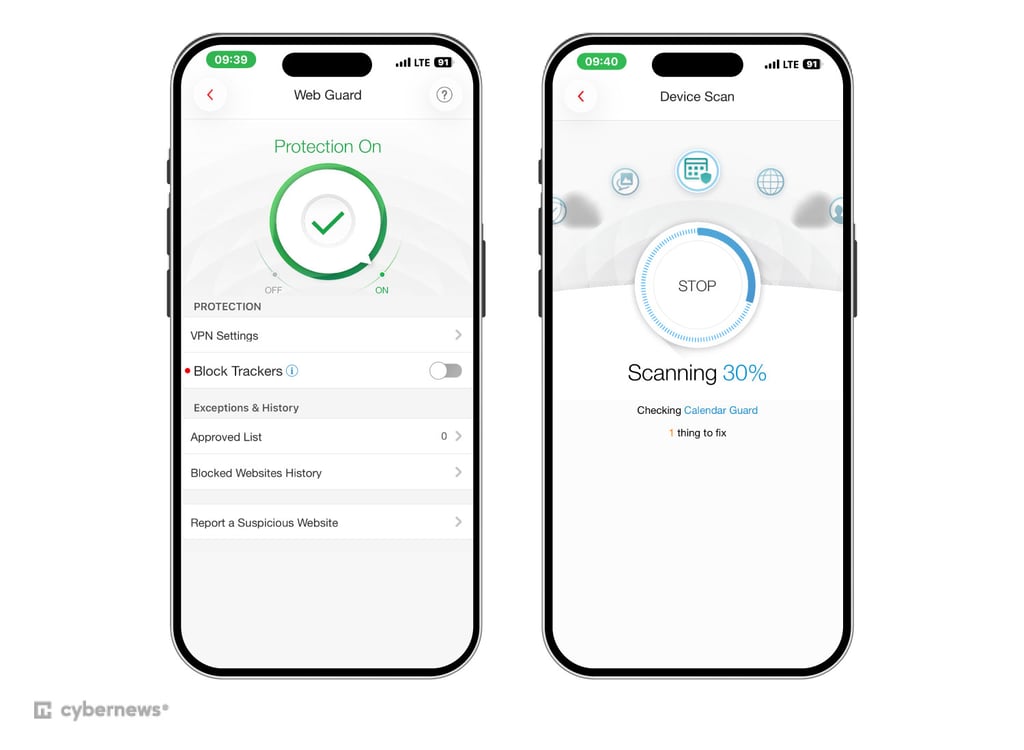
When it comes to our in-house testing, Trend Micro was also a bit of a mixed bag. It blocked 7/10 phishing URLs but stopped only 4/10 malicious URLs, leaving it behind the above providers in my list for web protection. It did detect unsafe Wi-Fi networks, though the standard mobile plan skips both a VPN and data breach alerts.
The 17% battery impact looks great next to McAfee’s 31% and Norton’s 40%, but the weaker blocking takes some of the shine off. Trend Micro ran smoothly and never slowed down my iPhone, although I would happily sacrifice a little more battery if it meant catching more malicious links.
Trend Micro pricing for iPhones isn’t the best either. Trend Micro’s cheapest iPhone-compatible plan is Maximum Security at $49.95/year. It includes core mobile security tools, but no VPN. The $99.95/year Premium Security Suite adds the VPN, identity protection, advanced scam features, and 24/7 support. All plans come with a 30-day money-back guarantee. Trend Micro does offer a cheaper $29.95/year plan, but it does not support iPhones.
Overall, I recommend Trend Micro for iPhone users who regularly receive suspicious messages and want an effortless way to check scams inside texts, links, and screenshots. Its scam tools and low battery impact are useful, but Norton, Bitdefender, and McAfee provide stronger overall web protection.
Video review
If you prefer a visual guide or want to see antivirus performance on iPhone in action, check out our detailed video review covering the best antivirus options for iPhone in 2026.
Other iPhone antiviruses we tested
In addition to the top choices, together with the Cybernews team, I also tested several other iPhone antiviruses that came close to making my list. Here’s a quick overview of noteworthy contenders:
- AVG Internet Security offers a basic free version with solid protection against viruses and an intuitive interface. However, it is relatively expensive compared to competitors, costing around $39.99/year, with even higher renewal prices. Our testing also found it generated quite a few false positives, and the knowledge base is not very helpful for users seeking quick solutions.
- Malwarebytes Mobile Security provides protection against malicious links, blocks unwanted callers, and filters suspicious text messages. However, it falls short in comparison to other apps on my list due to its limited features, performed less well in our real-world tests, and offers weaker overall value for money.
- I also tested Surfshark and NordVPN because both now offer antivirus security features alongside their VPNs, including scam detection and data breach alerts. Both are leaders in the VPN market and have very little impact on battery life, but their iOS apps are still built primarily around VPN and privacy features.
What security threats do iPhone users face?
Besides the usual threats that are inseparable from using any digital technology, there are some security risks that iPhone users might encounter:
- SMS hacks and scams. Phishing links can impersonate parcel delivery services, government agencies, or even telecom companies. Avoid opening unexpected links or attachments and never enter passwords or verification codes on a page reached through an unsolicited message. A reliable antivirus can prevent you from falling victim to phishing scams.
- Spyware. Advanced spyware like Pegasus is designed to secretly monitor targeted iPhone users, potentially accessing messages and location data, and capturing audio or using the camera or microphone. Typically used for targeted attacks, this type of spyware poses a severe risk to privacy. These threats are highly sophisticated and operate at a system level beyond the reach of most apps. Consumer iOS security apps generally cannot detect or remove such system-level spyware, so keeping iOS up to date is the most important protection.
- iPhishGuard. A term sometimes used for phishing scams aimed at iPhone users, this phishing scam targets users with harmful emails and text messages to steal personal information. Luckily, good antivirus software issues warnings before you enter any personal details that could be used against you. Still, do not rely solely on security software: always verify the sender and website before entering personal details.
- Malicious apps. While the Apple App Store has an App Review process and automated malware scans, harmful or deceptive apps can still occasionally reach users. Before downloading an unfamiliar app, check the developer, ratings, reviews, requested permissions, and privacy details. Be especially cautious with apps from unknown providers or copies that imitate popular services.
- Compromised Wi-Fi networks. Public Wi-Fi at cafés, airports, and hotels is not inherently unsafe, but rogue hotspots and poorly secured networks can still pose privacy risks. HTTPS protects most modern web traffic, while iPhone security apps can add useful warnings for suspicious networks and, if they include a VPN, encrypt your connection on public Wi-Fi.
How to set up antivirus on an iPhone
Installing an antivirus application on your iPhone or iPad is super easy. Just follow these steps, and your iOS device will be protected in no time:
- Log in to your Apple account, go to the App Store, and find the application you want – I recommend the top-rated Norton Mobile Security, now 60% OFF
- Download the app onto your iOS device and open it
- Sign in or create an account if you don't have one yet
- Follow the application instructions and finish setting up the app
- Enjoy full mobile security
What is iPhone antivirus, and how does it work?
An iPhone antivirus is a tool that protects your device from cyberthreats. Although the term iPhone antivirus isn’t exactly correct when discussing iOS mobile security, it's a catch-all term many users use when researching the best iPhone security apps. This is due to iOS sandboxing, which isolates apps from the system and from each other, preventing apps from accessing files outside their own environment.
However, the iPhone doesn’t have a built-in virus scan, as viruses (a type of malware) do not typically attack iOS devices. Also, a traditional antivirus simply wouldn't have the permission necessary to perform such crucial functions as full scans.
In short, when someone uses the term iPhone antivirus, they're most likely referring to an iOS security app capable of protecting against phishing, malicious ads, and other cyberthreats. Apps in my list use web protection to filter URLs and block dangerous websites, monitor for malicious links in emails or messages, and provide tools like VPNs or password managers to reduce the risk of data theft.
Therefore, it's recommended to get a comprehensive security app that includes VPNs, password managers, and other helpful features that make them particularly useful in day-to-day use.
Do I recommend a free antivirus for the iPhone?
Yes, a reputable free iPhone security app can be enough if you only want basic protection. However, free plans usually reserve stronger web, scam, identity, or VPN features for paid subscriptions.
That said, you can use a free antivirus, as long as it’s reputable and tested and comes from a trusted provider. Well-known services like Avast and Avira offer free versions that are safe to try. These can help you get a feel for the app and see whether it meets your needs before committing to a subscription.
You can also use free trials or free plans of premium providers. For example, TotalAV’s free plan includes the Smart Scan data breach checks, photo and video cleanup, duplicate contact management, and calendar checks. Bitdefender, meanwhile, offers a 7-day trial of its premium iOS features without requiring a credit card.
Just keep in mind that free plans or free antivirus software usually come with limitations, as they often lack essentials like real-time protection, web protection, or a full VPN.
Conclusion
Choosing an iPhone antivirus works a little differently than picking one for Windows or macOS. iOS does not allow security apps to scan other apps or system files, so antivirus apps mainly tackle phishing links, scam messages, unsafe Wi-Fi, exposed data, and other threats they can actually detect.
Norton came out ahead here, especially once I compared the actual test result. It caught every malicious URL we tried and missed just one phishing attempt, while also offering scam detection, unsafe Wi-Fi alerts, and a strong set of iPhone security tools.
Bitdefender came very close, especially a good choice if battery life is a bigger concern of yours. Its protection results were strong, but the 17% battery impact was much lower than Norton’s. And finally, McAfee is one of the best fits for families, thanks to plans that cover multiple people and devices under a single, affordable subscription.
FAQ
Can iPhones get viruses from websites?
Not usually in the traditional sense. Visiting a malicious website does not normally install a virus on an iPhone, but unsafe pages can still expose you to phishing, scams, and other web-based threats. Keeping iOS updated and using web protection tools, such as Norton Mobile Security, can reduce these risks.
Does Apple recommend antivirus for iPhone?
Apple does not tell iPhone users that they need traditional antivirus software. iOS already uses features like app sandboxing, code signing, and regular security updates to limit malware. Third-party iPhone security apps are better viewed as extra protection against phishing, scam messages, unsafe Wi-Fi, and data breaches.
How do I know if my iPhone has been hacked?
Warning signs that your iPhone is hacked may include unfamiliar Apple ID activity, settings you did not change, unknown devices signed into your account, unexpected configuration profiles, or an Apple threat notification. If something looks wrong, review your Apple Account devices, update iOS, and check your privacy and sharing settings.
How do I remove spyware from my iPhone?
Start by updating iOS, removing unfamiliar apps or configuration profiles, and reviewing account access and sharing permissions. Apple’s Safety Check can also help you see who and what has access to your information. If you seriously suspect malicious software remains on the device, a factory reset is the strongest option.
What are the built-in security features of iOS?
iOS includes strong built-in protections like Find My iPhone for locating or remotely securing your device, frequent security updates that patch emerging threats, and Face ID, which uses secure facial recognition to lock and unlock your phone and protect sensitive data.