NordVPN review 2026: privacy, speed, and streaming tested
Our in-house cybersecurity experts and journalists, renowned for major reports like The Mother of All Breaches, conduct transparent, unbiased VPN testing and in-depth analysis.
With 750+ articles crafted based on real-world research, we empower readers to make informed purchasing decisions through first-hand expertise.
Learn more

-
I found NordVPN to be one of the fastest and most reliable streaming VPNs available, unblocking Netflix, BBC iPlayer, Disney+, and other major streaming platforms without errors or noticeable buffering.
-
NordVPN delivers strong security and privacy, backed by six independent no-logs audits, Panama jurisdiction, RAM-only servers, and data leak-free results in my own hands-on testing.
-
NordVPN has thousands of servers across 225 locations, giving you plenty of options for accessing content unavailable in your region and allowing seamless switching between libraries.
-
Pricing is higher than most competitors, and renewal rates jump significantly once your introductory term ends, so I recommend planning for that cost upfront.
NordVPN is hard to miss. It’s recommended by your favorite YouTubers, dominates most “best VPNs” lists, and it’s the most popular VPN among Reddit users, which is an achievement in itself. NordVPN has now built the kind of brand recognition that makes you wonder if it lives up to the hype or if you’re paying mostly for the branding.
To find the answer to that question, I used NordVPN across my main devices for the past eight months. For this NordVPN review 2026, I also worked with the Cybernews research team on a separate, controlled testing round covering speeds, streaming, privacy features, security tools, and everyday usability.
What follows is not a recap of NordVPN’s marketing claims. It’s my experience living with the service day to day, backed up by targeted testing where details mattered.
NordVPN test result summary
After a dedicated round of controlled testing, I can say that NordVPN earns its reputation as one of the best VPNs of 2026. It combines fast speeds with a strong security record backed by independent evaluations and adds a feature set no other provider can match.
| ⭐ Rating: | |
| 🥇 Overall rank: | #1 out of #41 |
| 📖 No logs policy: | No logs |
| 💵 Price: | From $3.49/month |
| 🖥️ Servers: | 8,000+ servers in 149 countries |
| 🍿 Streaming services: | Netflix, Hulu, BBC iPlayer, Disney+, and more |
| 🔥 Coupons: | NordVPN coupon 75% OFF |
NordVPN pros and cons
Before we get to the full breakdown, here are NordVPN's biggest strengths and weaknesses based on everything I tested, to give you the general idea.
How much does NordVPN cost?
Starting at $3.49/month, NordVPN’s pricing sits on the premium end of the VPN market, but after using the service daily for more than half a year, I can confidently say that the value holds up. You’re paying for consistently fast speeds, a huge server network, and an ecosystem built around three main pillars: Protect, Connect, and Monitor.
However, it’s important to note that the advertised rates are NordVPN’s introductory pricing. Once your first term ends, NordVPN renews at a noticeably higher standard rate, so I suggest choosing the longest term for the best savings. Just make sure you check both the sign-up and renewal prices before committing.
Here's how much NordVPN’s three plans cost:
| NordVPN plan | 1-month | 1-year | 2-year | Renews at |
| Basic | $14.99/month | $5.49/month ($65.88 billed upfront) | $3.49/month ($94.23 billed upfront*) | $139.08/year (~$11.59/month) |
| Complete | $19.99/month | $6.49/month ($77.88 billed upfront) | $4.49/month ($121.23 billed upfront*) | $219.48/year (~$18.29/month) |
| Prime | $29.99/month | $9.49/month ($113.88 billed upfront) | $7.49/month ($202.23 billed upfront*) | $296.28/year (~$24.69/month) |
*The 2-year plan currently includes 3 extra months at no added cost, so you're billed for a 27-month term instead of a flat 24. Prices were checked in September 2026 and reflect current promotional rates, which may change as deals fluctuate. Visit our NordVPN coupon page for the latest discounts before purchasing.
So, which NordVPN plan is best? Based on my testing, I’d recommend Complete to most users. Servers, speeds, protocols, and security standards are all identical across all three plans, so you’re not missing out on any actual VPN functionality by skipping the higher plans. However, what changes are the bundled extras:
- Basic gives you the core NordVPN experience, with scam and phishing protection, 10 simultaneous connections, and Dark Web Monitor for up to 5 emails.
- Complete adds NordPass (password manager), 1TB of encrypted NordLocker cloud storage, next-gen antivirus, an ad/tracker blocker, and scam call protection. It also upgrades you to Dark Web Monitor Pro, covering up to 8 emails, phone numbers, credit cards, and national ID/Social Security numbers for potential leaks. There’s also transaction monitoring for US bank accounts.
- Prime stacks Coveron identity protection on top of that, with 1-Bureau credit monitoring, credit score analysis, credit freeze assistance, and up to $1M in identity theft insurance plus $100K in cyber extortion coverage. If you wanted more, standalone Coveron plans include identity theft insurance of up to $2M, home title protection, and many more perks. You can also get couples or family plans, covering up to 5 adults and all children.
Dedicated IP address and personal data removal services by Incogni can also be added as add-ons at checkout. The Basic plan covers everything you might need from a VPN for everyday browsing, but by upgrading to Complete, you get an all-in-one digital security suite for just a dollar more.
A single subscription covers up to 10 devices simultaneously, which is a solid allowance for most households. And if you’re willing to go through the hassle, you can set up NordVPN on your router and have everything on that network protected without eating into your device limit. I also didn't run into any bandwidth throttling or hidden fees during testing, and what I appreciated most was that checkout was completely free of the pushy upsell prompts.
NordVPN’s pricing structure doesn't include a direct free trial, but there are a couple of ways to try it risk-free. Android users get a 3-day free trial through Google Play – and once you've registered through it, that trial period actually carries over to other platforms too, so you can test it on Windows, macOS, and iOS, not just Android. Beyond that, every plan, regardless of tier or billing length, comes with a 30-day money-back guarantee, so if you don’t have an Android device or you decide it's not a fit after committing, you can request a full refund within 30 days of purchase.
There’s one important thing to mention when it comes to refunds because it’s easy to miss (and because I almost got tripped up by it myself): purchases made via the Apple App Store must be refunded through Apple, not directly by Nord Security.
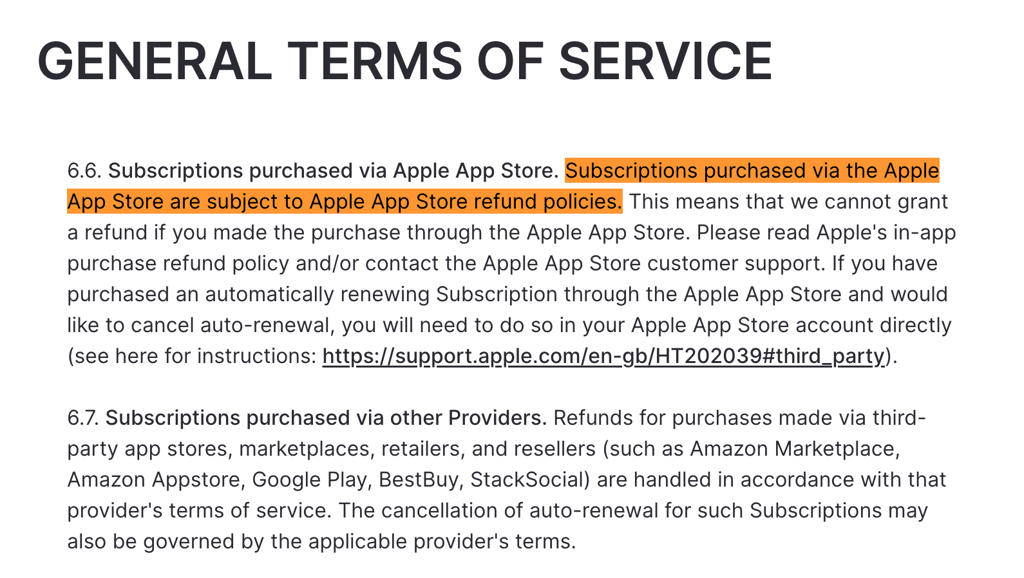
As such, if you're downloading NordVPN on an iPhone or iPad, I recommend subscribing through its website on a mobile browser instead. Note that the same refund policy applies to purchases made through third-party app stores and retailers. Prepaid card and gift card payments are non-refundable if the card provider doesn’t support refunds.
At checkout, you can pay with all major credit cards, PayPal, Google Pay, Cash App, and several cryptocurrencies via CoinGate, including Bitcoin, Ethereum, and Monero.
How fast is NordVPN? Speed test results
NordVPN is one of the fastest VPNs I’ve tested, but “fast” cannot be captured by a single number: it also depends on the protocol you're using and how far you are from the server, and both can influence the results more than you might assume. Besides, I wanted to see if NordVPN is actually good at holding onto that speed as the distance to the server increases, not just how it performs on nearby connections where almost any VPN could look impressive.
So, for this review, I ran a fresh round of speed tests across all its available protocols. With a baseline connection of 930Mbps download (how fast data loads to your device), 600Mbps upload (how fast data sends from your device), and 1ms ping (how quickly your connection responds), I connected to servers across four distance ranges: local (Vilnius, Lithuania), close-range (London, the UK), mid-range (New York, the US), and long-distance (Tokyo, Japan).
For the numbers to make sense, it helps to know what each VPN protocol is actually built for, since NordVPN gives you not one but four connection methods:
- NordLynx. This is NordVPN's proprietary protocol, built on top of WireGuard. NordLynx is the default for a reason: it’s the fastest and most efficient option in nearly every scenario I tested, and it's what I'd recommend for everyday browsing, streaming, and downloads.
- NordWhisper. This is a newer, obfuscation-focused protocol that disguises VPN traffic as regular browsing. This is the one to reach for on restrictive networks (e.g., on school or work Wi-Fi or in countries that actively block VPN traffic), but it’s not for maximum speed.
- OpenVPN (UDP/TCP). A widely supported, industry-standard protocol that many VPNs use as a reliable fallback when newer options can’t connect. A UDP port is typically faster and better for streaming or gaming (confirmed in my testing), while a TCP port exchanges speed for reliability and is often the safer choice on restrictive or unstable networks, especially for long file transfers.
- IKEv2. This one is worth flagging, since NordVPN retired IKEv2 in its native apps and now directs users to NordLynx for the best combination of speed and security, which is why I didn't include it in this round of testing. If you specifically need IKEv2 (e.g., for a router setup or an older device), NordVPN still publishes manual configuration guides, but you won't find it as a one‑click option in the app itself anymore.
Now, with that context, let’s see how each protocol actually performed in my speed tests.
NordLynx speed test results
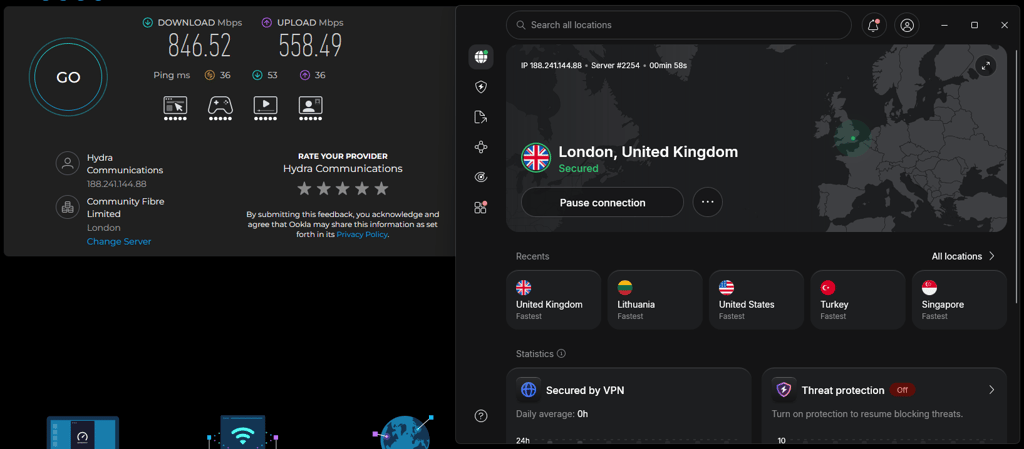
NordLynx is the clear standout among the four protocols, and the download retention numbers are nothing to worry about.
| Location | Download | Retention | Upload | Retention | Ping (ms) |
| Local | 891Mbps | 95% | 567Mbps | 94% | 1 |
| UK | 846Mbps | 90% | 558Mbps | 93% | 36 |
| US | 815Mbps | 87% | 172Mbps | 28% | 115 |
| Japan | 674Mbps | 72% | 75Mbps | 12% | 272 |
Even connected to Japan, NordLynx was still pulling 674Mbps (72%), which is more bandwidth than most home connections offer in the first place. The more revealing column is Upload. Everything looked fine while I was connected to the UK server, but beyond that point, upload speeds dropped sharply, retaining only 172Mbps (28%) of my baseline connection on the US server and just 75Mbps (12%) in Japan. Ping stayed low and predictable throughout, climbing from just 1ms locally to 272ms in Japan – a steady, expected increase with distance without any erratic spikes.
Practically, that means NordLynx handles distance well for anything you're pulling down from the internet (loading pages, streaming shows, downloading files, updating software), but if your workflow depends on pushing data out (backing up files to the cloud, hosting a video call, live streaming, uploading large files), your uploads will slow down a lot sooner than your downloads do – download stays fast at any distance with NordLynx, but upload doesn't.
NordWhisper speed test results
NordWhisper protocol trades raw speed for stealth, and its speed test results make that obvious:
| Location | Download | Retention | Upload | Retention | Ping (ms) |
| Local | 867Mbps | 93% | 232Mbps | 38% | 23 |
| UK | 899Mbps | 96% | 255Mbps | 42% | 39 |
| US | 636Mbps | 68% | 199Mbps | 33% | 209 |
| Japan | 275Mbps | 29% | 67Mbps | 11% | 443 |
Interestingly, the UK server actually outperformed the local one in download speed retention (899Mbps vs 867Mbps). This is a reminder that distance isn't the only thing affecting speed: how busy a server is with other users or the specific route your data takes to reach it at the time of testing can matter as much. On a Japanese server, it was down to 275Mbps (29%) and a 443ms ping – the highest of any protocol I tested and too sluggish for anything beyond basic browsing. Compared with NordLynx, NordWhisper kept up better on download speed on local and nearby servers, but its overall performance still degraded more sharply as server distance increased.
Because of this, I’d treat NordWhisper as a situational tool only: it comes in handy when you're on a network actively trying to detect or block VPN traffic, but I wouldn't choose it for streaming or downloading unless the server is reasonably close to you.
OpenVPN UDP and TCP speed test results
The OpenVPN UDP results were the most unexpected of the four protocols, with speeds increasing with distance instead of reducing:
| OpenVPN UDP port | Download | Retention | Upload | Retention | Ping (ms) |
| Local | 437Mbps | 46% | 500Mbps | 83% | 1 |
| UK | 483Mbps | 51% | 101Mbps | 16% | 35 |
| US | 585Mbps | 62% | 73Mbps | 12% | 97 |
| Japan | 656Mbps | 70% | 70Mbps | 11% | 292 |
This stood out enough that I reran the test multiple times to be sure it wasn't a fluke: download speed actually got faster the farther away I connected, going from 437Mbps (46%) locally to 656Mbps (70%) in Japan. That's the opposite of what you'd normally expect. The result held steady across every rerun, so it wasn't a one-off testing error, but I still don't have a clear explanation for it. I wouldn't count on replicating the same result yourself or expect to see it consistently, though. At the same time, ping rose steadily with distance as expected, from 1ms locally to 292ms in Japan. These results track closely with those of NordLynx despite the unusual download pattern in the same testing.
Either way, it doesn't change my overall takeaway here: even where download surprised me, upload stayed weak at every distance, and higher latency on long-distance servers would still be noticeable in real-time tasks, such as gaming and video calls.
On the other hand, OpenVPN TCP showed more predictable results:
| OpenVPN TCP port | Download | Retention | Upload | Retention | Ping (ms) |
| Local | 622Mbps | 66% | 210Mbps | 35% | 1 |
| UK | 576Mbps | 61% | 366Mbps | 61% | 62 |
| US | 613Mbps | 65% | 90Mbps | 15% | 182 |
| Japan | 206Mbps | 22% | 32Mbps | 5% | 348 |
The TCP port stayed reasonably competitive across the US, with 613Mbps (65%) speed retained, but then it dropped in Japan: 206Mbps (22%) download and upload retention collapsed to just 32Mbps (5%). Ping also climbed more sharply at longer distances than with the other protocols, reaching 348 ms in Japan – the second-highest result of the four tested.
Between the two, I'd default to UDP if you ever need to fall back on OpenVPN, and save TCP for situations where a network is specifically blocking UDP traffic.
My baseline connection (930Mbps download/600Mbps upload) is much faster than a typical home connection, which usually falls somewhere in the 100–300Mbps range. This matters because the same percentage drop hits differently depending on where you start. A 72% retention on my connection still leaves about 670Mbps, which is far more than most people need. On a 150Mbps connection, though, that same 72% only leaves 108Mbps – still enough for HD or 4K streaming, but it’s a drop you'd actually notice. So treat the retention percentages as the more transferable number here.
Here’s what’s worth cross-referencing here: independent testing lab West Coast Labs ran its own VPN benchmarking report in October 2025. It clocked NordVPN's average download speed at 817Mbps (87%), beating competitors by margins of 29Mbps to 92Mbps. That lines up with what I found in my own testing – NordVPN is indeed fast on a technical level, and it held up well across local and close-range servers no matter which protocol I used. But download speed alone doesn’t tell you the full story because it doesn't consider either upload speed or ping, and server distance for them. As such, it doesn't tell you that upload speed drops on long-distance servers or that NordWhisper's speed retention wanes past mid-range.
And that's exactly the part worth understanding before you pick a server and protocol. Long-distance connections are where issues might show up, especially with anything upload-dependent. For example, if you're trying to video call or upload large files while connected to a server on the other side of the world, you're going to feel real lag no matter which protocol you pick. My advice is to stick to NordLynx for long-distance connections and keep your expectations realistic for upload-heavy tasks. I also wouldn’t rely on NordWhisper for anything beyond basic browsing once you're outside your own region. And whatever numbers you see here or anywhere else, remember to weigh them against your own baseline speed.
Unblocking Netflix and other streaming platforms
NordVPN is great at unblocking streaming platforms – in my testing, it got past geo-restrictions on every major service I tried and did so without needing to switch servers or troubleshooting on my end. Here are the platforms I checked during my testing:
| Streaming platform | Accessed regions | Buffering | Errors |
| Netflix | US, UK, Canada, Japan, Australia | Slight buffering with farther regions | None |
| BBC iPlayer | UK | No buffering | None |
| Amazon Prime Video | Germany | No buffering | None |
| Disney+ | US | No buffering | None |
| Hulu | US | No buffering | None |
| HBO Max | US | No buffering | None |
| Apple TV | US | No buffering | None |
| Sling | US | No buffering | None |
| ESPN | US | Slightly longer loading with live content, no issues with on-demand videos | None |
I connected to the first server NordVPN offered for each region tested, no manual retries needed, and ran my tests using the NordLynx protocol and Chrome browser.
Netflix was the platform I spent the most time on, partly because it's the one people ask about most, and partly because it’s a great place to test whether NordVPN holds up when you switch libraries mid-session. I moved between the US, UK, Canada, Japan, and Australia libraries back to back, and every single one loaded without Netflix catching on or blocking the connection.
I settled on watching Schitt’s Creek in both HD and 4K on the Canadian library, since it's not available in my home region. Netflix recommends 5Mbps or higher for Full HD and 15Mbps or higher for 4K, and across every region I tested, NordVPN's connection speed remained well above these requirements, retaining 82% of my connection speed when connected to a Canadian server. Video quality never dropped mid-stream, and playback started within just a few seconds.
I only noticed some friction on servers in Japan and Australia – a brief moment of buffering right as playback started, before it settled into a clean stream. That's consistent with what showed up in my speed tests earlier: NordVPN doesn't fall apart at distance, but the further the server, the more likely you are to notice a small hiccup before things smooth out.
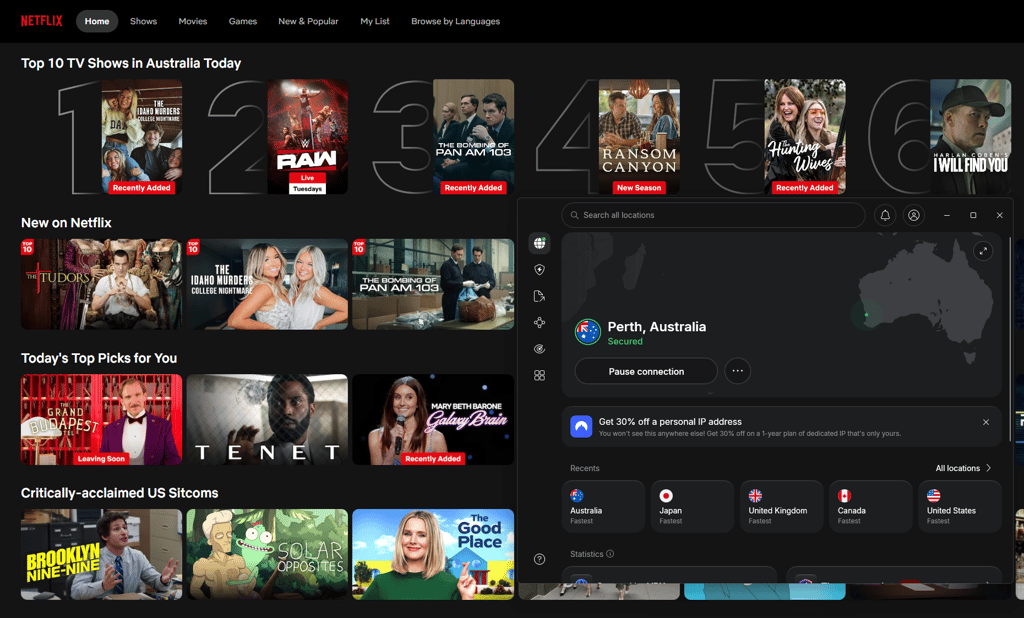
Switching my location with a VPN this many times in one sitting is also a good indicator of NordVPN's server reliability and its capabilities to bypass geo-restrictions. If even one of those five connections had dropped me into a blocked server, I'd have hit an error instead of a desired library. With NordVPN, that didn't happen once across this entire round of testing – neither on Netflix nor elsewhere.
Now, is NordVPN good at more than just Netflix? I saw similar results across Disney+, HBO Max, Amazon Prime Video, and other platforms I tested NordVPN with. Still, I was curious how it’d do on a more demanding one: Apple TV. Apple requires a minimum of 25Mbps for 4K streaming (vs Netflix's 15Mbps), and that's before you factor in bitrate. Since Apple compresses its video far less aggressively than most competitors, its streams can average around 25–40Mbps compared to the roughly 10–25Mbps average across Netflix, Disney+, and Amazon Prime Video. To put it simply, Apple TV pushes meaningfully more data per second, which makes it a better stress test than Netflix or any other platform on my list for how one of the best streaming VPNs handles a genuinely heavy connection.
I put the new episodes of Ted Lasso on to test this out, connected through NordVPN’s US server the whole way through purely out of curiosity about whether the higher bitrate would expose any weak points. It didn't – the stream held at full 4K HDR from start to finish, no visible quality drop and no buffering, even though this was objectively a harder connection to sustain than anything Netflix asked of it.
Great VPN for streaming sports
NordVPN is a strong VPN for streaming sports specifically because it consistently holds up across a wide range of sports platforms and events. Since I've been testing it for eight months now, I've had the chance to put it through more than just a quick platform unblocking check. My initial round of testing covered ESPN and Sling, both of which unblocked cleanly in the US: Sling had zero issues, while ESPN's live content took slightly longer to load than its on-demand videos, though neither ever showed an error.
Over the past several months, I've also caught different sporting events through NordVPN to see how consistent that reliability actually is. For one, I watched the World Cup semifinal between Argentina and England using NordVPN’s UK servers to unlock the BBC iPlayer stream. This was a great stress test considering that this match peaked at 24 million viewers on BBC One and BBC iPlayer alone, and any buffering or dropped stream during a semifinal like that would have ruined the experience. The results were flawless throughout 90+13’ minutes: no dropped live feed, stable video quality, from kickoff to the final whistle.
Earlier I also tried Australian servers to pull in SBS On Demand's coverage and watched the France vs Norway group stage match there, but the quality wasn't quite on par with the UK servers (89% speed retention in the UK vs 60% in Australia explains why). There was more buffering during high-action moments, and video quality never improved past 480p, but the stream never cut out entirely. I’d say that’s a passable result for a match with far lower stakes than the semifinal, though this was the moment I knew I shouldn’t rely on long-distance servers for something as high-pressure as England vs Argentina. For the same reason I consider NordVPN useful for getting around blackout restrictions or watching a broadcast you can't get locally – just stick to servers closer to you whenever possible.
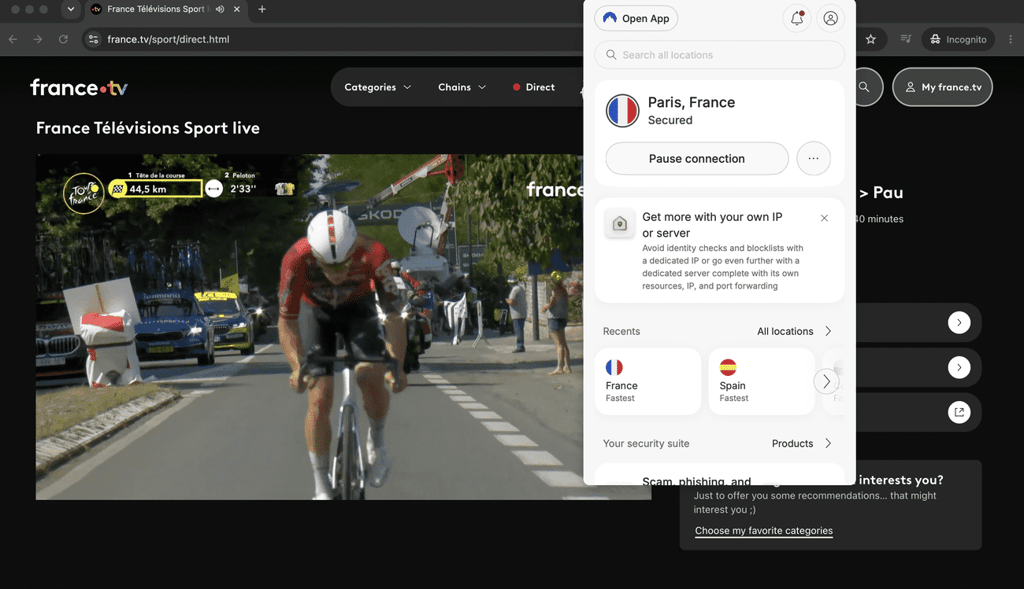
Beyond the big global tournament, FIFA World Cup 2026, I also checked how NordVPN handles a less mainstream option: France.tv's live coverage of the Tour de France, which, with 89% retention on French servers, was unblocked without any trouble either. To me, that’s a good sign that NordVPN's sports streaming access isn't limited to the handful of major platforms every VPN prioritizes.
For this review specifically, I also ran a fresh test in the past week: a regular-season MLB matchup, Athletics vs Los Kansas City Royals, 7:40PM ET on Wednesday, August 19th, on Sling. I picked that specific slot on purpose – weekday evenings are when server load tends to be higher than on weekend afternoons, giving me a more realistic read on NordVPN performance under typical peak conditions. Even then, the stream held up: I experienced no buffering and no drop in quality, and the game loaded just as quickly as with a no-VPN connection.
Across eight months of testing, NordVPN hasn't given me a reason to doubt its reliability for sports. If I had to note one thing, it's that server location matters more for sports than it does for on-demand shows. For this reason, remember to go for close-range servers whenever possible and stick to US locations for global access rather than distant, less polished regions like Australia.
Gaming with NordVPN
With low ping, zero packet loss, and stable jitter across every server I tested, NordVPN is a reliable gaming VPN, even though the test didn’t go as smoothly as I expected initially. I ran tests on a Windows 11 machine (i5-13600KF, 32GB RAM, RTX 4070) on the same 930Mbps down/600Mbps up/1ms ping baseline connection I used for my other tests. For the game itself, I chose Counter-Strike 2, since competitive shooters are about as unforgiving as gaming gets when it comes to latency. My baseline ping without a VPN sat around 6ms, which gave me a clean reference point to measure against. Here are the metrics I relied on:
- Ping is the round-trip time between your device and the game server. Under 20ms is ideal for competitive play (most critical for tactical FPS and fighting games), around 50ms is still perfectly playable for many other genres, and anything past 150ms starts to feel sluggish – you'll notice your shots landing late or opponents appearing to teleport.
- Packet loss is data that never reaches the server at all. Even small amounts can cause rubber-banding or your character freezing mid-action, since the game has to guess what happened in the gap.
- Jitter is how much your ping fluctuates from one moment to the next. A stable 100ms ping is more playable than one that jumps between 40ms and 150ms, because that inconsistency is what actually breaks synchronization between what you're seeing and what's happening on the server.
The thing is, NordLynx failed to connect to a single match – every attempt I made hung or timed out. Switching to OpenVPN UDP fixed it immediately, and all results below reflect that protocol instead. Based on some digging afterward, this doesn't appear to be a known or common issue: NordVPN explicitly recommends NordLynx as the protocol of choice for gaming, and I couldn't find reports of other users encountering the same issues. So, I want to point out that this is a rather specific result from my testing environment than something you should expect to come across yourself.
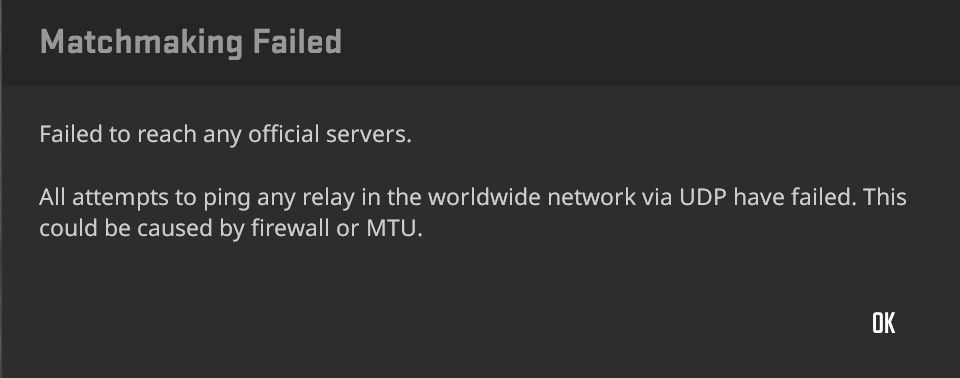
However, considering the results I got with OpenVPN UDP, its performance was solid enough on its own that I didn’t even think of dismissing NordVPN for gaming over this. Here’s how it performed across each distance:
| Server location | Ping | Packet loss | Jitter | Loading |
| Local | 8ms | 0 | 1ms | No issues |
| Germany | 53ms | 0 | 1ms | Match reloaded once |
| US | 112ms | 0 | 1ms | Match reloaded once |
| Japan | 293ms | 0 | 1ms | No issues |
As you can see, ping stayed under 20ms locally and around 53ms on a mid-range server in Germany, both of which are ideal-to-good results. Moreover, jitter never moved off a solid 1ms at any distance, which matters more for actual gameplay feel than the raw ping number does. Zero packet loss across every test meant no rubber-banding or dropped hits. The US connection landed at 112ms: it was still playable but noticeably slower for a fast-twitch shooter. Meanwhile, Japan's 293ms was the point at which competitive play became impossible for me, even though the connection itself stayed clean. The reload on the Germany and US servers happened once, right when I connected (not during the match itself), so I took it as a one-time connection glitch and moved on.
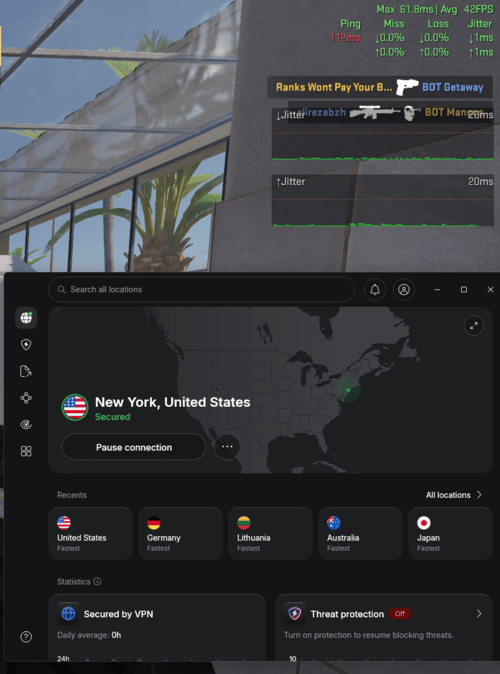
All in all, when gaming with NordVPN, I recommend sticking to local or nearby servers for anything competitive. And if you want the VPN active without adding latency to your game specifically, keep in mind that split tunneling lets you exclude your game client from the VPN tunnel entirely.
NordVPN privacy and security
NordVPN is a safe and secure VPN, with independently audited no-logs policies, Panama jurisdiction, strong encryption, and a clean track record on data leak protection – both in my own testing and in third-party lab results. Here’s a quick rundown before we get into details:
| Privacy aspect | Quick facts |
| Encryption standard | AES-256-bit, ChaCha20, and post-quantum |
| VPN protocols | NordLynx (WireGuard-based), NordWhisper, OpenVPN (UDP/TCP), IKEv2/IPSec |
| No-logs policy | Strict no-logs policy, independently audited 6 times |
| Jurisdiction | Panama, outside of Five, Nine, and Fourteen Eyes alliances |
| Server infrastructure | 100% RAM-only (diskless) server network |
| Leak protection | Built-in DNS, IPv6, and WebRTC leak protection |
| Kill switch | Automatic system-level and application-level kill switches available |
| Two-factor authentication (2FA) | Available to secure your Nord Account login |
Some of these privacy aspects deserve more attention than just a brief mention – let me walk you through them.
Encryption and protocols
NordVPN secures your traffic with AES-256 encryption, the same security standard used by banks and governments, and ChaCha20, which pairs specifically with NordVPN’s WireGuard-based NordLynx protocol.
NordVPN also supports post-quantum encryption on all its apps exclusively via the NordLynx protocol. Post-quantum encryption is designed to withstand future quantum computers capable of breaking today's standard encryption methods. You can enable it in Settings by turning a single toggle on. However, note that it won’t activate if you’re using a dedicated IP address or obfuscated servers.
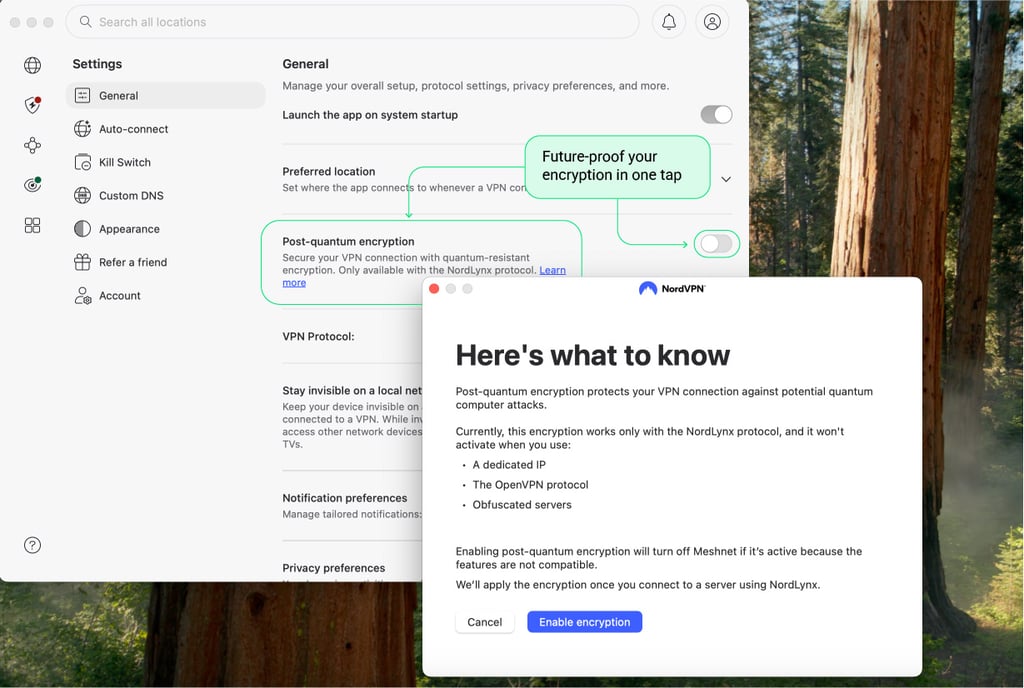
NordVPN doesn't disclose what encryption NordWhisper actually uses, so that's one protocol I can't vouch for the same way. Otherwise, the encryption strength itself isn't really in question across NordVPN’s protocols – what actually separates them is speed and detectability.
No-logs policy and independent audits
NordVPN's no-logs policy means it doesn't record your browsing activity, connection timestamps, or traffic data – and rather than asking you to just take that on faith, the provider has now had this claim independently verified for 6th time since 2018. PwC handled the first two rounds, in 2018 and 2020, and then Deloitte took over annual NordVPN audits ever since – in 2022, 2023, 2024, and most recently in December 2025. You can find these reports by logging into your Nord Account.
These audits are conducted in accordance with the ISAE 3000 (Revised) standards set by the International Auditing and Assurance Standards Board (IAASB) and verify whether NordVPN's servers and infrastructure are configured as the company claims. Auditors interview NordVPN's staff, inspect server configurations directly, and review the technical logs (or lack thereof) across NordVPN's standard VPN, Double VPN, Onion Over VPN, and obfuscated server infrastructure.
Overall, this kind of yearly assurance engagement matters because a single audit would only tell you about NordVPN’s practices at a specific point in time, but 6 consecutive years of clean results make it much harder to write off as a marketing claim. Furthermore, NordVPN backs this up with an ongoing bug bounty program through the HackerOne platform, too, paying independent researchers to find and report vulnerabilities year-round rather than relying solely on these annual check-ins.
Leak test results
I also wanted to see how the provider’s connection safeguards work in real time, so I ran my own leak tests with NordVPN's kill switch (which blocks the internet if the VPN drops) and DNS leak protection enabled. I checked my connection on ipleak.net and dnsleaktest.com, both of which are pretty self-explanatory tools if you want to run the same check yourself: they instantly flag your real IP address, your browser's IP address, or your ISP's DNS servers if any of them are leaking. Across all tests, NordVPN's results were perfect: no IP leaks, no WebRTC leaks, no DNS leaks.
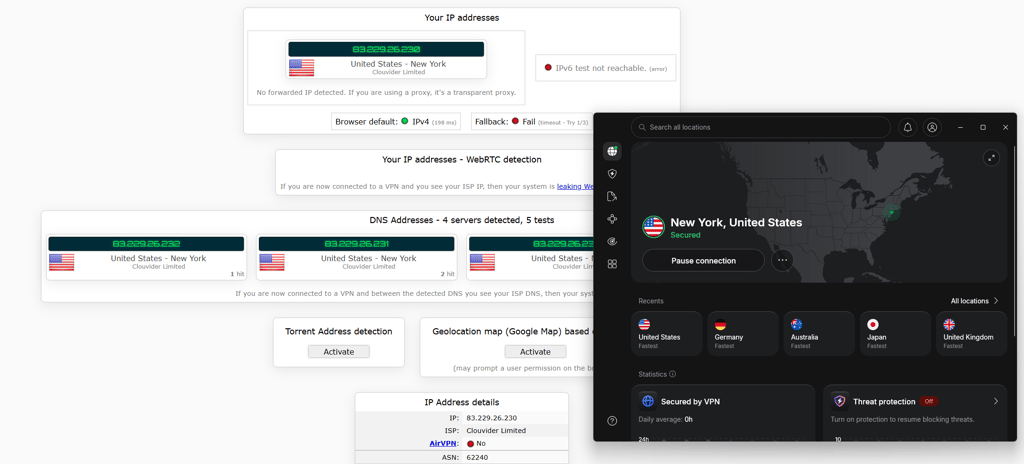
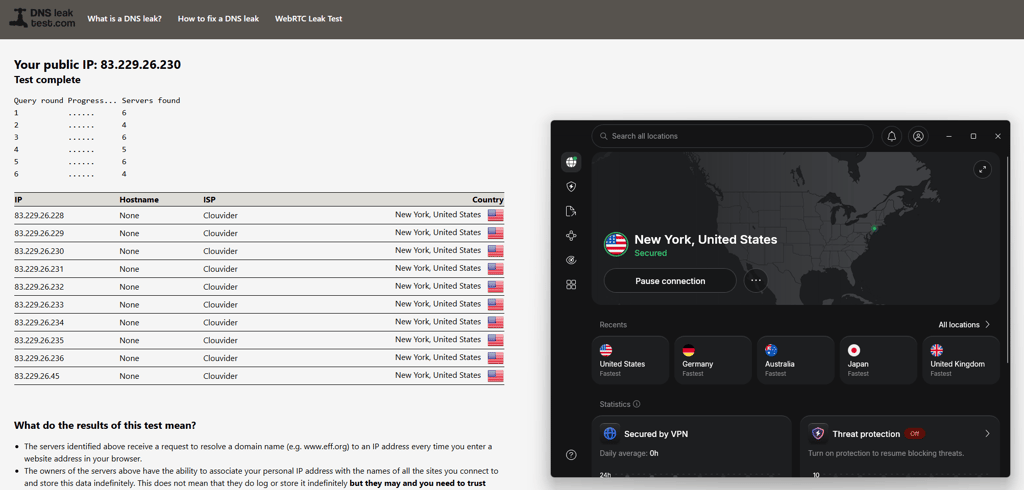
My results line up with independent lab testing, too. West Coast Labs' October 2025 evaluation I mentioned earlier also put NordVPN through 455 separate network transitions across eight distinct leak scenarios: IP, DNS, WebRTC, and IPv6 leaks, plus leak checks during server switching and Wi-Fi network changes. NordVPN passed all eight, with zero leaks recorded across the entire test set. Considering my own hands-on results and this level of independent evaluation, I’m glad to see NordVPN's safeguards prove reliable in practice.
Server infrastructure
NordVPN runs its servers on RAM instead of traditional hard drives. That means information isn’t permanently saved to the server itself: when a server restarts or loses power, the data in its memory disappears. It’s an extra privacy safeguard because an offline server should not contain a stored record of past activity for someone to recover.
NordVPN introduced this approach after a 2018 security incident involving one rented server at a data center in Finland. An attacker accessed that server via a remote management system that the third-party data center left active, without NordVPN’s knowledge. NordVPN stated the attacker obtained an expired TLS key, but not user passwords, browsing data, or activity logs, as the server didn’t keep those logs in the first place.
NordVPN only learned about the breach in April 2019 and publicly disclosed it in October that year, a delay that understandably drew criticism. Afterward, it ended its contract with that data center, reviewed its broader server network, launched a bug bounty program, and began moving to RAM-only servers – a process that was completed by early 2020. While a 2018 data breach still detracts from NordVPN’s overall record, the company did make meaningful infrastructure changes afterward, and I think its RAM-only setup is one of the clearest examples of that response.
Jurisdiction
NordVPN is headquartered in Panama, a jurisdiction with no mandatory data retention laws and no membership in the Five, Nine, or Fourteen Eyes alliances. Practically, that means NordVPN isn't legally required to retain or share your data with allied governments. Even in the event of a data request, breach, or hack, there's simply no browsing history or connection log sitting on a server to hand over or steal in the first place. That's a meaningful safeguard, whether you just don't love the idea of a permanent record of your activity existing somewhere or you're more focused on protecting your data if NordVPN's own systems were ever compromised.
NordVPN used to publish a warrant canary: a webpage stating that it had not received certain secret government data requests. If it ever received one and was legally barred from discussing it, the company could stop publishing or updating that statement. In 2024, NordVPN started moving away from a warrant canary system and toward detailed quarterly transparency reports. As for me, these are more useful than a missing webpage because they show actual figures for DMCA notices, government inquiries, and requests that led to a disclosure, with the latter being updated daily.
There is one important example. In October 2024, NordVPN shared that it received a legally binding warrant from Panama’s prosecutor’s office during a criminal investigation. NordVPN complied with the request but stated that it could provide only payment-related information and confirmation that the account existed. Because NordVPN doesn’t keep traffic, connection, or browsing logs, it had no online-activity data to hand over. To this day, this is the only instance in which NordVPN was legally obligated to provide the requested user data.
NordVPN features
NordVPN packs in one of the most feature-rich apps of any VPN I've used – well beyond just encrypting your connection. With its all-in-one approach to digital security, it now bundles a next-gen antivirus, a mesh networking tool, streaming-specific DNS routing, and a growing set of scam-protection tools that most competitors don't offer alongside their VPN services at all.
Here’s a quick breakdown of what you get, categorized by each feature’s primary function:
| Functionality | NordVPN feature | What it does |
| Connect | Meshnet | Directly connects your devices for private file sharing, remote access, and LAN-style gaming |
| Split tunneling | Lets you choose which apps or sites use the VPN while everything else uses your regular connection | |
| Invisibility on LAN | Hides your device from other devices on the same local network – useful on public or shared Wi-Fi | |
| Dedicated IP/Dedicated server | A static personal IP address or a physical server reserved for your use only, instead of a shared one | |
| SmartPlay/SmartDNS | Automatic encrypted DNS routing for streaming (SmartPlay) and standalone DNS-only unblocking for devices that can't run the app (SmartDNS) | |
| Custom DNS | Allows you to set your own preferred DNS servers instead of NordVPN's default | |
| Auto-connect | Automatically activates NordVPN on new or unsecured Wi-Fi networks | |
| Protect | Next-gen antivirus | Blocks phishing pages, scam sites, malware downloads, ads, and trackers – independently tested with strong results |
| Scam call and message protection | Flags or blocks suspicious calls and texts on mobile before you engage with them | |
| Monitor | Dark Web Monitor Pro | Scans for your leaked email, credit card, phone number, or SSN and alerts you if found |
| Transaction monitoring | Watches linked bank/credit card accounts in real time and alerts you to unauthorized activity (US only) |
Not every feature carries the same weight, so I focused my testing on the tools most relevant to privacy and everyday VPN use.
Next-gen antivirus
NordVPN's next-gen antivirus (NGAV) is a rebrand of what used to be called CyberSec, then Threat Protection Pro – same underlying feature, expanded and renamed rather than rebuilt from scratch. I think it's best described as a web threat shield: it scans links before you click them, scans files as they download, and blocks ads, trackers, and known scam sites. That's a meaningfully different function than what a traditional full antivirus does, and it's worth being precise about it before we look at the scores.
In independent testing, NordVPN’s NGAV results are impressively strong. AV-Comparatives certified NordVPN's anti-phishing protection in May 2026 with a 96% block rate across 275 phishing URLs and zero false positives. AV-TEST ran a separate evaluation in November 2024 focused specifically on malware and phishing link detection, but it's worth being clear about what that test actually compared: AV-TEST measured NordVPN against other VPN providers' built-in security add-ons, not against dedicated antivirus software. Within that comparison, NordVPN came out well ahead of ExpressVPN, IPVanish, Mullvad, and Proton VPN, with the lab's own report stating the best product was NordVPN at 83.42%, followed by IPVanish at only 46.96% and then the remaining products.
I ran my own smaller-scale tests to see how it behaves in everyday use. Results were positive, except for one category:
| Test | Result |
| Phishing URLs blocked | 30% (3/10) |
| Malware URLs blocked | 90% (9/10) |
| Adult site blocker (available on mobile only) | 100% (3/3) |
| Ad blocker (via adblock-tester.com) | 100/100 |
Malware URL blocking, ad blocking, and the adult site filter all performed well in my testing. Phishing was the weak spot – a 30% block rate on my samples is really low, though with only 10 URLs tested, I'd trust AV-Comparatives' much larger 275-URL dataset as the more statistically reliable picture of real-world performance.
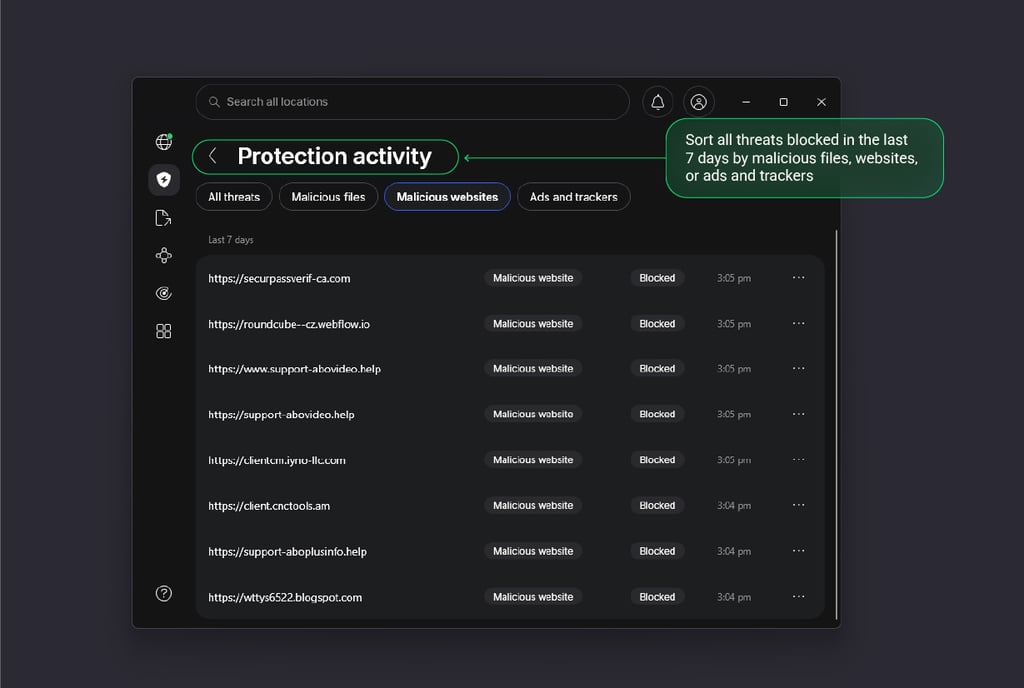
I think it’s important to note that “next-gen” in NordVPN’s next-gen antivirus signals that it’s a different kind of protection and not a replacement for your regular antivirus. It doesn’t scan your whole device or monitor running processes. Instead, it focuses on identifying and stopping web-based threats before they reach you.
The feature itself is a really useful download scanner and phishing blocker. It's a solid first line of defense against online threats you actually encounter day-to-day: malicious and phishing links, infected downloads, ads, trackers, and adult content filtering. What I also like about it is that you can set this protection to be active even when you’re not connected to a VPN itself.
If you’re considering dropping a standalone antivirus tool in favor of this, I encourage you to check out our dedicated NordVPN next-gen antivirus review for a closer look first.
Dark Web Monitor and transaction monitoring
Setting up Dark Web Monitor Pro took a few minutes: I added my main email addresses, phone number, and one credit card, and NordVPN ran an initial scan against known breach databases before switching to ongoing monitoring mode. While everything looked clean overall, one of my email addresses received 3 alerts from the get-go, all of which contained precise information about the exposed data (a password, in this case) and the breach it came from.
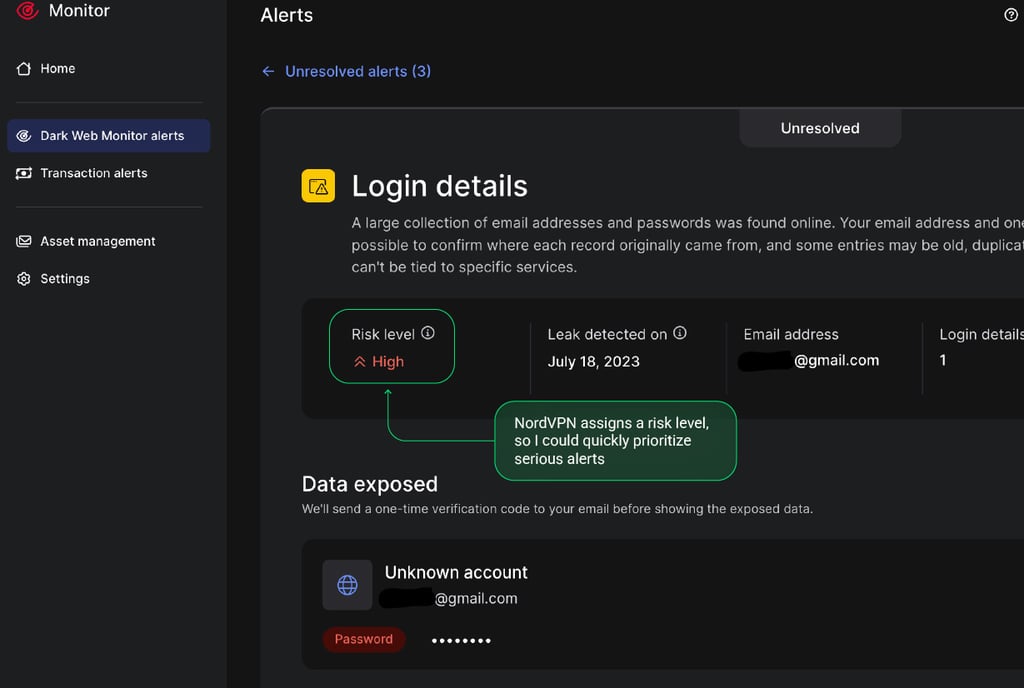
I found the dashboard itself straightforward: each monitored item has its own line showing when it was last checked, and adding or removing something takes seconds.
NordVPN recently paired this with transaction monitoring, a newer feature currently available to US bank account holders, which looks like a logical extension of what Dark Web Monitor already does. It doesn’t just tell you your card details were exposed somewhere, it watches your linked bank and credit card accounts directly and alerts you the moment it detects unauthorized activity. This way, you can freeze your account before further damage is done.
Scam call and message protection
NordVPN's mobile apps now also screen incoming calls and texts for scam patterns and check phone numbers against a regularly updated database. This way, NordVPN flags suspicious messages before you engage with them. Moreover, call protection can automatically decline flagged calls entirely so they never reach your screen (I like this one a lot). Message protection works similarly for SMS messages (you get an alert and can decide whether to delete the message), but it’s currently Android-only, following its recent rollout.
It’s important to note that neither feature reads or stores your actual call or message content. They’re checking sender reputation and known scam patterns, and that’s about it.
Meshnet
Meshnet lets you directly connect your own or another person's devices (with their permission), over an encrypted private network, without routing your connection through NordVPN's regular servers. In practice, you can securely transfer files between your laptop and phone, remotely access a home computer while traveling, host a LAN-style multiplayer session with friends who are elsewhere, or route your traffic through a linked home device to use its home IP address while away. While that might sound complex, the best part is that linking external devices takes literal seconds.
Meshnet has become one of the tools I use daily now, mainly for sending files between my devices without emailing them to myself or going to cloud storage (what a relief). One small detail is that Meshnet assigns each connected device a name by default. While I personally like that, I can see that it can become confusing once you have several devices connected. This is solvable, though: you can rename them yourself to make the list easier to scan.
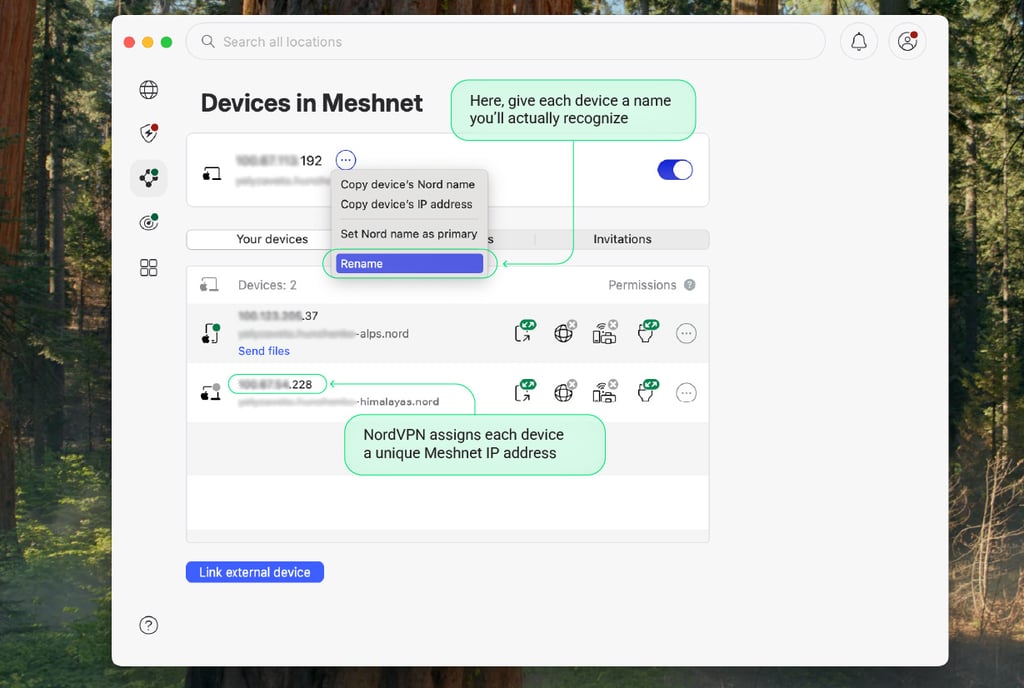
It’s one of NordVPN’s more distinctive features, and one I have found more practical than I initially expected. I also haven't found an equivalent to such a dedicated mesh-network tool among NordVPN’s competitors.
Split tunneling
Split tunneling lets you choose exactly which apps or websites route through the VPN and which use your normal connection. Setup is simple: pick a connection type (I went with Don't use VPN for selected apps), then add whichever apps you want excluded – I tested it with Chrome.
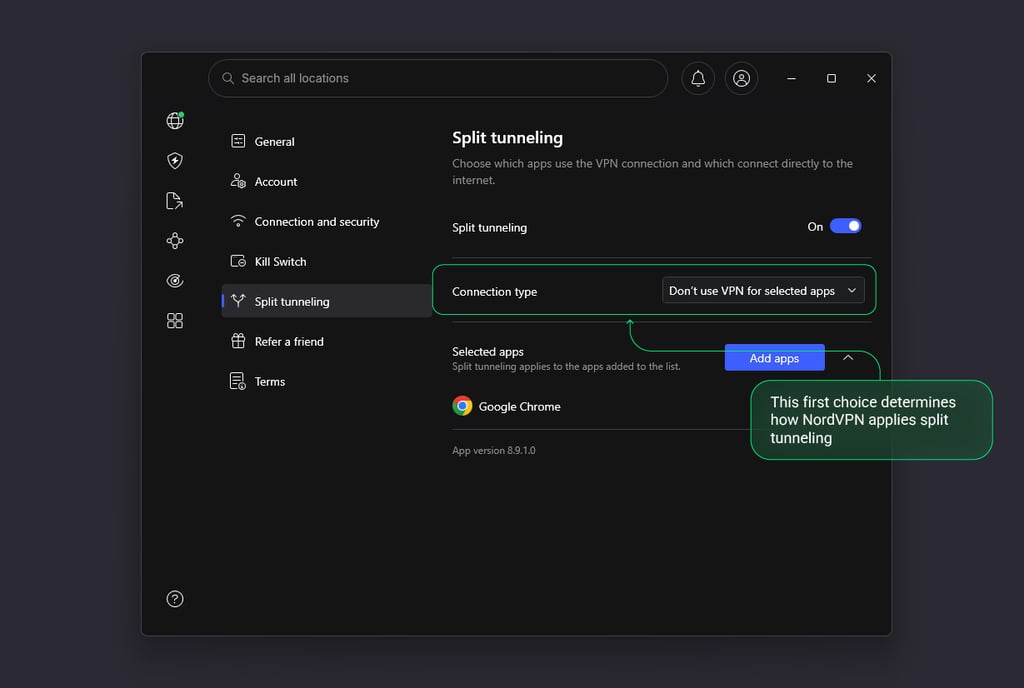
Having used competitors' versions as well, I personally prefer Surfshark's Bypasser, mainly because it defaults to a simpler flow where you just pick which websites and apps to exclude instead of choosing a connection type first. NordVPN's version works fine once it’s set up, but that first step makes the setup feel slightly less intuitive.
A more noticeable limitation, though, is that NordVPN lacks native split tunneling support on Apple devices. That is frustrating in everyday use: on my iPhone, for example, I’d like to exclude FaceTime from the VPN when call quality becomes an issue (which is quite frequently, considering how taxing FaceTime is), while keeping the rest of my traffic protected by the VPN. Without split tunneling, I have to disconnect NordVPN completely.
SmartPlay, SmartDNS, and Custom DNS
The names sound too similar, so it’s only natural that these features constantly get confused. Still, each one does something different:
- SmartPlay is built into every NordVPN app and runs automatically the moment you connect. It combines DNS routing with full VPN encryption, so you get streaming access to geo-restricted content while your IP address stays hidden and your traffic remains encrypted. This is the option I use for streaming on devices that support the NordVPN apps, and it’s exactly the feature that did the work in the streaming tests earlier in my review.
- SmartDNS is a separate tool for devices that cannot run the NordVPN app, such as some smart TVs. You set it up manually in the device’s network settings to help access streaming libraries, but it doesn’t encrypt traffic or hide your IP address. For this reason, it’s just a convenience feature, and I’d stick to SmartPlay wherever possible.
- Custom DNS is unrelated to unblocking entirely. It lets you use a DNS provider of your choice instead of NordVPN’s default DNS. This can be useful if you already have a preferred privacy-focused or ad-blocking DNS service.
Auto-connect
Auto-connect automatically activates NordVPN the moment you join a new or unsecured Wi-Fi network. If you don’t get much use out of a VPN because you just constantly forget to turn it on in the first place, this feature solves that for you.
It's easy to fine-tune, too: for any network you don't want NordVPN auto-connecting on, you just click Trust this network, and it's excluded going forward. I did this for my home Wi-Fi, so the VPN doesn't kick in every time I'm just on my own network, but I keep auto-connect on anyway, so I don’t need to remember to turn the VPN on when I’m at a coworking space.
NordVPN for torrenting
With fast speeds across all protocols I tested and P2P support on all its standard servers now, NordVPN is one of the best VPNs for torrenting out there. Here’s what its torrenting test results look like:
| Protocol | Max speed | Total time | Avg speed |
| NordLynx | 104MB/s | 48s | 93MB/s |
| NordWhisper | 74MB/s | 1min 10s | 63MB/s |
| OpenVPN UDP | 62MB/s | 1min 18s | 57MB/s |
| OpenVPN TCP | 82MB/s | 59s | 75MB/s |
NordLynx is the clear winner here, finishing the download in just 48 seconds and averaging 93MB/s. This is consistent with it outperforming the other protocols across all my other tests. OpenVPN TCP unexpectedly placed second, ahead of NordWhisper, with an average of 75MB/s and downloads finishing in under a minute, despite TCP generally carrying more overhead than UDP. OpenVPN UDP was the slowest option in this test (57MB/s, 1 minute and 18 seconds) – a counterintuitive result, but one that can vary with server conditions, network routing, and swarm health. Considering that NordWhisper is designed primarily for restrictive networks rather than peak speed, it’s no wonder it didn’t challenge NordLynx here, averaging 63MB/s and taking 1 minute and 10 seconds to download the file.
If you are torrenting with NordVPN, NordLynx is the protocol I’d use by default. It delivered the best balance of speed and reliability in my testing.
However, my testing didn't start smoothly, and I’d rather not skip that part. I picked a torrent file and connected through NordVPN, expecting a routine download. Instead, the client could find only one seed, regardless of which torrent client I used, and speeds never exceeded 40 KB/s.
My first instinct was to switch to NordVPN's dedicated P2P servers in the app, which had fixed similar issues for me before. However, that option was no longer available in the app (since all NordVPN’s standard servers now support P2P), so I also tried several protocols, with no improvement. I then thought of NordVPN's lack of port forwarding – an issue I've seen come up repeatedly in user discussions, although it had never affected my own torrenting tests before. To rule out this as a possible issue, I tried downloading the same file using a different VPN that also doesn’t support port forwarding. It immediately connected to plenty of seeds and reached 80 MB/s, which makes port forwarding an unlikely explanation for this particular result as well.
Ultimately, the issue was specific to that torrent file rather than NordVPN: another torrent started downloading normally right away. Once I ran out of troubleshooting ideas, I raised the original file’s behavior with NordVPN support, which I cover later in this review. With that out of the way, I ran a proper protocol comparison using the 4.47GB Kali Linux 2026.2 ISO torrent. I used the same 930Mbps download/600Mbps upload baseline connection throughout, connected to NordVPN’s London server.
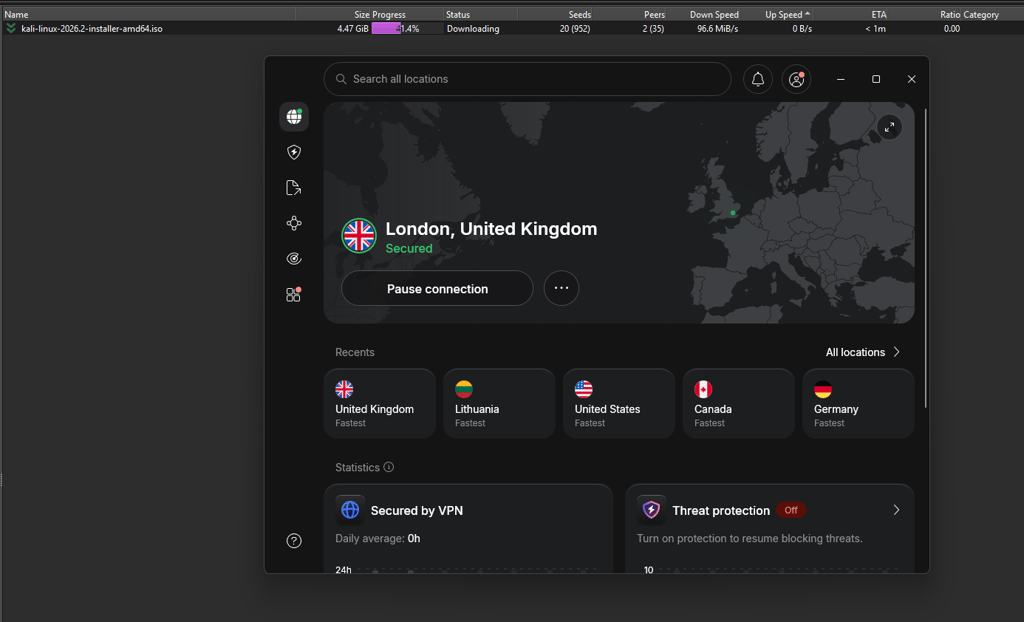
Overall, once the original torrent issue was out of the way, NordVPN performed well: downloads were fast, I saw no apparent throttling, and P2P traffic worked on the standard servers I tested. This combination is exactly what I'd want from a VPN for regular torrenting. The rough start with that first file is worth noting, but it’s also not a reason to assume NordVPN is broken the moment a single torrent misbehaves. As my testing shows, it was the exception rather than the rule.
NordVPN server network
NordVPN has one of the largest VPN networks out there, with more than 8,000 servers across 225 locations. Every server now runs on 10Gbps infrastructure, which helps explain the consistently strong speeds I recorded throughout this review. The company also uses a hybrid model for server ownership: it still rents a portion of its servers from third-party providers but has also been transitioning to a co-located network, where it owns, maintains, and operates a growing share of its server fleet.
In everyday use, though, I think the size of the network matters less than how easy it is to find the right connection. NordVPN’s standard servers cover normal browsing, streaming, gaming, and torrenting, while the app also includes several specialty options for more specific privacy or access needs. Here’s a quick overview of their purposes, alongside my experience using each server type:
| Server type | Purpose | My experience |
| Standard servers | Everyday browsing, streaming, gaming, and P2P traffic | My default for most testing. They provided the best mix of speed and usability, and all standard servers now support P2P traffic. |
| Dedicated IP | A fixed IP address for IP allowlists, remote work, or avoiding repeated CAPTCHA checks | Useful for remote work and account-access consistency, but it costs extra, and it’s rather unnecessary for basic user needs. |
| Dedicated server | A private server environment for a team or organization | Primarily a business feature. Unless you need organization-level control, it’s not something most individual VPN users will need. |
| Meshnet | Privately linking your own devices (or trusted contacts’ devices) for file transfers, remote access, virtual-LAN gaming, or traffic routing | One of NordVPN’s most genuinely useful extras. I use it regularly to send files between devices without relying on cloud storage. |
| Obfuscated servers | Networks that block or identify VPN traffic | Essential for restrictive networks. |
| Double VPN | Routing traffic through two VPN servers for an additional privacy layer | NordVPN uses fixed two-server routes rather than letting you select both server locations yourself. It’s fine for users who simply want a two-server route, but I’d prefer more control over the entry and exit locations I’ve seen in Surfshark’s MultiHop. |
| Onion Over VPN | Reaching the Tor network through a VPN without installing or opening Tor Browser first | Useful for anonymity-focused situations, but considerably slower than a standard VPN connection and overkill for daily use. In my testing, performance was so slow that normal browsing became practically unusable. |
The table covers my experiences using NordVPN’s different specialty servers, but its obfuscation deserves a closer look. To test NordVPN’s obfuscation servers, I connected to the VPN, captured the network traffic in Wireshark, and analyzed the resulting .pcapng file with nDPIreader. The goal was to see whether deep packet inspection could identify the connection as VPN traffic.
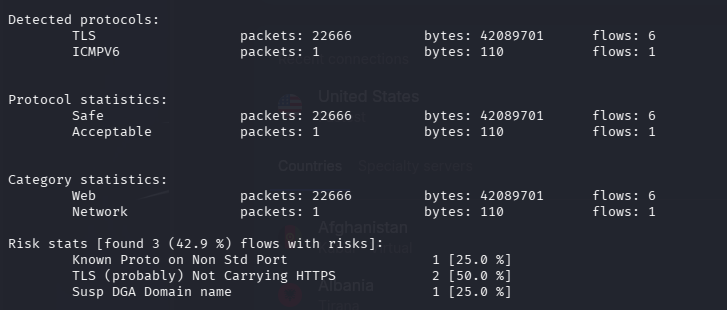
NordVPN only successfully hid VPN traffic when I used NordWhisper. In that test, nDPIreader classified the connection as standard TLS traffic rather than a VPN connection, which means NordWhisper successfully concealed the VPN signature from DPI. NordVPN’s other tested connection methods were still identifiable as VPN traffic. That makes NordWhisper the protocol I’d use on restrictive networks where VPN detection is a concern. It also aligns with NordVPN’s own positioning of NordWhisper as a protocol for restrictive local networks and its instructions to use obfuscated servers to bypass network firewalls.
This especially matters for travel to China and other heavily censored regions. NordVPN’s regular connections may not always be reliable against aggressive filtering, but NordWhisper’s ability to avoid detection in my DPI test gives it a more credible use case than standard protocols. However, I still recommend signing in, downloading any required configuration files, and testing the NordWhisper connection before you travel. Also, keep a manual setup method and a backup connection option ready. NordVPN’s own support documentation says the Android app is fully blocked in China and provides a manual IKEv2/IPsec setup as an alternative.
NordVPN apps and ease of use
NordVPN is generally easy to use on all major platforms, though your experience may still vary slightly depending on your operating system.
Desktop (Windows, macOS, and Linux)
On first install, NordVPN walks you through enabling its extra security features, regardless of the desktop app you use. This way, you're covered beyond the VPN itself from the start.
Past that initial setup, though, the interface has become less intuitive, in my opinion, since NordVPN's recent redesign. The main window shows VPN locations, plus a sidebar for Scam, phishing, and malware protection, Meshnet, and Dark Web Monitor, as well as other bundled tools under the Products tab, but the actual settings are harder to find now. You have to go through the Profile menu, open a separate settings window, then click through several subsections just to toggle something as simple as a protocol or the kill switch.
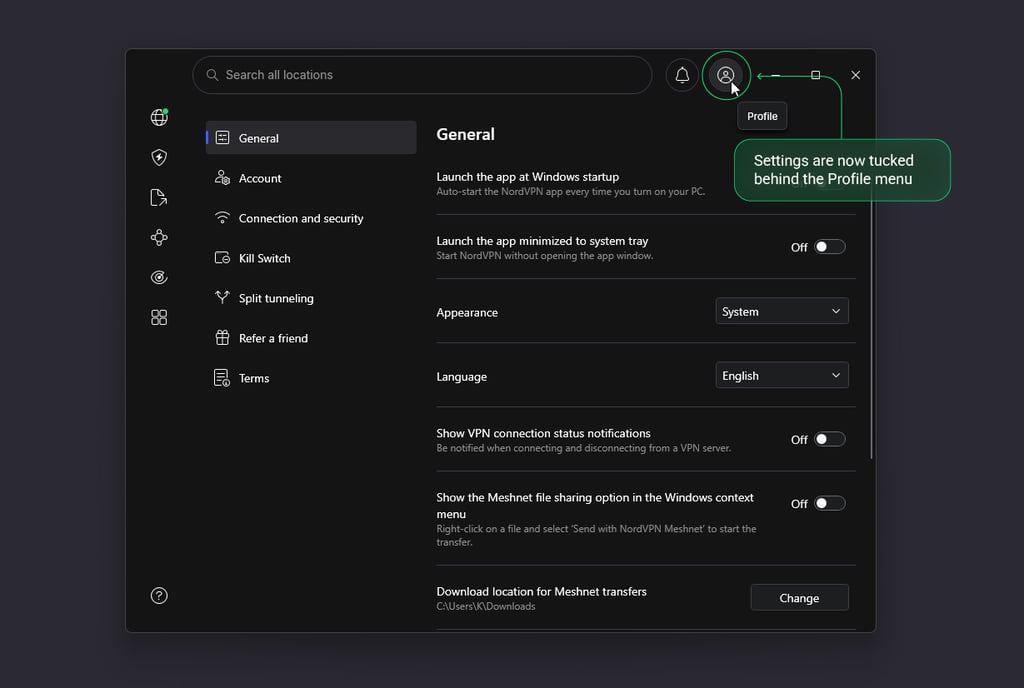
I also ran into real connectivity issues, specifically on Windows (e.g., unstable connections, unexpectedly slow torrent speeds, and an inability to connect to certain servers – all described in this review). macOS, by contrast, was flawless throughout testing. Here, I'd recommend downloading the NordVPN app directly from its website rather than the Apple App Store, though. Apple's sandboxing restrictions limit some features on App Store versions, including the app-level kill switch, so you get the fuller feature set going directly.
The only thing that slightly bothers me while using a NordVPN app for desktop is that there’s no one-click disconnection option, and to turn off the VPN, you need to first click Pause connection and then choose Disconnect.
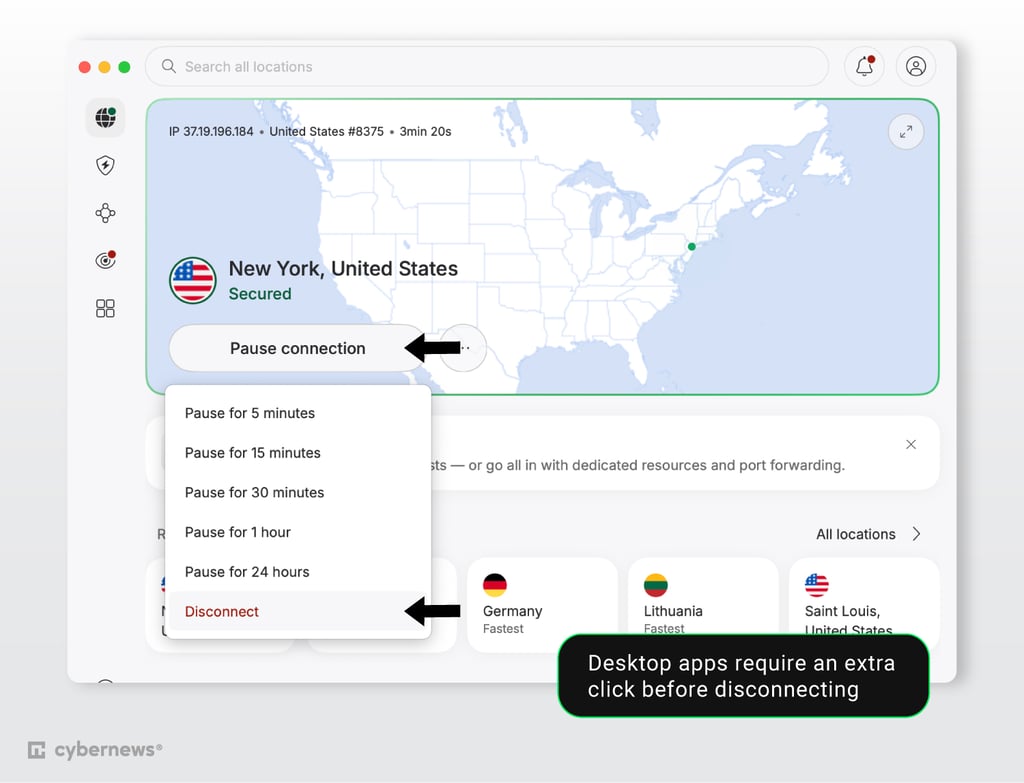
However, the biggest surprise among NordVPN desktop apps was Linux: it now has a genuinely functional graphical interface, works out of the box, and can be installed without any of the manual terminal fuss Linux VPN apps are typically known for.
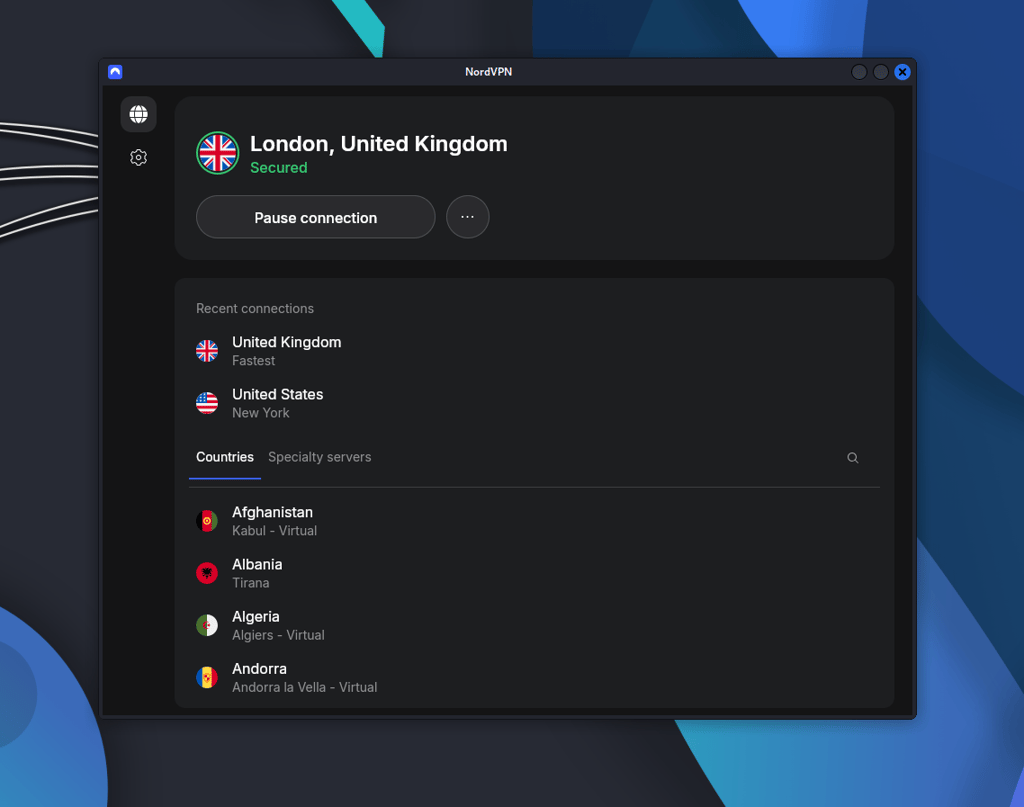
Mobile (Android and iOS)
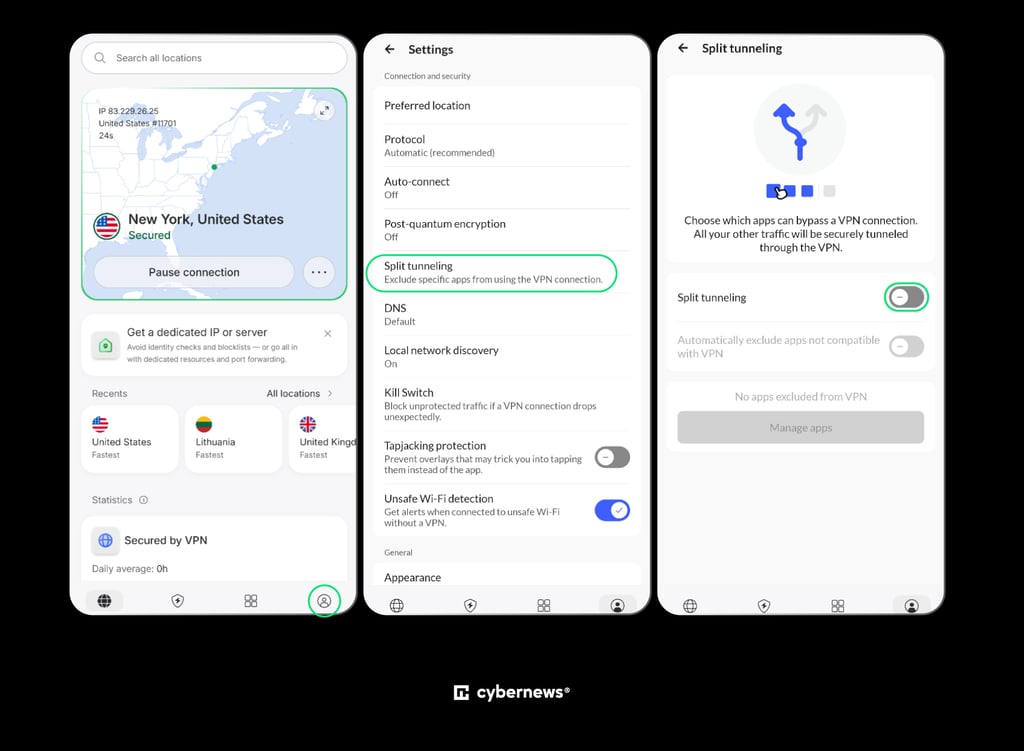
Both NordVPN mobile apps are clean and easy to navigate, and the interface feels more intuitive than on the desktop counterpart. On Android, additional features are easy to find without digging through nested settings menus, unlike on Windows. Here’s, for example, how to use NordVPN’s split tunneling on an Android:
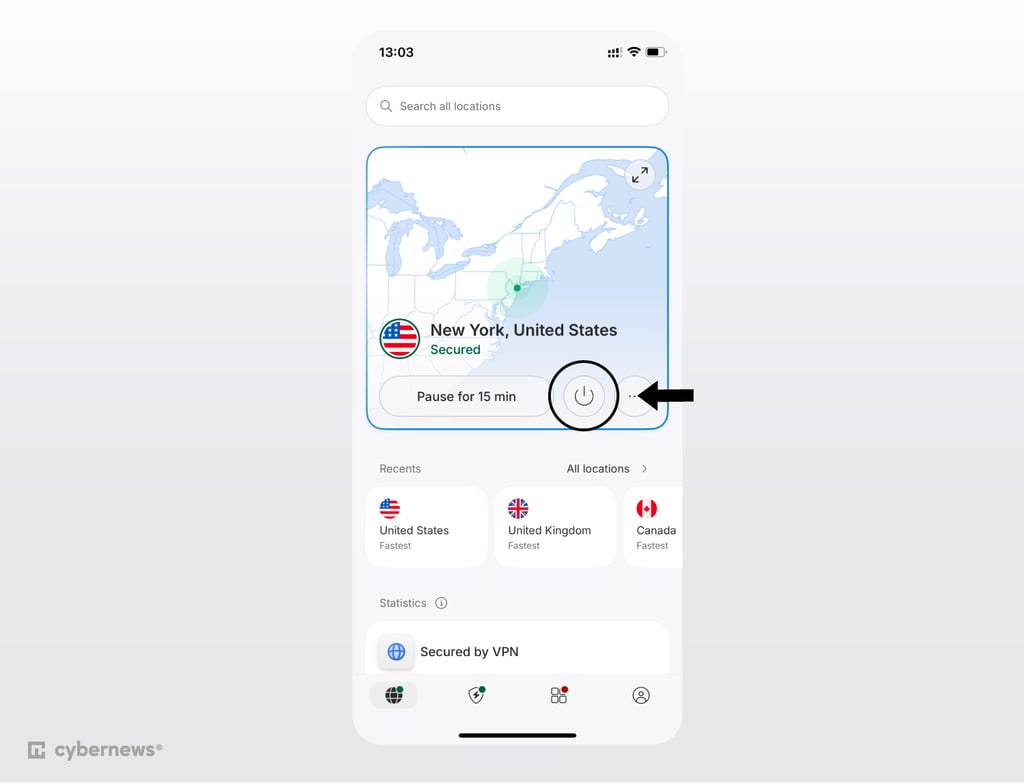
iOS provides a similarly straightforward experience: connecting takes one tap, and what I especially liked was that disconnecting also only takes one tap. The app also clearly shows your current server and protection status once you're connected, no ambiguity about whether the VPN is actually active.
Smart TVs and other devices
You don’t need to rack your brains trying to figure out how to use NordVPN on devices without a dedicated app – it just requires a slightly different setup. For one, SmartDNS covers you for older smart TVs and similar devices. NordVPN does have native apps for Android TV and Amazon Fire TV/Firestick, both of which mirror the mobile experience closely enough that switching between them doesn't require relearning the interface.
Beyond dedicated apps, NordVPN extension is also available for Chrome, Firefox, and Edge for quick browser-only protection. There’s also router support if you want your entire home network covered without installing the app on every individual device.
Across the board, one thing that stood out throughout this review was that NordVPN's native apps are updated regularly, and it shows – most platforms felt current and well maintained to me.
Setup and installation walkthrough
Getting started with NordVPN took me under five minutes from start to finish, and none of the steps required anything beyond what you'd expect from signing up for any subscription service.
Step 1. Pick a plan and create your account
Head to NordVPN's website, choose between Basic, Complete, and Prime, then pick your billing term – 1-month, 1-year, or 2-year. You'll enter your billing details and set up your account credentials during checkout.
Step 2. Download the app
Once you're signed up, you can grab the app straight from your account dashboard or pull it from the Mac App Store or Microsoft Store if you'd rather install it that way. However, my preferred method is to always download the app directly from the provider’s website.
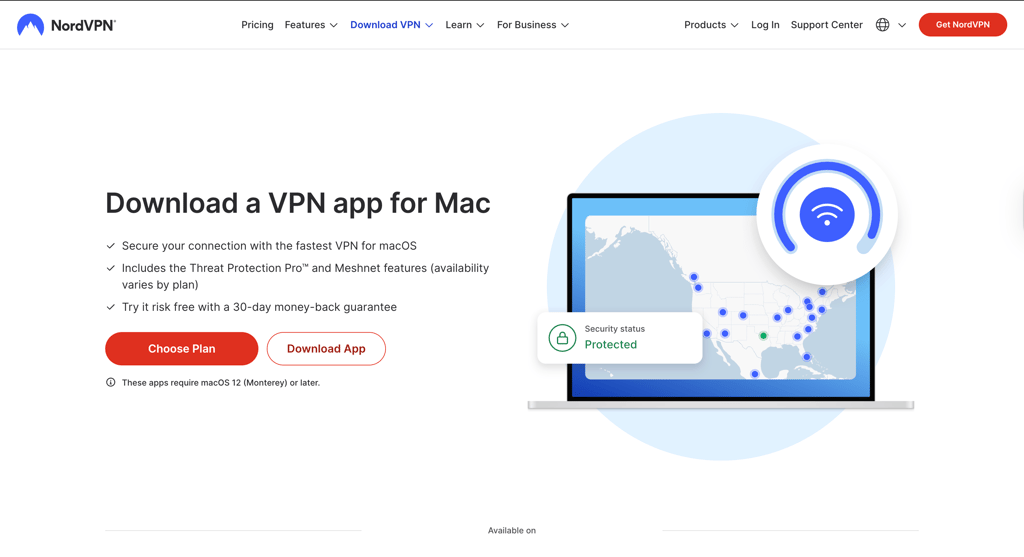
Step 3. Get any bundled extras if your plan includes them
If you're on Complete or Prime, NordPass and NordLocker are available to download from that same account page. No separate purchase or account needed, they're tied to your existing subscription.
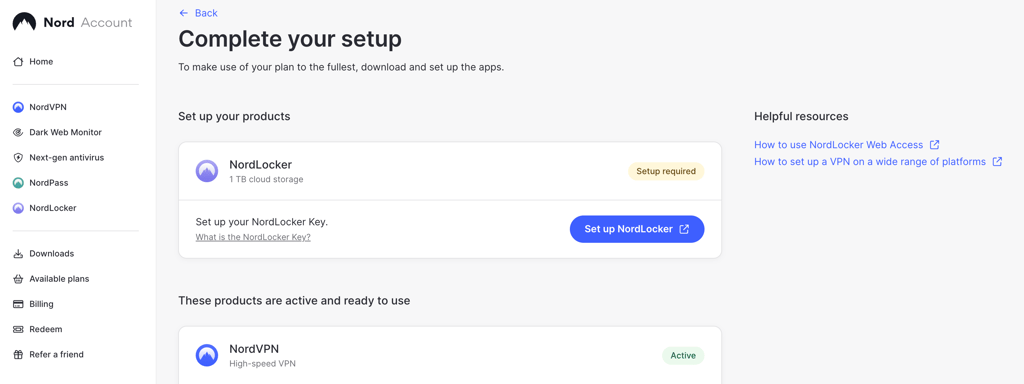
Step 4. Log in and connect
Open the app and log in with the account you just created. Pick a server or click Secure my connection to get assigned the fastest one, and you're ready to go.
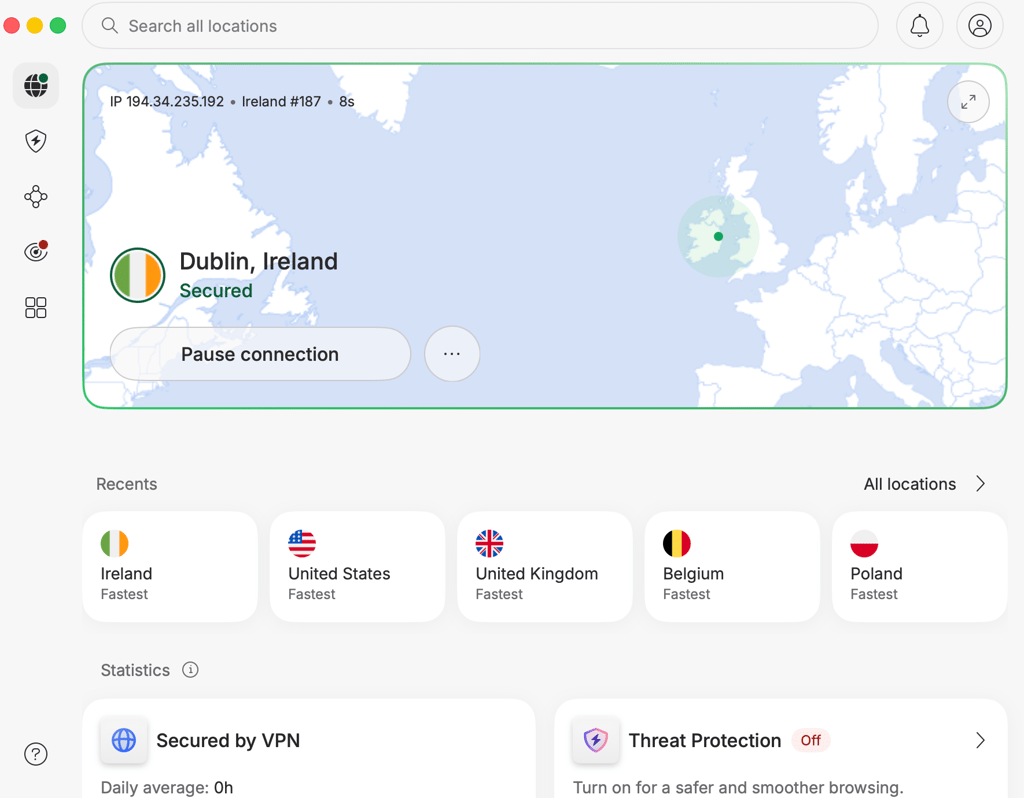
From there, NordVPN handles updates automatically: you'll get a prompt when a new version is available, and you can install it immediately or defer it, though I'd recommend not putting it off for long, since updates are also how NordVPN patches security issues.
NordVPN customer support
I found NordVPN customer support to be responsive, knowledgeable, and, in my particular case, very dedicated to resolving a real technical issue, where I usually expect to be pointed to the knowledge base tutorial instead. NordVPN offers a few ways to get help:
- 24/7 live chat (the first line of contact, and where most of my testing happened)
- Email support for less urgent or more detailed cases
- Extensive help center with troubleshooting guides and setup tutorials for anyone who'd rather self-serve before reaching out to a human
There’s no phone support, but it’s not common among VPN providers overall.
NordVPN's live chat is powered by an AI agent from nexos.ai. In my initial request, it gathered my location, operating system, and whatever I'd already tried before offering anything.

To its credit, when I came back with a torrenting issue, it didn't keep looping through generic suggestions. Once it recognized I'd already tried basic troubleshooting steps, it connected me to a live agent from NordVPN's Connectivity department. From there, the process actually felt methodical and not scripted: they asked which torrent client I was using, sent me a quick diagnostic test to run, and, once I sent back my results, followed up with step-by-step instructions and screenshots showing how to make changes in my torrent client. After that, the torrenting issue I had was gone.
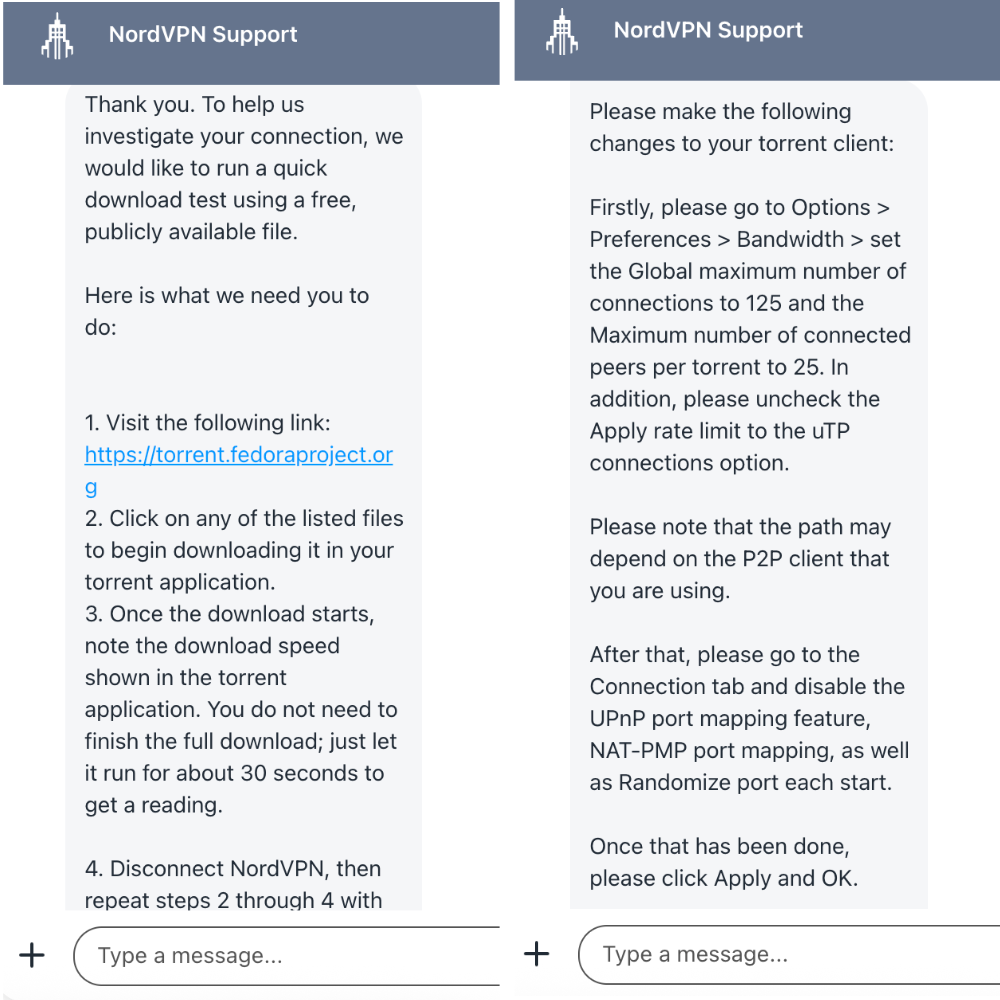
Moreover, my agent's shift ended partway through, but the handoff was seamless – a new representative picked up the same chat with full context, and there was no need for me to re-explain anything. All in all, the fix took about an hour and a half, though most of that was just me running the test and then reviewing the results, not due to any actual delays or unresponsiveness. For a truly tricky issue, I walked away pretty impressed.
What real users say about NordVPN
Overall, real users back up what I found in my own testing: strong ratings across every major review platform, with most of the criticism aimed at NordVPN’s billing practices rather than the VPN itself.
Across the Apple App Store and Google Play, NordVPN's ratings are strong: 4.7 out of 5 from over 695,000 ratings on the US App Store and 4.6 out of 5 from 1.33 million reviews on Google Play.
High app-store scores are common among major VPN providers, so these figures aren’t a decisive differentiator on their own. Still, the scale matters: more than 2 million combined ratings suggest NordVPN has been used and rated by a very large mobile audience over time. I would treat that as a useful baseline for overall user sentiment, but not as proof that every user has a seamless experience (even I didn’t). And while app-store ratings can be influenced by prompts, temporary incentives, review selection, and changes to an app over time, a review base this large is more informative than a score based on a few hundred responses.
Trustpilot paints a slightly less flattering picture: NordVPN sits at 4.2 out of 5 across roughly 50,000 reviews. That is still a solid score, but it is noticeably lower than the company’s App Store and Google Play ratings. One thing I noticed is that the negative feedback is often less about the VPN’s core performance and more about subscription management. In particular, reviewers frequently mention unexpected auto-renewal charges, higher renewal prices after an introductory deal ends, and, in some cases, difficulties with refunds or support.
That tracks with NordVPN’s discounted introductory pricing model. If you sign up for a long-term plan, it’s another reminder to turn off auto-renewal in your account settings if you do not want the subscription to renew automatically at the standard rate. Trustpilot’s own review summary highlights subscriptions and refunds as recurring complaints, while also noting reports of connectivity and customer service issues.
Reddit feedback is expectedly mixed, but the comments I reviewed leaned broadly positive. Some users describe several months of trouble-free use, particularly for streaming while abroad. That reflects my own streaming tests, although no VPN can guarantee access to every service or region indefinitely – streaming platforms routinely detect and block VPN IP addresses.

One of the comments that grabbed my attention came from a user saying they chose NordVPN partly because it was available through the Arch User Repository (AUR). They also described using Meshnet to stream between their PC, Steam Deck, and laptop while travelling for work – an everyday use case that closely matches my own experience using NordVPN.

Of course, these are only individual experiences, but the recurring positives mentioned in them (reliable streaming and useful extras beyond the core VPN) line up with the strengths I identified in my own testing.
How I tested NordVPN
I’ve used NordVPN daily for the past eight months, running it across my main devices for everyday browsing, streaming, and work. For this review, I teamed up with the Cybernews research team to run a dedicated, controlled round of testing – specifically covering speed, streaming, and torrenting performance but also delving into obfuscation and other privacy tests. Most tests were conducted between August 18th and 25th, 2026, in Vilnius, Lithuania, except for the streaming performance, which I’ve been testing throughout the eight months.
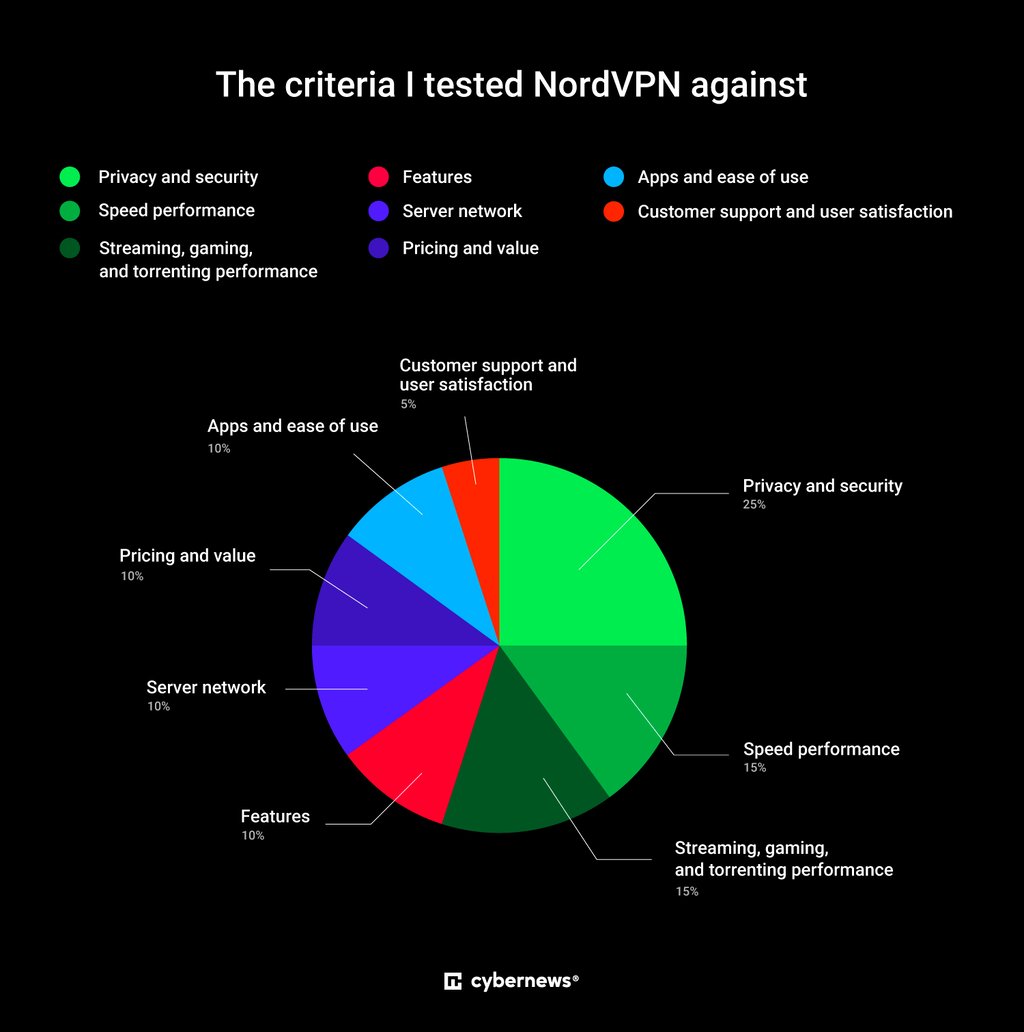
These 8 criteria are what I judged NordVPN against, each reflecting our VPN testing methodology and relevance to everyday use. Here’s a closer look at how I tested each.
As you can see, across every single one of these categories, NordVPN didn't just meet the industry bar – it consistently surpassed what I'd consider the baseline expectation for a VPN. That's a rare thing to say about any provider across eight separate, independently tested criteria, and it's a big part of why NordVPN comes out as one of the strongest all-around picks in 2026.
NordVPN alternatives
NordVPN is a top-performing VPN, but it's not the only VPN worth considering, and depending on what you value most, be it price, unlimited devices, or more emphasis on privacy, another provider might actually fit your needs better. Below is a quick comparison of how NordVPN stacks up against the VPNs I'd consider its closest competitors.
| VPN | Rating | Free version | Stating price | Simultaneous devices | Kill switch | Split tunneling | Compatibility |
| NordVPN | ❌ No | $3.49/month | 10 | ✅ Yes | ✅ Yes (Windows and Android) | Windows, macOS, iOS, Linux, Android | |
| Surfshark | ❌ No | $2.49/month | Unlimited | ✅ Yes | ✅ Yes | Windows, macOS, iOS, Linux, Android | |
| Proton VPN | ✅ Yes | $2.99/month | 10 | ✅ Yes | ✅ Yes | Windows, macOS, iOS, Linux, Android | |
| ExpressVPN | ❌ No | $2.99/month | 14 | ✅ Yes | ✅ Yes | Windows, macOS, iOS, Linux, Android |
If you want to explore NordVPN compared to other providers in greater detail, check out our dedicated comparison articles:
Is NordVPN worth it in 2026? Final verdict
Yes, NordVPN is definitely worth it in 2026. Across eight months of testing, it delivered consistently fast speeds, a leak-free security record backed by six independent audits, reliable streaming and torrenting performance, and a genuinely useful bundle of extras, including Meshnet and next-gen antivirus.
In my opinion, NordVPN is the best fit for anyone who wants one subscription that handles streaming, security, and everyday privacy without much fuss, all backed by in-house testing that consistently delivered better results than what you’d expect from an average VPN. For most people, it's a truly safe, fast, reliable, and complete choice.
NordVPN video review
Prefer to watch instead of read? Check out our video review covering NordVPN's speed, streaming, privacy, and usability, tested fresh in 2026.
FAQ
Is NordVPN legit?
Yes, NordVPN is legit. It's backed by six independent no-logs audits, RAM-only servers, and a leak-free track record in both my own testing and West Coast Labs' evaluation. It's one of the most independently verified VPNs on the market.
Does NordVPN work with Netflix?
Yes, NordVPN works with Netflix. In my testing, I unblocked several different Netflix libraries without a single error or blocked connection, all on the first server I tried each time.
Does NordVPN work in China?
NordVPN's own support documentation confirms that the Android app is fully blocked in China, and that reliability on other platforms can be inconsistent given how aggressively the country filters VPN traffic. My DPI testing found NordWhisper was the only protocol that successfully disguised VPN traffic from detection, which gives it a real shot at working. However, I'd still recommend setting up the app, downloading configuration files, and testing your connection before you travel, with a manual backup method ready just in case.
Does NordVPN slow down your connection?
Yes, NordVPN might slow down your internet connection, but this is normal with any VPN. Besides, NordVPN is one of the fastest VPNs out there, with almost negligible impact on nearby servers. In my speed tests, NordLynx retained 95% of my baseline speed on local servers and still held onto 72% even connecting to a long-distance server in Japan.
Is NordVPN free?
No, NordVPN isn't free, its plans start from $3.49/month. However, there are ways to try it without paying upfront: a 3-day free trial on Android and a 30-day money-back guarantee on every paid plan, which effectively functions like a free trial in practice.
How to cancel NordVPN?
You can cancel NordVPN anytime through your Nord Account by heading to your subscription settings and turning off auto-renewal, or by requesting a refund through live chat if you're still within the 30-day money-back window. Just remember to go to Apple directly to request a refund if you subscribed through iOS.
Can I be tracked if I use NordVPN?
No, not through NordVPN itself. Its no-logs policy means there's no browsing or connection history stored that could be traced back to you, and my leak tests confirmed no IP, DNS, or WebRTC leaks that could expose your real location. That said, a VPN doesn't make you anonymous everywhere online – logging into accounts, accepting cookies, or browser fingerprinting can still identify you regardless of which VPN you use.
What are the cons of NordVPN?
NordVPN’s two main drawbacks are higher renewal rates once your first term ends and a lack of split tunneling support on Apple devices.