Best eSIM for USA travel in 2026
Our in-house expert researchers and journalists conduct independent, unbiased testing of eSIM services, assessing their real-life effectiveness and usability.
By staying current with industry developments and openly sharing our transparent testing methodologies, we ensure readers receive accurate, up-to-date insights so they can make informed choices about eSIM solutions.
Learn more

The last time I landed in the US, I quickly realized how much I relied on having data right away. Without it, even simple things like loading Google Maps at JFK airport or messaging my ride felt frustrating and slow. Roaming wasn’t an option I wanted to think about, especially when I just needed reliable internet for navigation, bookings, and staying in touch.
This time, using an eSIM completely changed how I traveled through cities like New York, Los Angeles, Miami, and Chicago. I could navigate in real time, message without delays, upload photos instantly, and even use my laptop as a hotspot in cafés without scrambling for Wi-Fi or a local SIM.
But not all eSIMs perform the same once you’re actually on the road. Some struggled in busy city areas, while others couldn’t handle heavier use like hotspot or streaming. Choosing the wrong one can impact your trip when you depend on your phone for maps, communication, and bookings. In this guide, I share which eSIMs worked best during my US travels – and which ones are worth using for your own trip.
My top 5 eSIM picks for the USA
- Saily – best overall eSIM for USA travel
- Jetpac – USA eSIM with travel perks
- Ubigi – eSIM for USA with great connectivity
- Airalo – best-value eSIM for the USA
- Nomad – best eSIM for flexible data plans




Our team of researchers thoroughly tests eSIM services using a clear and consistent process. We combine first-hand experience with expert analysis to evaluate features, performance, coverage, and pricing - so you can make confident decisions before your trip. Learn how we test eSIMs.
Recent Updates
Key considerations for USA eSIMs
Choosing the right eSIM for the US can make a big difference to how smoothly your trip goes – especially when navigating foreign streets, making reservations, or texting your relatives at home. Here are the key aspects you should look for:
- Data usage and plan length. Think about how you’ll use data during your trip and how long you’ll be staying. Many budget eSIMs come with smaller allowances, like 1GB or a few GB, which can melt quickly if you’re using maps or social media. For longer stays or heavier use, it’s usually better to choose a larger plan.
- Performance and network reliability. Speed and coverage matter, especially in a country as large as the US. A good eSIM should offer stable 4G or 5G connections and maintain consistent performance not only in major cities like New York or Los Angeles but also when you’re traveling between regions.
- Pricing and overall value. Price isn’t always a clear indicator of quality, and some of the best-performing eSIMs are actually mid-range options. Instead of focusing only on the cheapest plan, compare what you get for the price – data allowance, validity period, and network quality.
- Calls and messaging limitations. Most eSIMs are data-only, which means you won’t get a traditional phone number for calls or SMS. If having a local number is important for your trip, you’ll need to specifically look for providers that offer call and SMS support.

Best eSIMs for the USA in 2026: which one is right for you?
Not all eSIMs perform the same across the US, and I was reminded of this once again during my trip. They can have different coverage, speed, additional travel or security features, and pricing. In the section below, I break down how each provider actually performs on the road and what it’s best suited for. Use this as a simple guide to quickly find the best eSIM based on your travel style, budget, and data needs.
1. Saily – best all-around eSIM for traveling across the USA

| Rating: | |
| Supports 5G networks: | ✅ Yes |
| Coverage: | Available in all US states, except for Alaska |
| Starting price: | $3.59 |
Saily is one of the most well-rounded eSIM options I tested for the US, offering a strong balance of price, performance, and usability. What makes it stand out is its inclusion of built-in security features such as ad blocking, web protection, and optional VPN support, which add an extra layer of safety when browsing on public networks abroad.
Pricing falls in the budget-to-mid-range category, making it a solid option for most travelers. Plans start from around $3.00–4.00, with mid-range options typically sitting in the $10.00–20.00 range, depending on data allowance and duration. Unlimited data plans are also available for heavier users and longer trips.
I also plan to try Saily Ultra on my upcoming travels. It includes up to 30GB of high-speed data in 121 countries, including the US, along with perks like fast-track services, airport lounge access, and additional cybersecurity tools such as NordVPN.
In terms of network coverage, Saily connects to major US carriers and delivers consistent 4G and 5G performance in most cities and tourist routes. During my travels across places like New York, Los Angeles, Miami, and Chicago, speeds stayed stable for navigation, streaming, and hotspot use. The only limitations I noticed were that coverage can be less consistent in very remote rural areas and that the US plan doesn’t include Alaska.
What’s also useful is that Saily now offers a US (+1) phone number add-on, allowing you to send SMS messages and make calls.
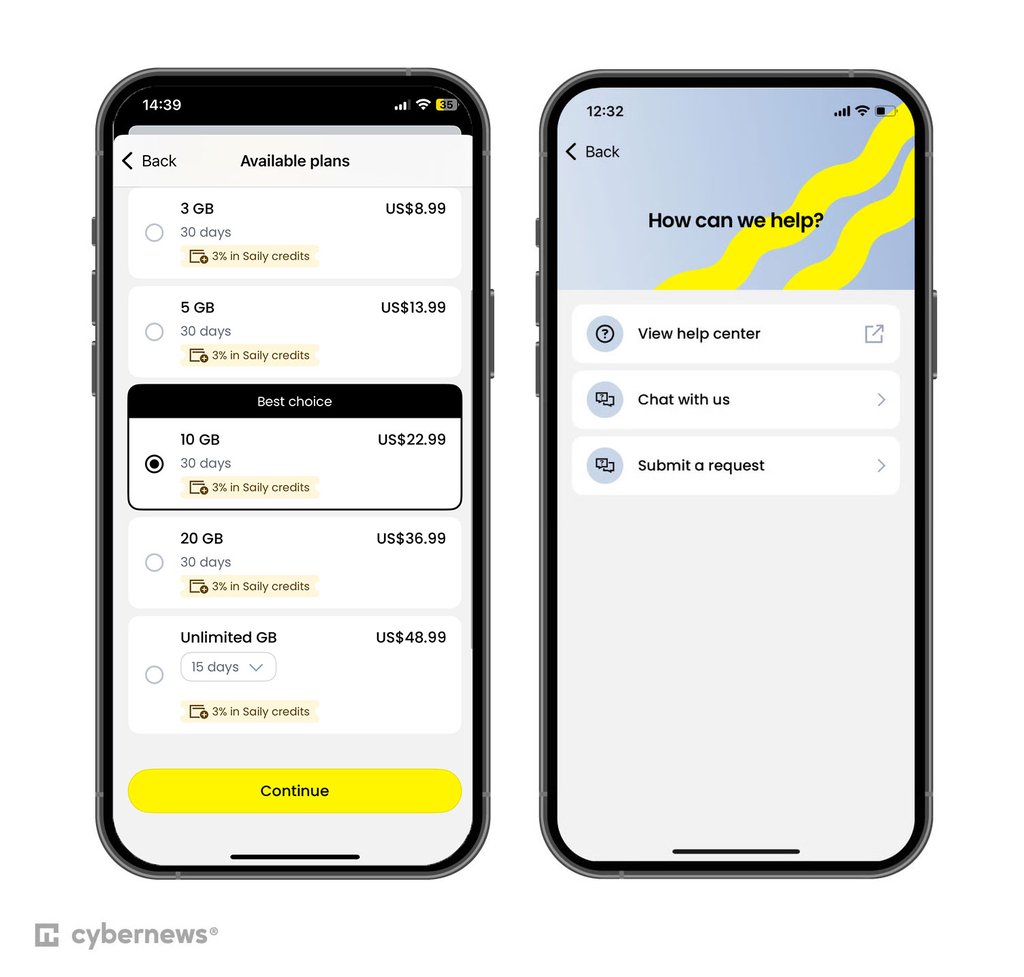
Setting up Saily eSIM is really easy and straightforward – even if you’ve never used eSIM before. I simply installed the Saily app and followed the in-app instructions to set up my eSIM before my trip, and it activated automatically upon landing at JFK. Throughout my trip, I could track my data usage, top up, and switch plans in the same app, which was really helpful since I didn’t need to go to a physical store. For more insights, check out our full Saily review.
2. Jetpac – eSIM with additional travel perks

| Rating: | |
| Supports 5G networks: | ✅ Yes |
| Coverage: | Available in all 50 US states |
| Starting price: | $4.00 |
If you’re a first-time eSIM user, you might like Jetpac. It’s an easy-to-use eSIM packed with broad connectivity, fast speeds, and travel perks like airport lounge access if your flight is delayed. What really sets it apart is the built-in safety net – even if you run out of data, essential apps like Google Maps, Uber, and WhatsApp still keep working. This is incredibly useful when you’re navigating a new city or trying to stay connected without immediately topping up.
It’s also a budget-friendly option overall. Plans start from around $4.00 for smaller data packages, while mid-range options (10–20GB) vary from $10.00 to $35.00. If you’re a remote worker or heavy user, you might enjoy its unlimited data plans. You can also find some regional plans, though global plans aren’t available.
For coverage, Jetpac connects to a major US network, T-Mobile, delivering reliable 4G and 5G speeds in most cities and tourist areas. In my experience, it handled everyday use like maps, messaging, and streaming without issues, though performance can dip slightly in more remote locations.
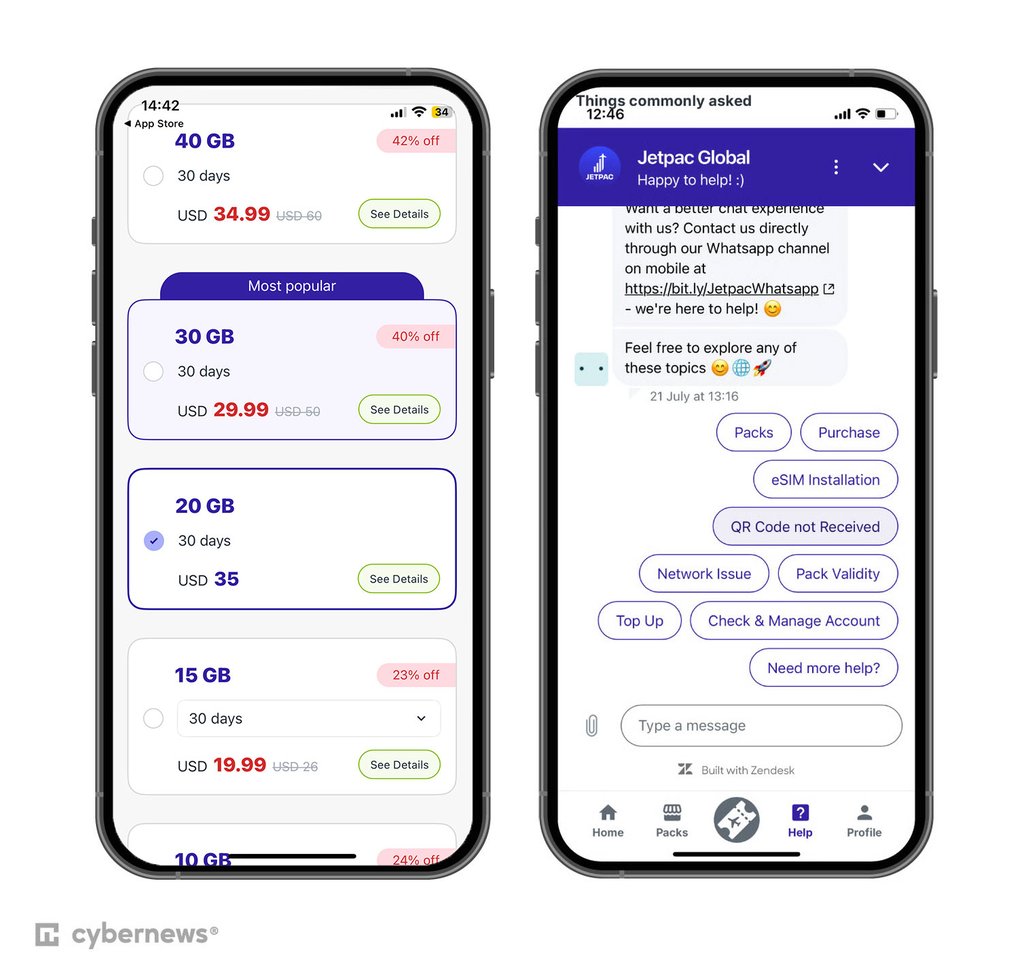
Getting started is quick and beginner-friendly. In my experience, the app guides you through setup step by step, with options to install via QR code or automatically. Once activated, it connects instantly to the strongest available network, and tracking your data usage is simple throughout your trip. If you’d like to learn more about this provider, check out our in-depth Jetpac review.
3. Ubigi – best user-friendly USA eSIM
| Rating: | 4 |
| Supports 5G networks: | ✅ Yes |
| Coverage: | Available in all 50 US states and Puerto Rico |
| Starting price: | $2.90 |
As I was visiting more states, I needed an eSIM that would be affordable, flexible, and user-friendly. I found all of this in the Ubigi eSIM for the US. While it offers data-only plans, Ubigi gave me a wide range of regional plans that were perfect for a multi-country trip.
Ubigi comes with pretty decent cost, with its plans ranging from $2.90 to $65 for data plans with data allowance between 500MB and 60GB. However, you can also find regional US plans with unlimited data, which is perfect if you plan to stay for a while.
When it comes to the coverage, Ubigi will let you connect to the most prominent US networks, including T-Mobile and Verizon. I was able to reach 5G/4G speeds in cities, while the signal dropped slightly in smaller towns. Keep in mind that the 5G can be unavailable outside of the urban areas, but that’s why Ubigi covers you with 3G and LTE connections, as well. The bottom line is that I managed to access the navigation app, stream, and even message without any issues.
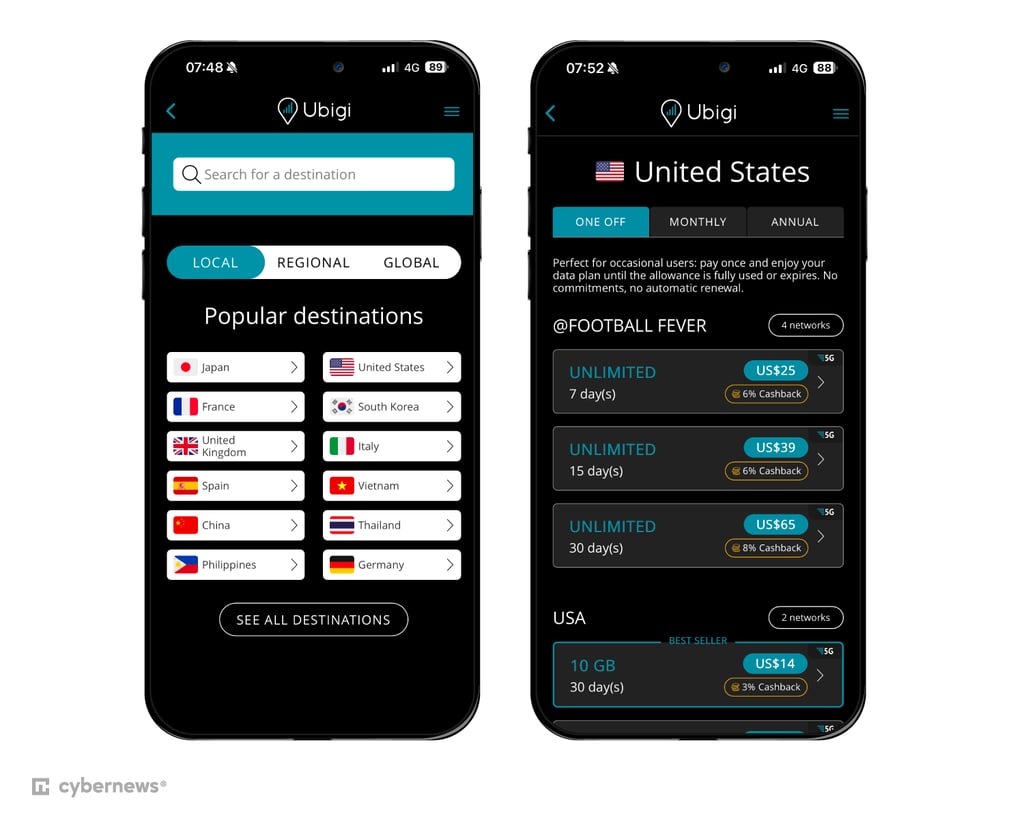
Another thing I really liked was the simple and user-friendly setup of Ubigi’s eSIM. I installed the app with a single click, and the plan was up and running as soon as my phone got on a US network. The app is also very intuitive, so you can top up, switch plans, or do anything else without facing any difficulties. For more insights, refer to our full Ubigi review.
4. Airalo – best-value eSIM I used in the USA

| Rating: | |
| Supports 5G networks: | ✅ Yes |
| Coverage: | Available in all 50 US states and Puerto Rico |
| Starting price: | $4.00 |
On my trip to the US, I was also visiting Canada, so I wanted to find an eSIM with an affordable regional plan. Airalo offered me the best-value regional and global plans for a multi-country trip. Moreover, unlike most eSIM providers, it has plans with texts and calls included if you need more than just simple data.
Airalo’s pricing falls into the budget-to-mid-range category, depending on the plan. Local US plans start at around $4.00, with larger 10–20GB options typically priced between $20.00 and $33.00. Unlimited data plans are also available, and for travel beyond the US, Airalo’s regional and global options often provide better overall value compared to buying separate local plans.
In terms of coverage, Airalo connects to major US networks like T-Mobile and Verizon. I was able to reach 4G/LTE speeds in cities, while the signal dropped slightly in smaller towns. 5G is available, but I noticed it’s less consistent outside major urban areas. Overall, it handled everyday tasks such as navigation, streaming, and messaging without major issues.
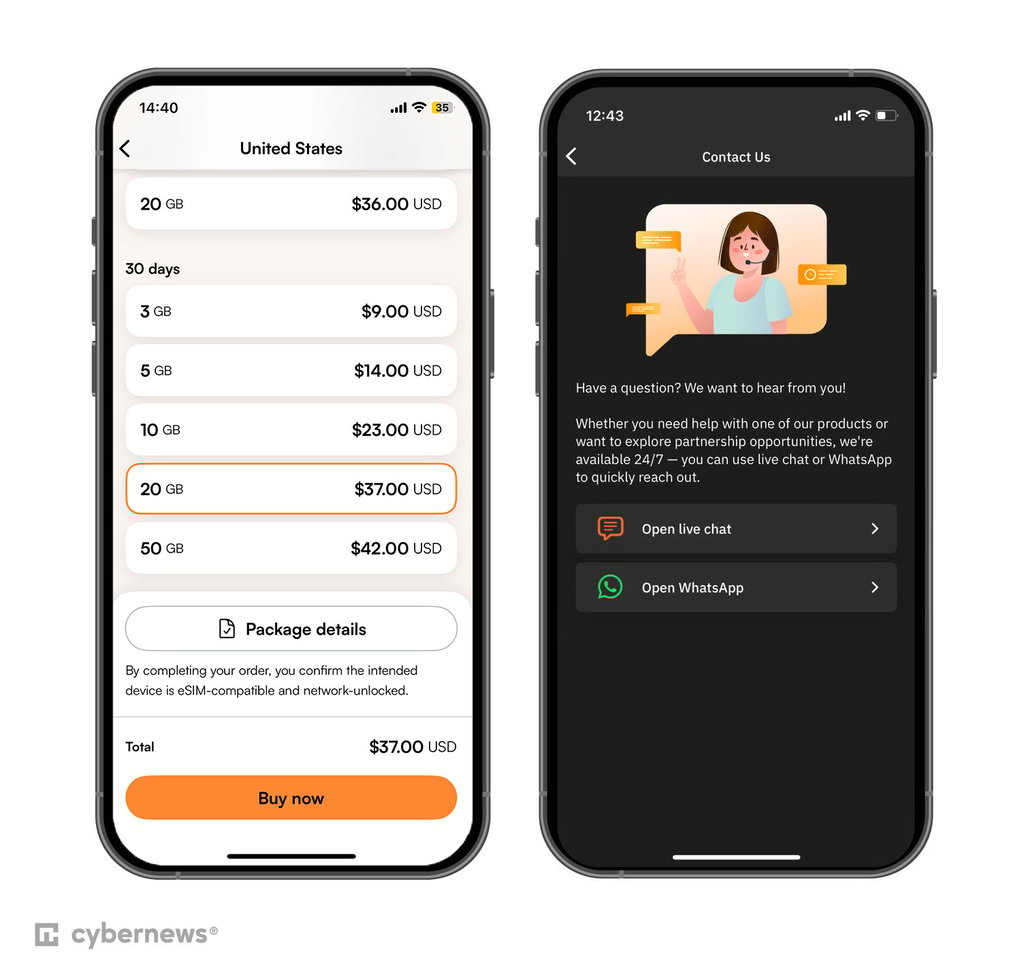
I found Airalo’s setup quick and beginner-friendly. I installed the eSIM through the app in just a few steps, and it activated automatically once I arrived. The app itself is clean and easy to navigate, so you can check your limits, top up, or switch plans without any confusion. For more insights, refer to our full Airalo review.
5. Nomad – travel eSIM with flexible data options

| Rating: | |
| Supports 5G networks: | ✅ Yes |
| Coverage: | Available in all 50 US states |
| Starting price: | $5.00 |
I feel that flexibility is often an underrated eSIM feature. With a flexible eSIM provider like Nomad, you can align your eSIM plan to your travel duration and needs, and actually save money. Unlike more rigid providers, it offers a wide range of short and long-term and unlimited data options, so you can scale your plan depending on whether you’re on a quick city break or a longer trip across multiple states.
At first glance, Nomad might seem like a premium option, with entry plans starting at around $5.00/GB for short durations. However, its mid-tier options are often more competitively priced than some budget-focused alternatives. Unlimited data plans are also available for heavier users, along with regional and global options for travelers crossing borders.
Nomad works with popular US network providers like T-Mobile and AT&T, so you can expect strong 4G and 5G performance in most cities and well-traveled routes. In my experience, speeds were consistently solid for navigation, streaming, and video calls, with only occasional dips in more remote or less populated areas.
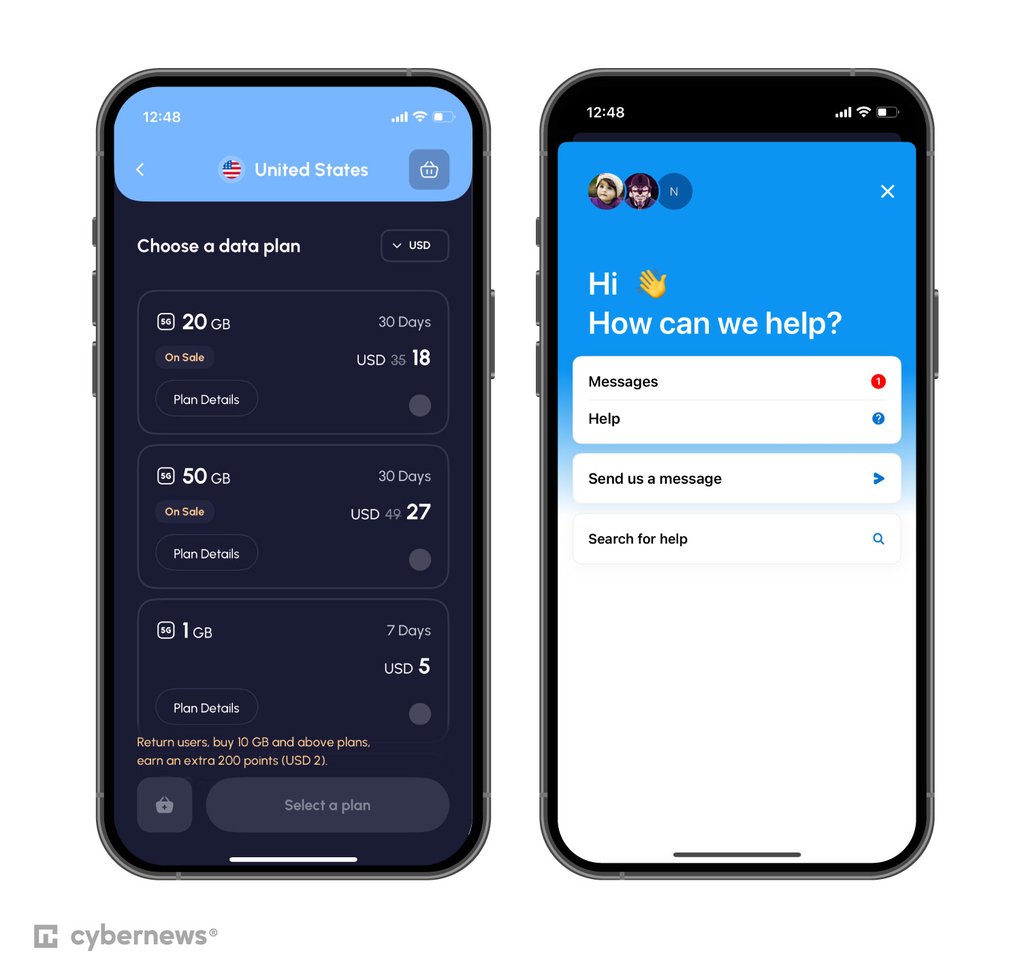
The setup is quick and straightforward, even for first-time users. The app guides you through purchasing and installing the eSIM in a few taps, and activation happens automatically once you arrive in the US. Managing data usage and switching plans is also simple, thanks to a clean and easy-to-navigate interface. Check out our full Nomad review.
6. aloSIM – US eSIM for texting and calling

| Rating: | |
| Supports 5G networks: | ✅ Yes |
| Coverage: | Available in all 50 US states |
| Starting price: | $4.50 |
If you’re an old-schooler like me and prefer calls and texts on your eSIM plan, check out aloSIM. This provider pairs data with a real phone number via its sister app, Hushed. So when you’re traveling in the US, you can easily send texts or make calls to order a taxi, make reservations, or share how your trip is going with friends.
aloSIM is competitively priced, with plans starting from around $4.50 per GB for 7 days. Mid-tier options range between $23.00 and $37.00, depending on duration and data allowance. Unlimited data plans are also available for heavier users, along with regional and global options for travelers crossing borders.
In terms of coverage, aloSIM runs primarily on T-Mobile’s network, delivering solid LTE and 5G performance in cities and suburban areas. In my experience, it handled everyday use like navigation, messaging, and streaming without issues, though speeds can slightly drop in more rural locations. Overall, connectivity remained stable for most travel scenarios.
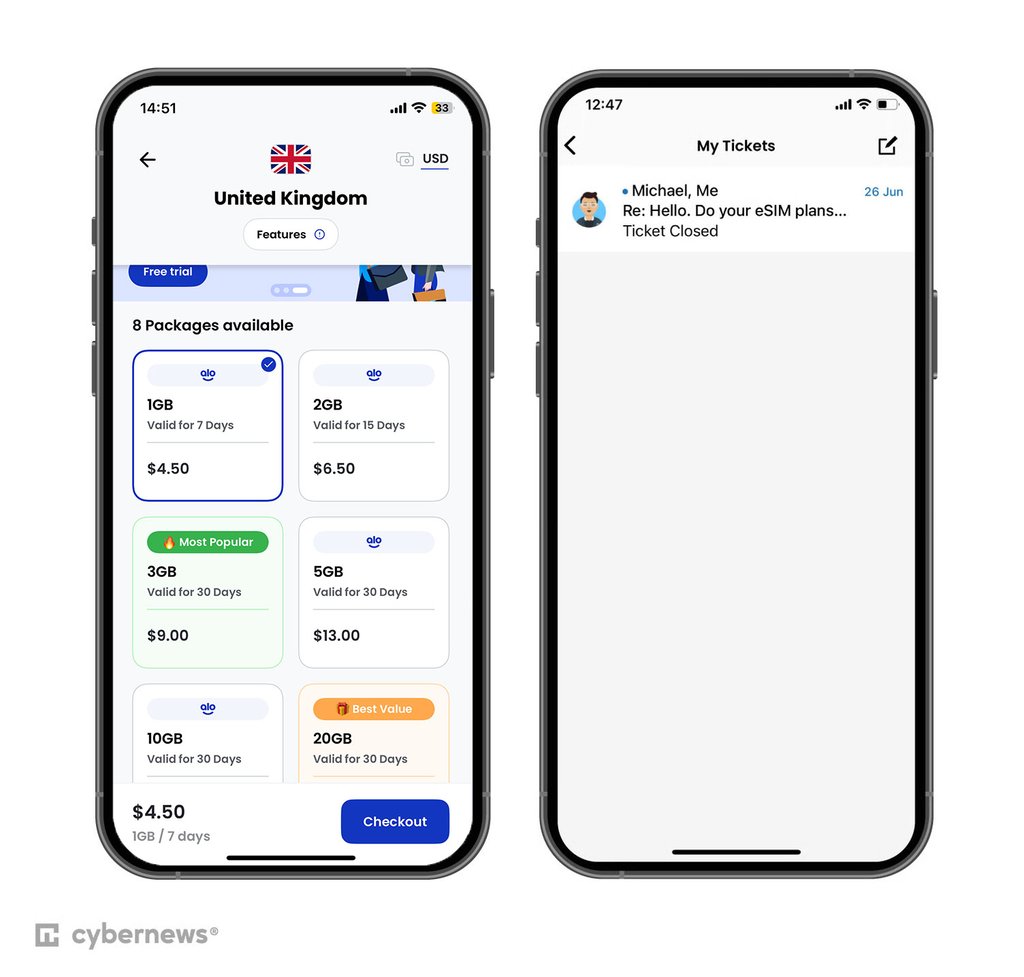
If you’re a first-time user, aloSIM makes it quick to get started. The app is clean and easy to use, with a simple setup process via QR code or automatic activation on newer devices. Managing your plan, tracking usage, and pairing with the Hushed app for calls and texts is all handled in one place. You can learn more about this provider on our full aloSIM review.
7. Holafly – best unlimited data eSIM for the USA

| Rating: | |
| Supports 5G networks: | ✅ Yes |
| Coverage: | Available in all 50 US states |
| Starting price: | $3.79 |
Holafly is best suited for heavy data users. Whether you’re working remotely or exploring a city with Google Maps, you won’t need to worry about tracking your usage since all of its plans come with unlimited data. Another thing I like is the flexibility – it offers plans ranging from 1 to 90 days, giving you plenty of options to choose from.
Compared to other providers on my list, Holafly sits in the mid-to-premium range, with pricing starting from around $3.00–4.00 per day. Short trips tend to be more cost-effective for a few days of unlimited data, while longer plans scale up based on validity rather than data volume. There are no fixed GB tiers, as all plans are built around unlimited usage for a set duration.
Holafly runs on two networks in the US – AT&T and T-Mobile – for stable 4G, LTE, and 5G speeds in most major cities and travel routes. During my experience in places like Miami, Orlando, and Houston, speeds were strong enough for streaming, navigation, and video calls. However, I did notice occasional slowdowns during peak hours and weaker signals in more remote or less populated areas.
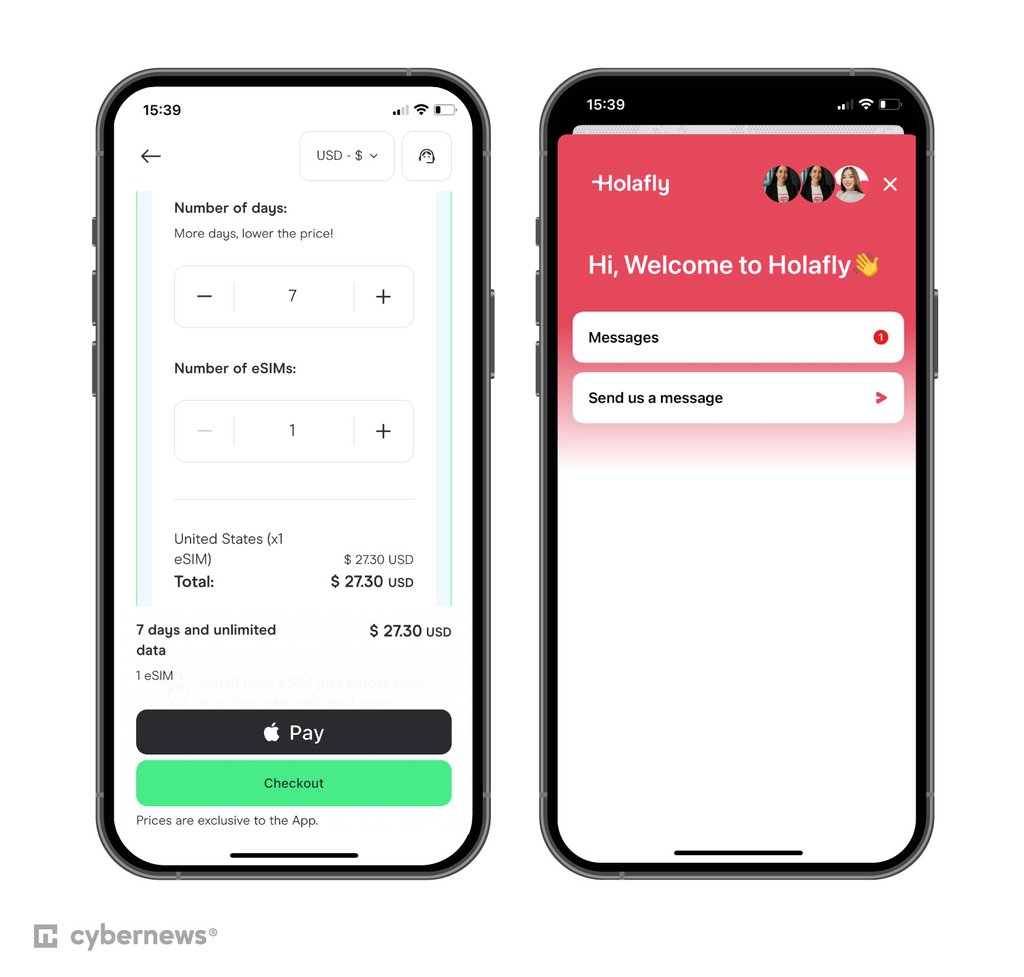
Like other providers on my list, Holafly has a quick and beginner-friendly setup. The installation process takes just a few steps via QR code, and activation happens automatically once you land in the US. Everything is managed through a simple flow without needing extra apps. For deeper insights, we have a full Holafly review.
8. Roamless – best pay-as-you-go eSIM for the USA

| Rating: | |
| Supports 5G networks: | ✅ Yes |
| Coverage: | Available in all 50 US states |
| Starting price: | $2.45 |
Roamless is a great choice if you want a pay-as-you-go eSIM that doesn’t lock you into fixed plans. What makes it different is its credit-based system – your data doesn’t expire, so you can use what you need and save the rest for future trips. I found it works best for short or occasional trips to the US.
Pricing is flexible and generally budget-friendly. You can start with a small credit and typically pay around $2.00–4.00 per GB, depending on the plan type, with larger bundles offering better value. Fixed 30-day plans are also available if you prefer a more traditional setup, but the main advantage is the no-expiry option, which sets it apart from most competitors.
Roamless collaborates with major US networks like AT&T and T-Mobile, so you can expect stable 4G and 5G speeds in cities and suburban areas. During my trip, it handled my everyday tasks like checking bus schedules, messaging, or watching Reels without issues, with automatic network switching to maintain a steady connection. As with most providers, performance can dip slightly in more remote regions.
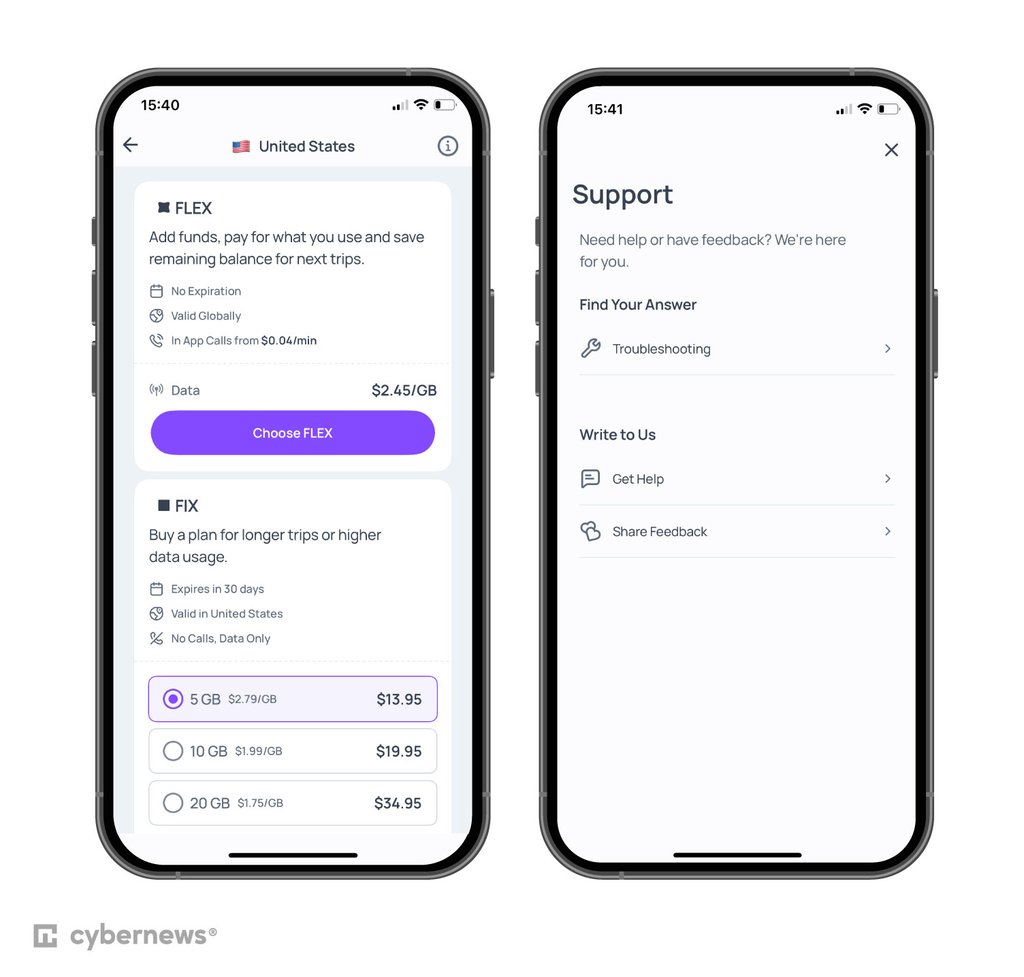
Roamless is pretty easy to set up via the app. Installation takes just a few steps, and once activated, the eSIM connects automatically when you arrive. The app makes it easy to track usage, top up credits, and manage your plan, which is especially convenient even if you’re a beginner. If you’d like to learn more about this provider, check out our Roamless review.
9. Instabridge – best free eSIM option for the USA

| Rating: | |
| Supports 5G networks: | ✅ Yes |
| Coverage: | Available in all 50 US states |
| Starting price: | $2.00 |
What I liked about Instabridge is definitely its affordability – you can get a few GBs for free with an ad-supported version or opt for a paid eSIM plan for merely $2.00/GB for 7 days. It’s built with budget travelers in mind, combining cheap data rates with extras like a Wi-Fi hotspot map and data-saving tools – features you don’t usually see at this price point.
Pricing sits firmly in the budget category. Plans typically start at around $2.00/GB for short durations, making it one of the cheapest options available, with mid-range bundles still priced competitively. You can choose between fixed plans and pay-as-you-go credits, but there are no unlimited options, so it’s better suited for light to moderate use.
Instabridge connects to multiple US carriers and automatically switches between them to maintain a stable signal. In my experience across cities like Chicago, Denver, and Atlanta, it delivered reliable 4G and 5G speeds for everyday tasks like maps, messaging, and browsing. Performance can drop in more rural areas, but overall stability is impressive for a lower-cost provider.
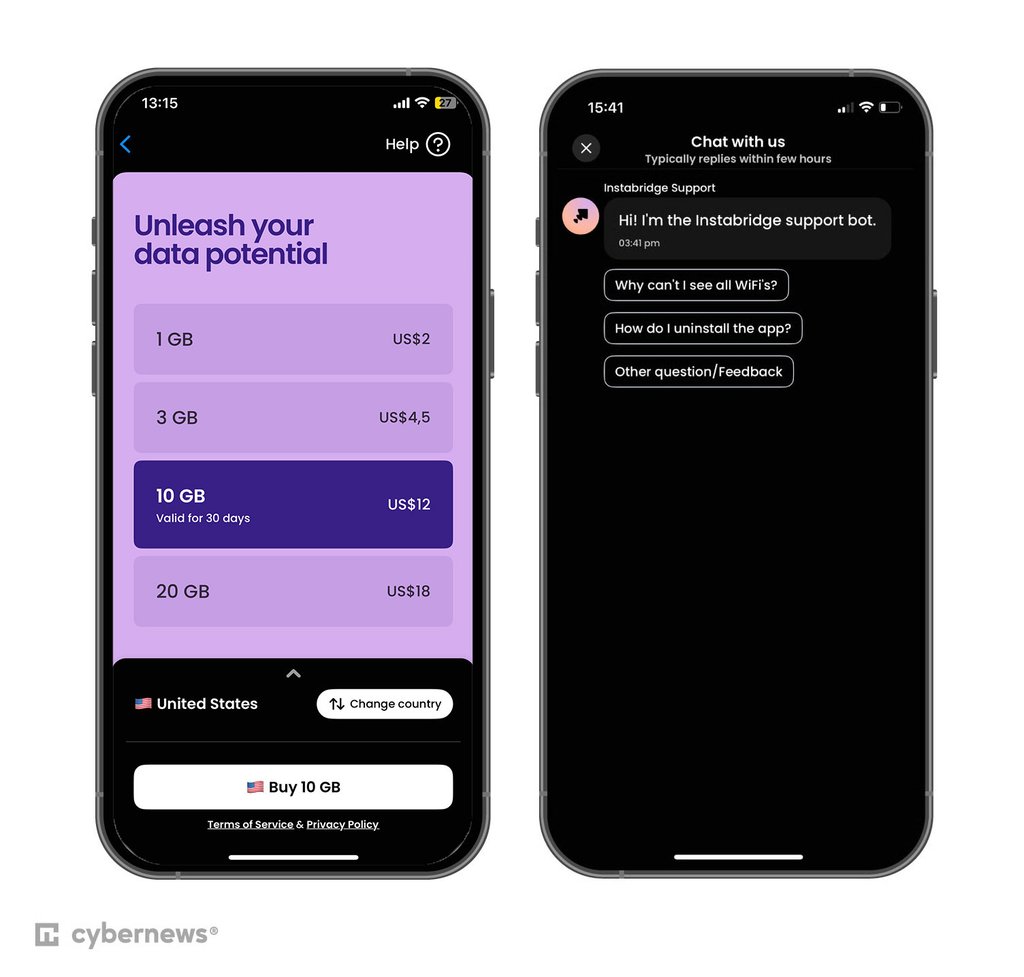
From my experience, I set up Instabridge eSIM in a few minutes via the app. Once activated, the eSIM works immediately. The app is clean and easy to navigate, making it simple to track usage or top up, with additional tools like its Wi-Fi map available if you want to stretch your data further.
Comparison of eSIMs for the USA
I compared the top eSIM providers side by side, focusing on what actually matters in real travel situations, so you can quickly see which one matches your travel style and keeps you reliably connected. Here’s how they stack up against each other:
| Provider | Rating | Starting price per GB | Availability in the US | Calls and texts | Networks | Compatibility |
| 1. Saily | $3.59 | Available in all US states, except Alaska | ✅ Yes | 3G, 4G, LTE, 5G | All iPhone and Android devices that support eSIM | |
| 2. Jetpac | $4.00 | Available in all 50 US states | ❌ No | 3G, 4G, LTE, 5G | All iPhone and Android devices that support eSIM | |
| 3. Ubigi | $2.90 | Available in all 50 US states and Puerto Rico | ❌ No | 3G, 4G, LTE, 5G | All iPhone and Android devices that support eSIM | |
| 4. Airalo | $4.00 | Available in all 50 US states and Puerto Rico | ✅ Yes, but only on its Global+ plan | 3G, 4G, LTE, 5G | All iPhone and Android devices that support eSIM | |
| 5. Nomad | $5.00 | Available in all 50 US states | ❌ No | 3G, 4G, LTE, 5G | All iPhone and Android devices that support eSIM | |
| 6. aloSIM | 4.3 | $4.50 | Available in all 50 US states | ✅ Yes, but on a sister app, Hushed | LTE, 3G, 4G, 5G | All iPhone and Android devices that support eSIM |
| 7. Holafly | 3.8 | $3.79 | Available in all 50 US states | ❌ No | 3G, 4G, LTE, 5G | All iPhone and Android devices that support eSIM |
| 8. Roamless | 4 | $2.45 | Available in all 50 US states | ✅ Yes, but only in-app calls | 3G, 4G, LTE, 5G | All iPhone and Android devices that support eSIM |
| 9. Instabridge | 3.9 | $2.00 | Available in all 50 US states | ❌ No | 3G, 4G, LTE, 5G | All iPhone and Android devices that support eSIM2 |

How to activate an eSIM on your phone
There are various ways to install and activate an eSIM. I’ll briefly highlight the options available to you below. However, I recommend consulting your eSIM provider’s website for a detailed guide on how to install and activate your eSIM.
Most eSIM providers direct users to scan a QR code to install their eSIM. The process is as straightforward as it sounds:
- Choose a data plan from a reliable eSIM provider – I recommend Saily, now with 10% OFF
- After purchase, you will receive a QR code and installation instructions via email
- Scan the QR code and follow the on-screen instructions
- Turn on data roaming
- Set the eSIM as your primary SIM – make sure it’s selected for mobile data (and calls/texts if supported)
You can also install and activate your eSIM using the app of your eSIM provider:
- Sign up and choose a plan that suits your needs
- Download and install the app
- Click Activate on the eSIM app
After installation and activation, you may be required to change some settings on your device.
While it is more elaborate than the other methods, manual eSIM installation is easy if you follow your eSIM provider’s instructions:
- Get a plan from the chosen provider’s app or website
- You’ll receive an eSIM activation code, along with the SM-DP+ address and other setup information
- If you're using an iPhone, head to Settings > Mobile Data and manually enter the eSIM information
- On Android devices, go to Settings > Network & Internet and select the option to add a new eSIM manually
Most eSIM providers include step-by-step setup instructions, so it’s best to follow their guide closely to avoid any hiccups during activation.
Which eSIM I’d choose for the USA
eSIMs have made staying connected in the US far more straightforward than relying on roaming or hunting for a physical SIM on arrival. You can land and get online within minutes, which makes a big difference when you’re navigating airports, ordering rides, or checking maps right away. When picking an eSIM, it really comes down to coverage, price, ease of setup, and any extra features like security or hotspot support.
For me, Saily stands out as the strongest all-around option for the US. Built with Nord Security’s backing, it combines reliable nationwide coverage with useful privacy tools like ad blocking, web protection, phone number for calls and SMS, and virtual location. The app is simple to use, activation is quick, and support is available whenever you need help.
Explore the best eSIMs by destination
- Best eSIMs for international travel: find best-value eSIMs for connectivity worldwide
- Best eSIMs for Canada: discover top-rated eSIM providers for traveling in Canada
- Best eSIMs for Mexico: explore the best eSIM options for travel in Mexico
- Best eSIMs for Europe: check the best eSIM providers for traveling across Europe
FAQ
Is it worth getting an eSIM for the USA?
Yes, getting an eSIM for the USA is worth it. It offers instant activation, helps you avoid expensive roaming fees, and ensures seamless connectivity across major cities and remote areas. Without the need for a physical SIM card, you can effortlessly switch plans and stay connected throughout your trip.
Which eSIM is best for the USA?
Saily is the best eSIM for the USA. It offers a range of short-term and long-term plans to suit different travelers. Saily's app is very easy to use and provides 24/7 customer support.
What is the cheapest eSIM card for the USA?
Instabridge is the cheapest eSIM for the USA, starting at $2.00. Saily is also a great-valued option that offers more features like 24/7 customer support, hotspot data sharing, and a user-friendly app, making it a solid choice for hassle-free connectivity throughout your trip.
Can I use 5G on a USA eSIM card?
Yes, most eSIMs support 5G in the US. However, support for 5G depends on your eSIM provider and location in the country. eSIM providers like Airalo support 5G in all 50 US states and Puerto Rico.