Best free antivirus software in 2026
Backed by leading cybersecurity experts and investigative journalists, we deliver independent, real-world antivirus testing and analysis, guaranteeing objective evaluations without undue influence or bias from outside parties.
Our transparent and consistent methodologies ensure objective, up-to-date reviews, empowering readers to make well-informed decisions.
Learn more

Windows Defender is free and comes pre-installed, but in our testing, dedicated free antivirus tools consistently do a much better job – Avast One detected 72% malware samples, whereas Microsoft Defender caught only 56%. The security gap is real, and closing it doesn't cost anything. Over 3 weeks, we stress-tested 20 free antivirus programs against 150+ malware samples, 25 phishing links, and 25 malicious URLs to find which ones are actually worth installing.
Top free antivirus programs that passed our tests
- Avast One – best cross-platform free antivirus
- Avira Free Security – best free local protection
- Bitdefender Free – best free Windows antivirus
- TotalAV – best for non-technical users
- Sophos Home Free – best free antivirus for families
- AVG Free – best free web protection
- Malwarebytes Free – best on-demand malware scans
- Microsoft Defender – best companion antivirus




Our team of researchers thoroughly tests antivirus software following a well-established testing process. In unison, our experts combine in-house and independent testing lab findings with first-hand experience to help you make informed decisions about each product. Learn how we test antivirus software.
Our methodology: testing free antivirus apps
We tested 20 antivirus programs as part of our research. After several months of testing, we can reveal that Avast One leads with a high real-time detection rate (68%), full-scan detection (72%), excellent web protection that caught 100% of phishing links, and a full suite of free features.

Ranking second in our tests, Avira Free Security showed a high real-time detection rate (84.67%) and full-scan detection rate (72%); however, its web protection isn’t included for free. Bitdefender recorded the highest scan detection rate (89.33%) and an 80% real-time detection rate, but it increased the device's boot time.
Other providers such as TotalAV, Sophos, AVG Antivirus, Malwarebytes, and Microsoft Defender showed weaker protection capabilities, especially in web protection tests. The full report with detailed results is available below, and you can access the complete testing spreadsheet here.
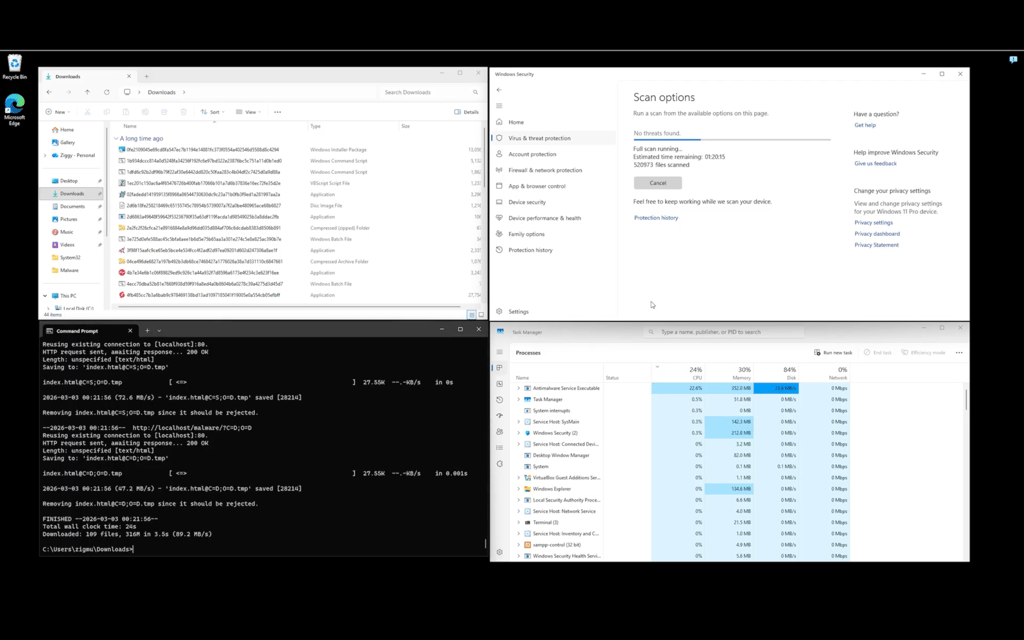
Each program was tested on a standard Windows 11 system without any other third-party antivirus software installed. For malware detection tests, we used over 150 malware samples from MalwareBazaar to test full-scan and real-time detection.
Web protection features were tested by opening 25 phishing URLs from PhishTank and 25 malicious URLs from URLhaus. Finally, for the performance impact tests, we measured changes in boot time, idle RAM usage, and scan time by comparing the results to the system baseline without antivirus software.
We calculated the final scores based on the following weighted criteria:
- 30% – system protection and malware detection
- 20% – web protection
- 20% – free feature set (availability of real-time protection, ransomware shield, firewall, and web filtering in the free tier)
- 15% – performance impact
- 15% – usability
Best free antivirus programs compared
Here’s a quick comparison table of the best free antivirus software, based on our internal test results:
| Rating | On-demand malware scan | Malicious URL blocking | Phishing protection | Real-time protection | Vulnerability scan | Firewall | |
| Avast One | ✅ Yes | ✅ Yes | ✅ Yes | ✅ Yes | ✅ Yes | ❌ No, only in the paid version | |
| Avira Free Security | ✅ Yes | ❌ No, only in the paid version | ❌ No, only in the paid version | ✅ Yes | ✅ Yes | ❌ No, only in the paid version | |
| Bitdefender Free | ✅ Yes | ✅ Yes | ✅ Yes | ✅ Yes | ✅ Yes | ❌ No, only in the paid version | |
| TotalAV | ✅ Yes | ✅ Yes | ✅ Yes | ❌ No, only in the paid version | ✅ Yes | ❌ No | |
| Sophos Home Free | ✅ Yes | ✅ Yes | ✅ Yes | ✅ Yes | ✅ Yes | ❌ No, as a separate product | |
| AVG Antivirus | ✅ Yes | ✅ Yes | ✅ Yes | ✅ Yes | ✅ Yes | ❌ No, only in the paid version | |
| Malwarebytes | ✅ Yes | ✅ Yes | ✅ Yes | ❌ No, only in the paid version | ✅ Yes | ❌ No, only in the paid version | |
| Microsoft Defender | ✅ Yes | ✅ Yes | ✅ Yes | ✅ Yes | ✅ Yes | ✅ Yes |
Recent Updates
The best free antivirus programs for 2026
The Cybernews research team tested 20 antivirus programs to find the top 8, so you can choose the one that best suits your browsing habits and privacy preferences.
1. Avast One – overall best cross-platform antivirus
| Rating: | |
| Free features: | Malware protection, scam detection, Wi-FI vulnerability scanner, and password manager |
| Platforms: | Windows, Mac, Linux, Android, iOS |
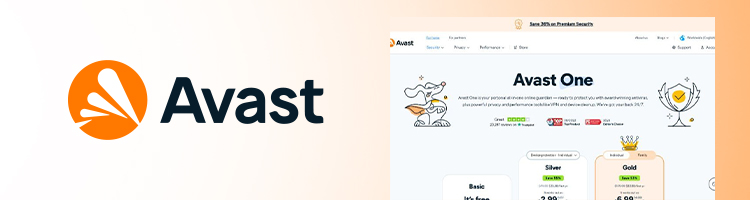
Among the free antivirus programs we tested in-house, Avast One offers the best overall security protection suite. It achieved 72% in scan detection and 68% in real-time detection. Plus, its free features are usable across Windows and macOS devices.
In our in-house tests, Avast One showed near-perfect web protection scores – it blocked 100% of phishing URLs and 84% of malicious URLs. This is significantly better than Windows Defender (4% for phishing URLs and 0% for malicious URLs). Independent tests by AV-Test also confirm its strong protection capabilities, ranking Avast 6/6 across protection, performance, and usability.

Avast One’s free features include:
- Real-time protection against malware, including ransomware and viruses
- Online scam detector
- Wi-Fi security scanner
- Password manager
Overall, the boot time of our test device increased by only 27s over the baseline, so you won’t even notice it when turning on your computer. The idle RAM usage sat at 60% – while it’s on a higher side, it shouldn’t affect the performance if your system has at least 16GB of RAM.
Who it’s for
Avast One is equally perfect for Windows and Mac users who want premium protection against viruses, ransomware, and other types of malware for free.
2. Avira Free Security – best for free local protection

| Rating: | |
| Free features: | Real-time protection, an on-demand virus scanner, a password manager, and a software updater for Windows |
| Platforms: | Windows, macOS, Android, iOS |
Avira Free Security comes second, scoring 72% in full-scan detection and 84.67% in real-time detection in our in-house tests, which is one of the best among all free antivirus tools tested.
It only comes second, as the free version doesn’t include web protection. However, Avira’s paid plan detected 92% of phishing links and 100% of malicious links – even though these are wonderful scores, Avast One shows similar results while being completely free.
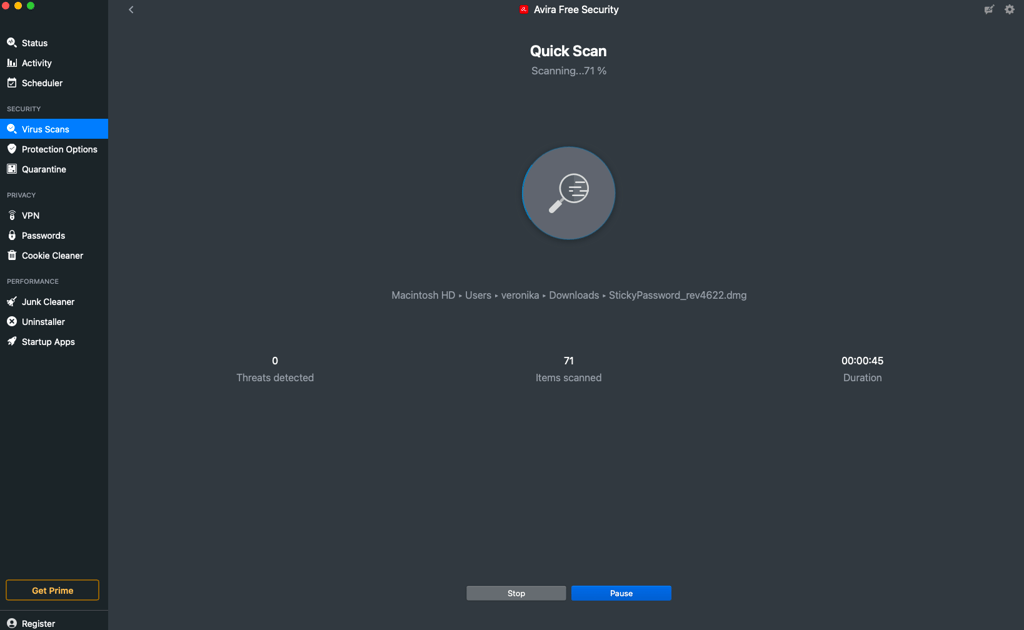
Here’s what you get for free in Avira Free Security:
- Real-time protection against viruses and malware
- Manual virus scanner
- Free VPN for 1 month
- Password manager
- Software updater for Windows to reduce vulnerability
Avira Free Security barely affected system performance: the boot time increased by only 26s, while the idle RAM usage remained at 49%. It means that the Avira Free Security won't bog down your device during daily tasks, regardless of your system RAM.
Who it’s for
Avira Free Security is best for those who primarily use their Mac and Windows computers for offline tasks or locally stored files and want a minimalist shield without the heavy background processing.
3. Bitdefender Antivirus Free – best free antivirus for Windows

| Rating: | |
| Free features: | Real-time protection against ransomware and other types of malware, web protection, and VPN with 200MB/day |
| Platforms: | Windows |
Bitdefender Free is one of the most reliable, set-it-and-forget-it security solutions with truly premium-grade protection and no pop-ups pushing you to buy premium features. This is fully supported by our test results, where it achieved 89.33% in full-scan detection and 80% in real-time detection.
We tested that Bitdefender Free caught 48% of phishing links and 96% of malicious links, which is a bit lower than Avast One but still better than Microsoft Defender (4% for phishing URLs and 0% for malicious URLs) and TotalAV (28% for phishing URLs and 12% for malicious URLs). Overall, our tests show that Bitdefender Free is extremely effective at blocking dangerous downloads, even if its ability to spot fake websites is only average.
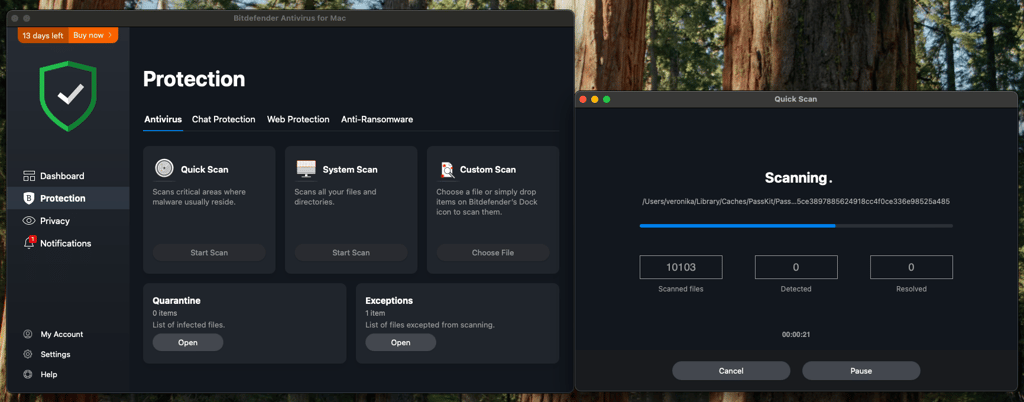
Here are the free features of Bitdefender Free:
- Basic real-time protection against ransomware, viruses, and other malware
- Web protection for phishing and malicious links
- VPN with up to 200MB of free traffic per day per device
This is why Bitdefender Free comes third: the boot time has increased by 102s, which is a noticeable difference. On the plus side, once it was downloaded, the idle RAM usage didn’t exceed 47%, which means it won’t drain your memory during heavy multitasking or gaming.
Who it’s for
Bitdefender Free is best for Windows users looking for low-maintenance, reliable protection. Premium plans start at $12.99/year and support macOS, iOS, and Android devices.
4. TotalAV – best free antivirus for non-technical users

| Rating: | |
| Free features: | Manual malware scanner and basic web protection |
| Platforms: | Windows, macOS, iOS, Android |
TotalAV Free is a basic, user-friendly antivirus that acts as an on-demand vulnerability scanner, though without real-time protection. In our in-house tests, it achieved 66% in full-scan detection rates, while AV-Test gives it the perfect 6/6 rating for protection, performance, and usability.
TotalAV Free’s WebShield identified 28% phishing links and 12% malicious links, which are quite low scores for comprehensive web protection. However, the results are still better than Microsoft Defender (4% for phishing URLs and 0% for malicious URLs).
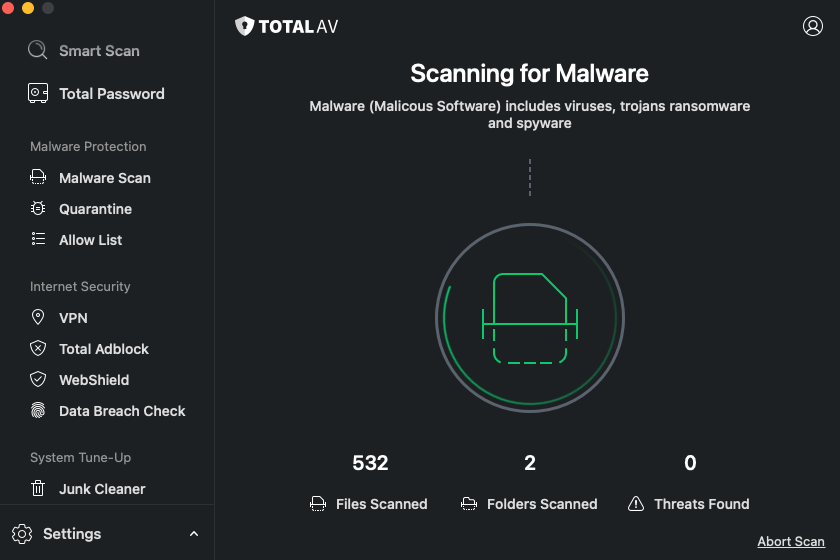
TotalAV offers the following free features:
- Manual malware scans
- Limited access to WebShield for web protection
- Junk cleaner
TotalAV added 27s to our testing device’s boot time, while its idle RAM usage reached 53%. While these are decent results, given its limited feature set, it could run much lighter.
Who it’s for
TotalAV can be a good fit for non-technical users who want a simple, visually appealing malware scanner to manually check for basic threats and clear out system junk, rather than an active, everyday shield.
5. Sophos Home Free – best for families

| Rating: | |
| Free features: | On-demand scanner, real-time protection, web protection, and parental web filtering |
| Platforms: | Windows, Mac, Android, iOS |
Sophos Home Free is a decent household antivirus that provides a moderate baseline for security. It scored 68% in real-time protection and 72% in full-scan detection, which means it misses more malware than top-rated alternatives.
Its web protection turned out to be weak – it caught only 16% of phishing links and 8% of malicious links. So, Sophos Home isn’t the best option for actively blocking dangerous downloads or protecting you from scams.
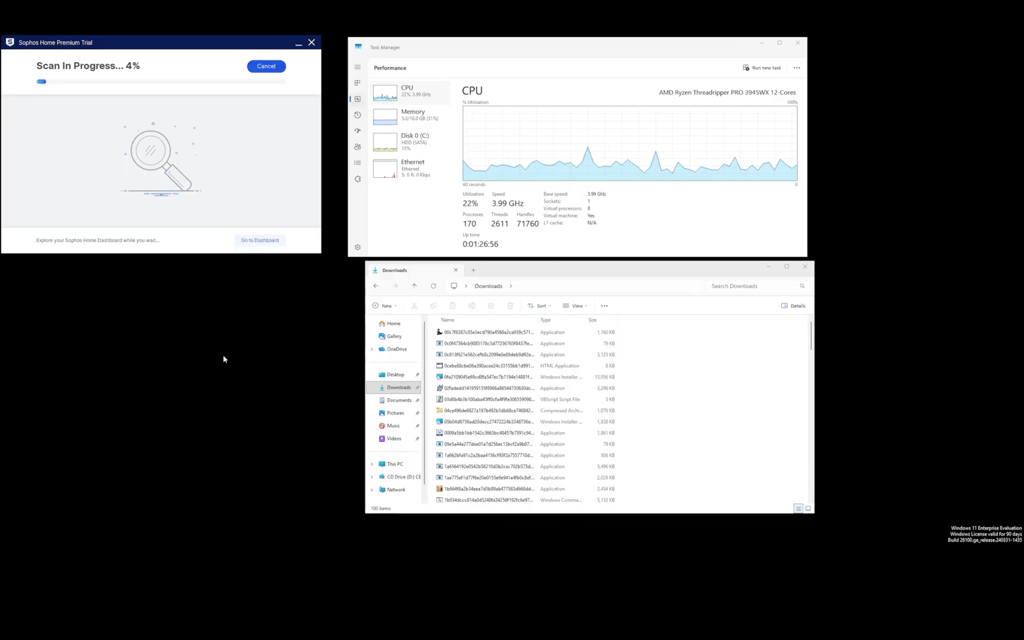
Regarding system impact, our computer’s boot time increased by 37s, while the idle RAM usage stayed at 40% with Sophos Home running. From our experience, it’s a typical performance footprint, and the tool won't cause major lag during standard daily tasks.
Here are the free features of Sophos Home Free:
- On-demand and real-time protection against malware, including ransomware and spyware
- Web protection features
- Parental web filtering
While these features are free for 30 days, you can then consider Sophos Free Firewall Home Edition – it’s a completely free network-level firewall that has all the features above and protects every device in your home with no time limits; however, it requires a separate computer to run.
Who it’s for
Sophos Home Free is for users looking for basic local malware protection, including built-in parental web filtering for a household, provided you already have safe browsing habits to compensate for its poor malicious link detection.
6. AVG Antivirus – best for free web protection

| Rating: | |
| Free features: | Real-time and manual system protection, web protection, PC performance scans, and real-time security updates |
| Platforms: | Windows, macOS, iOS, Android |
AVG Antivirus Free is a useful free web browsing safety net against dangerous file downloads. In our testing, AVG struggled against offline threats, achieving only 37.33% in full-scan detection and 32.66% in real-time detection.
However, it showed surprising strength online. Its web protection successfully identified 48% of phishing links and 92% of malicious links. This means that while it provides only average protection against fake login pages, it’s highly effective at stopping you from accidentally downloading malware from shady websites.
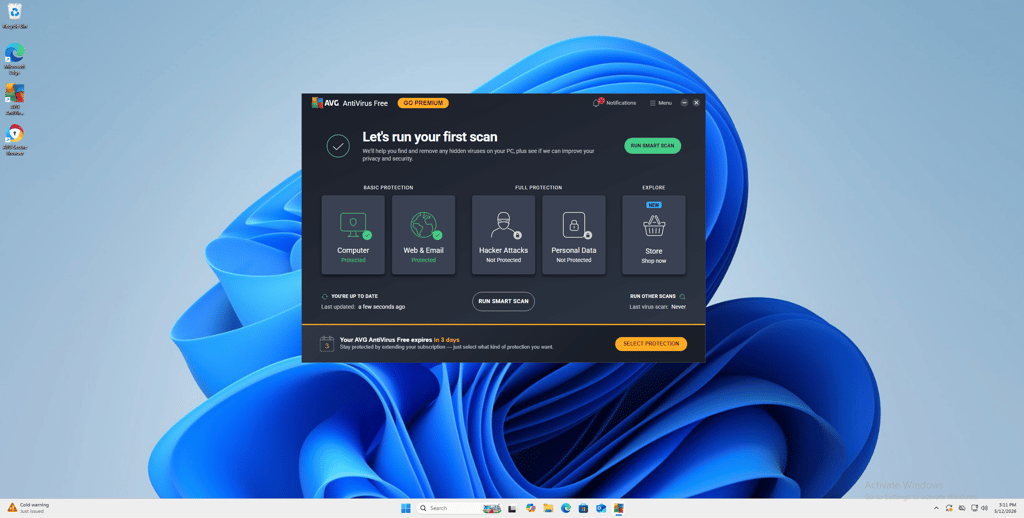
The free features by AVG Antivirus include:
- Real-time and manual system checks for various types of malware, including ransomware, viruses, and spyware
- Web protection for malicious and phishing links and email attachments
- Computer performance scans
- Real-time security updates
In terms of system impact, AVG added a minimal 26s to boot time, but 50% of overall RAM was occupied while it ran in the background. It may lead to lags for memory-intensive tasks like gaming and video editing, but it won’t impact standard, daily operations.
Who it’s for
AVG Free provides excellent protection for users who mainly work in a browser and whose primary concern is downloading a virus from a bad link.
7. Malwarebytes Free – best free on-demand scans

| Rating: | |
| Free features: | Manual malware scanner and browser extension for web protection |
| Platforms: | Windows, Android, macOS, ChromeOS, iOS |
Malwarebytes is a decent on-demand malware scanner, achieving 59% full-scan detection rate in our in-house tests, though it offers no real-time protection for free.
When we tested Malwarebytes web protection, it caught 20% of phishing links and a notable 80% of malicious links, which is similar to AVG Antivirus results. This shows Malwarebytes’ high effectiveness at blocking dangerous downloads, while spotting credential-stealing scams may be its weakness.
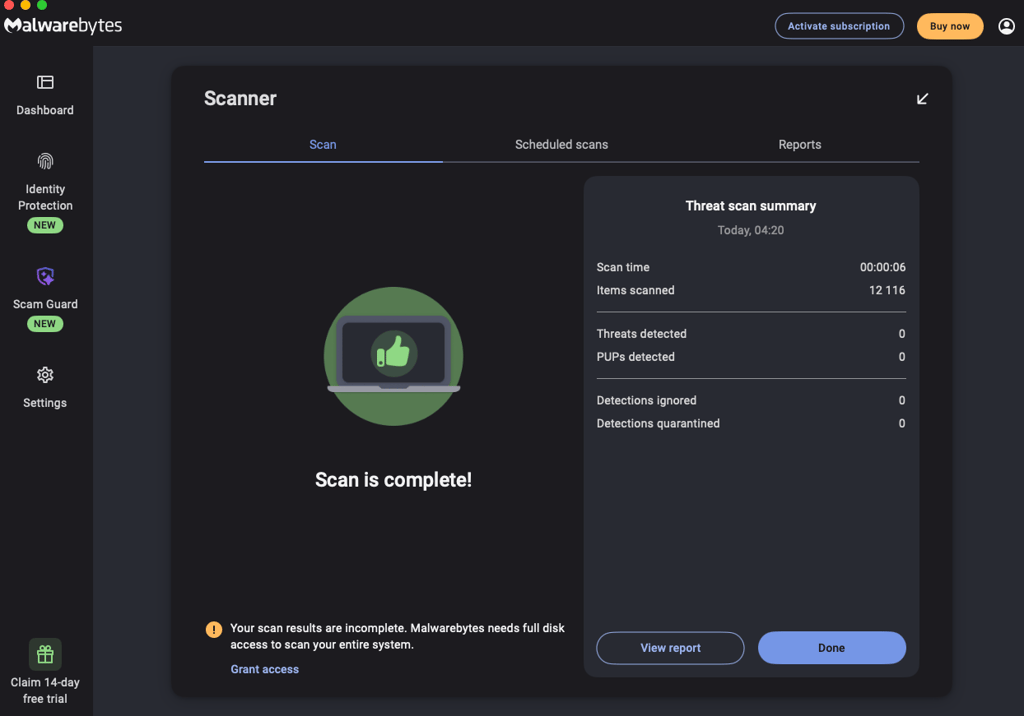
Here’s what is included for free in Malwarebytes:
- Manual system scan for malware
- Web protection via a browser extension
What’s great about Malwarebytes is its lowest impact on the device, just what I expect from a lightweight, on-demand antivirus. Our measurements showed a 17s-boot time increase and 38% of idle RAM usage with the antivirus on – these are the best results among all free antivirus providers on my list.
Who it’s for
Malwarebytes is best for users looking for a highly efficient, lightweight scanner to run alongside a primary antivirus like Microsoft Defender. Because it operates entirely on demand and boasts the lowest system impact on the list, it won't conflict with your main security software.
8. Microsoft Defender – free companion antivirus for Windows
| Rating: | |
| Free features: | Firewall, real-time protection, web protection, and parental controls |
| Platforms: | Windows |
Microsoft Defender is a built-in, free antivirus for Windows that serves as an easy starting point to protect your device. Our in-house tests show it’s better suited as a baseline to complement other free tools since it achieved a 56% full-scan detection rate and an exceptionally low 8.67% real-time protection rate.
We found that Microsoft Defender’s web protection is lacking, too. It identified only 4% of malicious links and 0% of phishing links.
This is what Microsoft Defender offers for free:
- Strong firewall to monitor network traffic and not let unauthorized programs remotely sneak into your computer
- Real-time protection against malware, including ransomware
- Basic parental controls and family safety options
- Web protection against malicious and phishing links
Since Microsoft Defender is built in, it has a very low impact on the system. Our test device’s boot time didn’t change, while the idle RAM usage remained at 37%. Overall, Microsoft Defender works imperceptibly to a user and, most importantly, without the constant pop-ups and upsells that other free tools display.
Who’s it for?
Microsoft Defender is best for users with pristine browsing habits who want an entirely invisible, zero-maintenance antivirus. Also, it’s a perfect security foundation when paired with an on-demand scanner like Malwarebytes Free or Avast One to cover its blind spots.
Which free antivirus programs should you avoid?
While there are several reputable free antivirus programs available, users should be cautious and avoid certain well-known options due to various concerns.
First, avoid Kaspersky, as the US government has officially banned the sale and updates of its software due to national security concerns. Because it can no longer receive critical threat updates in the US, it’s no longer a safe option for protecting your devices.
You should also be skeptical of unverified free security apps, especially those promoted by aggressive pop-ups that claim your computer is already infected. Cybercriminals often design these fake ads to trick you into downloading actual malware or handing over your credit card information.
Then, it’s best to avoid obscure free antiviruses that lack recent, verifiable scores from independent testing labs like AV-Test or AV-Comparatives. Many of these tools offer no actual protection, while others exist just to gather and sell your private browsing data.
You should look for reliable alternatives like Avast One, Avira, or Windows Defender to ensure comprehensive and trustworthy security. Read more on how to choose free antivirus.
Free antivirus vs paid antivirus
While free antivirus software can protect from known malware threats, a paid antivirus is better equipped to detect and remove new, zero-day threats.
| Features and functionalities | Free version | Premium version |
| Real-time protection | ❌ Mostly unavailable | ✅ Available |
| Web protection | ❌ Mostly unavailable | ✅ Available |
| Built-in VPN | ❌ Mostly unavailable | ✅ Mostly available |
| Operating systems | Windows, macOS, Android, iOS | All available OS and browser extensions |
There are good free antiviruses like Bitdefender, Avast One, and Avira that use advanced technologies to protect you from malicious web threats and include real-time protection against ransomware. If chosen wisely, a reputable free provider can absolutely do the job for an average user.
However, free antiviruses are almost always licensed strictly for personal, non-commercial use. If you use your device for freelancing or business, you’re legally required by the software's terms of service to buy a commercial or premium tier.
Beyond licensing, paid tools offer continuous, multi-layered protection from online threats and bundle in valuable extras that boost your overall online safety. For example, they often include VPNs with unlimited data, password managers, and advanced browser extensions that are incredibly useful for both beginners and advanced users.
So, consider upgrading to a paid antivirus if you use your computer for work, handle highly sensitive financial data, often connect to public Wi-Fi, or need an unlimited VPN. Also, it’s worth switching to a paid plan if you want to get an all-in-one security suite (instead of juggling a few tools) and to get rid of the constant ads and pop-ups that free antiviruses display.
Do I need antivirus software if I have a Windows Defender?
Yes, even though you have Windows Defender built into your computer, we still recommend using third-party antivirus software. Windows Defender is a pre-installed antivirus software that offers only basic malware protection, unlike free antivirus software. While Windows Defender provides a lightweight solution and integrates well with Windows devices, it’s highly recommended to use antivirus software for extra protection.
The limitations of Windows Defender include its basic feature set, vulnerability to zero-day attacks, limited customizability, lower malware detection rates compared to third-party options, and the lack of additional security layers.
Meanwhile, antivirus software providers are more versatile and secure than free antivirus providers. Paid programs offer advanced features, better protection against emerging threats, malicious threats, or malicious software, customization options, and additional security layers like firewalls and secure browsing. However, free antivirus software lacks versatile features, but still adds an additional layer of security to your Windows device.
Choosing between Windows Defender and antivirus software depends on personal preferences and the desired level of security. While Windows Defender suits most users, those seeking advanced features or enhanced protection may benefit from using additional antivirus software.
Video review: best free antivirus in 2026
Take a look at the video guide where we explain and show the pros and cons of each free antivirus software:
Is it worth paying for an antivirus?
Yes, paying for an antivirus tool is worth it if you need a comprehensive security suite with local and online protection. As our in-house tests revealed, many free antivirus programs struggle with web protection or lack essential web filtering features.
Premium antivirus programs close these gaps by offering advanced, real-time anti-phishing protection, along with unlimited VPNs, identity theft monitoring, password managers, and other useful extras. Moreover, they often offer 24/7 customer support, while free tools tend to force you to deal with issues on your own by searching online forums and FAQs.
So, if you want to fully cover the protection weaknesses we found in the free antivirus tools, upgrading to a premium security suite of Avast, Avira, or Bitdefender is the most reliable way to guarantee your safety.
FAQ
Is it safe to use a free antivirus?
Yes, it's safe to use a free antivirus if you're sticking with respectable antivirus suite providers. Usually, it will just be a bit limited when compared to the paid version, but you'll feel safe using it.
What's the best free antivirus program?
Avast One is the best free antivirus program, as it demonstrated near-perfect web defense in our tests, catching 100% of phishing links and 84% of malicious URLs. Combined with solid local security (a 72% full-scan detection rate and 68% real-time protection) and a generous range of free features, it’s the most comprehensive free choice.
Does free antivirus really work?
Free antivirus software can effectively protect your computer against certain types of malware, but it often lacks comprehensive coverage. While these programs typically offer basic features like virus scanning and removal, they may not include advanced functionalities such as real-time protection or additional security tools.
Does free antivirus slow down the computer?
Yes, free antivirus software can slow down your computer. This slowdown is typically due to the resources required for real-time scanning and other protective measures. However, the performance impact varies by program, with some free antiviruses being more resource-efficient than others.
Is Windows Defender enough?
Yes, Windows Defender can be good enough as a baseline for the average user. Even though independent labs rate it 6/6 for protection, performance, and usability, our in-house tests found that it struggled with our threat samples. It scored low on scan detection (56%), real-time protection (8.67%), and overall web defense (caught 4% of phishing URLs and 0% of malicious links).