NordVPN vs Proton VPN comparison (2026)
Our in-house cybersecurity experts and journalists, renowned for major reports like The Mother of All Breaches, conduct transparent, unbiased VPN testing and in-depth analysis.
With 750+ articles crafted based on real-world research, we empower readers to make informed purchasing decisions through first-hand expertise.
Learn more

-
NordVPN came out on top for everyday performance. It pairs fast speeds with a richer feature set and solid streaming support, making it the more complete package for most users.
-
Proton VPN is the stronger pick for privacy-focused users. The provider offers fully open-source apps, a Swiss-based jurisdiction, and a transparent no-logs track record, along with solid speeds and a functional free version.
I spent a week putting NordVPN and Proton VPN through the exact same tests, side by side, to see which one actually holds up once you look past the marketing. This means the same connection, the same servers, the same streaming platforms, and the same torrent tests. If one provider could consistently deliver better speeds, stronger streaming access, or more reliable privacy, it would show up in the results. And it did.
NordVPN is better in the areas most people care about day-to-day: speed, streaming, torrenting, and a more complete feature set. Proton VPN's strength is in privacy and transparency, backed by a spotless legal track record and apps you can actually inspect yourself. While this focus might seem narrow, it brings a real difference for users whose main concern is privacy.
Still, both are excellent VPNs, so here’s what my NordVPN vs Proton VPN comparison for 2026 is really about: not which one is objectively better, but which one is the right one for you.
Key differences between NordVPN and Proton VPN
Both NordVPN and Proton VPN are excellent choices, but if you prioritize speed and features, NordVPN comes out ahead as the best VPN for overall performance. It’s noticeably faster on long-distance servers, more reliable for streaming and torrenting, and bundles in extra tools like Meshnet and a next-gen antivirus. Proton VPN, though, is the better pick if privacy is your main priority. It’s based in Switzerland, keeps its apps fully open-source, and has a clean track record of standing up to real legal requests without handing over user data.
| Category | NordVPN | Proton VPN |
| Price from | $3.49/month | $2.99/month |
| Server countries/locations | 225 locations | 149 countries |
| Simultaneous connections | 10 | 10 |
| Jurisdiction | Panama | Switzerland |
| Standout tools | Next-gen antivirus, Meshnet, dedicated IP addresses and servers, Dark Web Monitor | Secure Core, NetShield, open-source apps, Proton Sentinel |
| Best for | Top performance overall, reliable streaming, and all-around feature set | Privacy, transparency, and a usable free plan |
Choose NordVPN if:
- You want the fastest connection speeds and streaming that just works. In my NordVPN testing, it was consistently the fastest, even on long-distance servers. It also proved more reliable for streaming: Netflix, Disney+, and BBC iPlayer all unblocked on the first try with no buffering.
- You want more built-in security and convenience tools. NordVPN’s next-gen antivirus has independent phishing-detection certifications, and its unique Meshnet feature lets you privately network your own devices – extras Proton doesn’t have equivalents for.
- You want a more consistent experience across devices. NordVPN's apps look and behave the same on major platforms, so there's no need to relearn the interface when switching between platforms.
Choose Proton VPN if:
- Privacy and transparency are your non-negotiables. Proton is based in Switzerland, publishes its full third-party audit reports openly, and has denied all 458 legally binding data requests it’s received since 2017 – a cleaner record than NordVPN’s.
- You want a free plan you can actually rely on. Proton’s free tier has no ads, doesn’t sell your data, and works fine for everyday browsing as opposed to NordVPN’s 3-day free trial.
- You want to verify privacy claims yourself. Every Proton VPN app is fully open-source, so anyone can inspect what the software is actually doing.
Pricing and plans: winner Proton VPN
Proton VPN is more affordable than NordVPN at almost every tier and offers a usable free version. You can see the price difference from how each provider structures its plans. Here’s a quick overview of NordVPN’s pricing structure:
| Plan duration | NordVPN Basic | NordVPN Complete | NordVPN Prime |
| 1 month | $14.99/month | $19.99/month | $29.99/month |
| 1 year | $5.49/month | $6.49/month | $9.49/month |
| 2 years | $3.49/month | $4.49/month | $7.49/month |
And here’s how Proton VPN subscriptions compare:
| Plan duration | Proton Free | VPN Plus | Proton Unlimited |
| 1 month | $0.00/month | $9.99/month | $12.99/month |
| 1 year | $0.00/month | $3.99/month | $9.99/month |
| 2 years | $0.00/month | $2.99/month | $7.99/month |
As you can see, for basic VPN functionality on entry-level plans, Proton VPN is cheaper. By upgrading from Proton Plus to Unlimited, you unlock the entire Proton ecosystem at once, with Proton Mail, Drive, Calendar, and Pass included for $7.99/month. While this sounds like a great deal, consider that going from NordVPN’s Basic plan to Complete costs only $4.49/month, and with that you get access to NordPass (password manager), next-gen antivirus, and 1TB cloud storage – essentially an all-in-one digital security suite.
However, given that in both cases the best prices are only available with 2-year subscriptions, it’s important to review renewals before you commit. With NordVPN’s Basic plan, you’ll pay $94.23 upfront for a 2-year plan, which then renews at $139.08/year. At the same time, Proton Plus will cost you $71.76 upfront for the first 24 months and renew at $83.88/year. That’s $55.00 less annually.
Both NordVPN and Proton VPN offer a 30-day money-back guarantee, so overall, you can test either risk-free. What’s different is that NordVPN backs this up with only a 3-day free trial (which you need to register for using an Android device, although that same account you can later use on other platforms), and Proton VPN skips the trial altogether in favor of a free tier you can stay on indefinitely.
Both providers also accept cryptocurrency payments if you'd rather not use a card.
Proton VPN free plan
Proton VPN is the only provider with a free version out there I’m comfortable recommending, because it doesn’t sell your data, doesn’t insert ads, and still gives you real VPN protection with unlimited bandwidth. I found the Proton Free plan to be usable for everyday browsing, coffee-shop Wi-Fi, and basic privacy needs, as it runs on the same no-logs policy and WireGuard-based protocol as the paid plans.
Nonetheless, it’s not a full substitute for Proton VPN’s paid experience. For one, servers are limited to 10 locations only and are assigned randomly, meaning you cannot connect to a specific city or reach the full network. Moreover, if you’d like to switch servers, expect a cooldown period after each server change (45 seconds after the first change and 10 minutes after each subsequent change). In addition, with Proton VPN’s free version, you’re limited to 1 device at a time and have no access to specialty servers.

Streaming: winner NordVPN
NordVPN gave me a smooth streaming experience everywhere I tested, while Proton VPN wasn’t as reliable around live content specifically. Still, both NordVPN and Proton VPN unblocked the same major streaming platforms in my tests, so whether you can get around geo-restrictions with these providers isn’t really the issue. The real question is whether the streams hold up while you’re watching.
Here’s a quick overview of platforms and libraries I’ve tested for this Proton vs NordVPN comparison:
| Platform | NordVPN | Proton VPN |
| Netflix | ✅ Yes (US, UK, Canada, Japan, Australia) | ✅ Yes (US, UK, Canada, Japan, Australia) |
| Disney+ | ✅ Yes (US) | ✅ Yes (US) |
| BBC iPlayer | ✅ Yes (UK) | ✅ Yes (UK) |
| Amazon Prime Video | ✅ Yes (Germany) | ✅ Yes (Germany) |
| Hulu | ✅ Yes (US) | ✅ Yes (US) |
| Sling | ✅ Yes (US) | ✅ Yes (US) |
| ESPN | ✅ Yes (US) | ⚠️ Live streams blocked (error code 83) |
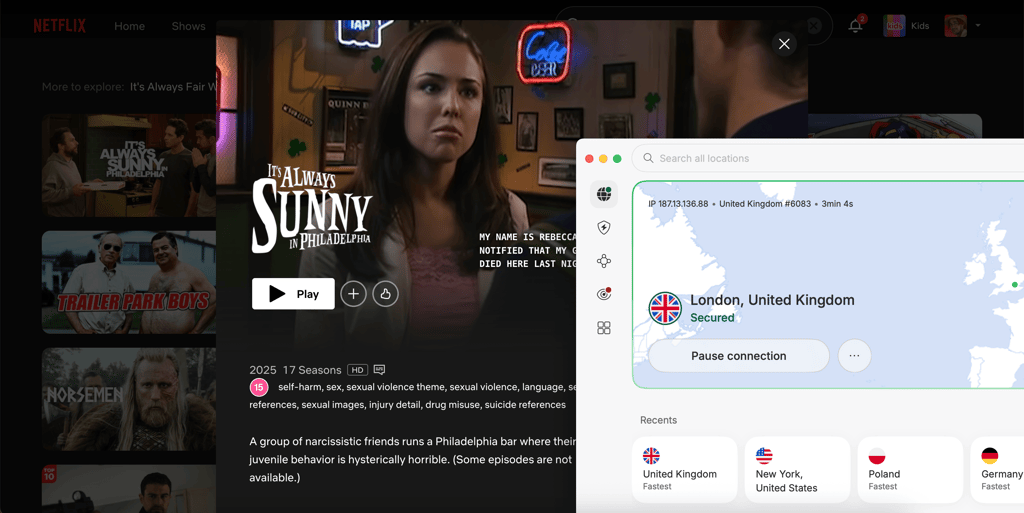
With NordVPN, I changed my location to London, the UK, and streamed It's Always Sunny in Philadelphia, which isn’t on my local Netflix library, and it played without a single buffer or quality drop. Netflix recommends around 5Mbps for HD, and with 90% download retention on the London server, NordVPN held well above that, with playback starting within seconds. I saw the same result switching between Disney+, Amazon Prime Video, and all the other platforms I tried: no blocks, no throttling, nothing that gave away I was on a VPN. And I didn’t have to switch servers once – NordVPN unblocked everything on the first try.
Proton VPN matched NordVPN’s performance almost everywhere, with Netflix, BBC iPlayer, Disney+, Amazon Prime Video, and Hulu all loading cleanly with no errors on my end. On Hulu (US library), I watched the new second season of Chad Powers without any issues whatsoever.
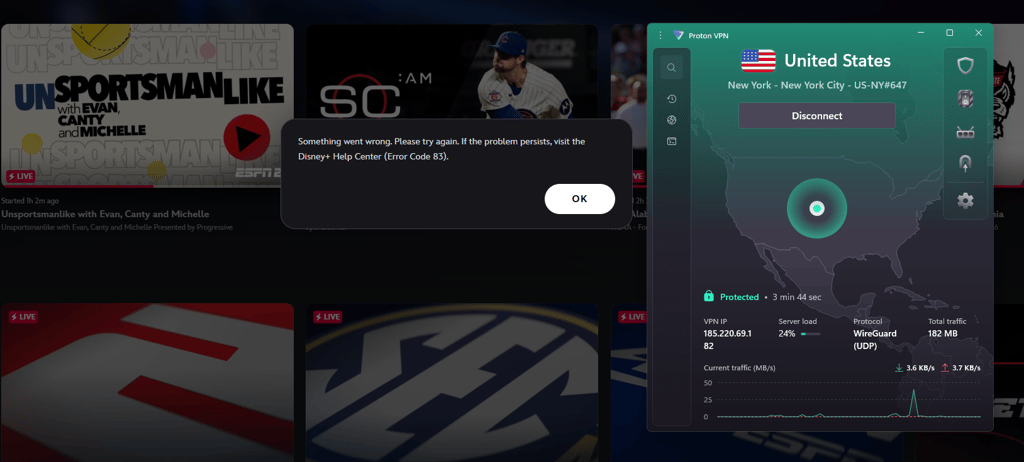
The one place Proton VPN failed in my tests was ESPN: live streams consistently threw error code 83, even though on-demand ESPN content played fine. In contrast, with NordVPN on, ESPN’s live content took slightly longer to load than on-demand but never threw an error, and playback held steady once started. Since I care about live sports, that's a real dealbreaker for me. Everything else Proton does for streaming is competitive, but this is the one platform where NordVPN simply worked, and Proton VPN didn't.

Speed and performance
I found NordVPN to be faster overall, especially on long-distance servers, but both providers deliver excellent real-world performance. I ran all speed tests from my Lithuanian connection (baseline: 930Mbps download/600Mbps upload/1ms ping) to ensure a consistent starting point and to measure the actual overhead of each provider’s leading protocol: NordVPN’s NordLynx and Proton VPN’s WireGuard.
I tested each VPN across four distance ranges (local in Lithuania, close in the UK, mid in the US, and long-distance in Japan) because speed doesn’t just drop uniformly with distance. Latency, routing, and server load compound differently as you move from nearby to intercontinental servers, and this spread mirrors real-world use: local and close servers for everyday browsing, mid-range for streaming and work, and long-distance for accessing far-off libraries or downloading from another continent. That makes it a more honest benchmark than relying on a single server.
Here’s how NordVPN’s and Proton VPN’s speed test results compare:
| Location | Metric | NordVPN | Retention | Proton VPN* | Retention | Winner |
| Lithuania | Download | 891Mbps | 95% | 894Mbps | 96% | Proton VPN by 1% |
| Upload | 567Mbps | 94% | 557Mbps | 93% | NordVPN by 1% | |
| Ping | 1ms | - | 15ms | - | NordVPN | |
| UK | Download | 846Mbps | 90% | 854Mbps | 92% | Proton VPN by 2% |
| Upload | 558Mbps | 93% | 361Mbps | 60% | NordVPN by 33% | |
| Ping | 36ms | - | 35ms | - | Proton VPN | |
| US | Download | 815Mbps | 87% | 752Mbps | 81% | NordVPN by 6% |
| Upload | 172Mbps | 28% | 126Mbps | 21% | NordVPN by 7% | |
| Ping | 115ms | - | 104ms | - | Proton VPN | |
| Japan | Download | 674Mbps | 72% | 484Mbps | 52% | NordVPN by 20% |
| Upload | 75Mbps | 12% | 78Mbps | 13% | Proton VPN by 1% | |
| Ping | 272ms | - | 267ms | - | Proton VPN |
*For Proton VPN, I kept its VPN accelerator feature enabled since it’s on by default and materially affects throughput. I also verified it was slower with the accelerator off, so the default-on configuration is the fairest comparison for most users.
Locally, the two are effectively tied: Proton VPN is a bit faster on downloads, NordVPN is a bit faster on uploads, but the difference is negligible. However, as soon as I started connecting to farther servers, it started growing.
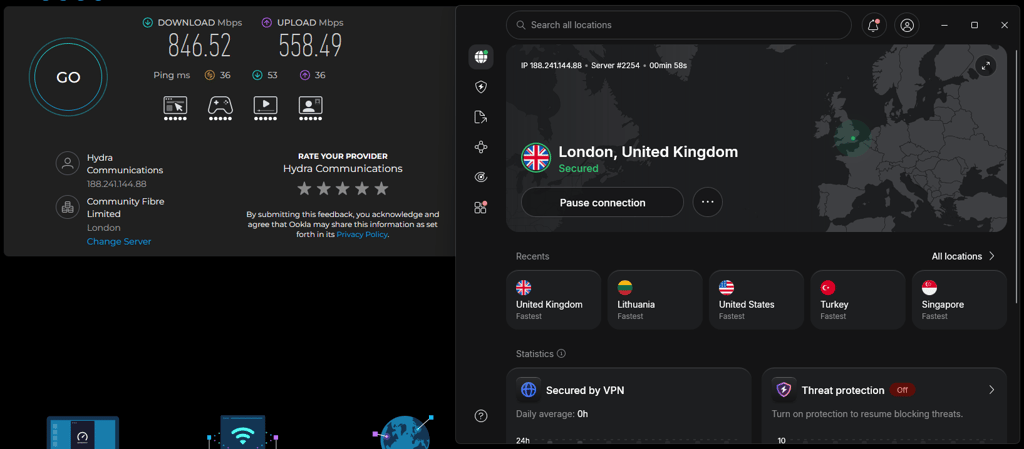
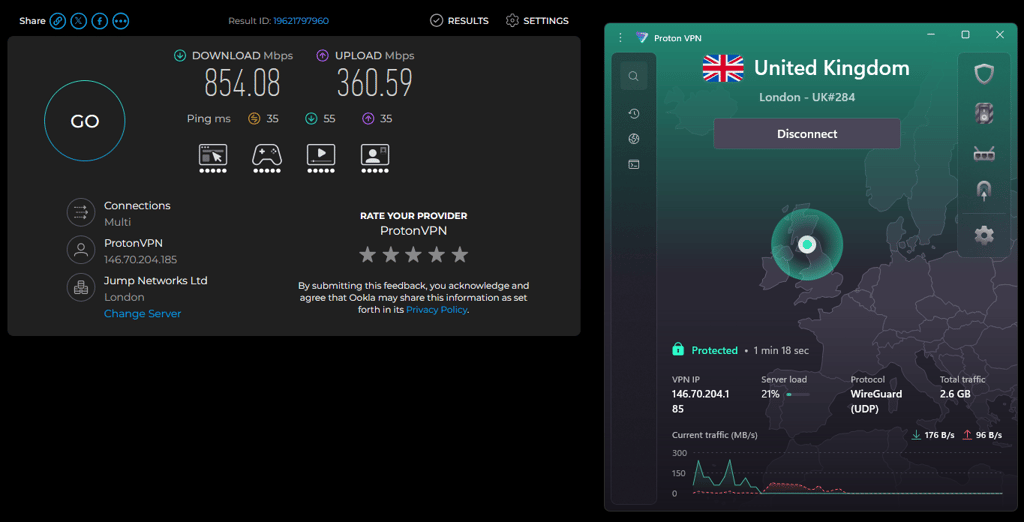
On the UK server, both NordVPN and Proton VPN maintained excellent download speeds, with 846Mbps (90%) and 854Mbps (92%), respectively. However, their upload retention results are much different: NordVPN kept 558Mbps (93%) of my baseline upload speed while Proton dropped to 361Mbps (60%) – a 33% gap that’s too large to ignore. And it repeated at longer distances: on the Japan server, NordVPN retained 674Mbps (72%) of my download speed vs Proton’s 484Mbps (52%) – a 20% real-world advantage on the kind of connection you’d actually use for a long-distance stream or large downloads.
Latency is more mixed. Proton showed lower ping to the UK, US, and Japan, even though NordVPN delivers better speeds on those same locations. That means Proton isn’t slower across the board. If your priority is responsiveness for calls, gaming, or interactive work, its latency performance is competitive. As such, NordVPN’s advantage is specifically in maintaining higher download and upload speeds on distant servers.
To see how much of a downgrade Proton VPN’s free version might be in terms of speed, I also ran WireGuard speed tests across three Canadian cities on both tiers. The results I got with its paid VPN Plus plan averaged higher overall, but the free-tier results were actually better on Montreal servers (584Mbps vs 497Mbps). For this reason, I think the real concern is that free might be inconsistent, not necessarily slower. So if you need predictable performance over just decent average speed, that would be the actual reason to upgrade.
Security and privacy: winner Proton VPN
Proton VPN is built by Proton AG, a company whose entire identity is privacy – and that shows up in its jurisdiction, transparency, and how it lets you verify its claims. NordVPN's infrastructure and features are excellent, but privacy just isn't where it makes its strongest case.
Jurisdiction and no-logs policy
NordVPN is based in Panama, a country with no mandatory data retention laws and no obligation to cooperate with intelligence-sharing alliances like Five, Nine, or Fourteen Eyes. In many cases, this is as strong a jurisdiction as a VPN can possibly have. However, Proton VPN still manages to take it up a notch: it’s based in Switzerland, where privacy is constitutionally protected. Switzerland isn't in the EU, so Proton isn't directly bound by the GDPR, but it operates under the Swiss Federal Data Protection Act instead, which is considered comparably strict and is what actually underpins Proton's no-logs legal position. Under current Swiss law, VPN providers can't be legally compelled to log user data in the first place.
I think it’s important to mention that, with a proposed Swiss surveillance ordinance (the VÜPF/OSCPT revision) that could eventually expand logging obligations, the company has already begun moving physical infrastructure out of Switzerland to the EU rather than waiting to see how it unfolds. I like that Proton acts preemptively here, not reactively. That's not just a legal technicality: since ProtonVPN launched in 2017, it's received 458 legally binding orders from Swiss authorities asking it to identify who was connected to a specific server at a specific time. All 458 were denied because Proton simply doesn't retain the connection logs that would make that identification possible.
NordVPN faced a similar test in October 2024, when it received a binding warrant from Panama's prosecutor's office as part of a criminal investigation. Unlike Proton's clean record, NordVPN was legally obligated to comply. Still, because of its own no-logs setup, all it had to hand over were payment details and confirmation that an account tied to the email in question existed. There were no traffic or connection logs and no browsing activity to provide because none of that exists on its servers either. Around the same time, NordVPN also moved away from the warrant canary it used to run (a page confirming it hadn't received a secret government request). Instead, it started publishing detailed quarterly transparency reports, which is actually how this Panama warrant became public in the first place.
Both providers back their no-logs claims with recurring independent third-party audits, with just one meaningful difference – access to said audits. Here’s how they compare:
| NordVPN | Proton VPN | |
| Auditor | Deloitte | Securitum |
| Most recent audit | December 2025 | May 2026 |
| Audit count | 6th (since 2018, PwC in 2018 and 2020, Deloitte from 2022 on) | 5th consecutive (since 2022) |
| Access to reports | Summary public, full reports available via logged-in Nord Account only | Full reports published openly, no account required |
Functionally, both NordVPN and Proton VPN have proven their no-logs claims multiple times over: six audits for NordVPN and five consecutive audits for Proton VPN, with no red flags from either. But Proton makes it easier to check that for yourself: its full Securitum reports are published openly for anyone to read, while NordVPN's full Deloitte reports are only accessible if you're already a logged-in, paying customer.
Encryption, protocols, and infrastructure
Both NordVPN and Proton VPN use the same industry-standard AES-256-GCM and ChaCha20 encryption and build their fastest protocols on top of WireGuard. NordVPN's version is NordLynx, Proton's is just WireGuard with its own VPN accelerator layered on.
However, your options don’t end here, since both providers offer multiple VPN protocols for different purposes:
| NordVPN | Proton VPN | |
| Leading protocol | NordLynx | WireGuard |
| Obfuscation protocol | NordWhisper | Stealth |
| Alternative protocols | OpenVPN (UDP/TCP) | OpenVPN, Proton WireGuard (beta), Proton Stealth (beta) |
NordVPN and Proton VPN have both moved away from IKEv2/IPSec protocol in favor of WireGuard. You won’t find it among the protocols available in the apps anymore, though NordVPN still provides guides for manual configuration.
Overall, NordVPN keeps it simple: you can pick NordLynx for speed, NordWhisper if you need to get past a restrictive network, or OpenVPN as a fallback. Proton's protocol menu is more diverse: you get access to standard WireGuard, an experimental Proton WireGuard framework, standard Stealth, an experimental Proton Stealth, and OpenVPN, split across separate Speed (UDP) and Reliability (TCP) categories.
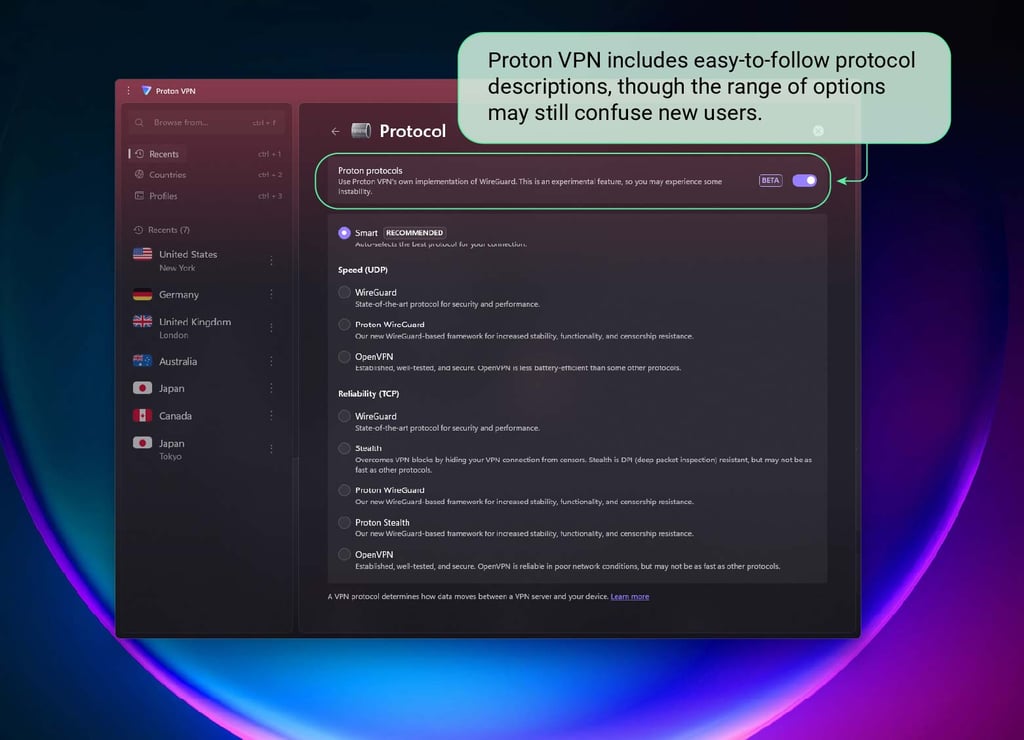
It’s a lot to parse, and I can see this protocol selection becoming overwhelming for first-time users, so fortunately, there's a Smart auto-select option that picks for you. If you’d rather not have to think about it at all, NordVPN's simplicity is a better fit.
NordVPN has added post-quantum encryption to NordLynx across every major platform, strengthening the first step that creates your secure tunnel so it should remain safe even if/when much more powerful quantum computers appear in the future. Recent research suggests that today’s common encryption types (like RSA-2048) could become breakable sooner than expected, and some attackers are already saving encrypted traffic to try to unlock it later. With this upgrade, NordVPN means to future-proof your connection against that risk.
Proton doesn't have an equivalent post-quantum rollout for its VPN yet. What it consistently guarantees across every protocol it offers is perfect forward secrecy: each session gets its own disposable key, so even if one session was compromised, none of your past sessions could be decrypted with it.
Infrastructure is where I saw the biggest difference between the two. NordVPN runs its servers RAM-only (a change it made after a 2018 Finland data center breach), so all data is wiped on every reboot instead of being written to a hard disk. That means there’s nothing durable on the machine for anyone to seize. Proton VPN doesn't run RAM-only servers, but fully encrypts its disks, a different approach to the same goal: to limit what an attacker could recover from a compromised server.
Proton also has something NordVPN doesn't offer at all: fully open-source apps. Every Proton VPN client (Windows, macOS, Linux, iOS, Android) has its source code published, meaning anyone, including me and you, can inspect exactly what the software is doing. NordVPN only opensources its Linux client, while everything else is closed.
Kill switch and leak testing
I tested both providers' kill switches by forcing abrupt disconnects (e.g., killing the VPN process, dropping the connection, and switching networks mid-session) and then immediately checking for exposure. They both worked as they should and blocked traffic when the VPN connection dropped.
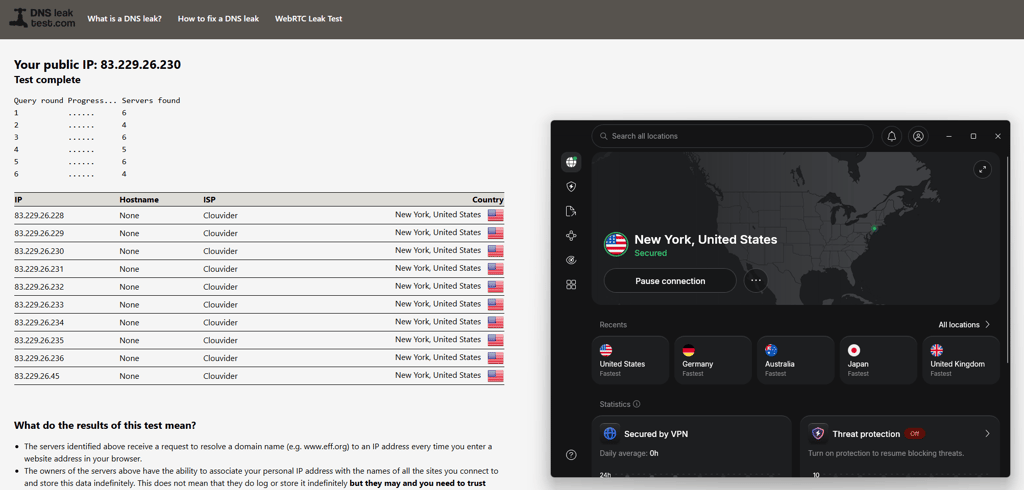
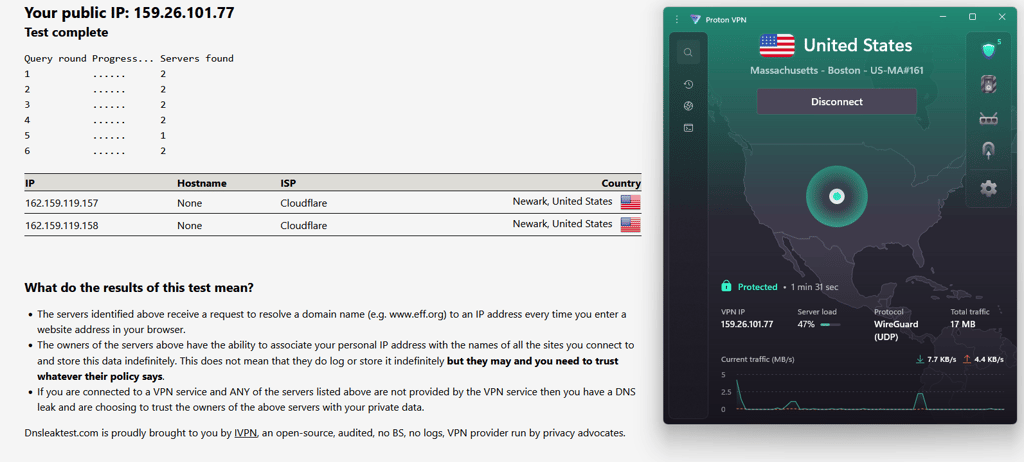
Alongside that, I ran repeated IP and DNS leak tests while the VPN was active, after reconnects, and during network changes. Neither provider leaked my real IP address in any scenario.
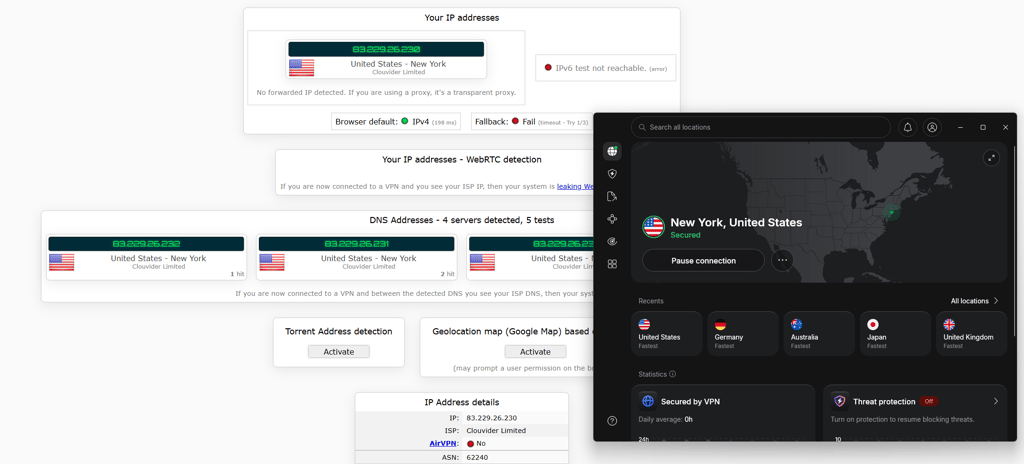
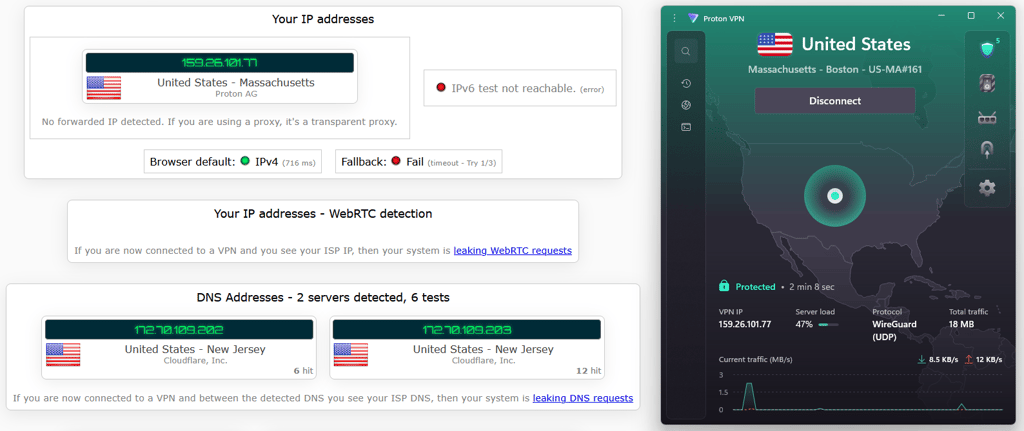
DNS leak tests confirmed that all queries stayed within the VPN’s own resolvers. All in all, zero IP leaks and zero DNS leaks, in every test, on both providers.
What ultimately won me over, though, is that Proton’s privacy commitment extends beyond its own app. It consistently speaks out on internet censorship and digital rights, publishing data on blocked services and restricted regions worldwide. Of course, it’s a part of its marketing strategy, but it’s also easily verifiable across its operations. Treating a free and open internet as a core principle is why I trust Proton VPN more in this category.
Features: winner NordVPN
Both providers now offer more than just a VPN tunnel. NordVPN has built a broad security suite, adding standalone tools such as next-gen antivirus, a password manager, encrypted storage, and breach monitoring. Proton keeps a more focused set of features that align with its privacy-first identity, rather than trying to match NordVPN tool-for-tool. If you want the most complete package in a single subscription, NordVPN is the better choice: it covers more use cases without requiring additional apps.
Here’s how NordVPN’s and Proton VPN’s feature sets compare at a glance:
| Feature | NordVPN | Proton VPN |
| Double VPN | ✅ Yes, fixed server pairs | ✅ Yes, Secure Core servers |
| Split tunneling | ✅ Yes | ✅ Yes |
| Obfuscation | ✅ Yes, obfuscated servers and NordWhisper protocol | ✅ Yes, Stealth protocol |
| Tor over VPN | ✅ Yes, Onion over VPN servers | ✅ Yes, Tor over VPN servers |
| Malware, phishing, and ad protection | ✅ Yes, next-gen antivirus | ✅ Yes, NetShield |
| Dark web/breach monitoring | ✅ Yes | ✅ Yes |
| Account takeover protection | ❌ No | ✅ Yes, Proton Sentinel |
| Dedicated IP/server | ✅ Yes | ✅ Yes, business plans only |
| Port forwarding | ❌ No | ✅ Yes |
| Device mesh networking | ✅ Yes, Meshnet | ❌ No |
| Smart DNS for streaming | ✅ Yes, SmartPlay | ❌ No |
| Kill switch | ✅ Yes, system-level and app-level | ✅ Yes |
| Bundled ecosystem | ✅ Yes (NordPass and NordLocker via Nord Security, plus identity theft protection by Coveron) | ✅ Yes (Mail, Drive, Pass via Proton Unlimited) |
Now let’s take a closer look at how these compare in real-world use.
NordVPN’s next-gen antivirus vs Proton VPN’s NetShield
It’s important to specify that while these tools address overlapping problems, they aren’t direct equivalents.
NordVPN’s next-gen antivirus (formerly Threat Protection Pro) is a web-threat shield available on Windows and macOS. It works by scanning links before you click them and files as you download them, blocking access to known phishing and malware URLs. On mobile, the same feature shows up as Scam and phishing protection, with an additional adult-site blocker that’s mobile-only. It can run even when the VPN itself is turned off, so it works as a standalone security layer.
In independent testing, AV-Comparatives certified NordVPN’s anti-phishing protection in May 2026 with a 96% block rate across 275 phishing URLs and zero false positives, and AV-TEST’s November 2024 evaluation ranked it as the best product with 83.42% total detection rate, well ahead of other VPN add-ons, including Proton VPN’s. It now also holds AAA certification from West Coast Labs from July 2026.
Proton’s NetShield works at the DNS level, meaning that it blocks ads, trackers, and known malicious domains before your device even resolves them. It works across every app on your device, not just your browser. However, it can’t do cosmetic cleanup (you may see blank ad-shaped gaps) and won’t catch everything a browser-based tool would, such as YouTube ads. In that same AV-TEST 2024 evaluation of VPN security add-ons, Proton VPN ranked third after NordVPN and IPVanish but ahead of several other providers.
If you want a broader security net with phishing protection backed by strong independent certifications, I’d say NordVPN’s next-gen antivirus is the stronger pick. If your main goal is system-wide ad and tracker blocking with zero setup, NetShield does that job well.
NordVPN’s Double VPN servers vs Proton VPN’s Secure Core servers
Both features route your traffic through two servers instead of one, but with different design goals. NordVPN’s Double VPN servers offer a handful of pre-set entry/exit server pairs. It’s simple and transparent, but not customizable. Proton Secure Core, in turn, always routes you first through hardware that Proton owns in Switzerland, Iceland, or Sweden (jurisdictions chosen for strong privacy laws and physical security) before you exit anywhere else on the network.
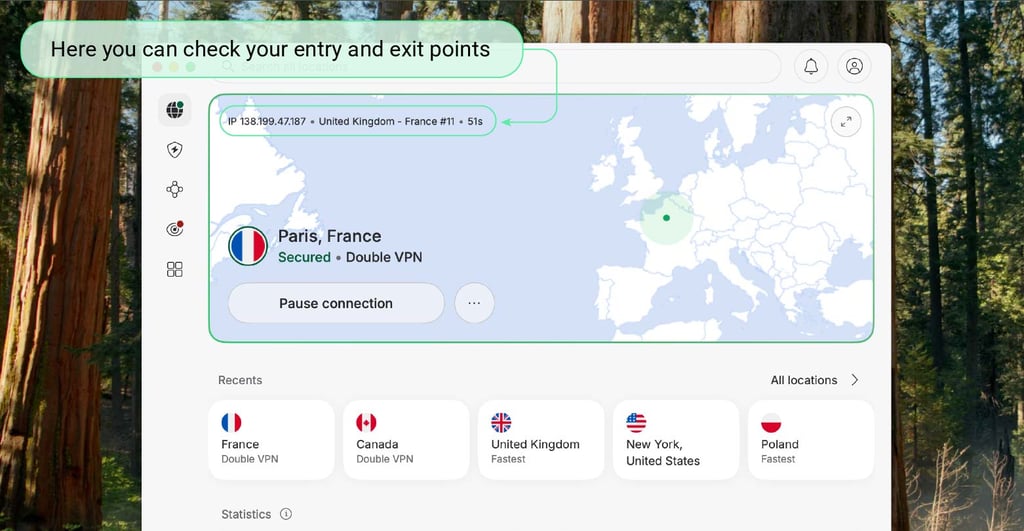
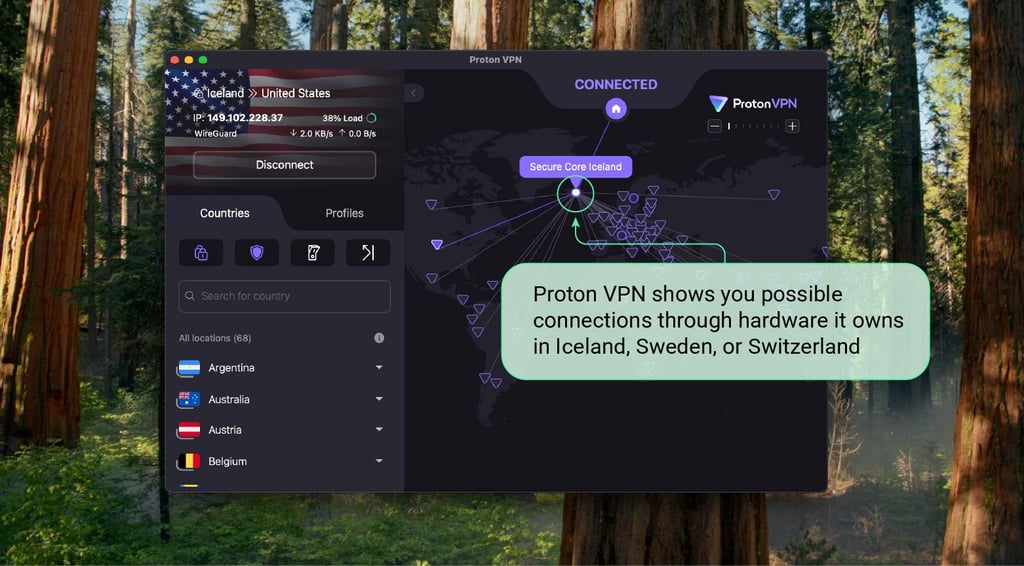
This way, Secure Core targets narrower, higher-risk use cases (journalists, activists, anyone worried about a compromised exit server) and costs noticeably more speed than a standard connection, but it’s the more deliberately engineered version of the same double-hop idea.
NordVPN’s Double VPN is simpler and lighter for everyday users, but Proton VPN’s Secure Core servers are a better option for maximum server-side protection.
Split tunneling
Both NordVPN and Proton VPN support split tunneling, but with important platform differences and slightly different implementations.
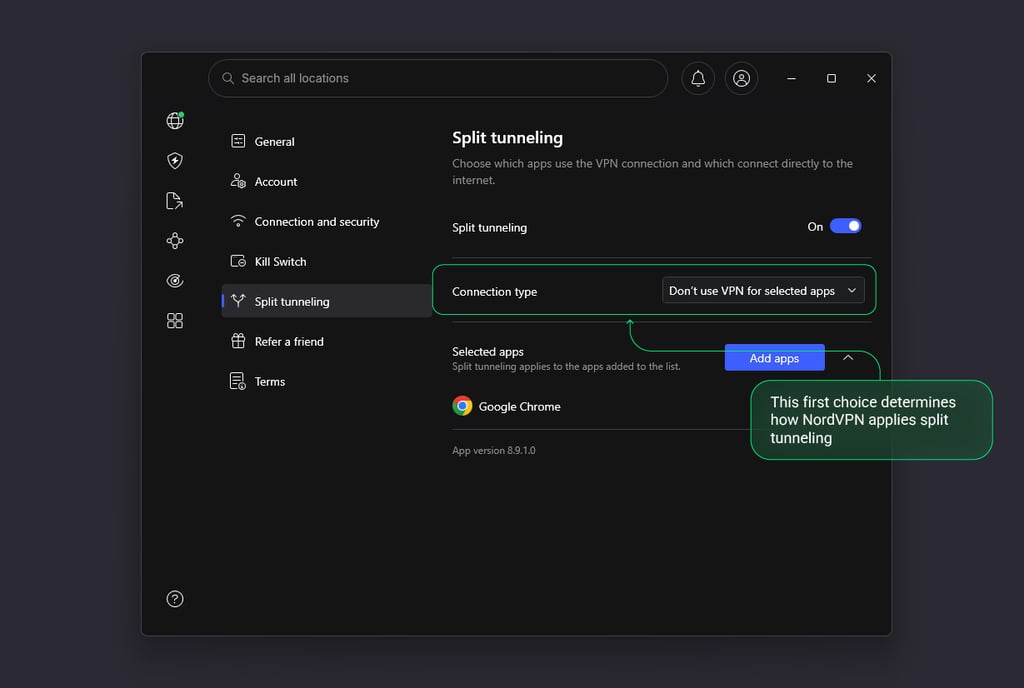
NordVPN offers split tunneling on Windows and Android, but not on iOS or macOS. On Windows, I used the Don’t use VPN for selected apps connection type to exclude Chrome from the tunnel while keeping my torrenting client routed through the VPN. This way, regular browsing and local sites worked normally without the VPN, while my downloads stayed secure and appeared to come from the VPN server location.
Proton VPN supports split tunneling on Windows, Android, and macOS, though on macOS it’s marked as experimental. In testing, I excluded my banking app from the VPN traffic so that it connected directly, while everything else still routed through the VPN. That let me avoid triggering fraud alerts on my mobile banking while keeping my browser and other apps protected.
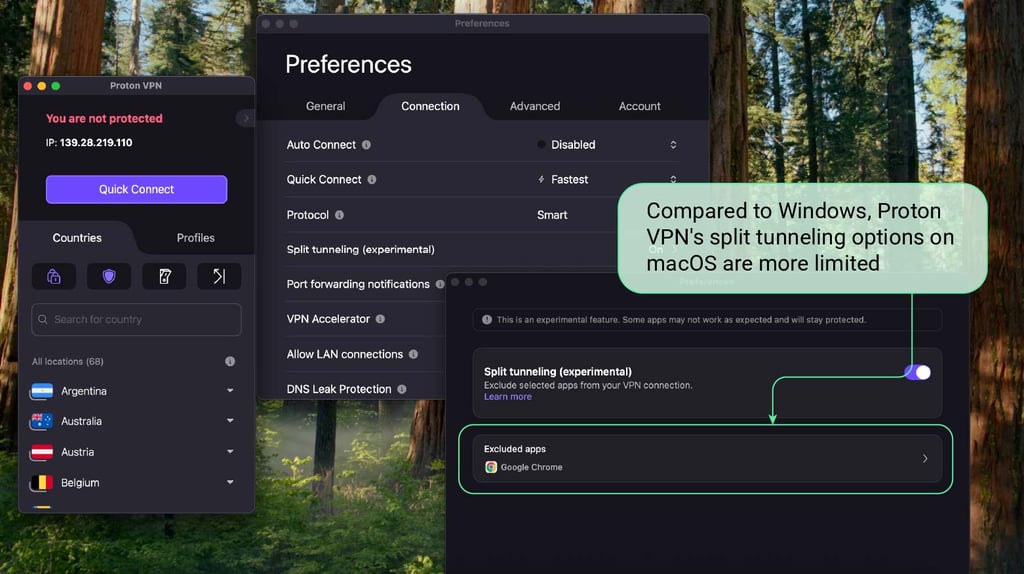
Ultimately, NordVPN’s implementation of split tunneling felt more reliable to me. Being primarily a Mac user, though, I like Proton’s flexibility, but I’d rather not rely on an experimental feature for something as security-sensitive as traffic routing.
Data breach and account monitoring
NordVPN offers two tiers of dark web monitoring. The standard Dark Web Monitor available with the Basic subscription scans up to five email addresses for exposures in known breaches and alerts you if your credentials appear on the dark web. Dark Web Monitor Pro (on Complete and Prime tiers) expands this to eight email addresses plus up to two credit card numbers, two national ID/SSN numbers, and one phone number. NordVPN also now supports transaction monitoring for US bank accounts, flagging repeated charges, unfamiliar merchants, and unusual spending patterns directly in the app.
Proton includes dark web monitoring on its Unlimited plan, scanning your Proton Mail addresses (and aliases) for exposures in known breaches. It then notifies you if your information is detected on illicit forums or in leaked databases. It doesn’t offer transaction monitoring or ID/credit-card scanning in the same way NordVPN does, but it integrates closely with Proton Pass so you can act on breaches (for example, by changing passwords) from the same ecosystem. On the Unlimited plan, you also get Proton Sentinel, which watches your Proton account for suspicious login attempts and escalates anything unusual to a human security team.
As such, Dark Web Monitor tells you when your data has leaked elsewhere, and Sentinel tries to stop someone from breaking into your Proton account in the first place. However, Proton’s dark web monitoring is only decent for email-focused users already in its ecosystem, and it’s much narrower in scope than what NordVPN offers with its Dark Web Monitor. It’s simply more useful for the average user’s day-to-day peace of mind.
The rest? Both NordVPN and Proton VPN now move to be all-in-one digital security suites, NordVPN just has more to offer at this point in time. Its Complete/Prime tiers bundle Meshnet (a private network across your devices), next-gen antivirus, a password manager and encrypted vault (NordPass/NordLocker), and scam call and message protection. Proton provides a password manager and encrypted storage, but only partially matches NordVPN’s full feature set.
Server network: winner NordVPN
Raw server counts are the easiest metric to misread when comparing Proton VPN vs NordVPN. Proton's total server count is actually higher than NordVPN's, but total servers and total reach aren't the same thing. Reach is what determines whether you can actually get a server where you need one.
| NordVPN | Proton VPN | |
| Number of servers | 8,000+ | 20,700+ |
| Locations | 225 locations | 196 locations |
| Virtual locations | ✅ Yes | ✅ Yes |
| 10Gbps servers | ✅ Yes | ✅ Yes |
| P2P servers | ✅ Yes | ✅ Yes |
| Double VPN | ✅ Yes | ✅ Yes, Secure Core servers |
| Tor over VPN | ✅ Yes, Onion over VPN servers | ✅ Yes, Tor over VPN servers |
| Dedicated IP | ✅ Yes, 46 locations (available as an add-on) | ✅ Yes, 21 locations (exclusively through Proton VPN business plans) |
| Dedicated servers | ✅ Yes, available as an add-on | ✅ Yes, but on Proton VPN business plans only |
| Obfuscated servers | ✅ Yes | ✅ Yes |
Proton has nearly three times as many physical servers as NordVPN, which mainly helps with congestion: fewer users share each server, so you’re less likely to hit a slow, overloaded node at busy times. NordVPN’s edge is in geographic spread. With servers in 225 locations as opposed to Proton’s 196, NordVPN offers servers in more places overall, including smaller or less common locations that Proton doesn’t cover. If you need a specific, less-obvious country, NordVPN is more likely to have it.
For most people who stick to major regions, this difference matters less. In countries where both providers operate, Proton’s larger server count can help with peak-time speeds, but that benefit only applies if your required locations overlap. For anyone who values choice and flexibility over just server count, NordVPN’s broader geographic coverage is the bigger practical win.
Both support the usual among premium VPNs specialty features: P2P, multi-hop, Tor access, obfuscation, and more. NordVPN now allows P2P traffic on all standard servers, so it has removed this subcategory from the app altogether. Proton VPN marks its P2P servers with a double-headed arrow in the app, and they make up the majority of its network. However, Proton keeps dedicated IP addresses and servers limited to its business plans, while NordVPN offers them to all subscribers as an add-on.
Apps and ease of use: winner NordVPN
NordVPN offers a smoother, more cohesive experience across platforms, which is the main reason I picked it as the winner here. Even though both do get you connected in one click, Proton is built for someone who wants to tune the VPN itself, and NordVPN is built to be the one app that replaces several others.
Desktop (Windows and macOS)
Proton VPN's desktop app leans into customization. Fresh out of install, it already has its recommended setup pre-enabled: Smart protocol selection, NetShield, VPN Accelerator, and the kill switch are all on, so a new user can just hit connect and get protected without touching a settings menu. Past that first connection, though, the app assumes you might want to go deeper: protocol selection, Secure Core routing, and NetShield's aggressiveness are all adjustable.
One detail I liked specifically: Proton shows a server load indicator right in the location list, so you can actually see which server is under less strain before you connect.
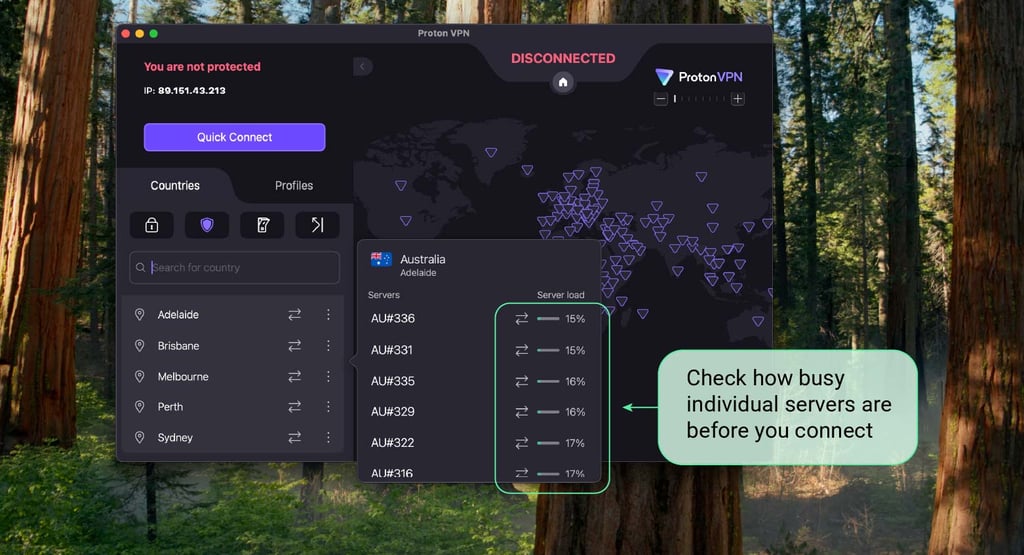
That depth comes with a consistency problem, though. Proton's Windows app runs a refreshed, more polished interface, but macOS is still on the older design, and it's not just visual details. The macOS app's protocol selection window is noticeably less detailed than Windows', likely because Proton's own beta labels suggest that platform is still catching up. However, if you split your time between a Mac and a PC, the app won't feel like the same product on both.
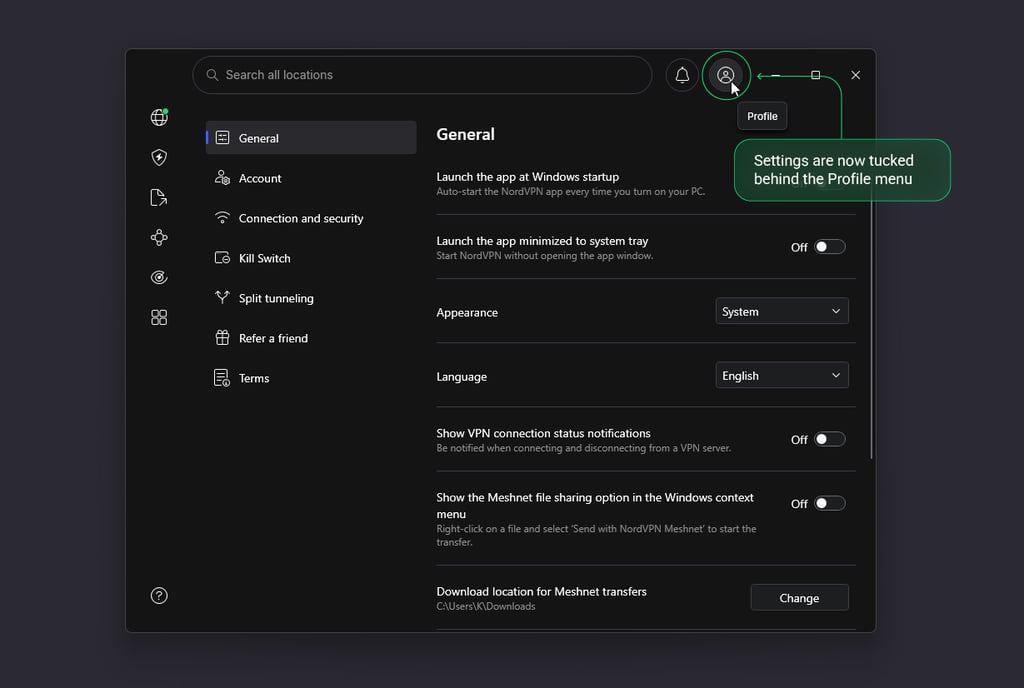
NordVPN's desktop app sits in the middle. You get less granular control over the VPN connection itself, but the main window puts every other feature front and center: server list, devices in Meshnet, as well as Protect and Monitor tabs are all one click away from the home screen and not buried in settings. And unlike Proton, that interface looks and behaves the same whether you're on Windows or macOS, which for me meant no adjustment period switching between them.
Mobile (Android and iOS)
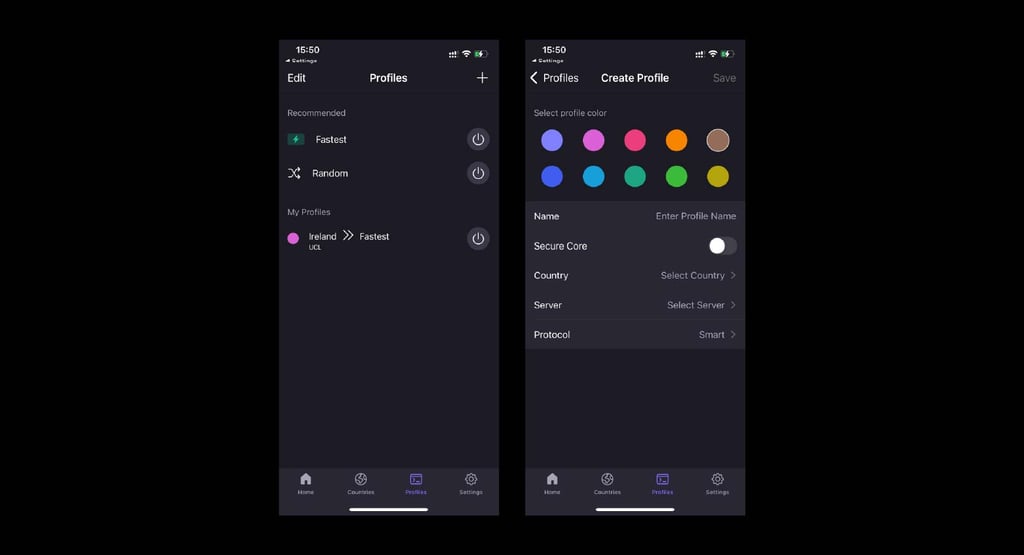
Proton's mobile apps carry over most of the desktop feature set: Secure Core, NetShield, split tunneling, and the kill switch are all there, plus a Profile feature for saving specific location/protocol combos you use often. For example, mine is already set to an Irish server, which is what I use to stream Champions League, so I don’t have to scroll through Proton VPN’s location list in a panic seconds before the kickoff whistle.
My experience with NordVPN's mobile apps was consistent with its desktop counterparts rather than feeling like a separate product: everything's reachable from the main screen – the VPN itself, Scam and phishing protection, and the Products tab. The latter includes quick settings for Scam and phishing protection, Monitor, Call Protection, Meshnet, and Scam Checker, all reachable in just a couple of taps.
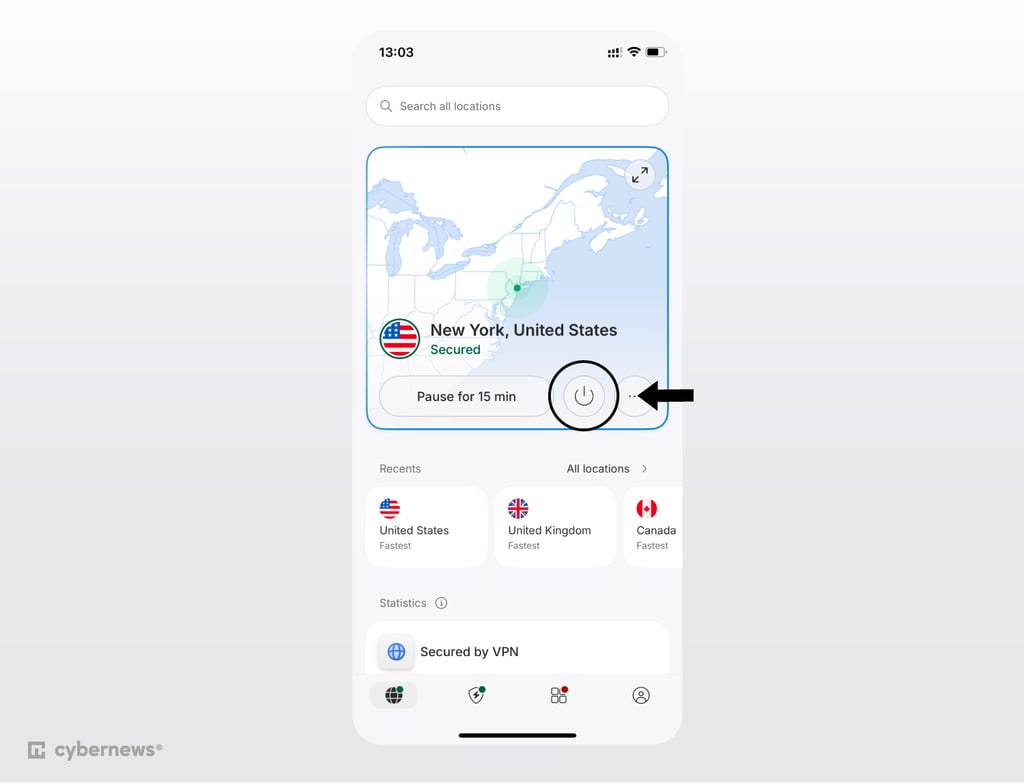
Browser extensions and other devices
Both NordVPN and Proton VPN also have browser extensions for Chrome, Firefox, and Edge, which I like for a quick connect/disconnect when you don’t want to open the full app.
Device support is close, with both offering native apps for Fire TV and Android TV, but NordVPN has one considerable advantage here: SmartDNS. This feature lets you unblock content on devices that can't run a VPN app at all, like older smart TVs or game consoles, by changing just the DNS settings. Proton doesn't have an equivalent here, so if you've got a device that simply can't install a VPN client, you’ll need to set it up on a router.
Torrenting: winner NordVPN
NordVPN turned out to be a better VPN for torrenting in my tests, even though both providers delivered near-identical top speeds on their fastest protocols. However, once I looked at how each provider holds up on TCP and obfuscated connections (setups that matter most if you're torrenting on a shared, throttled, or firewalled network), I saw that NordVPN maintains its speed and stability more reliably than Proton VPN.
I ran all downloads on the same Lithuanian baseline (930 Mbps download/600Mbps upload/1ms ping) while connected to London servers on both providers, downloading the same 4.47GB file across every protocol each service offers. I tested multiple protocols because torrent clients and networks behave differently: UDP is fastest on open networks, TCP holds up better under throttling, and obfuscated modes simulate censored or heavily shaped connections.
Here’s how NordVPN’s protocols compared in my torrenting tests:
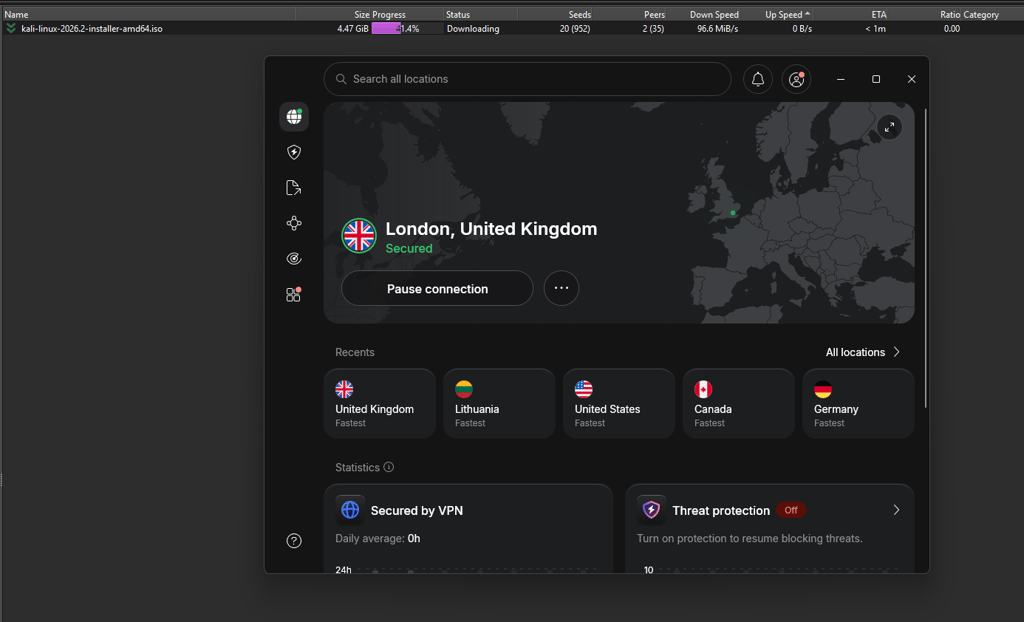
| Protocol | Max speed | Total time | Avg. speed |
| NordLynx | 104MB/s | 48s | 93MB/s |
| NordWhisper | 74MB/s | 1min 10s | 63MB/s |
| OpenVPN UDP | 62MB/s | 1min 18s | 57MB/s |
| OpenVPN TCP | 82MB/s | 59s | 75MB/s |
And here are Proton VPN’s torrenting results:
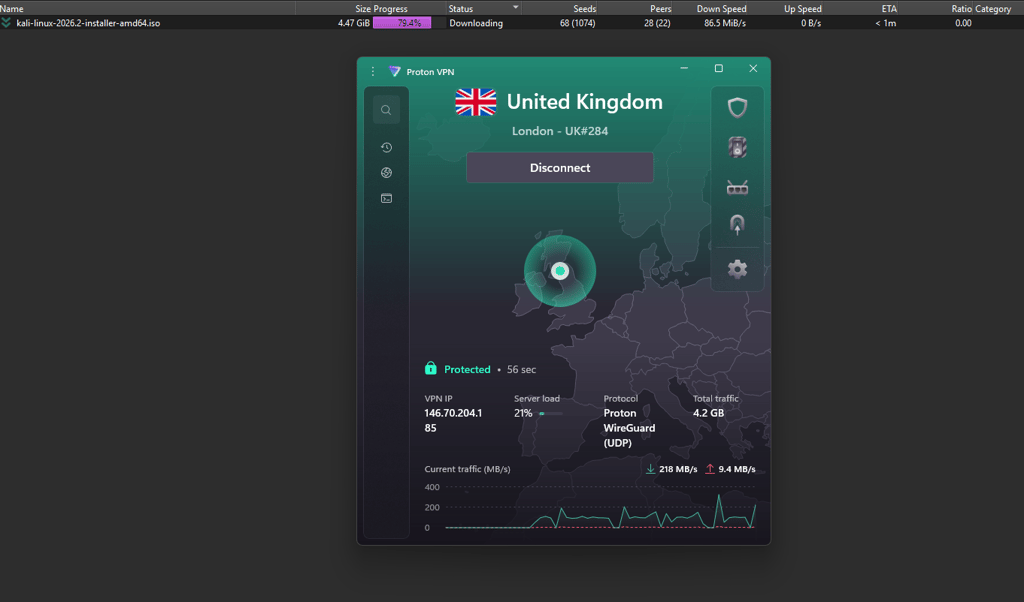
| Protocol | Max speed | Total time | Avg. speed |
| Wireguard UDP | 100MB/s | 47s | 95MB/s |
| Wireguard TCP | 70MB/s | 1min 10s | 63MB/s |
| Proton Wireguard UDP | 87MB/s | 54s | 82MB/s |
| Proton Wireguard TCP | 67MB/s | 1min 27s | 51MB/s |
| OpenVPN UDP | 55MB/s | 1min 25s | 52MB/s |
| OpenVPN TCP | 64MB/s | 1min 16s | 58MB/s |
| Stealth TCP | 67MB/s | 1min 24s | 53MB/s |
| Proton Stealth TCP | 58MB/s | 1min 37s | 46MB/s |
Now, what do all these numbers even mean? On open networks where UDP isn't blocked, NordVPN and Proton VPN are actually very close: Proton's WireGuard UDP averaged 95MB/s against NordLynx's 93MB/s, and NordLynx's peak (104MB/s) beat Proton's (100MB/s) by a margin most users won't notice.
However, on TCP and obfuscation protocols, which are what you actually fall back on when a network restricts or shapes standard VPN traffic, the difference gets wider. NordVPN's OpenVPN TCP averaged 75MB/s against Proton's best TCP result of 58MB/s, and NordWhisper (NordVPN's obfuscated protocol) averaged 63MB/s against 46–53 MB/s on Proton's stealth options. This is an 18–37% advantage for NordVPN on exactly the protocols you'd need on shared Wi-Fi, travel networks, or a throttled ISP.
Proton does offer one thing NordVPN doesn't: port forwarding, which some power users prefer for improving connectivity to peers. I personally find that interesting enough for a privacy-first provider, as opening a port also increases exposure. Proton itself notes the assigned port still runs through its own firewall, so I'd treat it as a niche feature rather than a default advantage.
Restrictive countries and censorship: draw
To assess each provider’s reliability on restrictive networks, I tested their obfuscation protocols using deep packet inspection (DPI) analysis. I’m calling this section a draw: both NordVPN and Proton VPN only hid their VPN signatures when I used their dedicated obfuscated protocols (NordWhisper and Stealth), while all other protocols remained identifiable as VPN traffic.
I connected to each VPN, captured the network traffic in Wireshark, and analyzed the resulting .pcapng file with nDPIreader to check whether DPI could identify the connection as VPN traffic. The goal was to determine whether the traffic resembled standard TLS (HTTPS-like web traffic) or exhibited a recognizable VPN signature that a firewall could block. This is critical in countries like China, Iran, Russia, the UAE, and others, where networks not only block IP addresses but also inspect packets and drop anything that doesn’t blend in with normal browsing.
NordVPN’s NordWhisper successfully concealed the VPN signature from DPI, as nDPIreader classified the connection as standard TLS traffic, not a VPN.
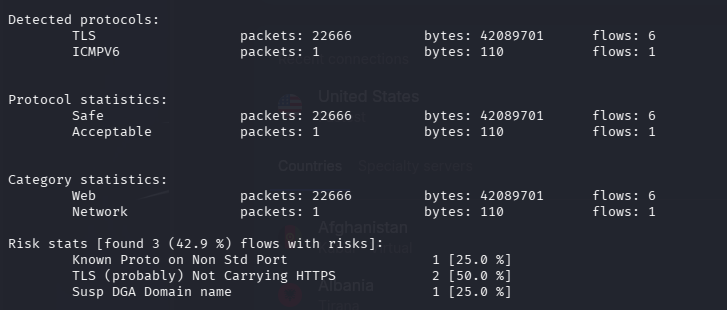
However, when I tested its other protocols (NordLynx, OpenVPN UDP and TCP), they were still identifiable as VPN traffic, meaning a sophisticated firewall could flag and drop them. In practice, I’d only trust NordVPN on restrictive networks when I explicitly switch to NordWhisper, and I’d expect occasional downtime as filters evolve.
I saw similar results with Proton VPN. nDPIreader labeled the traffic from its Stealth protocol as TLS (regular HTTPS-like web traffic), so the DPI tool didn’t detect a VPN signature.
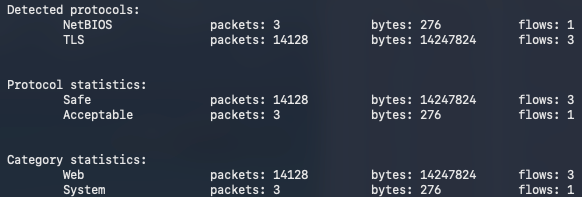
Still, its other protocols (WireGuard UDP/TCP, Proton WireGuard, OpenVPN UDP/TCP) showed clearer VPN signatures and would be easier for DPI to block, so I only suggest using Stealth in censored environments.
Since neither provider can guarantee uninterrupted access on a network that's actively trying to block VPN traffic, I recommend following this checklist to increase your odds of staying connected on censored networks:
- Enable obfuscation before you travel. Turn on obfuscated servers or protocols while you still have unrestricted internet access, since app stores and websites may be blocked once you arrive.
- Choose the right protocol. On NordVPN, select NordWhisper, and on Proton VPN, select Stealth. In my DPI tests, these were the only options that looked like standard TLS traffic. I’d normally also suggest trying OpenVPN TCP, but since it was identified as VPN traffic on both providers, I’d stick to each provider’s dedicated obfuscation protocol instead.
- Consider Proton VPN’s alternative routing. Unlike Stealth, which disguises your VPN traffic, alternative routing kicks in automatically if Proton’s servers themselves are blocked, rerouting your connection through third-party networks that are harder to block outright. It’s on by default, so there’s nothing to configure – just don’t turn it off before you travel. NordVPN doesn’t have a direct equivalent here.
- Pre-download and pre-configure. Install the app, log in, and save working servers before entering the country. Once inside, updates and new downloads can be blocked.
- Expect downtime and rotate servers. Even with obfuscation, filters change. I keep 2–3 backup servers ready and switch when one stops connecting.
Customer support: winner NordVPN
Both providers mainly rely on the same two customer support channels: live chat and email tickets. NordVPN's live chat is open to everyone, including people who haven't subscribed yet. Proton's is paid-customers-only, so if you're still deciding, you're limited to whatever's in the help center.
When I tested Proton's AI agent by asking for tips on using it on restrictive networks, it answered within seconds with straightforward, accurate steps – that's actually how I first learned about alternative routing.
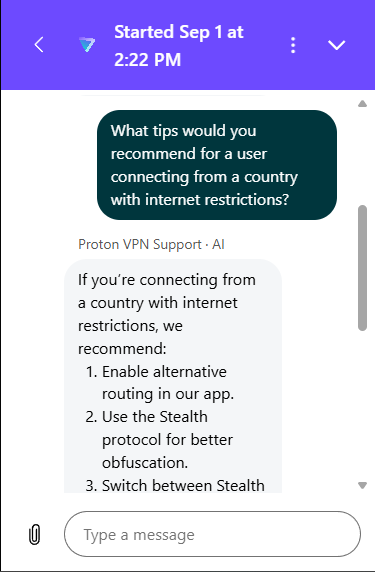
When I asked to speak with a human instead, I was connected within a couple of minutes, and the agent gathered more details about my situation before giving me a more tailored answer.
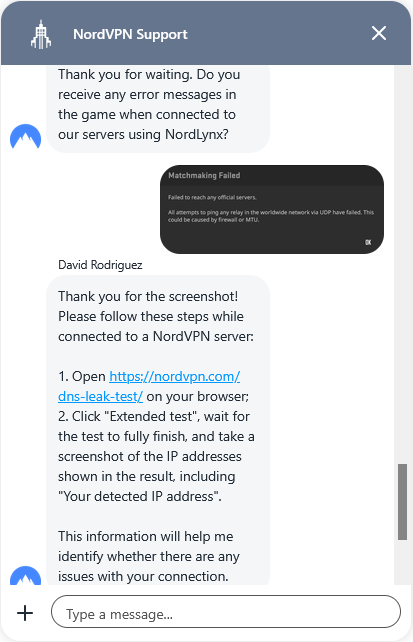
NordVPN's AI agent took a more proactive approach up front, asking about my setup before suggesting anything, but it was noticeably reluctant to hand me off, so it took a few prompts before I reached a person. Once I did, I described an issue I was having with the NordLynx protocol while gaming and sent over a screenshot of the error I was seeing. The agent walked me through some initial troubleshooting, and when that didn't resolve it, escalated me to NordVPN's advanced support team via ticket and suggested continuing the troubleshooting via email.
NordVPN or Proton VPN: final verdict
NordVPN is the better all-around VPN. It’s faster on long-distance servers, more reliable for streaming and torrenting, while also offering a deeper feature set, wider server coverage, and more polished apps and support. Proton VPN's one clear win is security and privacy, where its Swiss jurisdiction, open-source apps, and clean record against legal requests are hard to match, and it backs that up with the only genuinely usable free VPN plan around.
As such, I choose NordVPN as the strongest performer across the board. However, if privacy and transparency matter more to you than anything else, Proton VPN is worth the trade-off.
FAQ
Is Proton VPN better than NordVPN?
No, Proton VPN isn’t better than NordVPN overall. NordVPN is better in terms of speed, streaming, torrenting, features, server coverage, apps, and customer support. The one place it doesn't come out ahead is in security and privacy, where Proton's Swiss jurisdiction, open-source apps, and spotless record of resisting legal data requests give it the edge.
Is Proton VPN cheaper than NordVPN?
Yes, Proton VPN is cheaper than NordVPN. Proton VPN's entry-level paid plan undercuts NordVPN's equivalent on both month-to-month and long-term pricing, and its renewal rates stay closer to what you originally signed up for.
Which is faster, NordVPN or Proton VPN?
NordVPN is faster than Proton VPN. In my tests, the two are close to tied on local and nearby servers, but NordVPN's NordLynx protocol held onto more of its baseline speed on long-distance connections.
Can you be tracked with NordVPN or Proton VPN?
No, not through either provider's own logs. Both NordVPN and Proton VPN have independently audited no-logs policies and have been tested by real legal requests without exposing user activity. NordVPN encrypts traffic with AES-256-GCM and offers post-quantum protection on NordLynx. Proton uses the same encryption standard and guarantees perfect forward secrecy across every protocol it offers.
Does NordVPN or Proton VPN have a free plan?
Only Proton VPN has a free plan, with unlimited bandwidth, real WireGuard-based encryption, and no ads or data selling. I found it to be usable for everyday browsing on one device. NordVPN doesn't offer a free tier, but it gives new users a 3-day free trial instead.