Age Verification Can Be Less Invasive, and iDenfy Proves It
 Follow us
Recent mandatory age verification laws have divided opinions. Regulators say that it’s a security measure, designed to keep children away from harmful content, while users are furious. Mainly because the forceful adoption of mandatory government-issued ID checks and submissions of live selfies is a huge push away from the anonymity that was once a safe haven for chat forums and other spaces online.
Yet, the biggest concerns around security and privacy come from platforms like Reddit or Discord, where the audience is threatening to delete their account and leave. According to iDenfy, a global identity and fraud prevention company, this response is valid, but it comes with a price. Technology providers, including iDenfy itself, need to take responsibility and ensure that the age verification or age estimation workflow is secure and easy on the user. Otherwise, trust simply won’t be a part of the narrative.
Age Assurance Rules and Current Limitations
While “age assurance” is an umbrella term for various age verification methods online, the most controversial one yet remains age estimation. Different from the previous standard, where a person online is asked to photograph their passport, estimation provides only an estimated range of their age based on how old they look, like an “OK” green flag if they pass and if the system in the back office shows that they’re “over 18”.
So, there’s no way of knowing their exact date of birth that would be traditionally checked by looking at their ID. That’s where the issues began. Once regulators rolled out “under-16s” social media bans, like the one in Australia, platforms were advised to adopt facial age estimation technology simply because it’s considered to be a less invasive and much easier way to confirm age.
According to iDenfy’s CEO, Domantas Ciulde, challenges like racial bias or even verifying identical twins might deliver inaccurate results if the system isn’t developed correctly:
“A poor solution can show inaccurate results due to a simple feature, like a younger man with a mustache or a woman with grey hair.”
As an age estimation and verification provider, iDenfy stresses that service quality matters most. The company’s own take on age estimation has proved to be just that, reaching a 2.5-year accuracy rate, compared to an industry standard of 3-5 years. Higher error rates can be particularly concerning in sensitive areas such as adult-only platforms, which cannot afford to compromise privacy or allow minors to see harmful content.
Alternatives to Avoid Miscategorization During Estimation
Older people getting the result as underage when they’re not, and vice versa, is really disappointing, especially when the user is already not really fond of the whole process. iDenfy explains that its team solved this issue by providing multiple different age verification workflows to convert the user rather than instantly closing the door on them.
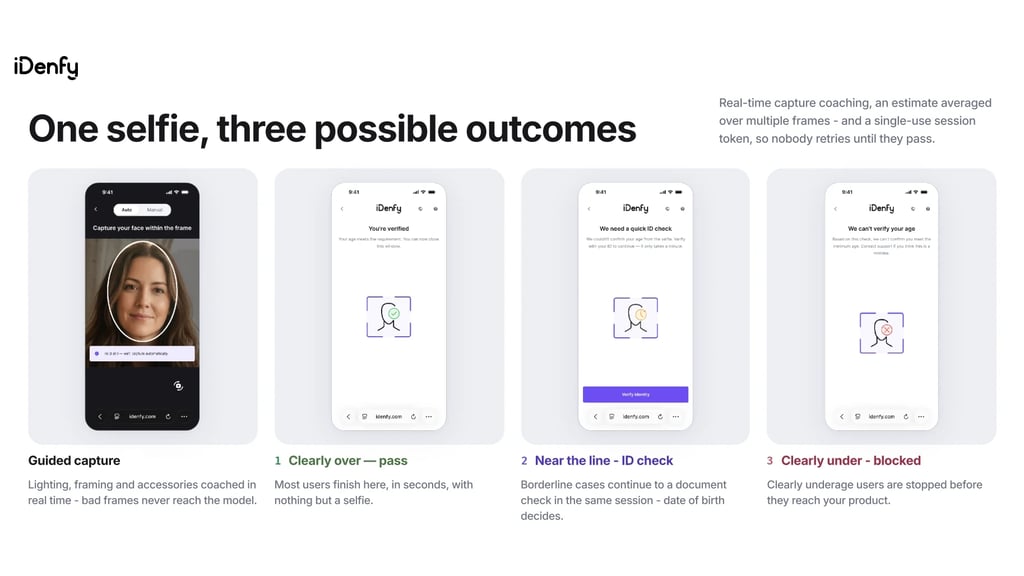
For example, if their estimated age is ambiguous, iDenfy automatically redirects the user to the document-based flow, where only then they’re asked to use their physical identity document. So, while iDenfy already offers accurate age estimation technology, Domantas Ciulde points out that the standard age verification process “should not be the enemy”, especially when it’s done right.
For that, the company prepared some tips:
- Test the sandbox environment and how the system performs, and don’t fall for sales representatives who claim their age estimation is 100% accurate; that’s impossible.
- Check your local regulations and use estimation if it’s possible. Typically, a user is more likely to capture a quick selfie than take out their ID from their wallet.
- Guide the user throughout the whole process, explaining why you need this check and that their information is safe.
- Don’t rely on age gates, as a simple “I’m over 18” checkbox is never enough.
iDenfy’s team recommends choosing an industry professional who specializes in this field.
That’s because there are major challenges that come with the development process. With sensitive data and strict regulatory rules, standards are hard to maintain. Vibecoding an age verification app or building your own estimation software is a risk that not everyone can take on. Effective systems need to be trained and tested on thousands of faces with different skin tones, textures, or even habits that affect biometrics.
Final Tips on Easy Age Verification Integration
Headaches become a real issue when you start thinking about integration. If you’re a business owner looking for a third-party, ready-made service, integration flexibility should be a part of your checklist. Age verification and estimation are often used with other fraud prevention tools, which means they all need to work as a system. For example, regulations require verifying users if the company’s internal system flags suspicious behavior.
That means you should use software that supports both: age checks during the initial account opening process and later on, if certain behavioral biometrics indicate risks. In practice, a simple message, like a “happy 14th birthday” post on a social media app, could trigger an age verification check if the user’s profile states they’re older. Existing users or those who have had their accounts for years might not need to be re-verified.
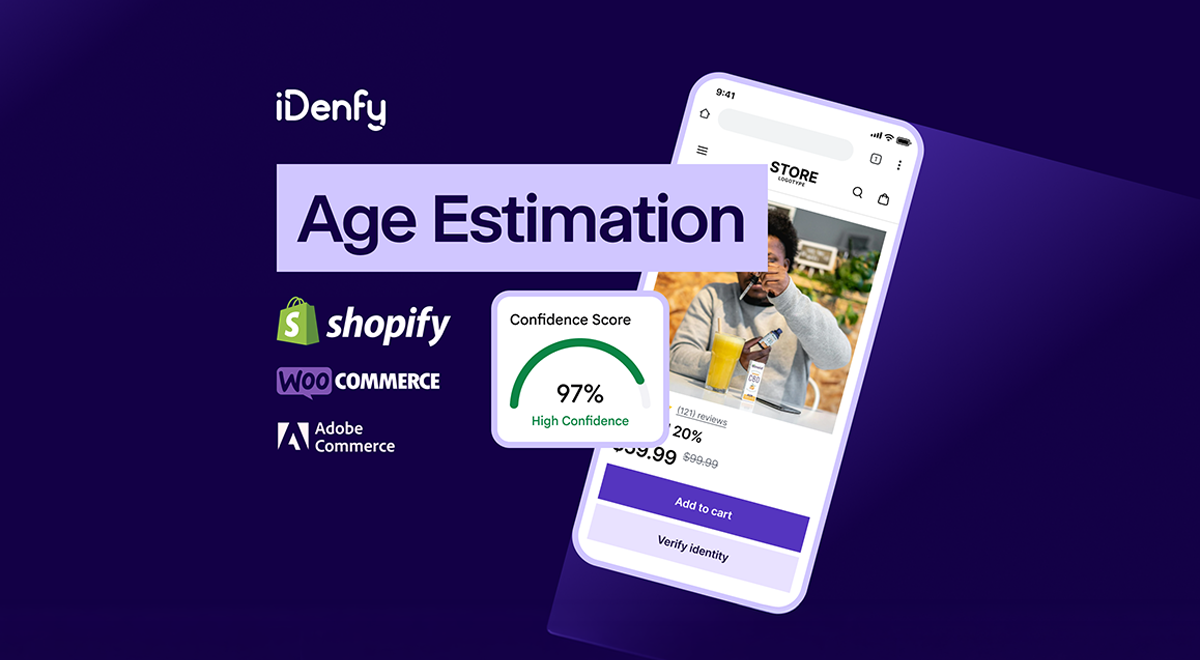
However, if you’re building a new e-commerce site, such as an alcoholic beverage store, that’s a different story. That’s important because minors often choose to shop online to avoid getting carded in person. iDenfy’s team anticipated this too, building special no-code age verification apps for Shopify, WooCommerce, and Adobe Commerce merchants.
About iDenfy
iDenfy is one of the few identity and age verification service providers in the market that offers multiple age assurance workflows in one place. Starting from standard identity document checks, the business has evolved into a full-scale KYC/KYB and AML platform, with the latest developments in selfie-based age estimation solutions. For those who want simple, straight access to document verification and face-matching at checkout, iDenfy’s no-code integrations are the way to go. Different from unreliable age-gating methods, iDenfy is compliant with global regulatory and data privacy standards.