AI executive search that keeps human judgment

 Follow us
Automations and professional data can help recruiters map leadership markets faster, but your decision-maker role is safe.
The qualities that matter most in a leadership hire rarely fit on a single CV line. Someone who scaled a business across three markets and steered it through a transformation may carry the title "General Manager" at a company nobody outside the sector has heard of. Hence the paradox: the sharper the AI prompt, the less a keyword can do for you.
That makes executive hiring as much a market research problem as a candidate search. The data is available – searching, verifying, and refreshing it by hand across countries and industries is the issue. AI executive search solves it by mapping the wider market instead of matching exact titles.
- The sharper the prompt, the worse keyword search performs – the qualities that matter don't live in job titles
- Executive hiring is a market research problem. The data exists; verifying and refreshing it by hand is what doesn't scale
- A shortlist starts decaying the day you build it. Treat it as a live feed, not a document
- Automation finds, merges, and sorts. Rejecting, ranking on fit, and making the offer stays human
Why executive search does not scale easily
Leadership profiles are rarely standardized, static, or easy to compare, which is why manual research breaks down as searches expand:
- Job titles aren't standardized. The same job can be CTO, VP of Engineering, or Engineering Director. Filter for "CTO" and you miss the rest.
- Experience is contextual. "Five years of leadership" says nothing about team size, company stage, regulated markets, or whether they led an acquisition.
- The best candidates aren't applying. Job postings reach only a fraction of the relevant market.
- Lists age fast. Executives get promoted, join boards, relocate. A shortlist can go stale mid-search.
- Complexity compounds. One search is manageable by hand. Thirty – across countries, industries, functions – each need their own title taxonomy, market definition, and refresh cycle.
AI executive search handles most of that. You just need the right steps.
AI executive search: from brief to live shortlist
The shift isn't from human search to automated search. It's from searching titles to searching evidence, and from a shortlist you build once to one that stays current. Below are the 4 steps to get you there.
- Describe the leader you need, not just their job title. For example, Coresignal's Agentic Search API takes the brief in natural language and returns relevance-ranked results across employee, company, and job posting data – no SQL, no schema knowledge.
- Map the market before building a shortlist. A fintech CTO search shouldn't stop at fintech CTOs. The right person might be a VP of Engineering at a payments company or a transformation lead inside a bank – neither surfaces in a search for "fintech CTO." Employee and company data together is what makes them visible.
- Rank on evidence, not title matches. Seniority, leadership tenure, promotions, responsibility for similar functions – signals that are objective and hard to assess by hand at scale. Recruiters can then judge from there.
- Treat the search as live. Coresignal's webhooks for Employee API flag job changes as they happen, so the VP who wasn't ready to move in January becomes a live conversation when they leave in July.
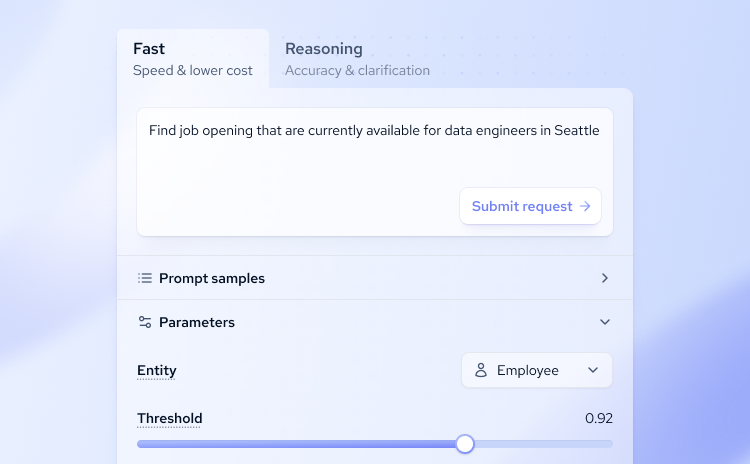
Building automation for executive search workflows
In practice, the split between machine and human work is clear – automation handles the research, you handle the decisions. To summarize the process:
- Write the prompt in plain language.
- Matching profiles come back, with company and growth context attached.
- Duplicates are resolved into single verified records.
- Candidates are grouped by relevant experience.
- You review and refine the longlist.
- Selected profiles go to your CRM, kept current by job-change signals.
- You handle outreach, interviews, and references.
Everything the machine does is preparation: finding, merging, verifying, updating, sorting. Every judgment call is still yours.
Why building this in-house usually stalls
Collecting profiles was never the hard part. A prototype takes a week, but then, the obstacles follow.
| Obstacle | What it really takes |
| Same person, four records | Entity resolution across name variants, renamed employers, contradictory dates – logic that only improves with volume. |
| Sources shift | Collection is an operation, not a build. No completion date. |
| Freshness | Quarterly refreshes can't support a live map. Cost scales with coverage. |
| Compliance | Data must be ethically sourced and compliant with data privacy laws. |
Most teams hit the last row after the first three works. And that’s when projects usually stop.
What AI should not decide
Sorting a market isn't the same as judging a person. AI shouldn't decide:
- Who gets rejected
- Who fits the culture
- Who has leadership potential
- Who gets the offer
Profiles go stale, records are incomplete, and models inherit whatever bias sits in their training data. One large-scale experiment found AI screening pushed more candidates to final interviews, but skewed younger and less experienced. If you can't see why a profile surfaced, you can't catch that.
From one-off searches to living talent maps
The future of executive search isn't a robot picking your next CEO – it's a talent intelligence layer that keeps the leadership market in view. Natural-language briefs replace title filters, employee and company data reveal who actually did what, and change tracking keeps the map live. The final judgment stays yours.