SeeAPI Launches NSFW APIs to Help AI Apps Reduce Content Risk and Wasted Generation Costs
 Follow us
In January 2026, Indonesia and Malaysia temporarily restricted Grok over non-consensual sexualized AI images. Indonesia later announced conditional restoration under strict oversight—a reminder that misuse of generation tools can disrupt an entire service.
Payment access also matters. Stripe prohibits AI-generated content meeting its adult-content criteria, while Mastercard’s requirements for adult-content merchants include pre-publication review. For AI businesses, content controls therefore affect both operations and revenue.
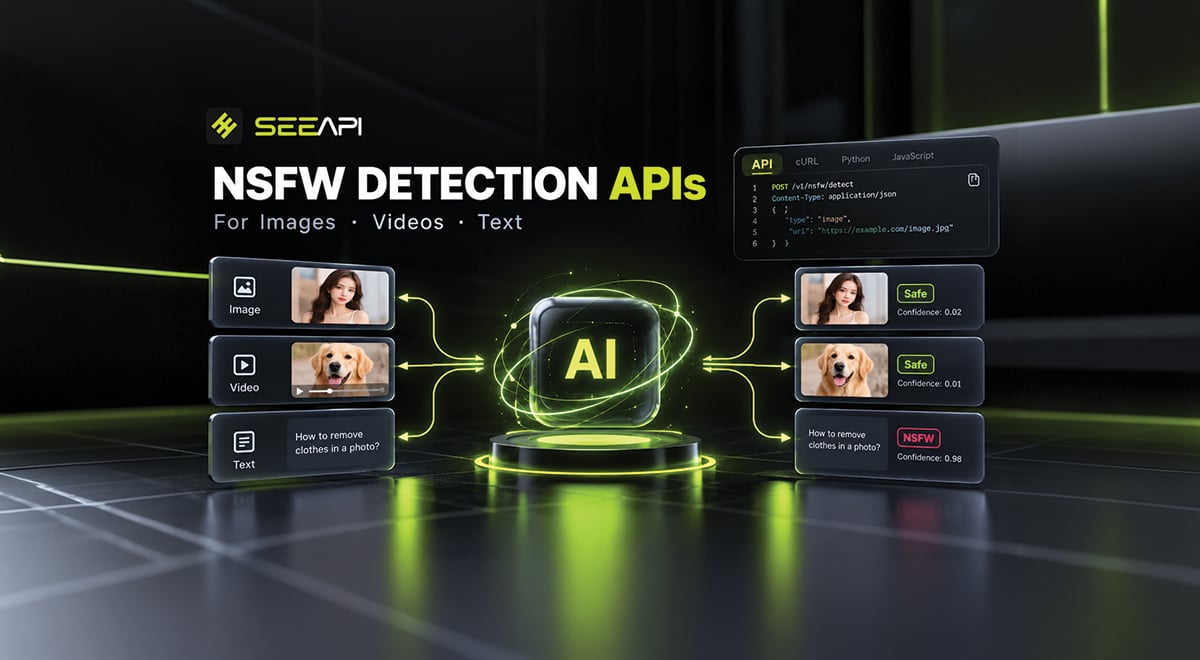
Even when unsuitable output is caught before delivery, its generation cost has already been incurred. SeeAPI’s new text, image and video NSFW filter APIs bring checks into one service, helping developers screen prompts and reference assets before generation, then assess outputs before delivery. Earlier checks can reduce wasted spending; output checks help prevent unsuitable content from reaching users. These checks support broader safeguards rather than replacing consent, age-verification or compliance measures.
Put Checks Where They Can Change the Outcome
An image-generation workflow illustrates how this works.
Check the prompt first. If a request meets the platform’s blocking criteria, stop it before analyzing reference assets or calling a generation model. SeeAPI’s Text NSFW Filter API checks categories including sexual content, violence, hate, harassment and self-harm. Developers choose the relevant categories and a shared threshold.
Check reference images next. A harmless-looking prompt does not establish that an uploaded image is appropriate. For image-to-image requests, assess the reference image before generation. Pure text-to-image requests skip this step.
Check the output before delivery. Acceptable inputs do not guarantee an acceptable result. Inspect the generated image before enabling downloads, sharing or publication. The application can then release it, withhold it or send it for review according to its rules.
The sequence is simple:
Prompt check → reference-image check, if needed → generation → output check → delivery.
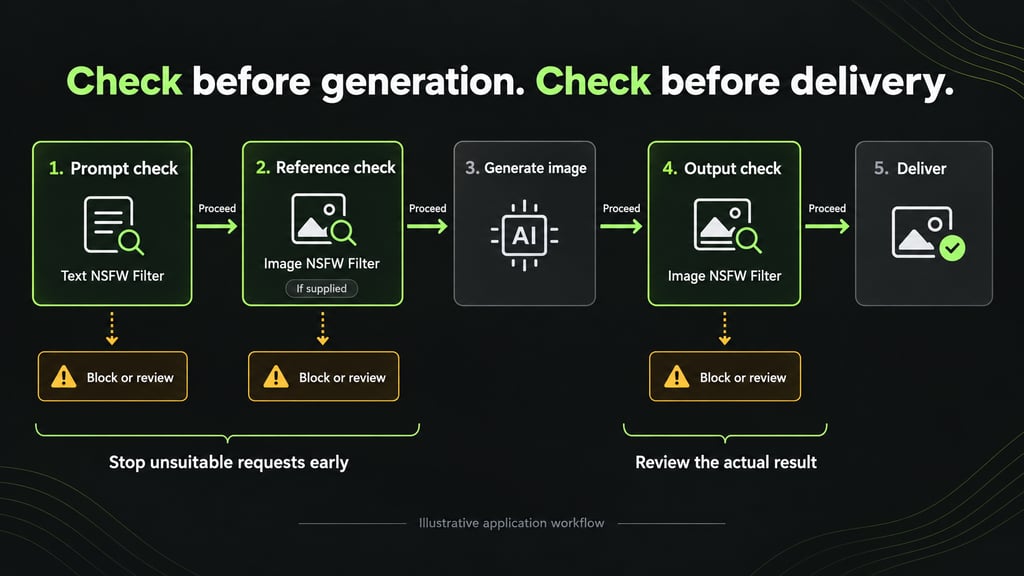
Early checks can avoid unnecessary downstream spending. Output checks address what was actually created. Both belong in the workflow.
For video, the same principle applies to prompts, supported reference assets and generated clips. SeeAPI’s video API analyzes sampled frames, returning frame-level assessments and approximate timestamps; developers can also request flagged-frame images for review. It currently supports MP4 or MOV clips up to 30 seconds and 8–32 sampled frames. It does not inspect every frame or moderate audio, and short incidents between samples may be missed.
Why Build the Workflow with SeeAPI?
Adding checks before and after generation should be affordable and straightforward to integrate. SeeAPI combines text, image and video moderation APIs in one service, with low usage costs and configurable checks for different stages of an AI workflow.
| Advantage | What SeeAPI provides | Value for AI businesses |
| Low moderation costs | Image checks at approximately $0.037 per 1,000 images, using the documentation’s displayed credit conversion. | Makes checking both reference images and generated outputs inexpensive. |
| One service for three content types | Text, image and video APIs for prompts, supported reference assets and outputs. | Reduces the need to integrate and maintain separate moderation providers. |
| Configurable detection | Selectable text categories, adjustable thresholds and visual moderation settings. | Helps teams tune checks to their content rules and evaluate missed violations alongside false alarms. |
| Explicit task handling | Asynchronous tasks, status queries, completion callbacks and structured results and errors. | Supports controlled delivery, retries and review when an assessment is delayed or unavailable. |
How the Image-checking Costs Compare
At the published rates below, SeeAPI’s estimated image-checking cost is 96.3% lower than the AWS Rekognition reference rate.
| Service | Rate used in this comparison | Cost for 20,000 image checks |
| SeeAPI Image NSFW Filter | 0.01 credits per image × $0.0037 per credit | $0.74 |
| Amazon Rekognition DetectModerationLabels | $0.001 per image, using the published first-tier Group 2 rate | $20.00 |
Illustrative usage-fee comparison, checked September 23, 2026. Excludes free allowances, promotional credits, negotiated discounts and ancillary charges. SeeAPI’s dollar equivalent depends on the selected plan; AWS pricing can vary by region and volume. Detection coverage and service terms differ.
Those 20,000 checks could cover one reference image and one output image for each of 10,000 generation requests. If prompt moderation also consumes one million billed input tokens, SeeAPI’s combined text and image moderation cost would be approximately $0.80, excluding generation and retries.
Early blocking offers a separate saving: requests stopped before generation do not incur the downstream generation fee. Actual net savings depend on moderation usage, generation prices and how many requests are blocked early.
Teams should validate detection quality and processing performance on representative workloads before rollout.
Add the Checks Your Product Needs
For AI image and video websites, multimodel platforms, independent developers and SaaS teams, the next step is to map content inputs and delivery points. Start with representative requests, configure the relevant checks and measure their impact on moderation decisions and costs.
Explore SeeAPI’s NSFW filter documentation, with navigation to all three APIs, and add checks before generation and before delivery.