Vertex AI
Last updated: June 16, 2026
What is Vertex AI?
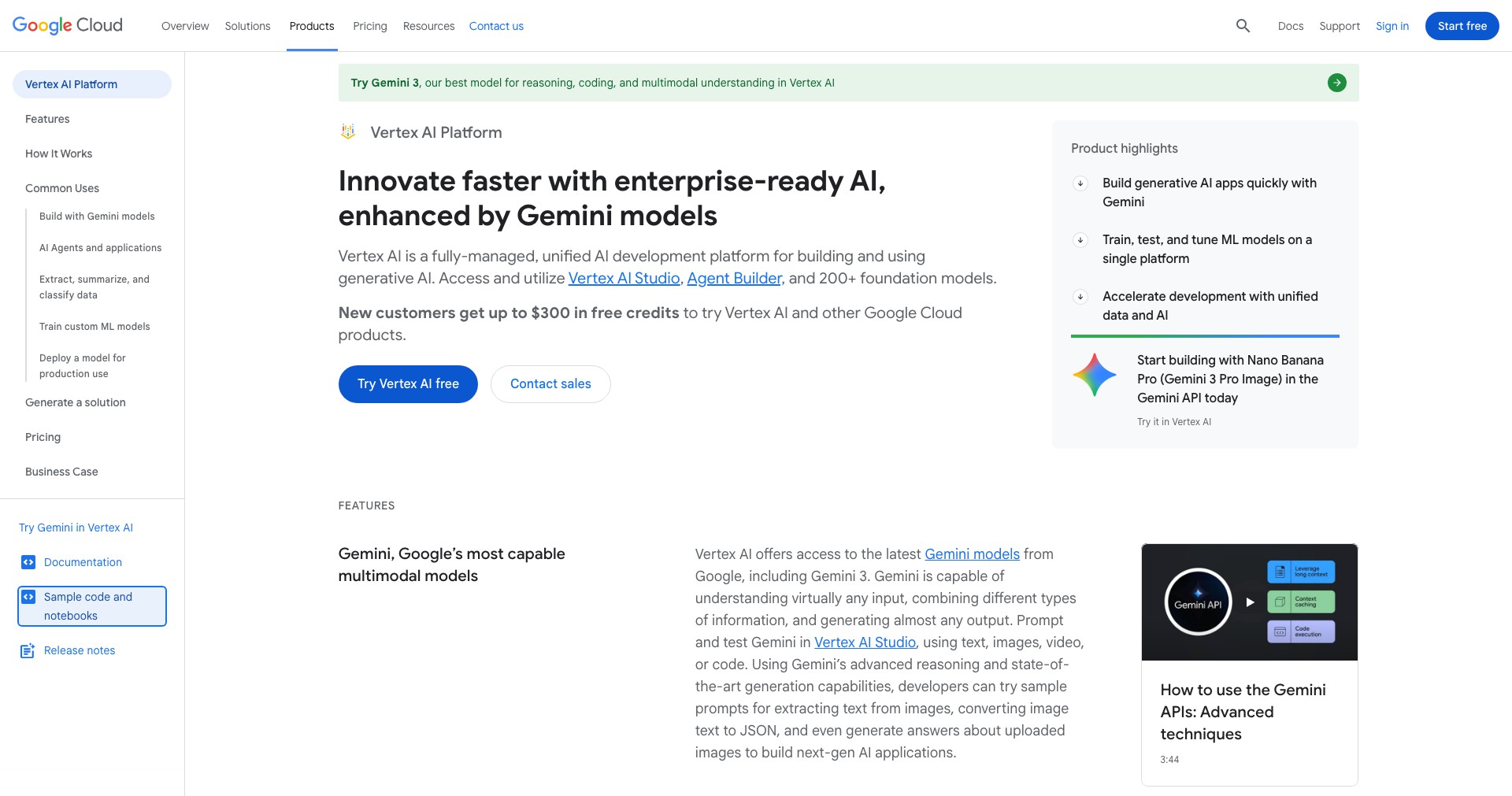
Vertex AI is Google Cloud's integrated machine learning platform designed to simplify the end-to-end ML workflow. By unifying data preparation, model training, deployment, and monitoring within a single environment, Vertex AI removes much of the typical complexity experienced in large-scale machine learning projects. Built on Google’s robust cloud infrastructure, Vertex AI supports both beginners and seasoned AI practitioners with a mix of user-friendly automation tools and advanced configuration options.
With Vertex AI, organizations can leverage managed datasets, automated model tuning, explainable AI, and scalable infrastructure to accelerate their AI initiatives. Whether the goal is to prototype quickly or productionize sophisticated machine learning models, Vertex AI's blend of no-code and code-first capabilities ensures teams can collaborate efficiently and deploy state-of-the-art AI solutions at scale.
Key Features:
-
Managed Data Preparation:
Vertex AI provides intuitive tools for ingesting, transforming, and managing datasets, enabling users to clean and prepare data for machine learning without needing to leave the platform. Preprocessing features and built-in integration with BigQuery further streamline the pipeline. -
Automated Model Training and Tuning:
With AutoML capabilities and hyperparameter tuning, Vertex AI enables rapid model development, making it possible to create high-performing models with minimal manual intervention. Users can choose between a no-code AutoML approach or custom model training with full control. -
Unified Model Deployment:
The platform simplifies moving models into production with scalable, managed endpoints for real-time and batch predictions. Built-in CI/CD and canary deployment support ensure seamless updates and minimal downtime. -
End-to-End ML Operations (MLOps):
Vertex AI offers tools for monitoring, versioning, and managing models throughout their lifecycle, ensuring reproducibility, traceability, and governance. Built-in drift detection, explainable AI, and model monitoring help maintain reliability post-deployment. -
Integrated AI Ecosystem:
Vertex AI integrates natively with Google Cloud’s ecosystem, including Dataflow, BigQuery, Looker, and TensorFlow, providing a cohesive development experience. This ensures that data, analytics, and AI solutions work seamlessly together.
What makes Vertex AI unique?
Vertex AI stands out by offering a truly unified machine learning platform that combines managed datasets, AutoML, custom model support, and production-grade MLOps in a single, cloud-native solution. Few competitors provide this extensive an integration with both data and analytics tools, accelerating time-to-insight for teams.
The platform’s deep integration with Google Cloud services, coupled with features such as Vertex AI Workbench (for collaborative notebook-based development) and built-in explainability, sets it apart from other cloud ML platforms. Vertex AI's flexible approach—serving both no-code users and advanced ML engineers—broadens its accessibility and applicability.
Pros and Cons
Who is using Vertex AI?
Enterprise Data Science Teams: Large organizations with dedicated data science or ML teams benefit from Vertex AI’s scalable infrastructure, security compliance, and collaborative features for deploying AI at scale.
ML Engineers and Developers: Technical professionals building custom machine learning pipelines can leverage Vertex AI’s flexible APIs, custom model support, and MLOps tools to manage the full AI lifecycle efficiently.
Business Analysts and No-Code Users: Users without deep AI expertise can utilize Vertex AI’s AutoML and pre-built models to derive insights and prototype applications quickly through intuitive user interfaces.
Evolution and Milestones
Since its launch, Vertex AI has rapidly expanded beyond its predecessor (AI Platform) by unifying data, training, and deployment into a single experience. Key upgrades include the introduction of AutoML, native integrations with leading data warehousing and BI tools, and user-centric notebooks.
Major updates have added support for explainable AI capabilities and advanced model monitoring, positioning Vertex AI as a leader in responsible AI. Google has continuously refined the workflow with features such as Vertex Pipelines (for orchestration) and improved support for frameworks beyond TensorFlow.
Most recently, Vertex AI introduced enhancements focused on generative AI models, making it possible to seamlessly use foundation models and LLMs within the platform. This evolution ensures Vertex AI remains competitive as AI capabilities and user demands continue to grow.
Pricing
| Plan | Price | About |
| Free Tier | $0 | Get started with Vertex AI with limited resources and features at no cost, ideal for basic prototyping and learning. |
| Pay-as-You-Go | Usage-based | Pay only for the resources consumed (compute, storage, training, and prediction), with granular control over spending. |
| Subscription Pricing | Custom pricing | Enterprises with high or predictable usage can negotiate custom pricing or commit to discounted rates for large-scale operations. |
Verdict
Vertex AI excels as a unified, cloud-based machine learning platform that caters to a wide spectrum of users, from business analysts leveraging no-code tools to advanced ML engineers developing bespoke pipelines. Its standout integration across Google Cloud’s ecosystem, automated workflows, and extensive MLOps capabilities position it as a market leader for organizations invested in the Google Cloud stack.
Potential users should consider the learning curve and close dependence on Google Cloud, but overall Vertex AI’s flexibility, scalability, and up-to-date feature set make it a top choice for both AI experimentation and production-grade deployments.


