Google search tricked into declaring Sam Altman dead
The OpenAI CEO is alive and well.
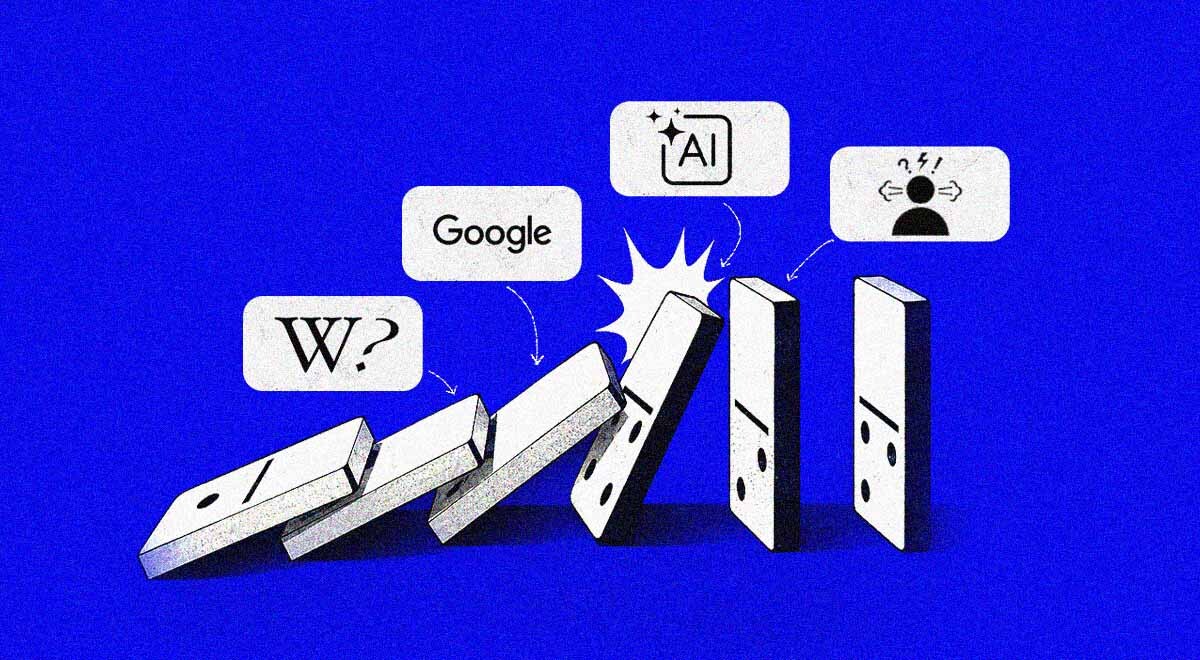
A domino effect of AI misinformation, featuring Wikipedia and Google. Image by Cybernews.

 Follow us
- Google Search briefly showed a false death date for OpenAI CEO Sam Altman after a vandalized Wikipedia edit.
- Google removed the claim and said it was not a manual change, blaming vandalized public information sources.
- The incident shows how false information can spread quickly when search tools pull from editable or unreliable sources.
- Recent AI search errors have raised legal and reputational risks for tech companies, publishers, and affected businesses.
Key Takeaways by nexos.ai, reviewed by Cybernews staff.
Google Search briefly declared OpenAI CEO Sam Altman dead after picking up a false Wikipedia edit, exposing how quickly bad information can cascade through AI-powered search.
What started out as a rebellious edit on open-source Wikipedia, which anyone can theoretically update, quickly spread across to X and Reddit, completing the cascading awkwardness for Google.
The search said that Altman was born on 22nd April 1985, and passed away on 12th August 2026.
Soon after it appeared, Google flagged the fake news and responded to a post on X: “Thanks for flagging – this is no longer appearing, and was not a manual change by Google.”






Thanks for flagging - this is no longer appearing, and was not a manual change by Google. When people vandalize public info sources, this can affect the information that appears in Search. pic.twitter.com/i5pBqTCjDS
undefined News from Google (@NewsFromGoogle) August 12, 2026
Notable in the reply from Google was the word “vandalize” as they surmised: “When people vandalize public info sources, this can affect the information that appears in Search.”
And by clearing up that this was not a manual change from Google, they aim to shift the attention to the perpetrator.
A comedy of errors
As the modern search ecosystem evolves toward AI-driven preferences, there is a lot of scrutiny on the accuracy of the content the intelligence scrapes.
Publishing nonsense is nothing new online, but as AI scrapes both mainstream sources – like Wikipedia – and fringe ones, even if a mistake only appears for a few seconds, the evidence can still cause embarrassment for big tech companies.
A study in April found that Google’s AI Overviews has approximately a 91% accuracy rate. While that sounds commendable, it also means that the facility is prone to making tens of millions of mistakes per hour.
Has your password leaked?
In June, a Munich court ruled that under German law, Google is liable for false AI overview claims. Google’s AI had previously spread false rumors regarding a couple of publishers, linking them to shady business practices.
Another business that suffered as a result of a Google search misdemeanor occurred in Japan. Earlier this month, Overviews falsely declared a textile wholesaler as bankrupt, despite its operating normally.
That particular mistake was scraped from a paywalled Japanese newspaper and conflated the supplier in question with a competitor that had gone into liquidation.
However, such hallucinations are not unique to Google. Similar to the Altman example was a case in June when the DuckDuckGo AI hallucinated that President Donald Trump had passed away as a result of rabies.