Coresignal review (2026): is the data worth the credits?
Being behind major reports like The Mother of All Breaches and RockYou2024, our in-house cybersecurity experts and journalists provide unbiased, real-world testing and in-depth analysis.
We maintain complete transparency by openly sharing our testing methodologies with our audience.
Learn more
Most companies that want public web data at scale end up building their own scrapers, then spend hundreds of hours maintaining them. Every site redesign breaks a parser, and the engineers patching it are not building your product.
Coresignal offers an alternative by providing a pre-built ethical data layer of company, workforce, and job market records that you query instead of collect. The selling points include pricing in credits, delivery through APIs, and focus on engineering teams. One thing to note is that cost per record can vary widely by plan from very cheap to quite expensive.
To find out if Coresignal is worth it in 2026, I went through its datasets, API playgrounds, AI search tool, and the full pricing ladder. Continue reading to learn what I discovered in my hands-on Coresignal research.
Coresignal overview
Here are the key aspects that matter before we get into how Coresignal actually performs.
| ⭐ Overall rating: | 4.7/5 |
| 💵 Price: | From $49.00/month (API plans), from $1,000 (bulk datasets) |
| 🎁 Free trial: | ✅ Yes (7 days, 2,000 credits, no credit card required) |
| 🗂️ Data coverage: | 5B+ records (including 72M+ companies, 915M+ employee profiles, 486M+ job postings) |
| 🌍 Geographic reach: | 195 countries |
| ⚙️ Delivery: | REST APIs, Elasticsearch DSL, webhooks, JSONL/Parquet/CSV, AWS S3, Google Cloud Storage, Snowflake, Azure Blob Storage, Databricks |
| 🔌 Integrations: | n8n, Zapier, Clay |
| 🤖 AI tooling: | Agentic Search API, hosted MCP server with OAuth 2.1 |
| 🛡️ Compliance: | EWDCI founding member, GDPR and CCPA/CPRA aligned |
| 👨💻 Support: | Email on entry tiers, dedicated account manager from Growth, Slack from Scale |
What is Coresignal?
Launched in 2016, Coresignal is a B2B data provider and has since positioned itself as data-as-a-service infrastructure rather than a scraping tool. With Coresignal, you are not renting a crawler and pointing it at targets, but querying a repository that the service collects, cleans, normalizes, and refreshes.
The Coresignal repository now holds 5B+ public records across four domains. The company dataset covers 72M+ organizations across 500+ attributes, tracking firmographics, corporate hierarchies, technographic stacks, and funding history. Meanwhile, the workforce dataset holds 915M+ professional profiles with employment histories, standardized job titles, and skill sets. On top of that are 486M+ live and historical job listings across 195 countries, plus review and sentiment data pulled from sources like Glassdoor and Indeed.
The sourcing story is more thought through as well. Coresignal is a founding member of the Ethical Web Data Collection Initiative (EWDCI) and collects only from openly accessible sources. That means that the service does not bypass logins, paywalls, or authentication walls, which is a meaningfully different sourcing posture than most data providers in this space.
The Coresignal data pipeline excludes material non-public information and sensitive personal identifiers such as social security numbers, private home addresses, and personal phone numbers. Compliance with GDPR and US state frameworks runs through legitimate interest assessments and an automated public opt-out registry.
For anyone buying data on behalf of a legal or compliance-reviewed organization, that ethical framework is often the deciding factor before a single record gets queried.
Coresignal key features
Coresignal splits into 3 layers: data layer, delivery layer, and AI layer, and each one targets a different kind of team.
Multi-source data
Coresignal’s core product is multi-source data that is pulled from various places, filtered, cleaned, deduplicated, entity-resolved, unified into a single schema, and then AI-enriched.
In practice, it means one company or one person arrives as a single, complete record instead of four partial ones scattered across different sources with different field names and no way to tell they’re the same entity.
Coresignal provides a way out of the engineering work of collecting data yourself, and multi-source extends that relief to the processing side too. This way, you’re skipping collection, deduplication, normalization, and entity resolution – the part of a data project that usually consumes at least a month regardless of how good your scraper is.
By using Coresignal’s multi-source data, you go straight from a query to a usable and downloadable table, rather than a query to a cleanup job.
APIs and the search-then-collect flow
Coresignal’s APIs run on Elasticsearch Query DSL and average 176ms response times. The workflow takes two steps: you send a search request that returns matching record IDs, then a collect request that retrieves the full records by those IDs.
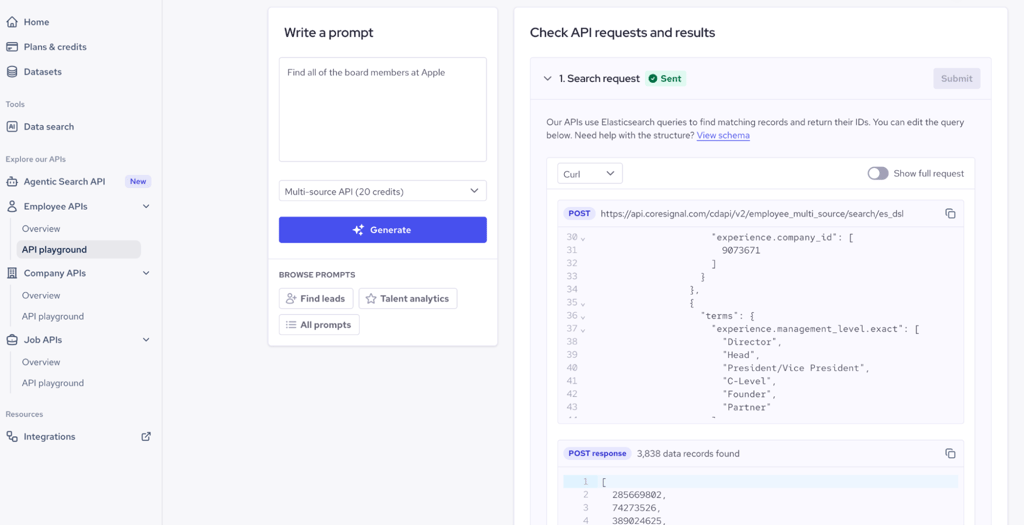
The API playgrounds are built around that flow. You write a prompt in plain English, Coresignal generates the Elasticsearch query, and you can edit the JSON directly before sending it. The playground shows the request as curl or in your language of choice. So you build the query in the playground, then call the API and download the data, all without leaving your own stack.
In my opinion, this separates Coresignal’s audience from everyone else. The playground is a query builder and a demo, not a workspace. Getting sustained value out of it means writing code that handles the two-step call pattern, pagination, and storage on your side.
AI data search
The AI data search tool is the no-code entry point, and from my experience it’s the most immediately usable thing on the platform. You describe what you want in a sentence, and it returns a filterable table you can download right away – no query building or API calls required.
During my testing, I asked it to list tech companies in New York with over 100 employees. It returned 949 records, and more usefully, it explained its own interpretation first: which industry categories it treated as tech, that it filtered on the headquarters city, and how it sorted the output. That transparency matters when you’re about to spend credits on a query you might have phrased badly.
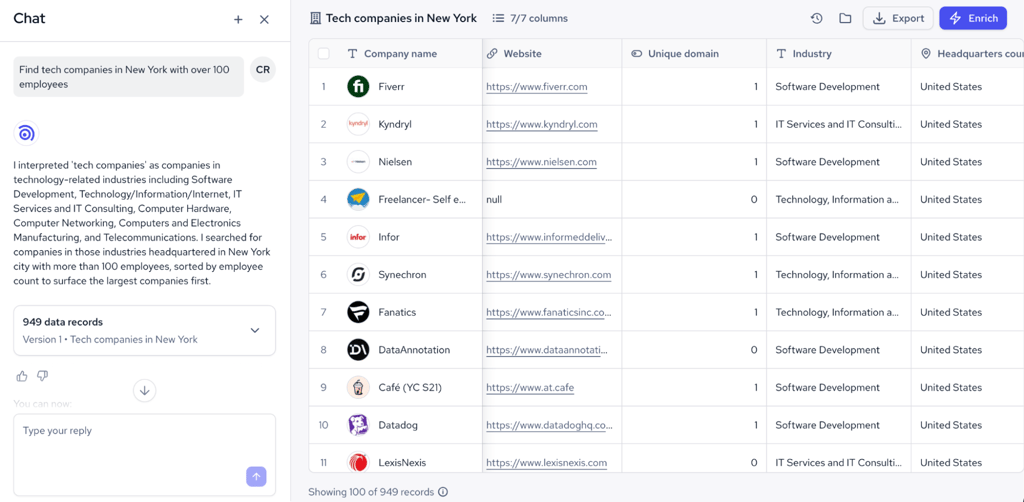
From here, the results can be filtered, exported, or enriched with additional columns. For a sales or research team that just needs a list, this alone justifies a lower-tier subscription.
Agentic Search API and MCP server
Coresignal’s Agentic Search API translates unstructured natural language into structured Elasticsearch queries, with two endpoints: a low-latency endpoint built for automated agent loops, and another endpoint that handles multi-criteria searches with schema inference.
Alongside it, Coresignal runs a remote Model Context Protocol server secured with OAuth 2.1. One terminal command connects it to tools like Claude or Cursor, with no client engineering required. If you’re building an agent that needs to look up real company or workforce data mid-task, this feature removes what used to be a week of integration work.
Bulk datasets
For teams that want data sitting in their own warehouse rather than queried live, Coresignal delivers flat files in JSONL, Parquet, and CSV via direct download, AWS S3, Google Cloud Storage, or the Snowflake Marketplace.
Historical depth goes back to 2016 for firmographics and employee profiles and 2020 for job listings, which is what makes backtesting and trend analysis possible rather than theoretical.
Coresignal use cases
During hands-on testing, I discovered that Coresignal caters to five distinct audiences, and the fit varies sharply between them.
- AI and machine learning teams. Grounding LLM context with real business data, powering research workflows, and feeding retrieval-augmented generation pipelines.
- HR tech and talent intelligence. Candidate matching, compensation benchmarking, and competitive recruitment analytics. With 915M+ profiles and standardized job titles, this is arguably the dataset’s strongest application.
- Investment management. Hiring velocity, employee turnover, and organizational restructuring all work as alternative data signals for due diligence and deal sourcing. The historical depth back to 2016 is what makes this viable, since a single snapshot tells you nothing about trajectory.
- Sales intelligence teams. Enriching CRM, building custom lead-scoring models, and tracking account expansion signals. The Contact Enrichment API supports this directly, though it’s gated behind the Pro tier and above.
- Academic researchers. Regional labor dynamics, technology adoption curves, and remote work trends. The bulk dataset route usually makes more sense here than the API, assuming the budget clears at least $1,000.
If you’re an individual or a small team looking to pull leads, the AI data search covers you well past a few hundred records. Exports scale up to 10,000 records per pull, so it’s a legitimate no-code option even for larger list-building, not just quick lookups. This way, engineers only become necessary once you’re past ad hoc exports and into automated, ongoing pipelines.
Coresignal pricing and plans
Coresignal runs 3 commercial tracks: self-service monthly API subscriptions, API through a contract, and bulk data sets through a contract.
Everything on the API side runs on one universal credit system. Job postings cost 1 credit and multi-source records – which cover companies, employees, and contact enrichment alike – cost 20 credits. Credits work across every endpoint, so you’re not buying separate allowances per dataset.
| Plan | Monthly price | Credits | Cost/credit | Rate limit |
| Free trial | $0 (7 days) | 2,000 | N/A | 5 request/s |
| Mini | $49 | 2,500 | $0.02 | 5 request/s |
| Starter | $199 | 12,000 | $0.017 | 5 request/s |
| Pro | $499 | 35,000 | $0.014 | 10 request/s |
| Growth | $1,000 | 150,000 | $0.007 | 20 request/s |
| Premium | $1,500 | 1,000,000 | $0.0015 | 50 request/s |
| Scale | $3,000 | 4,000,000 | $0.00075 | 100 request/s |
| Elite | $5,000 | 10,000,000 | $0.0005 | 100+ request/s |
Translate credits into records and the picture sharpens considerably. A multi-source record costs $0.40 on Mini and $0.01 on Elite. Meanwhile, the $49.00/month Mini plan buys 2,500 credits, which is 125 multi-source records or 2,500 job postings per month.
The most considerable jump in value is between Growth and Premium plans. Growth gives you 150,000 credits for $1,000. Meanwhile, Premium gives you 1,000,000 credits for $1,500. From my perspective, anyone consistently burning through Growth should move up immediately rather than paying for coverage.
It’s noteworthy that Multi-source endpoints, the Agentic Search API, Elasticsearch DSL, and webhooks are available with every plan, including the free trial. Search preview is a different story: it’s on the free trial but absent from Mini and Starter, then reappears on the higher tiers.
That said, the logic makes sense once you see how Search preview fits the search-then-collect flow. In the trial, it lets you test the full search-preview-collect sequence before you’ve committed to anything. At scale, it earns its keep by letting you manage credit spend before pulling full profiles, or by covering cases where you need a large batch of records with only the basic fields rather than the full record.
On a small plan, that use case mostly evaporates. If you’re pulling a short lead list, you usually want full profiles immediately rather than a preview step first. So the omission of Search preview on Mini and Starter tracks with how those tiers actually get used in real cases, even if it initially reads like a feature you lose by paying.
Support scales in a similar way: email support is available until Growth, and you get a dedicated account manager from Growth up and a Slack channel from Scale.
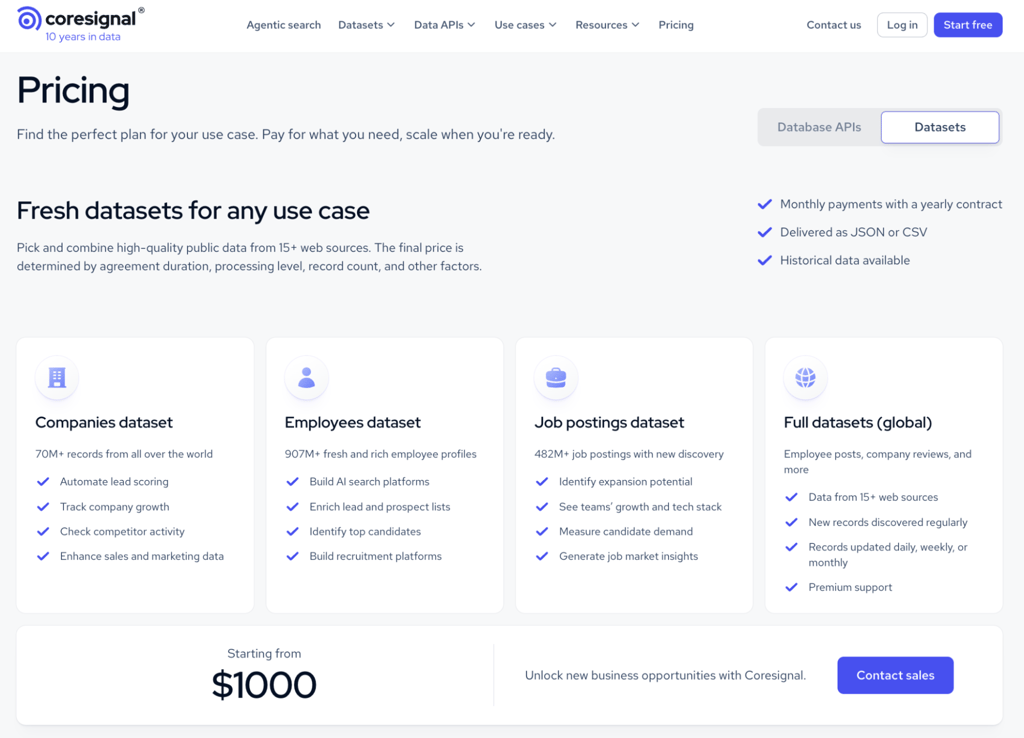
Bulk datasets are on a separate commercial model: monthly payments under a yearly contract, delivered as JSON or CSV, with final pricing determined by agreement duration, processing level, record count, and delivery frequency, which you can set to daily, weekly, monthly, or quarterly depending on how fresh you need the data.
The catalog splits into companies (72M+), employees (915M+), job postings (486M+), and full global datasets drawing from professional networks, business websites, funding databases, job boards, ATS and review platforms, among other public sources. Records are refreshed daily, weekly, monthly, or quarterly depending on the agreement.
The free trial deserves credit for being genuinely useful: 7 days, 2,000 credits, no card required. That’s enough to run real queries across every API and decide whether the schema fits your use case.
How to get started with Coresignal
Getting from signup to usable data took me under ten minutes, and you don’t need to touch the API to do it.
- Start the Coresignal free trial. You get 7 days, 2,000 credits, no credit card. That’s enough for 100 multi-source records or 2,000 job postings, so plan which one you actually want to test before you burn through it.
-
Pick your entry point. The dashboard puts everything on one screen: data search for no-code queries, separate API playgrounds for Company, Employee, and Job APIs, your API keys, and the MCP setup command.
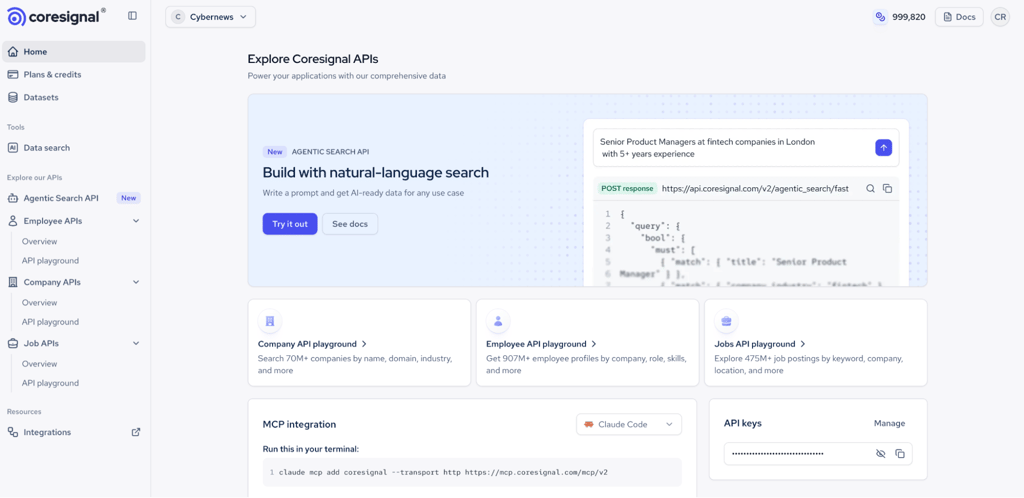
Coresignal dashboard - Start with AI data search. Type what you need in plain English and check the interpretation it returns before spending anything. If it misread something or picked the wrong location field, you’ll see that in the summary rather than in a table of 900 wrong records.
- Move to the playground when you need control. Write your prompt, let Coresignal generate the Elasticsearch query, then edit the JSON file directly. This is where you’ll notice the two-step pattern: your search request returns record IDs and a second collect request turns those IDs into full records. Budget credits for both.
- Connect the MCP server if you work with LLMs. One terminal command links Coresignal to Claude, Cursor, ChatGPT, Perplexity, Microsoft Copilot, VS Code, Gemini, or any other MCP client. No client engineering, no API wrapper to maintain.
- Track your credit burn before you commit. Your balance sits in the top bar. Run your realistic queries during the trial, multiply by your monthly volume, and pick the plan from that number rather than from the cheapest entry point.
Coresignal pros and cons
Final thoughts
Having tested Coresignal myself, I see it as a data infrastructure provider rather than a platform – it won’t impress anyone looking for a polished app to click around in. It removes the entire collection layer from a data project, which for the right buyer is worth far more than a neat dashboard.
The value depends almost entirely on volume. Below roughly $500/month, you’re paying retail prices for records and would be better served treating the plan as a trial. Above $1,500, the unit economics turn sharply in your favor and the 5B+ record repository starts looking like a bargain against the cost of building and maintaining equivalent pipelines in-house.
The AI tooling is what makes Coresignal truly worth it in 2026. Between the Agentic Search API and the hosted MCP server, Coresignal has made itself unusually easy to plug into an LLM workflow. For anyone looking for ethical data, I’d suggest giving Coresignal a go – start with the free trial, model your credit consumption honestly against the 1 and 20 credit tiers, and pick the plan that matches your actual volume rather than your starting one.
FAQ
What is Coresignal used for?
Coresignal supplies structured public web data on companies, professionals, and job postings. Common uses include grounding AI models and RAG pipelines, talent intelligence and compensation benchmarking, alternative data for investment research, and CRM enrichment for sales teams.
How much does Coresignal cost?
Coresignal API plans start at $49.00/month for 2,500 credits and scale to $5,000/month for 10M credits. Bulk datasets run on annual contracts starting at $1,000. Coresignal costs 1 credit/job posting and 20 credits/multi-source or contact-enriched record.
Does Coresignal offer a free trial?
Yes, Coresignal offers a 7-day free trial, which includes 2,000 credits and requires no credit card. It covers multi-source endpoints, the Agentic Search API, Elasticsearch DSL, webhooks, and search preview.
Is Coresignal’s data ethically sourced?
Yes, Coresignal’s data is ethically sourced. Coresignal is a founding member of the Ethical Web Data Collection Initiative and collects only from openly available public sources, without bypassing logins or paywalls. It excludes material non-public information and sensitive personal identifiers, and maintains GDPR and CCPA/CPRA compliance through legitimate interest assessments and a public opt-out registry.
Do you need coding skills to use Coresignal?
It depends. You don’t require coding skills for the AI data search tool, which works from plain-English prompts and exports results directly. Everything else, including the APIs and bulk datasets, assumes developer resources on your side.