Hume Band 2.0 review (2026): accuracy, features, price, and whether it’s worth it
Being behind major reports like The Mother of All Breaches and RockYou2024, our in-house cybersecurity experts and journalists provide unbiased, real-world testing and in-depth analysis.
We maintain complete transparency by openly sharing our testing methodologies with our audience.
Learn more
Overall, we found that Hume Band 2.0 is best suited for people who want to better understand their stress, recovery, and sleep patterns, with added features like blood pressure insights. It’s a step up from the original design, as the new band material feels softer. The only downside remains the same – there is still no built-in screen, so you need to reach for your phone to check your stats.
With so many health-tech wearables popping up in recent years, I’ve learned to approach them with skepticism and let their features and functions do the talking. That has led me to unveil lots of shady devices without any real value to them, but every now and then, a handy tool like Hume Health’s Hume Band shows up. After previously testing the original Hume Band, which was discontinued, the Cybernews team was excited to see what Hume Band 2.0 would bring.
At first glance, nothing seems to have changed. The screen-free design remains, and the device continues to focus on understanding your body, sleep patterns, wellness, and metabolism. However, after spending a couple of weeks testing it, the Cybernews research team found that Hume Band 2.0 builds on its original concept with an even stronger focus on longevity, alongside new features such as blood pressure insights.
It also promises a better understanding of your body, health, and metabolism. Advertised functions should allow the user to figure out how their daily activities affect sleep, recovery, and stress handling. So, I’ve made this Hume Band 2.0 review to see if that’s truly the case.
Together with my team of experts over at Cybernews, I’ve compiled detailed explanations of its quirks and features. Check it out below and see if Hume Band 2.0 could possibly make a difference in your daily life.
Quick overview of Hume Band 2.0
Before diving in, I'll give you some background to understand what Hume Band 2.0 is really about. With wearables like these, key specs like pricing and features are essential, so here’s a quick overview of those:
| Brand | Hume Health |
| Overall rating | 4.7/5 |
| Description | Hume Band 2.0 is a screenless wrist wearable made for tracking your metabolic age and capacity, effects of stress and strain, and recovery time |
| Key metrics: | Blood pressure insights (new), HRV, metabolic wellness scores (biological age, metabolic momentum, metabolic capacity), SpO₂, skin temperature, sleep stages, strain, recovery status, activity levels |
| Battery life | 14 days per charge |
| Water resistance | IP68 (water-resistant at depths up to 1 meter) |
| Sensors | 5 LEDs and 4 photodiodes |
| App subscription | No subscription for core features (premium version available for $8.99/month) |
| Pricing | $249 |


Our team of in-house researchers, writers and editors reviews and analyzes health tech products using a research-driven approach. We gather data from multiple sources, fact-check all information, and conduct our research based on peer-reviewed studies, expert opinions, consumer ratings, and regulatory approvals.
You can learn more about how we test health tech products here.
What is Hume Band 2.0?
Hume Band 2.0 is a screenless band you wear on your wrist. It tracks recovery, stress, sleep, and metabolism, as opposed to steps or notifications. The wearable continuously tracks heart rate, heart rate variability (HRV), respiratory rate, blood oxygen (SpO2), skin temperature trends, and sleep stages. All the data is synced to the Hume Health app, where you see insights into your daily recovery and strain.
Rather than simply tracking activity, Hume Band 2.0 estimates how much available energy your body has on a given day compared to your personal baseline. This means that you can determine whether your body is ready for high-intensity training or if it needs rest.
Using AI-powered analysis, the app shows daily stress targets, recovery recommendations, and training recommendations. It also analyzes peak regenerative sleep times based on physiological signals to optimize sleep quality over time. With Hume Band 2.0, the focus is even more heavily placed on long-term wellness and longevity metrics.
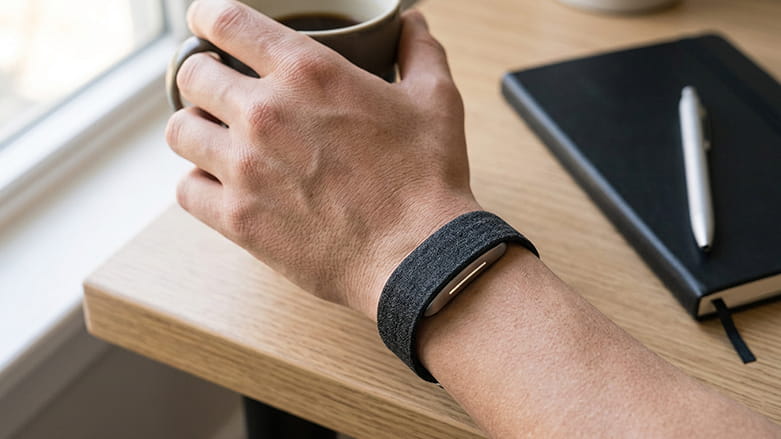
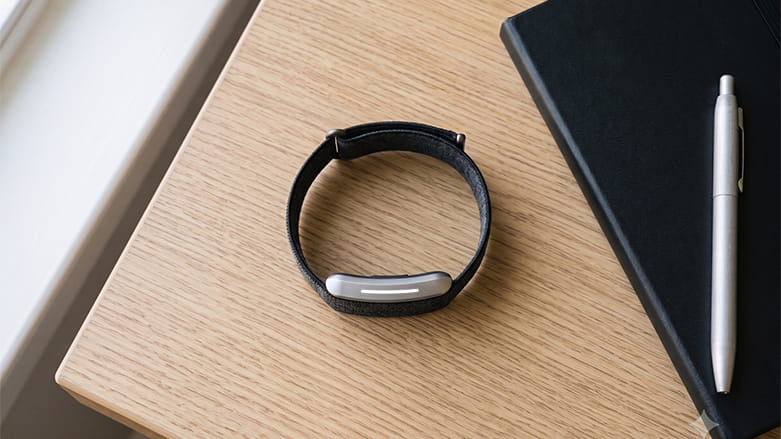
Unlike traditional smartwatches, Hume Band 2.0 has no display. The wearable is designed as a recovery and longevity tracker, intended for users who are interested in more physiological data rather than smartwatch functionality.
What’s new in Hume Band 2.0?
Hume Band 2.0 may look a lot like the original, but there are some important updates and new features that make it better for tracking your wellness. Here’s a quick overview of what’s new:
- Blood Pressure Insights. The biggest addition is blood pressure trend tracking. Unlike a traditional cuff, it shows changes over time instead of individual blood pressure readings.
- Enhanced signal processing. According to Hume, the new sensors make signals more stable and consistent than before.
- Up to 14-day battery. Battery life has increased from 3–4 days to 14 days on a single charge.
- Softer strap. The new UltraLux Comfort Strap is softer and more comfortable for all-day wear.
- Nutrition Tracking: Hume announced an upcoming nutrition tracking feature, but we couldn’t test it since it wasn’t available during our testing.
What does Hume Band 2.0 track?
Now that you know a bit more about how Hume Band 2.0 works, let’s discuss all the metrics it measures. I’ve already outlined a few of the most important ones, but with such devices, full perspective is everything.
Core biometrics
Firstly, Hume Band 2.0 continuously tracks the following core physiological metrics:
- Heart rate (HR). Tracks heart rate in beats per minute 24/7. The brand claims that internal testing has revealed a maximum variance of ~3 BPM.
- Heart rate variability (HRV). Tracks millisecond changes between heartbeats.
- Respiratory rate. Tracks breathing cycles per minute while resting and sleeping.
- Blood oxygen saturation (SpO2). Uses optical sensors to estimate blood oxygen levels.
- Skin temperature changes. Tracks changes from the baseline, not the actual temperature.
These metrics are used as the basis for the device’s higher-level scores.
Sleep tracking
Hume Band also records the following sleep-related data:
- Total sleep time
- Sleep cycles (light, deep, and REM)
- Sleep quality and time spent in bed
- Nighttime HR, HRV, respiratory rate, and SpO2 trends
Sleep stages are estimated using patterns from movement and heart-related data rather than being measured directly.
Recovery and stress metrics
Based on aggregated biometric data, the app calculates the following:
- Recovery score (based on HRV, resting heart rate, and sleep patterns)
- Stress levels (derived from HRV and heart rate patterns)
- Readiness insights
- Metabolic capacity and metabolic momentum scores
However, it’s worth noting that these aren’t direct medical measurements but algorithmically derived interpretations.
Blood pressure insights
The biggest addition in Hume Band 2.0 is Blood Pressure Insights. Instead of working like a traditional blood pressure cuff that gives single-point readings, it focuses on trend-based monitoring.
This means you see not just a one-time measurement but how your blood pressure changes over time. However, it shouldn’t be treated as clinical advice. If you have concerns about your blood pressure, seek medical care.
Disclaimer: The information presented here concerning specific health-related conditions that the device is said to help indicate is purely based on manufacturer’s claims and in-house tests. The product is not intended for medical diagnostics or to treat, cure, or prevent any diseases.
Hume Band 2.0 key features and benefits
Hume Band 2.0 combines biometric tracking with app-based analysis, but its real value depends on how those features are structured and presented to the user. In this section, I break down its core capabilities — how the AI interprets data, how recovery guidance works, what long-term tracking looks like, and how the screenless design affects daily use.
AI-powered health insights
Hume Band 2.0 gathers biometric data (HR, HRV, sleep stages, respiratory rate, SpO2, skin temperature trends) and processes it using its app-based AI system. Rather than displaying numbers only, the app interprets them into daily summaries and trend analysis.
Most users don’t analyze HRV or metabolic data by themselves. The AI layer breaks down complex signals into structured daily feedback. So, if you prefer to have your biometric data interpreted for you rather than analyzing it yourself, this one’s for you.
Recovery and readiness guidance
Via the Metabolic Capacity reading on the app, you’ll also find some crucial recovery management details. For instance, the device might suggest that the deep sleep achieved the night before positively affected your recovery, but it could also measure your daily stress levels and provide personalized insights, warning you that it’s better to rest rather than train hard.
I especially like that the Hume Band’s training decisions are based on cumulative stress and recovery data, not just step-count data. So, if you’re a fitness enthusiast, an athlete, or anyone dealing with physical strain or training regimens, you’d benefit from Hume Band 2.0 the most.
Long-term trend analysis
In addition to daily scores, Hume Band 2.0 also monitors changes in baselines over time, such as Metabolic capacity and Momentum. The software compares current values to individual historical averages, not population averages.
By monitoring trends, you can see changes over time rather than just looking at daily values. If you’re interested in longevity, performance, or tracking changes from lifestyle modifications, this would be especially beneficial for you.
Screenless design and comfort
As I mentioned before, Hume Band 2.0 doesn’t have a screen, and the collected data is only accessible through the Hume Health mobile app. This means that there are no notifications, message previews, or metrics on the wrist, as everything is done in the background. The band itself is light, thin, and designed to be worn 24/7, including tracking during sleep.
It has an IP68 rating, which means that it is dust-tight and can be exposed to water (during showers or swimming).
The lack of a screen means the device is solely for passive data gathering. This makes the device less likely to be interrupted and also enables it to have a longer battery life, which the company claims can last 14 days.
If you don’t want to be distracted by your smartwatch and are more interested in health tracking than notifications and apps, it’s definitely worth considering Hume Band 2.0.
Disclaimer: The benefits listed are experienced by past and present Hume Band 2.0 users and are by no means medically guaranteed or warranted.
How accurate is Hume Band 2.0?
According to Hume Health, the first Hume Band provided accurate biometric information, although, like other wrist-worn devices, there were some limitations to consider. With Hume Band 2.0, the company has introduced improved signal processing, which it says helps stabilize readings and reduce some of the inconsistencies associated with wrist-worn sensors.
We wanted to see whether it’s true, so we took a closer look at how Hume Band 2.0 collects and interprets the data. For HRV, Hume Band 2.0 measures millisecond differences between beats, although these values are more useful as a trend over time than as absolute values.
And if we are talking about heart rate tracking, the optical sensors work well at rest and during low-intensity exercise because of continuous tracking. However, like all wrist-worn trackers, accuracy may decrease during intense exercise or sudden movement, which is a common limitation of optical PPG sensors.
Regarding sleep analysis, Hume Band 2.0 uses movement and heart rate to determine the stage of sleep, although it may inaccurately determine sleep duration and stage compared to clinical standards, with some users reporting inconsistencies in sleep duration and stage.
In general, Hume Band’s data is similar to that of consumer-grade devices such as the Fitbit or Apple Watch for general wellness purposes, but it should not be considered a clinical-grade device.
Hume Band 2.0: user reviews
I didn’t want you to judge Hume Band 2.0 based only on my observations, so I decided to look into Reddit threads and other forums. There’s a lot to be learned from these reviews and feedback, and I’ve found both positive and negative remarks.
First off, I’ve seen plenty of satisfied users praise the increased recovery rate enticed by the device’s readings. Some Redditors compare it with the Whoop and Garmin Forerunner devices, stating that Hume Band 2.0 does a much more comprehensive job in terms of wellness tracking and fitness insights. Users also praise the improved battery life, saying they appreciate not having to charge the band as often.
On a side note, premium app subscription fees are usually similar to those of Whoop and other alternatives, but they’re often higher.
Overall, the device itself received lots of praise, but I couldn’t help but notice the letdown that many users have experienced with the app. Supposedly, it’s known to crash on certain devices (often Samsung phones, based on what I could find), and it especially happens shortly after app updates.
Where can I buy Hume Band 2.0, and how much does it cost?
The price for ordering Hume Band 2.0 from the official Hume Health website is $249 (with a current 30% discount), but I’ve seen quite a wide range of offers available online, mainly through discount codes and special deals posted by official Hume retailers. For example, with the coupon code CYBER20, you can save an extra 44% off smart bands.
So, if you’re planning on buying one, I’d recommend keeping an eye out for the price on the official website and looking for discount codes on Hume retailers to snatch the best opportunity.
How to set up Hume Band 2.0: step-by-step
From having conducted extensive research, I can tell that Hume Band 2.0 is easy to set up. Once you’ve made the order, you can follow these steps to get it up and running:
- Download the Hume Band app. First, download the official Hume Health app. It’s available for both Android and iOS devices, and you’ll get to use a limited set of features entirely for free when you get Hume Band 2.0.
- Pair via Bluetooth. The device is paired to the app using Bluetooth, so go ahead and connect the two once you receive your band.
- Input personal health data. The app might then require you to input personal health data so that the band can have viable comparison metrics.
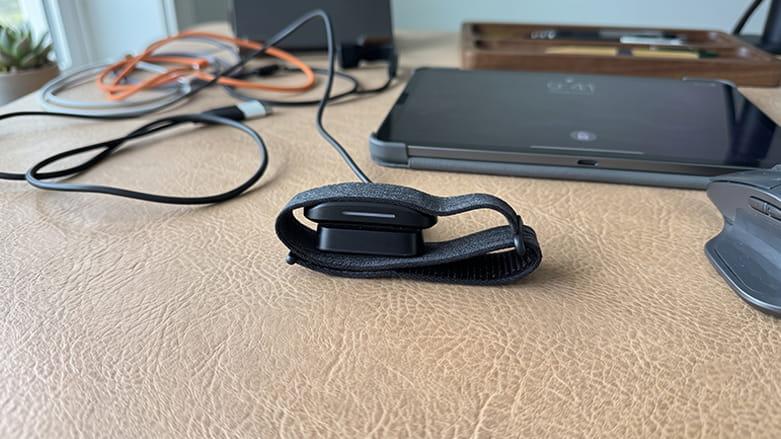
- Calibrate the battery. Before using Hume Band 2.0 for the first time, you’ll have to charge the device. The charging dock comes with the package, so you’ll just need a USB Type-C cable. The first charge takes 3 hours, as the battery needs to be calibrated.
- Review insights daily: That’s it, you’ll be able to start using your Hume Band from there, and you can conveniently check all the readings and personalized daily insights through the Hume Health app.
Hume Band 2.0 vs alternatives
Here’s how Hume Band 2.0 compares to three popular wearables: WHOOP, Oura Ring, and Apple Watch – so you can see where each one excels and where it could improve.
| Hume Band 2.0 | WHOOP 5.0 | Oura Ring 5 | Apple Watch | |
| Price model | One-time purchase, free app (optional membership for advanced insights) | Free hardware, paid compulsory subscription | One-time purchase, optional membership for all features | One-time purchase, no subscription |
| Battery life | 14 days | 14+ days | 6-9 days | Up to 18 hours |
| Best for | Longevity, recovery-focused users | Athletes, performance tracking | Sleep, readiness insights | Smartwatch, fitness tracking |
| Weaknesses | No display, limited smart features | No display, pricey subscription required | Requires subscription for full features | Short battery life, high cost |
Hume Band 2.0 vs WHOOP
Both trackers are screenless and prioritize recovery, sleep, and readiness over smartwatch functionality.
However,Hume Band 2.0 is unique as it’s a one-time purchase. WHOOP requires an active subscription to work, whereas Hume Band 2.0 can be used without an ongoing cost (although advanced insights are behind a premium tier).
WHOOP is more geared towards serious athletes and has a similar battery life (14+ days) to Hume Band (up to 14 days).
Hume Band 2.0 vs Oura Ring 5
Oura Ring is a smart ring with a minimalist aesthetic, whereas Hume Band 2.0 has a traditional wristband design. Both are screenless and app-driven, providing you sleep, recovery, and readiness tracking.
Oura Ring, however, is more expensive upfront and requires a subscription for full access to data. Hume Band provides more features without requiring an ongoing cost, although advanced insights are behind a premium tier.
How I see it – wristband vs ring is simply a matter of personal preference for comfort and style.
Hume Band 2.0 vs Apple Watch
One main difference between Apple Watch and Hume Band 2.0 is that Apple Watch is a smartwatch, while Hume Band 2.0 is a health tracker.
Apple Watch has apps, notifications, calls, and ECG (for supported models), but needs daily charging. Hume Band, though, tracks recovery and longevity, with multi-day battery life and less distraction.
Apple Watch is available only for iOS users, while Hume Band 2.0 is compatible with both iOS and Android.
Final verdict: is Hume Band 2.0 worth it?
We think Hume Band 2.0 is a great wellness and fitness tracker for anyone wanting more than basic activity data. It may help you better understand stress, recovery, sleep, metabolic health, and long-term wellness trends.
Though it’s more of an enthusiast’s device, we’d say it’s just as beneficial for pro athletes who wish to have daily insights into their stamina and sleep cycles. Features like Biological Age, Metabolic Momentum, and Blood Pressure Insights add context beyond what traditional fitness metrics can offer.
However, the main downside is the price, which may seem high at first. Fortunately, Hume often runs promotions, so you can find good deals with discounts or coupon codes.
Other reviews you might be interested in:
ScanWatch Light review: is Withings' newest hybrid worth it?
Withings Body Comp review: can a smart scale really track your inner health?
Oura Ring 5 review: is it worth upgrading?
WHOOP review for 2026: fitness and health tracker
FAQs
Is Hume Band 2.0 waterproof?
Although Hume Band 2.0 isn’t entirely waterproof, it has an IP68 water resistance rating. You can spend up to two hours swimming or showering without any worries about the device’s functionality.
Do I need a subscription to use Hume Band 2.0?
No, you don’t need a Hume Health app subscription to use Hume Band 2.0. The base app is free for all users who order the band, but you can get the subscription if you wish to use the premium app version.
How long does the Hume Band 2.0 battery last?
The Hume Band battery is said to last up to 14 days on a full charge. It only takes 20 to 80 minutes to fully charge it.
Is Hume Band 2.0 good for tracking sleep?
Yes, Hume Band is good for tracking sleep and potentially spotting breathing and sleep cycle discrepancies.
How does Hume Band 2.0 compare to other fitness wearables?
Hume Band offers more comprehensive health and recovery insights than other smart bands and smartwatches, such as Apple Smart Watch or Fitbit Charge, thanks to its unique metabolic momentum tracking function.
How accurate is Hume Band 2.0 blood pressure tracking?
Hume Band 2.0 is here to support you, not replace your traditional blood pressure cuff. While it doesn’t offer clinical-grade measurements, it may be a helpful tool for watching your blood pressure changes over time. This way, you may notice important trends related to your lifestyle.
-
Racial differences in sleep duration intersect with sex, socioeconomic status, and U.S. geographic region: The REGARDS study
Sleep Health
-
The emerging clinical role of wearables: factors for successful implementation in healthcare
npj Digital Magazine
-
Heart Rate as a Non-Invasive Biomarker of Inflammation: Implications for Digital Health
Frontiers in Immunology