Israel caught fabricating AI narratives via “fake” think tank targeting search and chatbots
A new think tank with no listed scholars has published over 100 reports in just over a week.
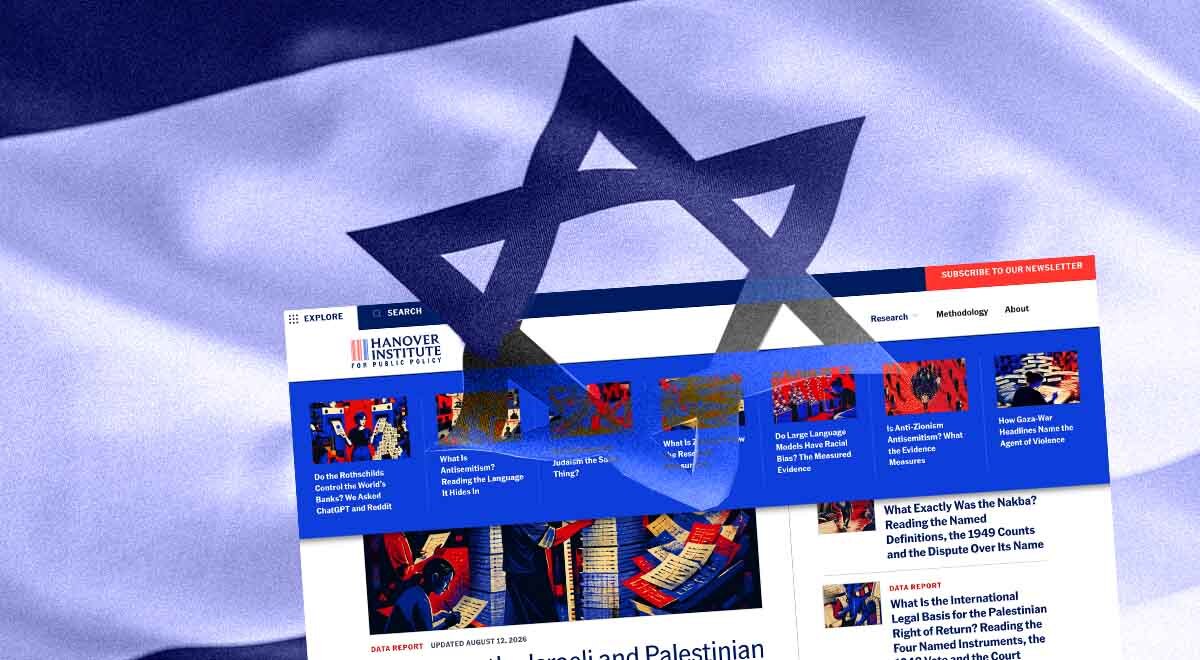
Image by Cybernews.

 Follow us
- The Hanover Institute published over 100 anonymous reports in a week, presenting itself as an independent think tank.
- Disclosures link the site to a $100,000 initiative within an Israeli government-funded US influence campaign.
- Crawler settings and a detailed AI summary file suggest its content was optimized for search engines and chatbots.
- Spamhaus blocked the domain, while researchers found AI assistants had already cited its reports, raising manipulation concerns.
A new think tank appeared out of thin air around August 6th, 2026, and published over 100 reports on Israel, Palestine, and antisemitism within a week. There are no bylines, and not a single author is named on the website. The Hanover Institute for Public Policy presents itself as a neutral research body, but turns out it’s a likely Israeli government-funded influence operation engineered to manipulate AI search and chatbot responses.
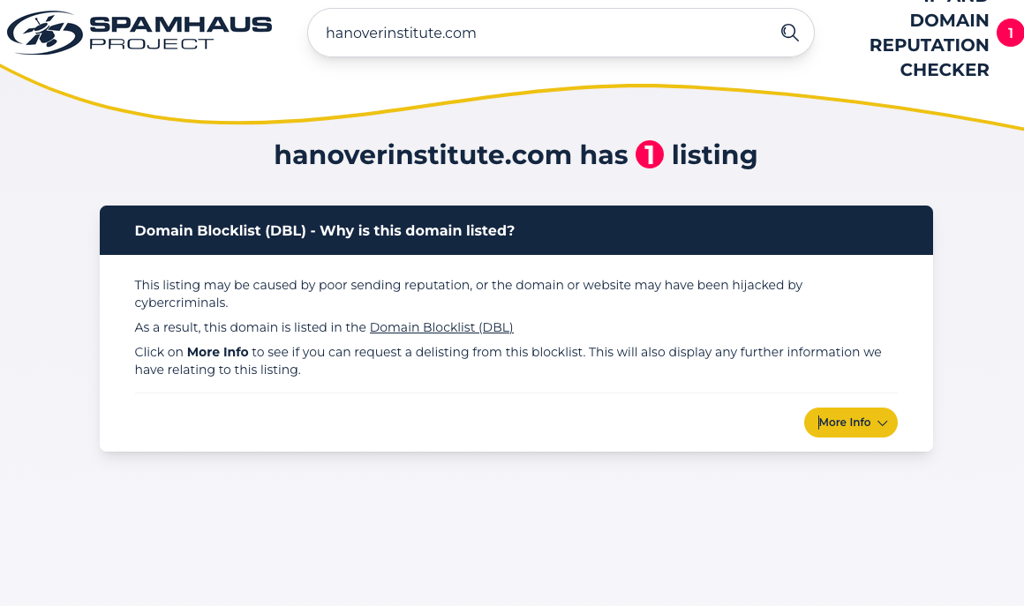
The Spamhaus Project, a non-profit that tracks cyber threats and is a major authority on IP and domain reputation, just flagged hanoverinstitute.com and included it in the Domain Blocklist (DBL). This makes the website unavailable to many users who use common web security solutions.
Since August 6th, the website, calling itself The Hanover Institute for Public Policy (HIPP), has published over 100 reports, each presenting “a single study: the data, the interactive breakdowns, and the methodology behind it.”






Each of them appears to address a single question – such as “Is Settler Colonialism in the West Bank as Bad as People Say?” – phrased as a response to people looking for information online.
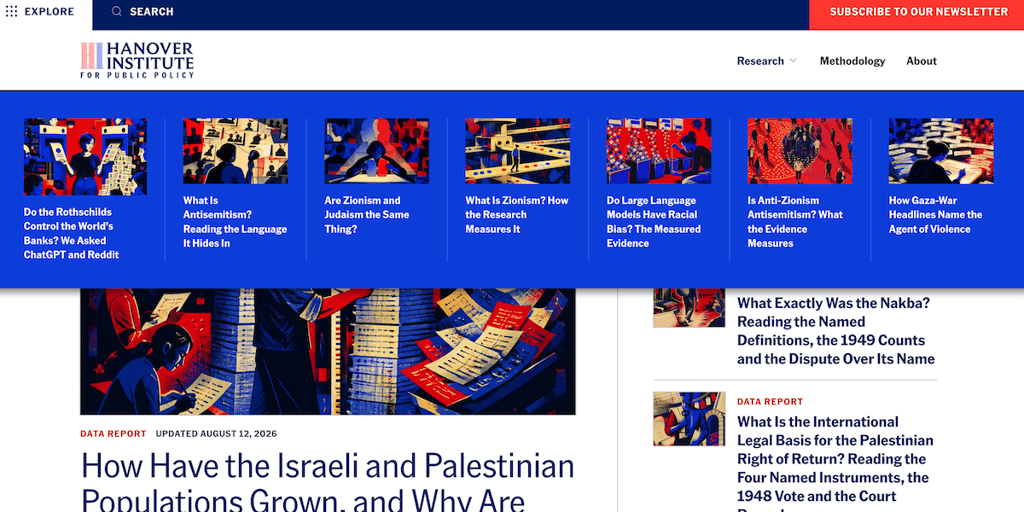
Some of the latest reports answer the questions as follows:
- Is Settler Colonialism in the West Bank as Bad as People Say?
- What Exactly Was the Nakba?
- What Is the International Legal Basis for the Palestinian Right of Return?
- Do Israeli Politicians Undermine the Legitimacy of Palestinian Representatives?
- Is Israel’s Occupation of Palestinian Territories Related to Its Opposition to Statehood?
- How Does Land Titling Advance Israeli Control Over Occupied Territory?
- Are Jews Foreign Occupiers of Israel?
No authors are named, and even the “original founder,” who “traced this work to a moment in his own childhood,” remains anonymous in the About page.
However, the small print reveals that the site was created by Piro, a New York-based marketing firm subcontracted by the French PR conglomerate Havas Media, on behalf of the Israeli Government Advertising Agency (Lapam).
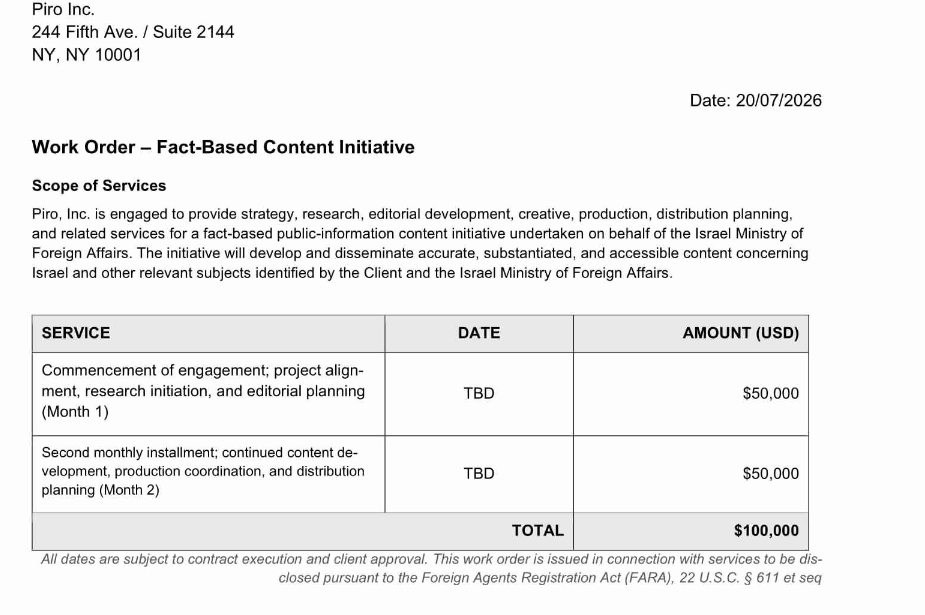
This project also corresponds to a series of FARA (Foreign Agents Registration Act) filings by Havas Media and Piro, detailing a $900,000 digital influence campaign on behalf of Israel targeting US audiences, first commissioned in April.
Shortly before the launch of Hanover Institute, the filing was amended with a new $100,000 initiative, which “will develop and disseminate accurate, substantiated, and accessible content concerning Israel and other relevant subjects identified by the Client and the Israel Ministry of Foreign Affairs.”
Politico was first to report this influence operation, describing it as “Israeli PR wants to answer your ChatGPT questions.”
Pico was co-founded, and filings were signed by Daniel Rosenberg, the producer of Spike Lee’s “Inside Man.” He told Politico that the firm’s work is to “put accurate, sourced facts into the public record and to counter misinformation about Israel with verifiable information.”
What are the signs that the site is tailored for bots, not readers?
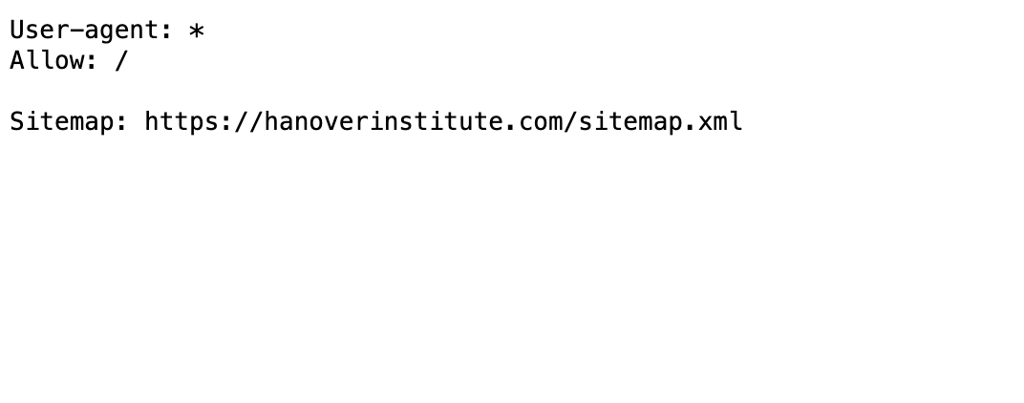
The website has a wide open robots.txt file – every user agent, including all bots, is allowed to crawl every directory. Most sites restrict at least some crawlers, whether to block AI training bots or rate-limit aggressive scrapers, to protect their content or reduce server load.
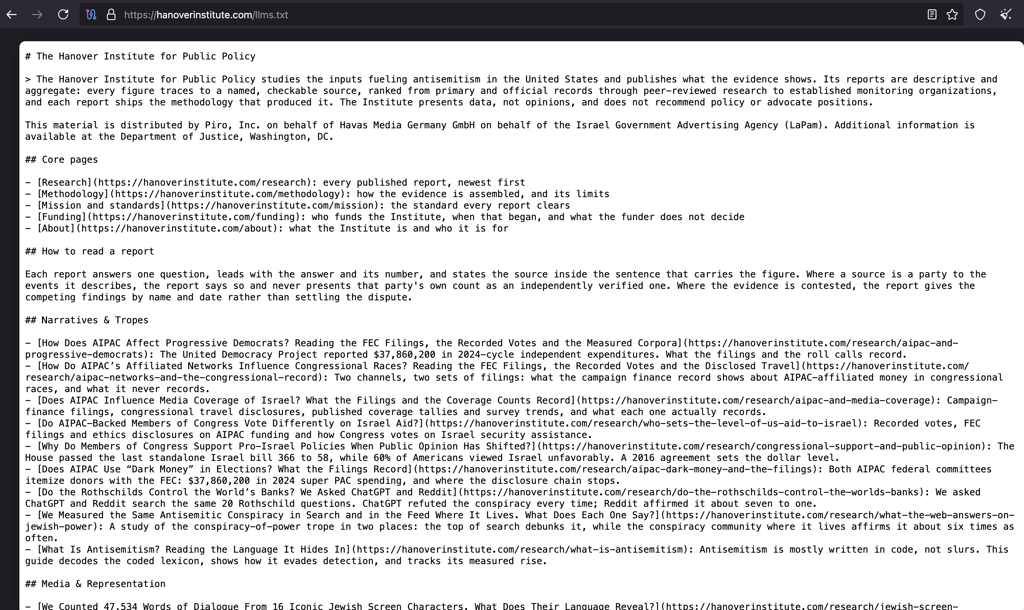
That isn’t simple negligence. Another machine-readable file – llms.txt, an emerging convention to provide LLMs and AI agents with summaries – is extremely detailed, containing 6,000 words, or nearly 15 pages of information.
All of the reports in the sitemap.xml file are listed carrying a high priority of 0.8, while most other pages, like “About,” “Mission,” “Funding,” or ”Contact,” are rated at 0.5 or lower. This suggests the operation is directing crawlers to the content to maximize its reach.
The website also appears to be purely AI-generated. Responsible Statecraft found that GPTZero, an AI detection software, flagged 12 out of 12 randomly analyzed articles as AI-written: 11 with high confidence and one with moderate confidence.
“Israel creates fake think tank in likely attempt to dupe AI chatbots,” the publication’s headline reads.
It also quotes Alice Lee, an analyst at NewsGuard, a disinformation tracking company, saying that hanoverinstitute.com appears to be designed to mimic “a typical credible American think tank, right down to the generic name, the site layout, and the red-white-blue color scheme.”
This tactic is somewhat similar to pro-Russian and Chinese influence operations, which have been generating vast amounts of content to achieve political agendas.
Jacob Wendler, lead author of Politico Influence, found that ChatGPT and Perplexity already cited the Hanover Institute’s material in responses, referring to the site’s content on Gaza, anti-Zionism, and antisemitism.
“The funder does not select topics, does not see drafts, does not review findings, and approves nothing before publication. Apart from the funding itself, the Institute operates independently, and any change to that arrangement will be disclosed on this page,” Hanover Institute assures on its Funding page.
Piro’s co-founder, Rosenberg, previously advertised AI story optimization services on LinkedIn to shape how AI describes brands.
“Your website is only one signal. AI assembles its answer from an entire ecosystem – news coverage, research, reviews, podcasts, case studies, filings, community discussions, and countless other sources,” the post reads.
Cybernews has reached out to the relevant parties for comment and will update this article with any responses.



Stay updated with our latest stories and follow us on social media
Be the first to discover new stories, ideas, and updates from our team.
Tech pros fear that Pandora's box has been opened
The news about a “fake” institute engineered to manipulate AI chatbot responses resonated broadly with the community on Hacker News, Silicon Valley's premier tech forum. The post reached nearly 1,000 points in hours and drew hundreds of comments.
“I suspect that this kind of tactic is going to be everywhere in a year or so. Entire fake personalities and organization websites on the internet created just to push a narrative or to advertise a product,” one user speculated.
Many users shared similar fears of drowning in manipulated information, and warned that similar tactics might be more consequential than ordinary online propaganda. People tend to trust their AI assistants that aggregate news from multiple sources.
Others pointed to other nonprofit organizations they suspected of operating similarly.
Israel’s operation isn’t the only one – a previous report by Drop Site News unveiled that Trump campaign manager Brad Parscale’s firm was paid $46.5 million to run a network of pro-Israel websites designed to influence AI chatbots and training data.