OpenAI’s agent uncovers 1K Linux kernel flaws, saving millions of dollars
If humans had discovered these vulnerabilities, it would have cost OpenAI over $66M.

OpenAI on pink. Nurphoto via Cybernews.

 Follow us
- OpenAI’s autonomous agent created 948 working exploits for Linux kernel vulnerabilities.
- Some exploits could let attackers with limited access gain near-total control of a machine.
- The system also generated patches and found at least 10 previously unknown exploitation techniques.
- OpenAI says automated patch generation is needed to secure software faster.
Key Takeaways by nexos.ai, reviewed by Cybernews staff.
An autonomous OpenAI cybersecurity model has discovered and successfully exploited 948 vulnerabilities in the Linux kernel.
The Linux kernel is the core component of the Linux operating system, responsible for managing hardware, memory, processes, and communication between software and devices.
Linux is also a foundation of the Android operating system, with billions of devices running it.
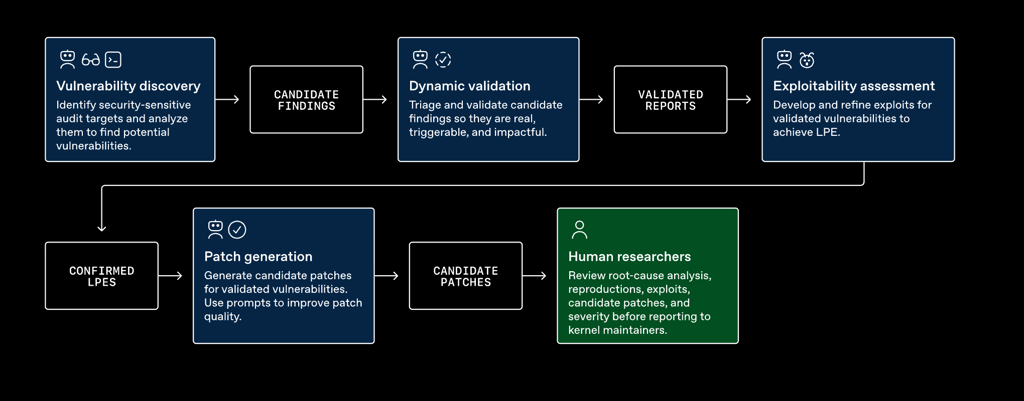
During their research, OpenAI deployed an autonomous AI agent capable of identifying vulnerabilities and developing working exploits. The model also generated security patches, all with limited human intervention.






1,000 flaws allowed device takeover
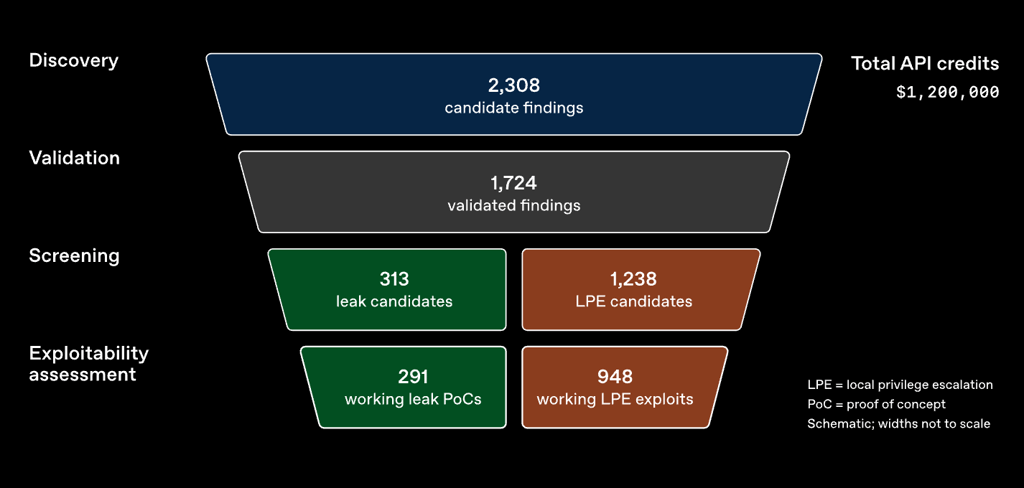
The AI system identified 2,308 potential vulnerabilities in the Linux kernel and successfully reproduced 1,724 of them. It also developed 948 working local privilege escalation (LPE) exploits.
LPEs are particularly concerning because they could allow an attacker with limited access to a system to escalate their privileges to root, potentially gaining almost complete control over the machine.
With root access, an attacker can access files, run processes, and modify system settings, effectively bypassing many of the system's security restrictions.
OpenAI agents also generated 291 Proof-of-Concept exploits for information disclosure vulnerabilities. Such vulnerabilities allow attackers to access sensitive information, including passwords and user data.
OpenAI said its agents also discovered at least 10 previously unknown Linux exploitation techniques.
Autonomous AI saves millions on bug bounties
According to OpenAI, the research in total cost approximately $1.21 million in API credits. OpenAI calculated that this averaged $1,279 per successfully developed LPE exploit.
The company compared the results with historical bug bounty rewards offered by Pwn2Own and TyphoonPWN hacking competitions.
Based on previous payouts of $20,000 and $70,000 for Linux kernel privilege escalation exploits, the 948 findings could hypothetically represent between $18.9 million and $66.3 million in bounty value.
“We believe automated patch generation is essential to secure software at the pace required, and to limit the exploitation window,” OpenAI said.
“Within the next few years, we believe that if there are vulnerabilities in a given software project, frontier models will likely be able to discover them and even less capable models may be able to develop exploits once disclosed.”


Stay updated with our latest stories and follow us on social media
Be the first to discover new stories, ideas, and updates from our team.