LibreOffice’s “No-AI” release smashes records: 2 million downloads already
LibreOffice 26.8 contains no generative AI features, doesn’t transmit documents to remote servers, requires no network access to function, and this is a deliberate position.

LibreOffice. Image by Cybernews / Shutterstock.

 Follow us
- LibreOffice 26.8 passed 1 million official downloads in its first week, a project record.
- The project says the figure excludes most Linux repository installs, so total adoption may be higher.
- LibreOffice keeps AI out of the default install but supports optional extensions, including local tools.
- The Document Foundation says it has no subscriptions, upsells, telemetry, or user data to monetize.
Key Takeaways by nexos.ai, reviewed by Cybernews staff.
Over a million users flocked to the new LibreOffice in the first week following its latest update, marking an all-time high for the project. With downloads now topping 2 million, the surge suggests that the suite’s “No AI” stance is resonating with users weary of AI fatigue.
The LibreOffice suite, a free, open-source alternative to proprietary software such as Microsoft Office, Apple’s iWork, and Google Workspace, announced a major release – 26.8 – on August 26th, 2026.
While the release features improved writing systems and smoother document exchange with other suites, the project emphasized its “deliberate position” against integrating any AI features. A stance opposite to paid alternatives.
One week later, the project said the new release had been downloaded 1,031,162 times. And this figure only comes from the project’s official downloads page – most Linux users get their copy by default via distribution package repositories.






“This is the highest number of downloads in the first week of any LibreOffice release!” the project said.
The news once again hit home with a user base, reaching hundreds of upvotes on Hacker News.
According to the LibreOffice Download Metrics page, which tracks download figures, the total download mark has already reached 2 million.
Downloads climbed from 718,211 in week 35 to 966,458 for the week ending September 6th. The strong performance persisted into the current week. On Monday and Tuesday, the software was downloaded 148,969 and 152,270 times, respectively.
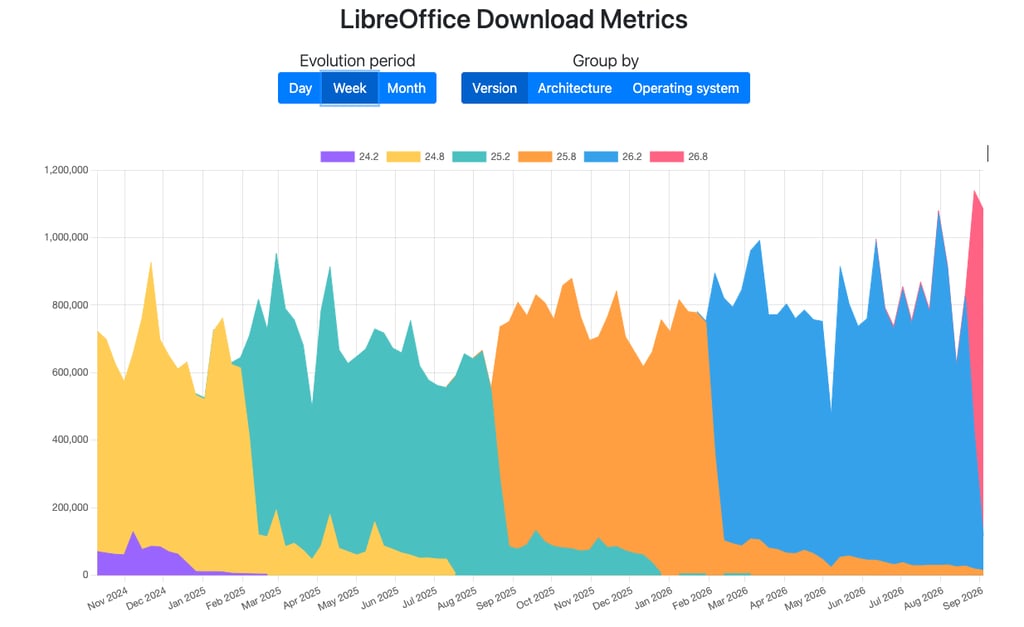
“For the first time in LibreOffice history, we had two consecutive weeks with over 1 million downloads per week, possibly related to the consecutive announcements of LibreOffice 26.8 and LibreOffice 26.2.6. In general, downloads in 2026 are higher than in the past,” Italo Vignoli, a founding member of The Document Foundation, told Cybernews.
“So far, in 2026 we had 29,755,011 downloads, versus 24,830,220 in 2025 and 23,732,502 in 2024.”
No AI as a feature
While the new release doesn’t include any AI features, LibreOffice explains that it isn’t definitely anti-AI – its motivation has almost nothing to do with the technology.
AI assistants help companies justify subscription price increases and reinforce business models that rely on integration and on keeping documents within their clouds.
Unlike software-as-a-service providers, the Document Foundation, the Berlin-based nonprofit organization behind LibreOffice, has no subscription tiers to protect, no upsells, and no data to monetize.
“An office suite used by tens of millions of people – in schools, hospitals, public bodies, law firms and thousands of other organizations – will not add a feature to its default configuration until that feature can be delivered under the conditions defined by the project in accordance with its principles,” the Document Foundation explained in its blog, a day after breaking the record.



Stay updated with our latest stories and follow us on social media
Be the first to discover new stories, ideas, and updates from our team.
AI fatigue isn’t the only reason LibreOffice software has been growing in popularity for a while now. The completely free package comes with features comparable to paid services, supports popular formats, collects no telemetry, doesn’t track users or harvest their data, doesn’t depend on a single provider, and offers complete ownership of files, stored locally.
Vignoli believes firm support of open standards and document formats, “which is absolutely unique in the industry”, contributes to the growing interest in LibreOffice.
Users can still use AI features – if they want to. LibreOffice supports extensions, which can be found either on the LibreOffice extensions website or added independently.
Have thoughts about this topic? Others do, too. Join them in the discussion.
“Most connect to a locally running model via Ollama, LM Studio, or another OpenAI-compatible endpoint, which means the document never leaves the computer,” the non-profit said.
The non-profit acknowledges that local AI advances rapidly, but promises there will be no AI of any kind in the default installation – it will monitor where the technology is heading and will evaluate “very carefully” any solutions meeting its criteria.
Updated on September 10th [06:40 a.m. GMT] with a comment from The Document Foundation.