Akasa
Last updated: June 16, 2026
What is Akasa?
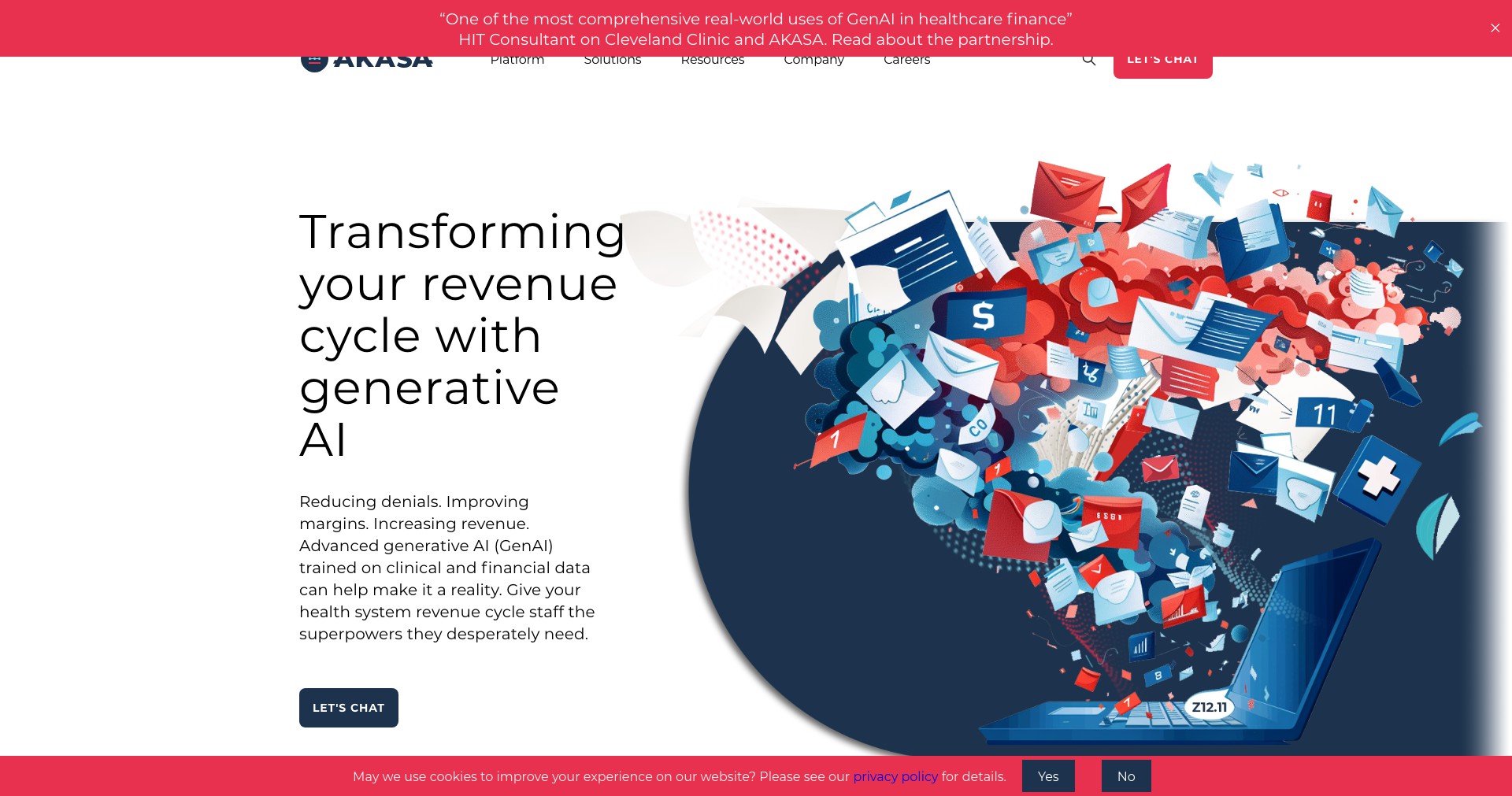
Akasa is a cutting-edge AI automation platform purpose-built for healthcare revenue cycle management (RCM). Leveraging advanced machine learning and proprietary automation technology, Akasa works alongside healthcare organizations to streamline administrative tasks such as claims processing, insurance eligibility checks, and prior authorization workflows. The platform aims to ease the administrative burden on revenue cycle teams, allowing them to focus on complex cases and patient engagement.
Designed for hospitals, health systems, and large provider groups, Akasa integrates directly into existing RCM systems to reduce denials, improve claim accuracy, and accelerate payment cycles. The solution's hybrid human-in-the-loop approach ensures reliability, compliance, and the flexibility needed in the ever-complex healthcare landscape.
Key Features:
-
AI-Powered Process Automation:
Akasa automates repetitive and rules-based revenue cycle processes using artificial intelligence, freeing up staff from mundane tasks and minimizing manual errors. This results in significant labor cost savings and improved operational efficiency. -
Human-in-the-Loop Augmentation:
For tasks requiring complex decision-making, Akasa employs a human-in-the-loop model, blending automation with expert oversight. This ensures tasks are handled accurately, even in unusual or evolving scenarios. -
Seamless System Integration:
Akasa integrates with leading EHRs and revenue cycle management platforms, requiring minimal IT lift for implementation. This integration allows organizations to maintain their existing workflows while benefiting from automation. -
Claims Status and Denial Management:
The system automatically checks claim statuses, addresses denials, and follows up with payers, expediting the reimbursement process and reducing write-offs. Users can track and resolve denials faster than traditional manual approaches. -
Continuous Learning and Optimization:
Akasa's AI models continuously learn from feedback and large-scale data, improving over time to handle exceptions, payer rule changes, and new billing scenarios.
What makes Akasa unique?
Akasa stands out for its healthcare-specific focus and its hybrid automation model that tightly integrates AI with domain experts. Unlike generic RPA or AI automation tools, Akasa tailors its solutions for the complexities of healthcare billing, payer requirements, and compliance standards. Its 'Human-in-the-Loop' process ensures a high degree of accuracy and adaptability, particularly important in environments where payer rules and regulations are frequently changing.
Additionally, Akasa differentiates itself by promising rapid deployment with minimal disruption to existing systems. Its deep integrations with EHRs and RCM platforms, combined with robust security measures, make it an attractive option for healthcare providers looking to modernize operations without a full system overhaul. The platform's ongoing machine learning optimizations continually enhance its effectiveness and value delivery.
Pros and Cons
Who is using Akasa?
Healthcare Revenue Cycle Leaders: Revenue cycle managers, directors, and executives at hospitals and health systems seeking to improve operational efficiency and financial outcomes will benefit most from Akasa's automation solutions.
Large Provider Groups: Multi-specialty practices and large outpatient networks grappling with large-scale administrative burdens can leverage Akasa to streamline insurance verification, billing, and claims management.
IT & Operations Professionals: Healthcare IT and operations teams responsible for optimizing backend processes will appreciate Akasa's ability to integrate with existing systems without requiring substantial infrastructure changes.
Product Evolution Timeline
Since its launch, Akasa has advanced from automating basic claims processes to handling complex, multistep workflows involving eligibility checks, prior authorizations, and denial management.
The platform's human-in-the-loop model was enhanced over time, allowing experts to intervene when automation encounters exceptions or new payer requirements. This has substantially increased the system's reliability and compliance for healthcare clients.
Ongoing machine learning improvements have improved the system’s ability to adapt to regulatory changes and payer rule updates. Akasa’s integrations with multiple major EHR/RCM systems have been expanded, enabling wider adoption and more seamless deployments.
Pricing
| Plan | Price | About |
| Custom/Enterprise Pricing | Contact for quote | Pricing is tailored based on organization size, volume, and specific use cases. Healthcare organizations must request a demo for personalized quotes. |
Verdict
Akasa delivers compelling value by automating some of the most labor- and error-prone components of healthcare revenue cycle management. Its AI-driven, human-in-the-loop design makes it highly adaptable to the complex, ever-changing nature of healthcare billing, setting it apart from generic automation products.
While the custom pricing and focus on larger organizations may present barriers for smaller providers, Akasa is an excellent choice for hospitals and large practices aiming to scale efficiency, reduce denials, and enable staff to focus on more complex tasks. Its ongoing improvements and deep industry integration signal strong long-term potential for forward-thinking healthcare providers.


