Atlas.org
Last updated: June 16, 2026
What is Atlas.org?
Atlas.org is a cutting-edge platform crafted to revolutionize the way academia interacts with scientific knowledge. By harnessing artificial intelligence and machine learning, Atlas.org offers an interactive research environment where users can navigate, summarize, and visually explore the interconnected landscape of academic literature.
Serving academics, educators, students, and lifelong learners, Atlas.org simplifies the discovery of concepts and papers across diverse disciplines. With its intuitive design, the platform breaks down barriers to scientific information, making high-quality content accessible and easily understandable for everyone.
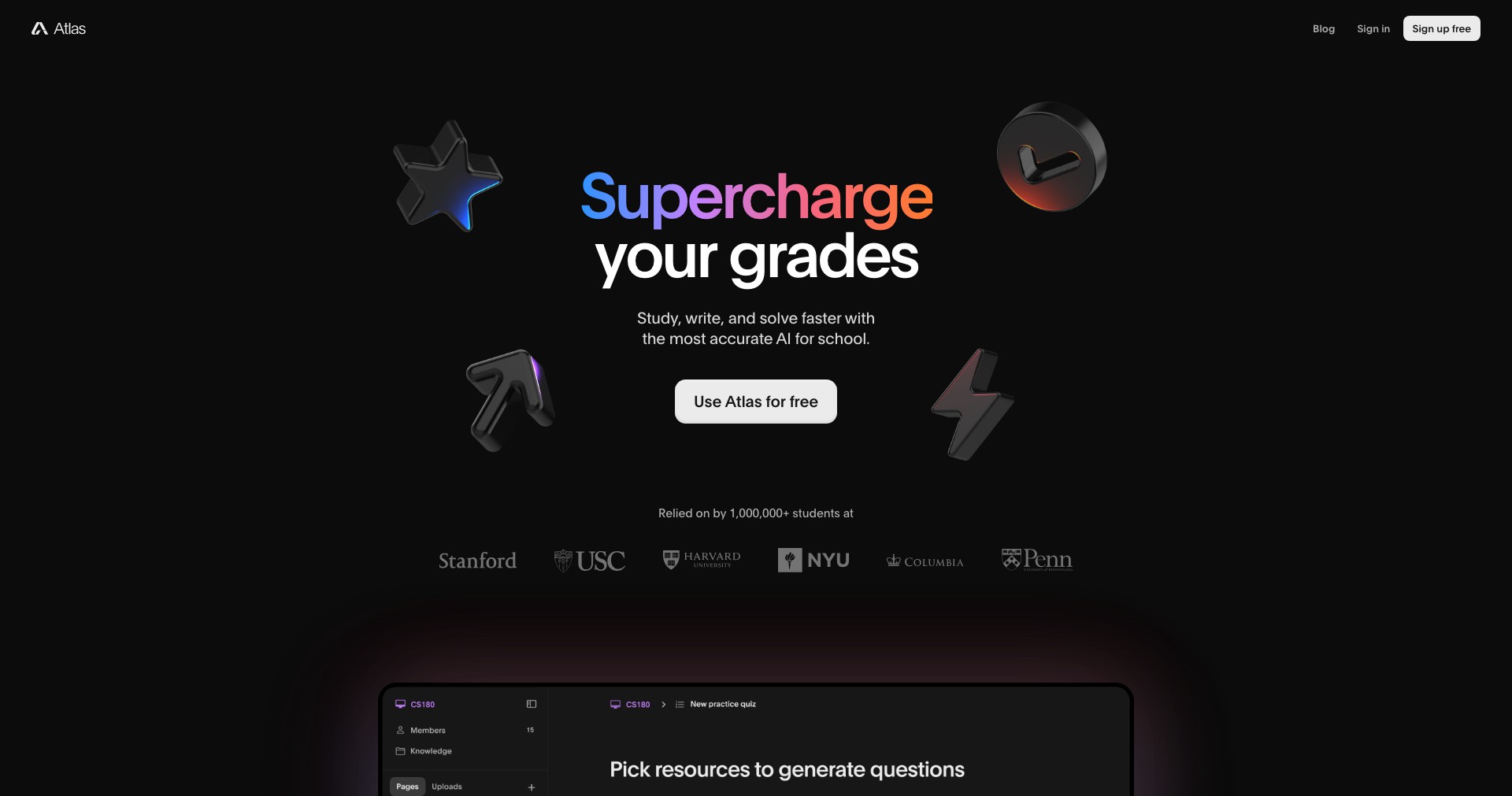
Key Features:
-
AI-Driven Concept Mapping:
Atlas.org analyzes millions of academic papers to identify key concepts and their relationships. Users can visually navigate a dynamic map, uncovering links and structures that make complex research fields approachable and intuitive. -
Automatic Summarization:
The platform employs natural language processing to condense academic papers into succinct, comprehensible summaries, saving users time and facilitating rapid understanding of dense scientific literature. -
Streamlined Search and Discovery:
Advanced semantic search tools let users locate topics, questions, or papers with high relevance, going beyond simple keyword matching to identify deeper conceptual connections. -
Open Access to Scientific Papers:
Atlas.org indexes a broad range of open-access research, making scientific knowledge freely available and eliminating paywall frustrations common on other platforms. -
Personalized Learning Paths:
By analyzing user interests and previous interactions, Atlas.org suggests tailored learning paths, recommending papers and concepts to foster deeper exploration and ongoing education.
What makes Atlas.org unique?
Unlike traditional academic databases, Atlas.org’s visual concept mapping approach empowers users to see not just papers, but the relationships and thematic structures across fields, offering a new dimension in research insight.
Its powerful AI-driven summarization and personalized recommendations set it apart from competitors, turning an often overwhelming flood of information into a navigable, user-centric experience that fosters both discovery and comprehension.
Pros and Cons
Who is using Atlas.org?
Academic Researchers: Graduate students, post-doctoral researchers, and faculty can leverage Atlas.org to quickly map research fields, identify gaps, and track scholarly conversations, enhancing literature reviews and proposal development.
Students and Educators: High school and undergraduate students, as well as teachers, benefit from simplified access to summaries and concept maps, making complex subjects approachable and visually engaging for classroom exploration.
Interdisciplinary Professionals: Industry experts, science communicators, and policy analysts use Atlas.org to contextualize technical developments, bridge research across fields, and rapidly gain insights into emerging trends and innovations.
Product Evolution
Atlas.org started as a small academic initiative to visualize research concepts and relationships. Early iterations focused on basic mapping of scientific fields.
Over time, it integrated more complex AI systems enabling automatic paper summarization and advanced semantic search, responding to user needs for efficiency and depth.
Recent versions have enhanced personalization—offering tailored paper recommendations and curriculum-style learning paths—while improving indexing of open-access content and refining the intuitive user interface for broader accessibility.
Pricing
| Plan | Price | About |
| Free Access | $0 | Full access to features and indexed content without subscription or paywalls. |
Verdict
Atlas.org stands out as a groundbreaking academic tool, making literature exploration, summarization, and conceptual understanding far more accessible to a global audience. Its innovative visual mapping, AI-powered summaries, and free access create real value for students, researchers, and professionals alike.
While some limitations exist in niche coverage and interface familiarity, the platform’s strengths significantly outweigh its drawbacks, particularly for those interested in rapid, intuitive, and cross-disciplinary learning and research.


