Faraday
Last updated: June 16, 2026
What is Faraday?
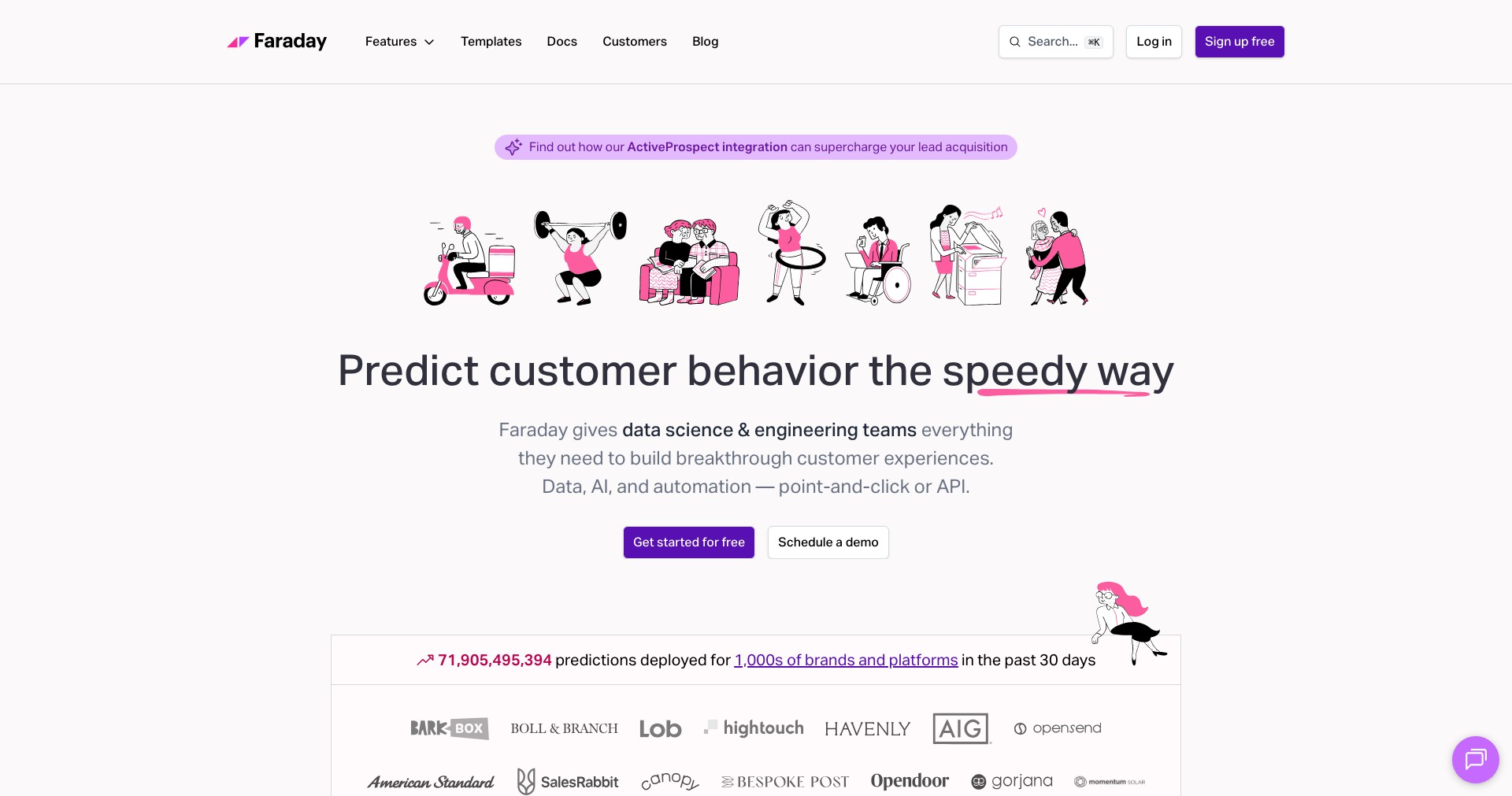
Faraday is an advanced AI-powered analytics platform tailored for consumer brands and businesses that seek actionable insights from their data. It enables companies to build powerful prediction models, segment audiences, and deploy AI for maximizing marketing and sales effectiveness without requiring deep data science expertise.
By integrating with popular data sources and platforms, Faraday empowers teams to efficiently harness their existing datasets, offering tools for lead scoring, churn prediction, lifetime value forecasting, and more. The platform transforms raw data into strategic recommendations, making it invaluable for marketing, product, and analytics professionals aiming to drive growth and customer retention.
Key Features:
-
Automated Predictive Modeling:
Faraday uses machine learning to automatically build and deploy predictive models for customer behavior, helping businesses identify high-value prospects, churn risks, and optimal engagement opportunities quickly. -
Audience Segmentation:
The platform enables sophisticated segmentation of customer bases, allowing targeted messaging, personalized experiences, and improved campaign performance by leveraging demographic, behavioral, and transactional data. -
No-Code Integrations:
Faraday connects with widely used tools like Salesforce, HubSpot, Shopify, and data warehouses, eliminating the need for complex engineering work through point-and-click integrations. -
Privacy-by-Design Architecture:
With robust data privacy and security features, Faraday is compliant with leading data protection standards such as GDPR and CCPA, ensuring businesses maintain regulatory adherence while leveraging powerful analytics. -
Actionable Recommendations:
Faraday automatically generates tailored recommendations for marketing and growth strategies based on predictive insights, translating raw data into strategic business actions.
What makes Faraday unique?
What sets Faraday apart is its specialized focus on consumer-facing brands and its commitment to democratizing AI with a genuinely no-code user experience. Instead of requiring users to have deep data science know-how, Faraday’s intuitive workflows and integrations make advanced predictive analytics accessible to marketing and revenue-focused teams.
Additionally, its privacy-by-design approach and out-of-the-box compliance with stringent regulations allow businesses to innovate confidently even with sensitive customer data—something many generic analytics platforms only partially address.
Pros and Cons
Who is using Faraday?
Marketing Teams: Marketers seeking to boost campaign performance and ROI will benefit from Faraday’s predictive targeting and audience segmentation, allowing for personalized outreach at scale.
Product Managers: Product teams can leverage customer insights and churn forecasting models to enhance retention strategies and inform feature development based on predictive analytics.
Data Analysts: Analysts responsible for business intelligence can rapidly deploy and interpret advanced models, supplementing their output with actionable recommendations straight from the platform.
Platform Evolution and Enhancements
Since its inception, Faraday has expanded from basic predictive scoring to offering full lifecycle analytics for customer acquisition, engagement, and retention.
The platform has introduced integrations with a broader suite of CRMs, e-commerce systems, and data warehouses, regularly updating these connections to maintain seamless data flow and usability.
Recent updates have focused on enhanced data privacy, no-code automation, and tailoring predictive AI outputs to provide even more granular, actionable recommendations.
Pricing
| Plan | Price | About |
| Enterprise Subscription | Custom pricing (quote-based) | Pricing is tailored to organization size, data volume, and use case needs; prospective customers must contact sales for details. |
Verdict
Faraday stands out as a leading option for consumer brands looking to leverage predictive analytics without hiring dedicated data science teams. Its streamlined integrations, user-friendly design, and focus on privacy and compliance make it a strong partner for marketing and analytics.
Despite opaque pricing and a primary focus on B2C markets, the platform’s strengths in no-code AI, actionable insights, and regulatory peace of mind make it an excellent investment for growth-oriented teams ready to drive better customer outcomes.


