Industrial Render AI
Last updated: June 16, 2026
What is Industrial Render AI?
Industrial Render AI redefines the rendering process for professionals in architecture, product design, and industrial visualization. Built using state-of-the-art AI algorithms, the platform dramatically accelerates rendering times while producing highly realistic images that rival results from much slower, traditional methods.
Whether you’re visualizing architectural blueprints, preparing product mockups, or showcasing industrial design concepts, Industrial Render AI offers a robust, user-friendly solution. It is crafted to meet the needs of teams and individuals who prioritize both speed and uncompromising image quality in their daily workflows.
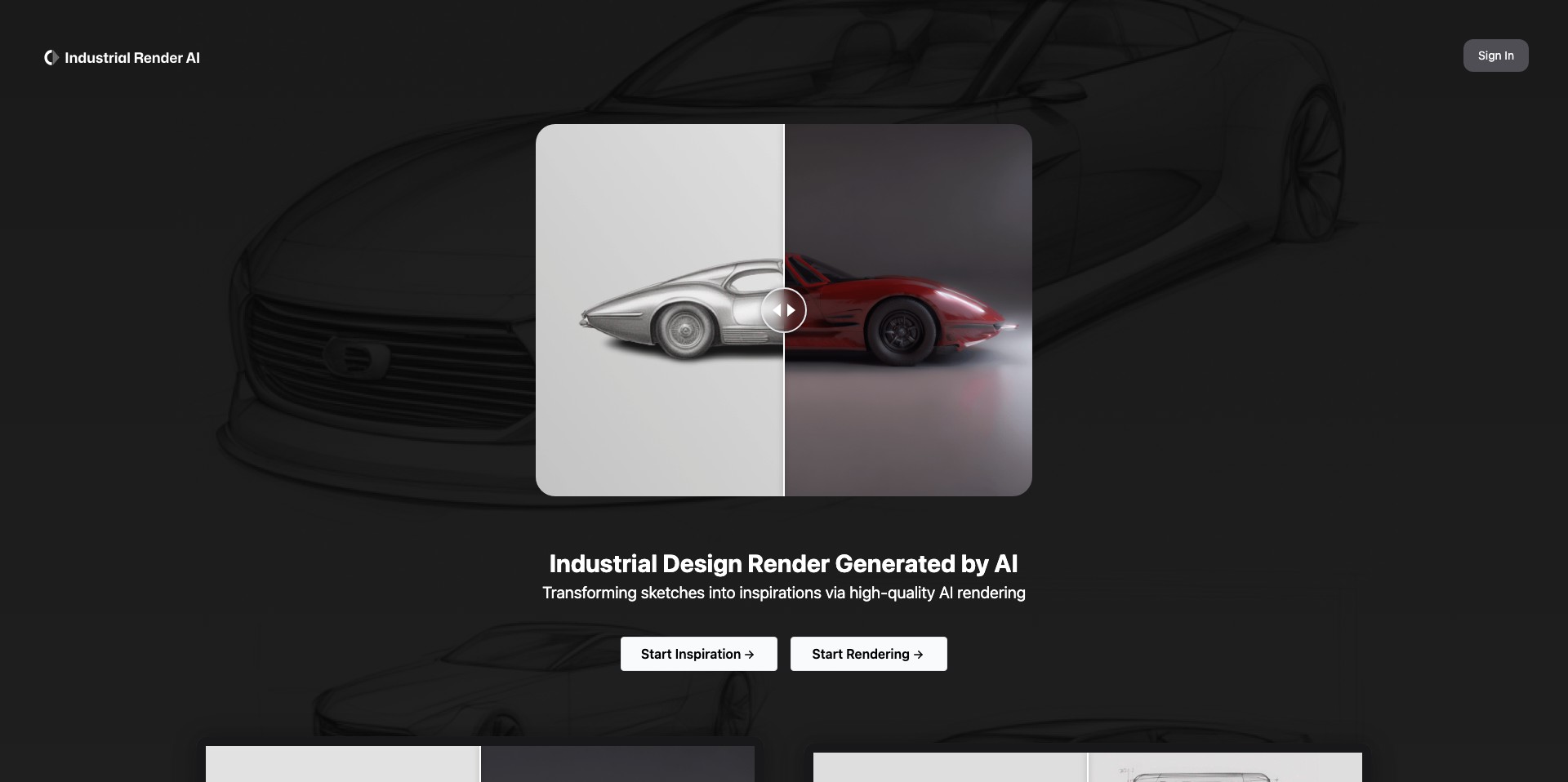
Key Features:
-
AI-powered Photorealistic Rendering:
Utilizes advanced artificial intelligence algorithms to quickly transform basic models or sketches into detailed, high-resolution, photorealistic images, cutting down rendering times from hours to minutes. -
Cloud-based Processing:
Renders are executed on powerful cloud servers, freeing up local machine resources and allowing users to multitask or use less powerful devices without sacrificing speed or quality. -
Real-time Preview:
Offers instant visual feedback as adjustments are made to lighting, textures, or camera angles, reducing the iterative cycles necessary to achieve the desired look. -
Seamless Integration:
Compatible with leading CAD and 3D modeling software, making it easy to import models and projects for fast rendering without file conversion hassles. -
Batch Rendering & Automation:
Supports batch rendering of multiple projects and automation of repetitive tasks, increasing productivity for firms handling large volumes of visualization work.
What makes Industrial Render AI unique?
What sets Industrial Render AI apart is its deep integration of artificial intelligence throughout the rendering pipeline. Unlike conventional renderers that rely purely on hardware acceleration or manual settings, its AI is optimized for both speed and quality, learning from vast libraries of design imagery to intelligently predict lighting, materials, and scene composition.
Additionally, the platform’s seamless interoperability with existing industry-standard tools, rapid cloud-based processing, and focus on real-time feedback cater perfectly to fast-paced design environments, minimizing bottlenecks and iteration delays common with offline renderers.
Pros and Cons
Who is using Industrial Render AI?
Architects & Architectural Firms: Benefit from fast turnarounds and high-detail renders to showcase building designs, interiors, and landscape concepts to stakeholders.
Industrial Designers: Use the platform to rapidly visualize prototypes, illustrate product features, and create marketing visuals from early concept stages.
Visualization & Creative Agencies: Find value in batch processing and automation for producing multiple client renderings, improving workflow efficiency in demanding projects.
Evolution and Updates
Since its initial launch, Industrial Render AI has seen rapid development. Early versions focused mainly on AI-powered static rendering, but soon introduced cloud compute support, real-time previews, and improved integration with design software.
Significant updates have included expanded material libraries, faster processing pipelines, and enhanced automation features such as batch rendering and API access for workflow customization.
User feedback has driven improvements to the interface’s intuitiveness and reliability, with recent versions emphasizing collaborative tools, version control for team projects, and expanded cross-platform support.
Pricing
| Plan | Price | About |
| Professional Plan | $49/month | Includes access to all core features, cloud processing, and basic support. |
| Enterprise Plan | Custom Quote | Offers advanced automation, batch rendering, priority support, and bespoke integration for larger firms. |
| Free Trial | $0 | Limited access for evaluation purposes, typically 7 days. |
Verdict
Industrial Render AI is a standout solution for professionals who demand fast, photorealistic visualization in their workflows. Its AI-driven features and cloud infrastructure significantly reduce both technical and time barriers encountered with conventional rendering, making it especially valuable in fast-paced industries.
While the subscription-based pricing may not suit all budgets, the productivity gains and output quality justify the investment for most studios and firms. Those who require offline rendering or operate with limited connectivity may find some drawbacks, but for the majority of visualization professionals, Industrial Render AI is a transformative tool.


