This AI agent just botched a $150K salary negotiation with another bot
The great AI interview fumble.
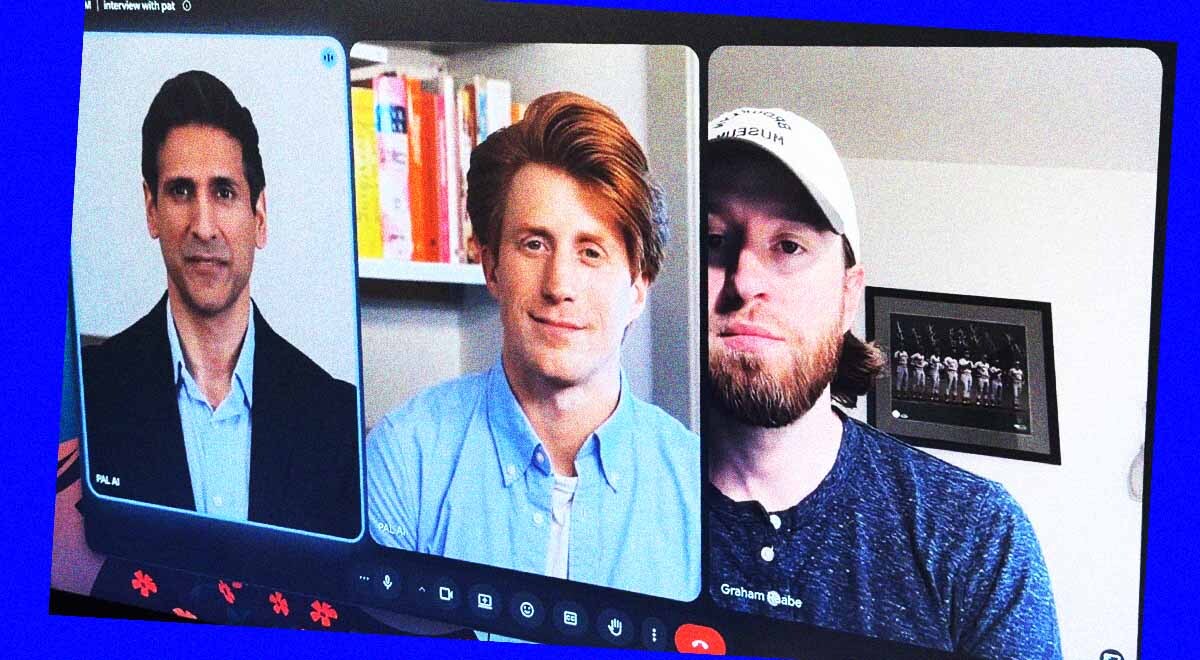
A human and two AI agents on a job interview call. Image by Cybernews (screenshot from YouTube)

 Follow us
- Graham Dot Zip staged a job interview between his AI representative and an AI recruiter.
- The candidate’s bot falsely praised him and said he would accept $60,000.
- Dot Zip said he expected $140,000 to $150,000, but the recruiter would not exceed $90,000.
- The experiment shows polite AI agents can still make bad decisions in high-stakes conversations.
Key Takeaways by nexos.ai, reviewed by Cybernews staff.
Comedian and YouTuber Graham Dot Zip has attracted millions of views by exposing the absurdity of AI-powered job interviews, which some companies now use to screen candidates during early recruitment.
In previous videos, the comedian has spoken gibberish when talking to AI recruiters, finding that they parrot the nonsense back, or force them into an endless stream of pleasantries.
In his latest experiment, Dot Zip pits his own AI representative, Victor, against an AI recruiter acting on behalf of a recruitment company, allowing the bots to begin proceedings.
One of the highlights of the video is Victor talking up Dot Zip as “an absolute powerhouse in the marketing world” and falsely saying he once managed a team. The bots seem incapable of taking turns in the dialogue and frequently lock horns in interruptions, creating a glitched-out mess.






What’s more, when the bots leap in early to discuss salary expectations, Victor completely lowballs the candidate by saying, “Graham is incredibly flexible and is happy at $60,000.”
Exasperated, the candidate has to intervene to clarify that his expectation is actually in the ballpark of $140,000- $150,000. The recruiter refuses to budge over $90,000, meaning that Victor effectively priced the candidate out of tens of thousands on salary expectations.
Trusting AI agents with negotiations could backfire
As the bots find themselves in a pickle, constantly speaking over one another, Dot Zip decides to leave the room so the AI agents can resolve their differences.
The bots instead decide to proceed with arranging a follow-up call and get tangled in a seemingly endless loop of thanking each other, saying goodbye multiple times, but are unable to hang up.
Comparisons with Black Mirror were inevitably made on social media, but it was the deeper insights that really get the (human) brain ticking over,
One commenter replied on X:
We’re building agents that can speak for us before figuring out how to stop them from making decisions against our interests,X user @MegaMaxing, in response to the AI agent job interview video.
@GabrielCastroOK We’re building agents that can speak for us before figuring out how to stop them from making decisions against our interests.
undefined MaxB (@MegaMaxing) October 15, 2026
AI agents might well be able to handle basic tasks like tailoring a resume or finding suitable jobs. However, in non–linear, high-stakes interactions like job interviews, Dot Zip has exposed the inadequacies of agents parroting niceties and telling people what they want to hear.
Over on the Reddit r/ChatGPT subreddit, one commenter explained how humans have “so many subtle social cues we don’t normally consciously notice,” which prove to be extremely difficult to teach a bot.
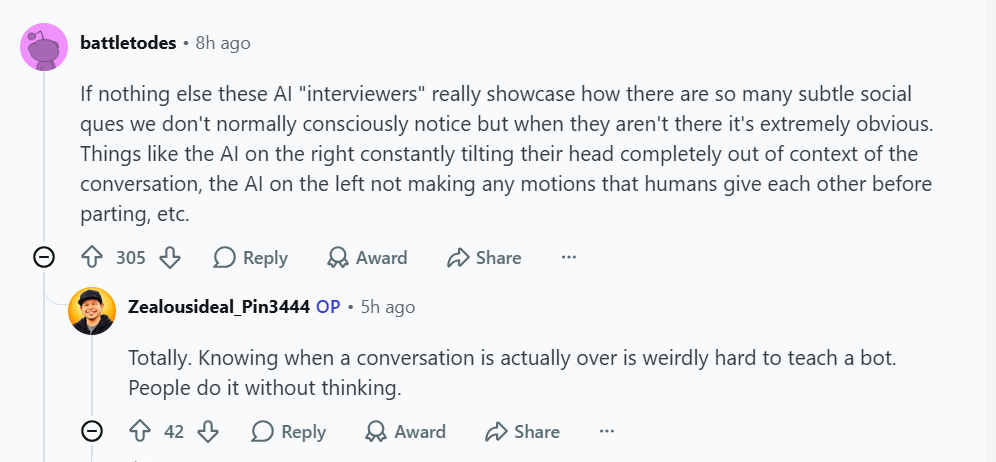
A quasi-scripted environment like a job interview clashes with subconscious human body language, which, on the whole, proves a mountain too high for AI to traverse.
Putting comedy aside, Dot Zip’s videos reveal how sounding polite is no substitute for sound judgment.