Best mobile proxy providers of 2026 (3G, 4G, 5G, LTE)


Mobile proxies route your web traffic through real mobile devices on cellular networks, making them perfect for high-stealth web activities like data scraping, getting location-specific content, and managing several social media accounts without getting blocked or encountering CAPTCHAs.
The best mobile proxies – many of which I’ve reviewed here – have enormous pools of real mobile IP addresses from authentic devices, routing your traffic via 3G, 4G, 5G, and LTE networks. When using one, websites will consider you as genuine mobile traffic. If you’re building serious web projects in 2026, you need the best mobile proxy you can get – one that’s ethically sourced, high-performance, and complies with privacy regulations.
Together with the Cybernews research team, I tested seven mobile proxy providers, evaluating their key features and real-world use cases. If you’re a digital marketer or analyst, an eCommerce business, or anyone who needs dynamic mobile IP addresses – keep reading.
Top 5 mobile proxy providers – shortlist
- Oxylabs – best mobile proxy for 2026
- Decodo – large mobile IP pool with great carrier diversity
- Webshare – budget-friendly solution for non-mobile needs
- Bright Data – mobile proxy with rigorous compliance measures
- DataImpulse – cheapest mobile proxies with pay-as-you-go pricing




We take proxy testing seriously – every service is put through real-world scenarios, benchmark checks, and hands-on feature evaluations. Our in-house team collects the data, and experts review and verify the results. Take a look at how we test proxies and what truly stands behind their performance.
What are mobile proxies?
Mobile proxies route internet traffic through real-world mobile devices that use SIM cards and mobile data networks (3G, 4G, 5G, LTE). This way, websites see the IP address of a genuine device on a mobile carrier network – not a data center server or a bot. This minimizes the chances of being blocked, banned, and seeing CAPTCHAs – very helpful if you’re doing location-specific research, automation, or scraping data.
Using mobile proxies is also one of the best ways to maintain online stealth. Compared to residential proxies and datacenter proxies, which use server IPs, mobile proxies fly under the radar of most websites – especially when rotated. That’s also why they’re often the most expensive type of proxy.
Mobile proxies use cases
The dynamic nature of mobile proxies makes them suitable for some unique use cases beyond what residential or datacenter proxies can handle. Here’s where mobile proxies shine:
- Web scraping and data collection. Collect search engine result pages (SERP) or product pages without getting blocked quickly.
- Ad verification. Verify geo-targeted ads and test mobile user experiences without being blocked or flagged.
- Managing social media. Make each social media account seem like it's run from a different device – avoiding unexpected bans when working with clients or brands.
- Price comparison and competitor research. Check geo-specific prices and discounts like a real mobile shopper in a specific city would – without being blocked.
- Accessing region-locked or localized content. Apps, games, or offers may only be available for those in certain locations, but a mobile proxy opens a window to these experiences.
- SEO and localized search tracking. Mobile proxies help you see how you really rank on Google as a mobile user in your target markets.
- App testing. Test mobile apps and sites in remote locations without requiring a physical device.
The best mobile proxies in 2026 – detailed list
I’ve created in-depth reviews of seven high-quality mobile proxies. In this detailed list, I cover the key features of each one – why it stands out, tech specs, target audience, and pricing.
1. Oxylabs – best overall mobile proxy

| IPs: | 20+ million mobile IPs |
| Locations: | 140+ |
| Connection types: | 3G, 4G, LTE, 5G |
| Free trial: | Yes (business trial via demo/request) |
| Starting price: | $9.00/GB (pay as you go) |
Oxylabs is my top pick. It’s a premium proxy by all means – and a web intelligence provider – with one of the largest mobile proxy pools out there. It has 3G/4G/5G/LTE proxies in over 140 countries – perfect for growing projects and full-scale enterprise applications.
The network performance is solid: 99.9% uptime, around 1.1s response time, automatic rotation on every request, and 30-minute sticky sessions for longer tasks. Oxylabs aims to reduce blocks and CAPTCHAs – and success rates are high for complex scraping and automation tasks.
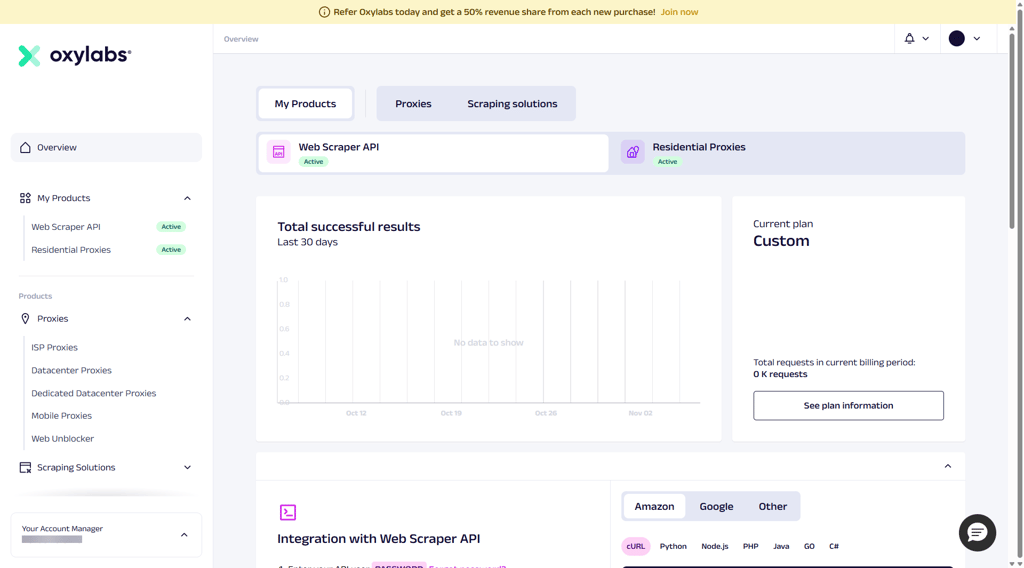
Everything’s managed from a single endpoint and a clean dashboard. You also get a Chrome extension, Android proxy manager, open-source tools, and multi-language integration. 24/7 support is available.
Pricing is based on traffic. Pay-as-you-go starts from $9.00/GB, while monthly plans add larger data allowances, with prices dropping to below $3.00/GB on enterprise deals (1TB+).
2. Decodo – best mobile proxy with wide carrier selection

| IPs: | 10+ million mobile IPs |
| Locations: | 160+ |
| Connection types: | 3G,4G, LTE, 5G |
| Free trial: | Yes (3-day free trial) |
| Starting price: | $2.75/GB |
Decodo praises its carrier-grade mobile proxies, with over ten million IPs and up to 195 global locations with advanced targeting and 3G, 4G, LTE, 5G support. It’s best for small teams to medium-sized projects, especially for AI and automation projects.
Decodo highlights its performance – reporting below 0.5s average response time and a 99.76% success rate on mobile. Rotating proxies and sticky sessions are also available. The dashboard is clean, with live usage stats.

It has extra tools like X Browser, Chrome and Firefox extensions, and HTTP(S)/SOCKS5 support. Plus, there are template configurations for Playwright, Puppeteer, and several popular browsers. 24/7 technical support is available.
Pricing is traffic-based, starting at $4.00/GB for a pay-as-you-go plan and dropping to $2.25/GB for Decodo’s higher-volume plans (500GB+). I find its price-to-performance ratio excellent.
3. Webshare – top budget proxy for non-mobile applications

| IPs: | 400K+ datacenter/ISP IPs, 80+ million residential IPs |
| Locations: | 195 |
| Connection types: | HTTP(S) and SOCKS5 |
| Free trial: | Yes (permanent free plan) |
| Starting price: | $1.19/GB for rotating residential |
Webshare delivers cheap proxies – datacenter and residential IPs. It works best for developers, one-man teams, and small businesses that don’t need mobile proxies. Its network is quite large and reliable – at over 80 million residential IPs, plus over 400K datacenter/ISP IPs. Webshare claims 99.97% uptime – ideal for general scraping, price tracking, and marketing tasks.

The dashboard is minimal – with a guided setup, API settings, and browser extension for common browsers. It’s easy to download proxy lists or use API integrations. 24/7 support is available.
Webshare’s pricing is its selling point – with access to a permanent free plan with 10 proxies and 1GB/month. The paid tiers are also affordable themselves, especially for rotating residential traffic, starting at $1.19/GB .
4. Bright Data – best for enterprise compliance and data collection

| IPs: | 7+ million mobile IPs |
| Locations: | 195 |
| Connection types: | 3G, 4G, 5G |
| Free trial: | Yes (duration not specified) |
| Starting price: | $5.00/GB |
Bright Data targets enterprise users that need strict compliance, high security, and free mobile geo-targeting. With over 7 million IPs in 195 countries (3G, 4G, 5G), it’s tuned for teams requiring complex, location-sensitive data scraping. Bright Data says its consumer IPs are ethically sourced.
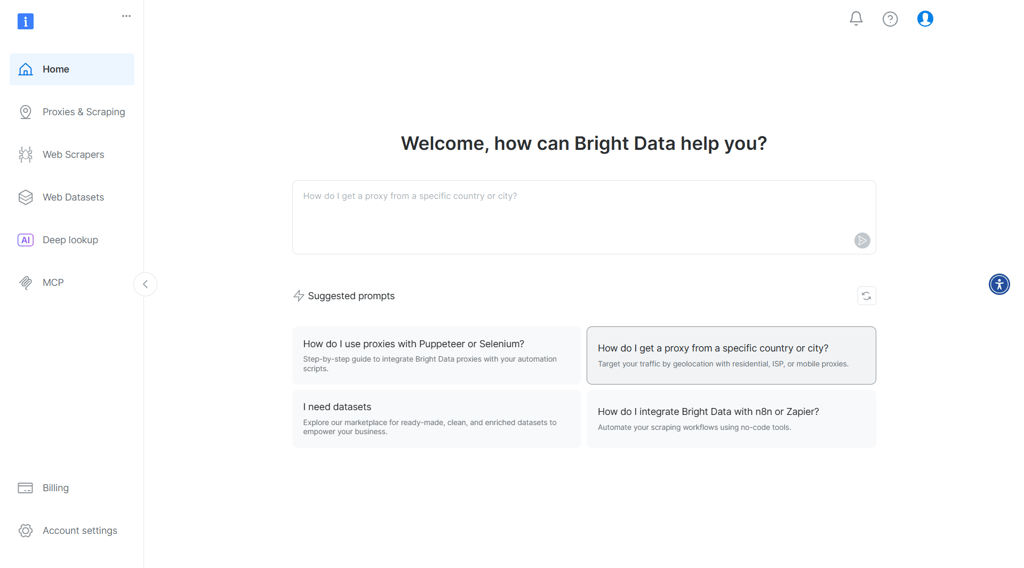
Bright Data claims a 99.95% mobile success rate, unlimited concurrent sessions, and QUIC/HTTP/3 for faster response times. Everything happens in the central control panel or API – with code examples in Java, Python, C#, Node.js, and Shell. The documentation is strong, and it’s developer friendly – you can integrate dozens of tools. 24/7 support is available.
The compliance stack is impressive (GDPR/CCPA, ISO 27001, SOC 2 and 3, CSA), and the pricing is transparent – $8.00/GB for a pay-as-you-go plan, dropping to $5.00/GB on 399GB plans.
5. DataImpulse – cheapest and simplest mobile-only pricing

| IPs: | 16M+ mobile IPs |
| Locations: | 195+ |
| Connection types: | 3G, 4G, 5G, LTE |
| Free trial: | No |
| Starting price: | $1.60/GB |
With 16M+ mobile IPs, DataImpulse focuses on mobile proxies with geo-targeting and simple pay-per-GB billing. It has mobile IPs across over 195 locations with 3G, 4G, 5G, and LTE support, plus rotating IPs after each request and sticky sessions.
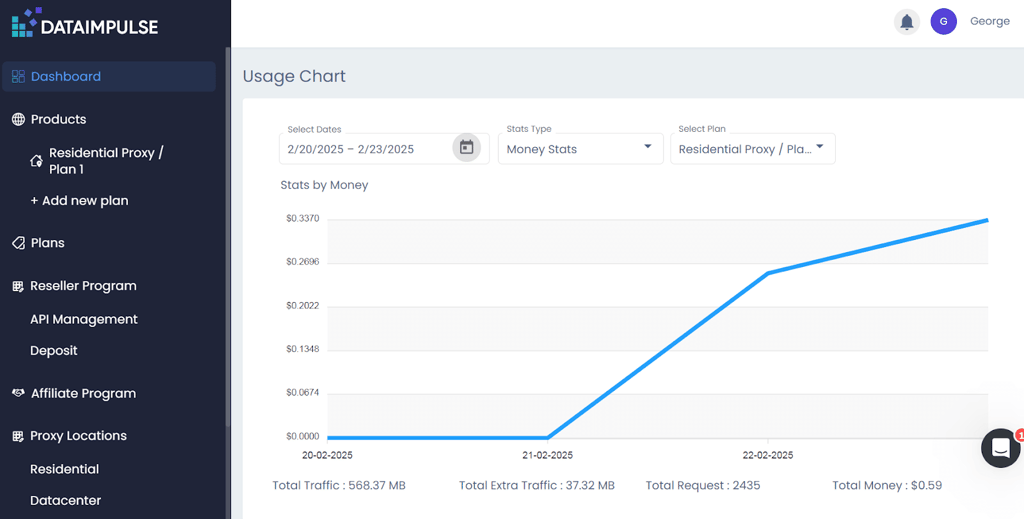
It’s well-suited for ad verification, review monitoring, and market research on a budget. The dashboard is simple – displaying traffic usage and proxy credentials. You also get HTTPS and SOCKS support, which helps with common scraping tasks and bots. 24/7 support is available.
Pricing-wise, it’s one of the most affordable options here – starting at $1.60/GB for the Advanced plan with traffic that never expires. Other plan prices start at $2.00/GB, and you can also choose custom pricing for bigger projects.
6. SOAX – top customized proxy solution

| IPs: | 33+ million mobile IPs |
| Locations: | 195+ |
| Connection types: | 3G, 4G, 5G, LTE |
| Free trial: | No |
| Starting price: | $2.00/GB |
SOAX is a mega-scale, unified proxy solution provider – bundling mobile, residential, ISP, and datacenter proxies. It’s perfect for when you need one subscription for several proxy types. It has over 33 million mobile IPs in over 195 locations, plus rotating proxies and one-hour sticky sessions.
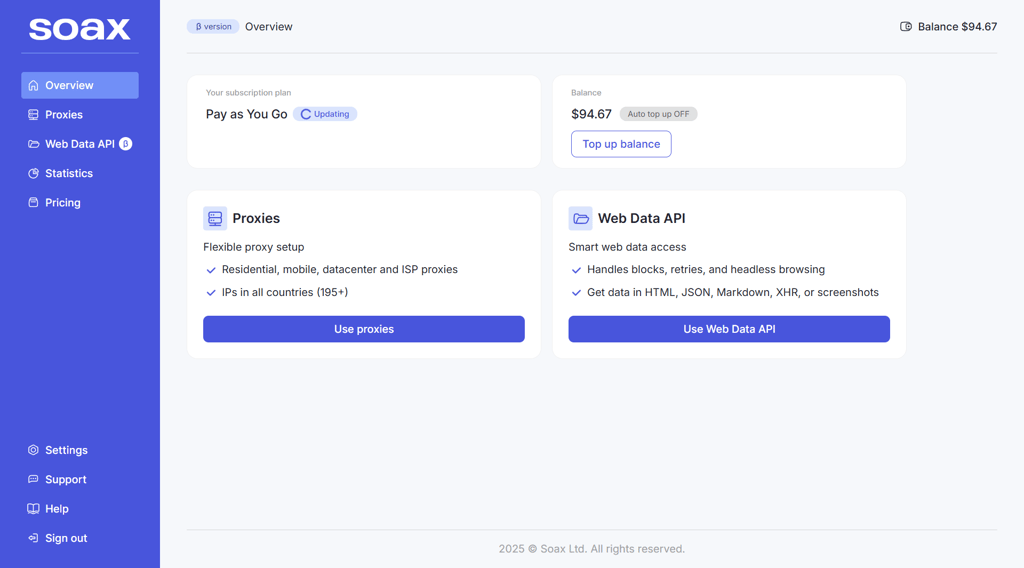
SOAX claims 99.95% success rates and 99.9% uptime, plus a response time of around 0.55s. You can adjust IP refresh intervals and retain mobile sessions for up to one hour. On the well-spaced dashboard, you can monitor usage, manage credentials, and export proxy lists. It has unlimited concurrent connections and support for 3G, 4G, 5G, and LTE. 24/7 support is available.
Prices start at $2.00/GB for the Business plan and even lower on custom Enterprise deals. The main caveat is that the mobile proxies share the same pool with other proxy types.
7. IPRoyal – best for unlimited bandwidth

| IPs: | 4.5+ million mobile IPs |
| Locations: | 195 |
| Connection types: | 3G, 4G, 5G |
| Free trial: | No |
| Starting price: | $117.00/month |
IPRoyal is a performance-forward mobile proxy provider with over 4.5 million IPs. Covering 195 locations, its plans provide unlimited bandwidth – great for bursty testing.
IPRoyal claims 99% uptime, download speeds of up to 100Mbps, and satisfactory response times of around 0.8s. IPs auto-rotate every few minutes, and you also receive instant IP changes. You can then disable rotation to achieve effective static IPs.
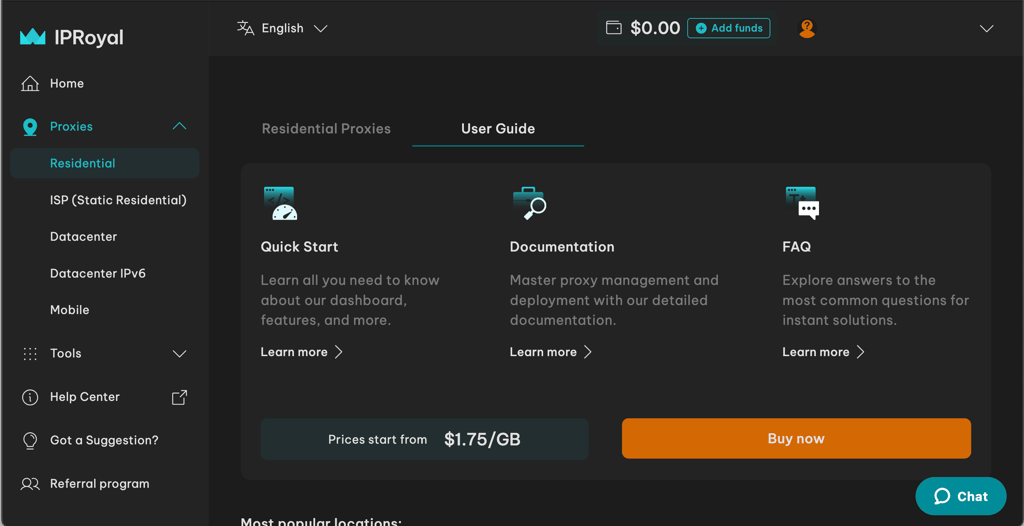
Proxies are authenticated via simple username/password credentials, and managed through the well-organized dashboard. API access is also available. Besides, it provides 24/7 customer support.
Pricing is based on duration – with unlimited bandwidth – from $10.11/day, dropping on the 60 and 90-day options to $117.00/month. IPRoyal doesn’t have a per-GB model, which isn’t ideal for short projects – but works for heavy, sporadic use.
Comparison of the best mobile proxy providers
Below is a comparison table with all of the mobile proxy providers I reviewed. I’ve included key details like the Cybernews rating, and essential specs.
| Provider | Rating | Proxy pool size | Connections | Locations | Geo-targeting | Free trial | Starting price |
| 1. Oxylabs | 4.9 | 20M+ mobile IPs | 3G, 4G, 5G, LTE | 140+ | Yes – down to coordinates | Yes | $9.00/GB |
| 2. Decodo | 4.7 | 10M+ mobile IPs | 3G, 4G LTE, 5G | 160+ | Yes – down to city | Yes | $2.75/GB |
| 3. Webshare | 4.5 | No mobile proxy pool | No mobile connections | 195+ | Yes – down to country | Yes | $1.19/GB (rotating residential) |
| 4. Bright Data | 4.6 | 7M+ mobile IPs | 3G, 4G, 5G | 195+ | Yes – down to ZIP | Yes | $5.00/GB |
| 5. DataImpulse | 4.3 | 16M+ mobile IPs | 3G, 4G, 5G, LTE | 195+ | Yes – down to ZIP | No | $1.60/GB |
| 6. SOAX | 4.4 | 33M+ mobile IPs | 3G, 4G, 5G, LTE | 195+ | Yes – down to city | No | $2.00/GB |
| 7. IPRoyal | 4.1 | 4.5M+ mobile IPs | 3G, 4G, 5G | 195+ | Yes – down to city | No | $117.00/month |

Final thoughts
Choosing the right proxy is the user’s top priority. My winner is Oxylabs – with Decodo, DataImpulse, and Bright Data not too far behind. Oxylabs isn’t necessarily the best for everyone, though it’s a beast for large-scale work. For smaller-scale work, Decodo is great. For medium-scale projects, I recommend SOAX.
When choosing your provider, use the free trials to test your chosen mobile proxy first and get a feel for the product. And if you ever feel lost, simply come back to this guide.
FAQ
Can mobile proxies be detected?
Yes, but not as easily as datacenter or residential proxies. Top-quality mobile proxies like those from Oxylabs route through real network carriers to increase anonymity. They’re also harder to detect through behavioral analysis and machine learning.
Should I use free mobile proxies?
We don’t recommend using free mobile proxies, as generally, paid mobile proxies are more secure and perform better.
What is the difference between mobile and residential proxies?
A residential proxy uses IPs from residential ISPs, while mobile proxies use IPs assigned by mobile network operators – often changing dynamically.
What are the benefits of mobile proxies?
Stealth and rotation make the user harder to detect, ban, or block. For those reasons, mobile proxies are preferred by marketers, social media managers, and data scrapers.
Are mobile proxies good for web scraping?
Yes, especially if a web scraping project requires avoiding bans and detection, or if it involves mobile-specific work. Otherwise, residential proxies also work for standard scraping tasks that require stable connections.