Datacenter vs residential proxies: comparison and use cases

Whether you’re trying to access geo-blocked content or you just want to be a bit safer online, proxies can be quite helpful. These tools act as intermediaries between you and the online service you’re using by substituting your real IP address with one of their own.
Both datacenter and residential proxies, the two most commonly used types, operate in this exact way. However, they also differ in terms of IP origins, speed, and pricing, so they’re often used for vastly different purposes.
To help you figure out which of these better suits your needs, Cybernews researchers and I looked at common proxy use cases, including scraping, SEO monitoring, ad verification, and account management. Below is a detailed look at datacenter proxies vs residential ones, along with their features, strengths, drawbacks, and differences.

What are datacenter proxies?
As their name suggests, datacenter proxies primarily source their IPs from data centers. As such, they’re not affiliated with any internet service provider (ISP).
These proxies go beyond hiding your IP address for safer web browsing. They offer tremendous speeds that regularly go up to 10Gbps, courtesy of the enterprise-level servers that their IPs are sourced from. They’re also more affordable and, thus, better for large-scale operations.
That said, even the best proxy providers of this kind can get their IPs flagged by websites due to response times lower than 100ms. They’re also more likely to be blocked due to their narrow IP range.
What are residential proxies?
Residential proxies use IP addresses that belong to actual household devices, assigned by ISPs. That’s precisely what gives them their real user touch and makes you appear as a legitimate website visitor from a different location when you use them.

As such, they’re excellent in situations where stealth and anonymity are vital, be it accessing geo-restricted sites or managing multiple social media accounts simultaneously.
However, these proxies are no match for datacenter ones in terms of speed. Their realistic appearance also comes at a price, with most residential proxies costing up to 10x more than their datacenter counterparts.
Datacenter vs residential proxies: use cases
It’s hard to pick a winner in the residential proxies vs datacenter proxies comparison, as both can be quite beneficial in multiple situations. That said, your choice will depend on what you need more – speed or anonymity.
Datacenter proxy use cases
This proxy type offers immense speed and scalability without breaking the bank. As such, it’s most commonly used for the following purposes:
- Web scraping. Websites can easily block a single IP address that sends out multiple scraping requests. That’s why scrapers are turning toward datacenter proxies, which offer vast numbers of IPs at an affordable price, allowing users to send out a few requests per address and avoid detection while scraping.
- SEO monitoring. Datacenter proxies allow SEO specialists to monitor search engine results from different geographic regions. As such, they can work wonders for tracking ranks and researching keywords, and they can even bypass CAPTCHA.
- Price monitoring. Last but not least, a datacenter proxy can also help businesses with price intelligence. These tools spread requests to efficiently scrape competitor sites for prices, discounts, listings, reviews, and more, giving you plenty of marketing insights.
Residential proxy use cases
When being stealthy or appearing as a legit website visitor is key, a residential proxy can make all the difference. These features make this particular proxy type popular for the following tasks:
- Privacy protection. The best residential proxies excel at keeping your identity safe. As such, they’re ideal for staying anonymous as you browse the internet.
- eCommerce testing. As residential proxies mimic real users, they’re great for simulating the real-world performance of an eCommerce store. In fact, testers regularly use them to see how a particular site would display content, including language, currency, payment options, and promotions, for users from different geographic locations.
- Social media management. Brand managers who run Instagram or Facebook accounts can benefit from utilizing a residential proxy. That’s especially true for those juggling multiple social media accounts at the same time.
Residential vs datacenter proxies compared
Now that you know which type excels at which tasks, let’s take a closer look at the datacenter proxies vs residential proxies comparison and see how they stack up in terms of features:
| Feature | Residential proxies | Datacenter proxies |
| IP source | Ethically sourced IPs from actual desktop and mobile devices | Data centers and web hosting companies |
| Speed | Moderate (up to 1Gbps) | Very fast (up to 10Gbps) |
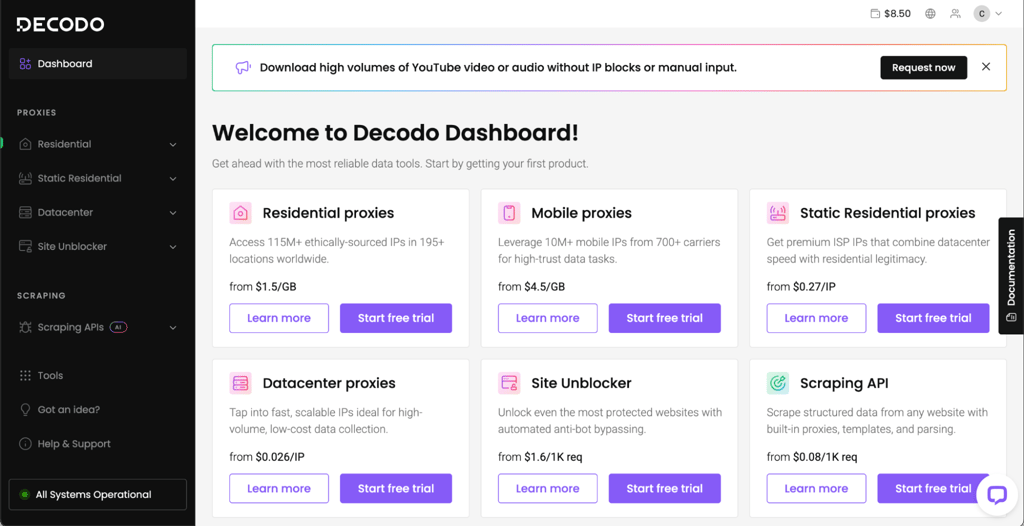
| IP pool size | Massive (115M+) | Limited (500K+) |
| Anonymity | High, as they appear as real users | Lower, as they’re easier to detect |
| Detection | Low | Higher chances |
| IP rotation | ✅ Yes | ❌ No |
| Pricing | Up to 10x more expensive than datacenter proxies | Among the most affordable proxy options out there |
| Best for | Anonymous web surfing, advanced site scraping, multi-account social media management | Accessing geo-restricted content, web scraping, SEO, and price monitoring |
Choosing the right proxy
While speeds and prices play a vital role, at the end of the day, the type of proxy you go with should depend on your specific use case.
When to use residential proxies
If you value your anonymity or can’t afford to get banned when accessing geo-restricted content, residential proxies are where it’s at.
Say you’re a social media manager with multiple clients. A residential proxy would make you appear as a real user to any of those social media networks you’re constantly accessing through multiple accounts.
The same goes for any situation where minimizing detection risk is vital. That could include scraping sensitive data or accessing geo-restricted streaming services, for example. In those cases, residential proxies would be a much safer option.
When to use datacenter proxies
If, on the other hand, you’re not concerned about getting banned, as you could just continue from a different IP address, datacenter proxies are the way to go.
For starters, they offer tremendous speed at an affordable price. In a scenario where those factors matter, such as scraping large volumes of data, this type of proxy is the ideal candidate.
Developers in need of multiple cheap accounts to test their sites or apps could also use these proxies. In fact, any operation that primarily relies on large-scale projects could benefit from high-quality datacenter proxies.
Final thoughts
While providers like Decodo offer both residential and datacenter proxies to mask your IP, these two common proxy types also differ in terms of origins, pricing, and speed.
Residential proxies use ISP-assigned IPs, which makes them more challenging to detect and, thus, ideal for geo-targeting and high-anonymity operations. However, they’re also slower and more expensive than their datacenter counterparts. Conversely, datacenter proxies excel in terms of speed and cost efficiency, so they’re great at large-scale scraping. Then again, their datacenter-sourced IPs are also easier to detect.
At the end of the day, both proxy types excel at certain things and have drawbacks. What you go with should come down to what your specific project needs and what your budget allows.
FAQ
What is the difference between residential and datacenter proxies?
Residential proxies rely on IPs from actual household devices. As such, they appear as real users. On the other hand, datacenter proxies source their IPs from data centers and web hosting companies. While they’re faster than residential ones, this also makes them much more susceptible to detection.
Are datacenter proxies detectable?
Yes, websites can detect datacenter-sourced IP addresses. In fact, this is quite easy for them to do, and for more than one reason. For starters, datacenter proxies have a limited IP range. Their quick response times also make them easy to categorize as non-human users.
Can residential proxies be detected?
Yes, a site could still detect that you’re using a residential proxy. That said, detection is drastically more challenging than with datacenter proxies. To do that, a website would need strong anti-bot measures and robust behavioral analytics.
Are residential proxies legal to use?
Yes, residential proxies are legal to use if you go with a reputable provider whose IPs are ethically sourced, such as Decodo. However, when it comes to scraping, it’s still important to follow the site’s rules, which you can find in its robots.txt file.
Which proxy type is more anonymous?
Residential proxies are more anonymous. They’re a go-to option for anyone trying to hide their true identity while browsing, as they offer real ISP-assigned IPs from real desktop and mobile devices. As such, they make you appear as a legitimate user.
When should I use residential proxies over datacenter ones?
Although there are perks to datacenter proxies, residential proxies are best for any situation where minimizing detection risk is paramount. That could be scraping sensitive data or accessing restricted content, for example. Verifying ads and managing multiple accounts on social media networks are also made easier with this proxy type.
Can I use both residential and datacenter proxies together?
Yes, you can use both residential and datacenter proxies together. In fact, it’s the smartest approach you can take. For example, you could be using datacenter proxies to scrape sites at a massive scale and then switch to residential ones when you come across sensitive data.