Alexa vs Similarweb: which one offers better website insights?
Being behind major reports like The Mother of All Breaches and RockYou2024, our in-house cybersecurity experts and journalists provide unbiased, real-world testing and in-depth analysis.
We maintain complete transparency by openly sharing our testing methodologies with our audience.
Learn more

Whether you’re in digital marketing or SEO, you know how helpful having insights into the competition and keywords can be.
That’s precisely where website analytics tools like Amazon’s Alexa (the analytics tool, not the home speaker) and Similarweb have been making a real difference. And while the former was officially discontinued on May 1, 2022, its historical value remains. In that sense, knowing how these two popular platforms stack up can still be quite useful.
To make that Alexa vs Similarweb showdown happen, the Cybernews research team and I thoroughly investigated both options. We looked into their strengths and weaknesses, reviewed their paid plans, and compared them across multiple scenarios. You can find our findings below.
Alexa vs Similarweb overview
Here’s a quick comparison table for the two. Give it a look to see exactly who each tool is for. You’ll also learn about their strongest points and see how much they’ll cost you on a monthly basis.
| Platform | Similarweb | Alexa |
| Rating | 4.4 ⭐ | 4.1 ⭐ |
| Market segments | Marketing agencies, SEO professionals, and digital strategists | SEO experts, business owners, and link builders |
| Key features | Robust market intelligence, enterprise-grade traffic insights, and verified data sources | Strong keyword tools, detailed backlinks reports, and decent traffic intelligence |
| Free trial | ✅ Yes (7 days) | ✅ Yes (7 days) |
| Price | From $125/month with annual billing ($199/month otherwise) | Discontinued (used to be from $19.99/month with annual billing) |

Alexa pros and cons
Similarweb pros and cons
Our methodology
To make this Alexa vs Similarweb comparison as unbiased as possible, the Cybernews crew and I relied on an evaluation strategy that spanned across provider claims, verified online sources, and real-user reviews. Here’s how we approached it:
- Data accuracy (25%). The reliability of each tool’s reports was pivotal, and that’s the first thing we looked at.
- Features and insights (25%). From there, we examined what’s on the menu in terms of SEO and keyword research tools, as well as the quality of insights they provide.
- Ease of use (20%). These platforms are supposed to make life easier. With that in mind, we looked at how user-friendly each one was in terms of interfaces and accessibility.
- Pricing and value (15%). Next up, we evaluated each tool’s features by plan to assess affordability and value.
- Customer feedback (15%). Finally, we read verified user reviews on dedicated platforms to gauge overall user satisfaction.
Alexa vs Similarweb: packages and pricing
While two of Alexa’s plans were more affordable than the entry-level Similarweb tier, the latter offers better overall value.
Historically speaking, Alexa started at $19.99/month. This Basic plan involved Alexa Traffic Rank for estimated daily visitors and page views, decent demographic data, and up to 6 months of historical trends. You could also give it a try via the 7-day free trial.
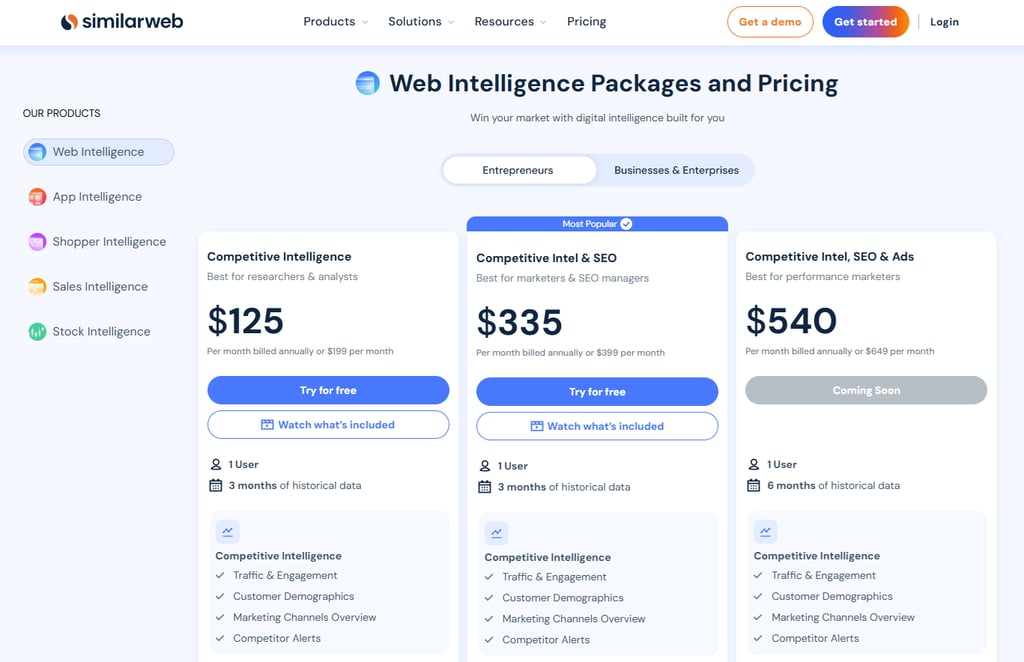
On the Similarweb side, you’ll first find a free plan with demographic and geographic parameters. As far as advanced features go, you’re looking at $125/month for the Competitive Intelligence plan, which you can also try during the 7-day trial period.
Going the paid plan route gives you traffic and engagement insights, more detailed demographic data, and an in-depth overview of marketing channels, which makes it the go-to for enterprises. That said, SEO intelligence requires the more expensive plan at $335/month.
Alexa vs Similarweb: overview insights
As far as general functionality goes, Similarweb’s website traffic data and engagement metrics are on a whole other level.
Alexa provided a site’s monthly unique visitors, as well as bounce rate, average pageviews per user, and daily time spent on the website. It then relied on the Alexa Traffic Rank feature to calculate the popularity of a website compared to its competitors.
And while finding your way around these insights was super straightforward, at the end of the day, Alexa’s keyword-based reports were relatively simple.
Meanwhile, Similarweb offers a much broader range of insights. In terms of engagement, you’ll find a ton of helpful metrics like average monthly visits, average session duration, pages visited per session, and bounce rate.
As for traffic data, Similarweb first breaks down sources into direct, search, and referrals. It also shows volumes by source and by country, as well as organic vs paid traffic. Lastly, you get to see site rankings by category, country, and global settings.
Similarweb vs Alexa: data sources
While both Similarweb and Alexa offer great insights, how they obtain them also matters.
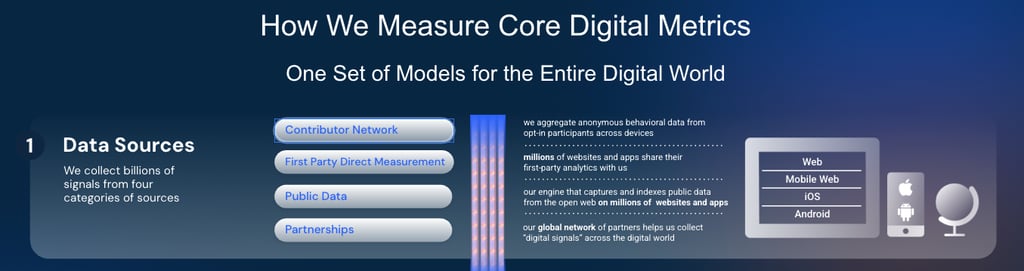
Similarweb loves to diversify and is very transparent about how it gets its data. In fact, there’s a whole page dedicated to its sources, where you can see how it relies on 4 main ones. This includes the data collected by various extensions and Similarweb’s own crawlers, as well as the data from contributor networks and partnerships in regions where that’s permitted.
In addition to using a multi-layered network, Similarweb’s data is still fresh as it’s being continuously updated.
The same can’t be said of Alexa, as its data hasn’t been refreshed in a while now due to the discontinuation.
And even when it was active, Alexa relied on a much narrower funnel. For example, the vast majority of its data came from browser extensions. That said, the Alexa script on third-party websites also pulled some of that weight.
Similarweb vs Alexa: data accuracy
Besides sources, accuracy is another vital aspect of estimating website traffic and engagement. And in our Similarweb vs Alexa accuracy showdown, the former easily takes the lead.
Similarweb might have had its fair share of accuracy issues in the past, but the 2024 update changed everything for the platform. Today, it’s widely considered one of the most precise tools on the market for global website traffic estimation, and for a good reason.
While it’s not ideal for websites with fewer than 5,000 visitors, its traffic estimations closely align with users’ Google Analytics data, especially for domains with more than 50,000 monthly visits.
Alexa, on the other hand, was never as accurate. According to historical user reviews we came across, its numbers didn’t always match those of Google Analytics, even during its peak. These comments also suggest that the tool’s accuracy dropped further later on due to a narrower data source funnel.
Alexa vs Similarweb: keyword insights
Shift the conversation to SEO and keyword data, and it’s not even close.
Before its discontinuation, Alexa’s Site Keywords tool offered info on organic traffic and paid campaigns, as well as the competitiveness of the top phrases. And while this level of data was undoubtedly helpful for SEO, it was rather basic.
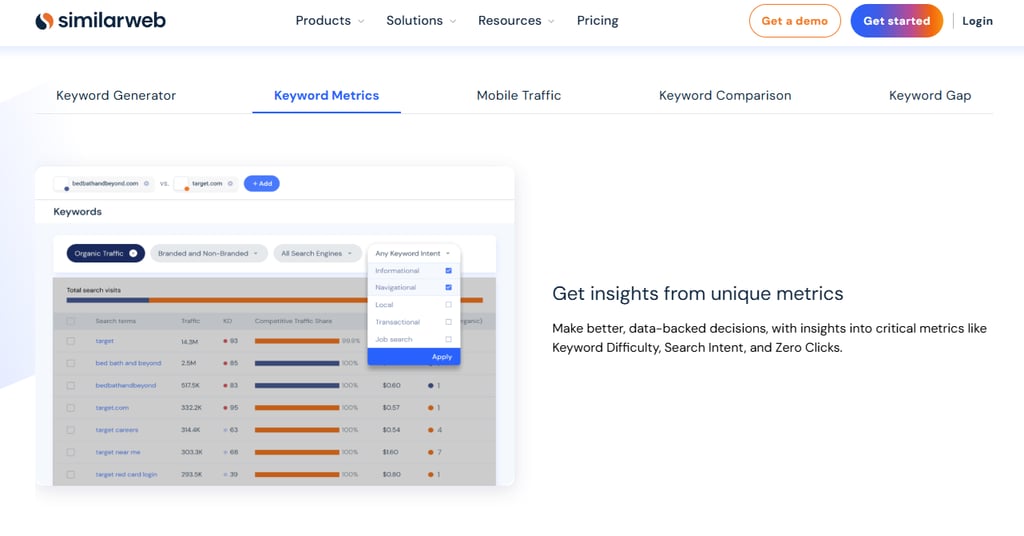
Similarweb, on the other hand, provides a wealth of information that goes beyond keyword rankings. There’s your standard organic vs paid traffic breakdown, as well as branded vs non-branded terms and far more detailed metrics on specific search terms. That includes difficulty ranking for each, zero-click percentages, and CPC ranges.
Similarweb’s Keyword Gap tool is also much more powerful. Meanwhile, the Keyword Ideas feature makes it easier to find opportunities and focus both your content and PPC campaigns on related and trending keywords or question queries.
Similarweb vs Alexa: referral websites and backlinks insights
As the final piece of the Similarweb vs Alexa puzzle, I thought it best to compare data that can help site owners improve their domains and boost traffic. And there’s a clear winner here.
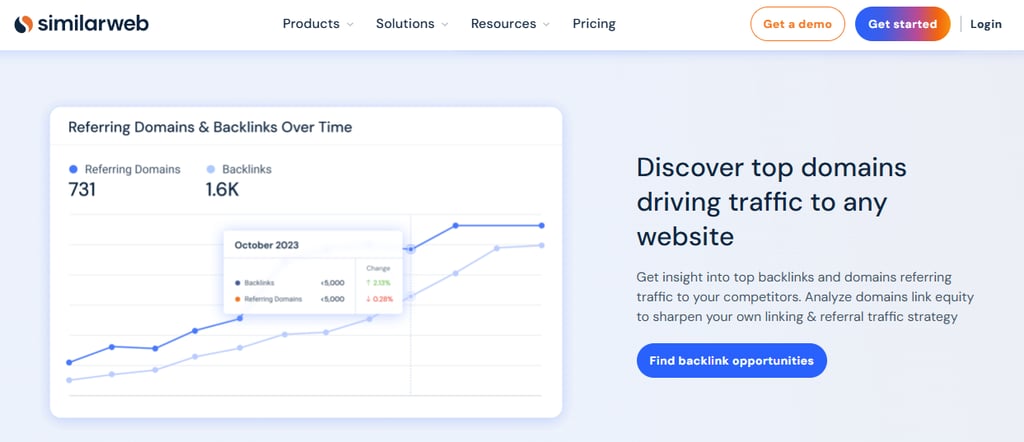
Even back in the golden age of Alexa, Similarweb’s Referrals section was dominating. Today, it’s part of a much broader Website Analysis tool that is tightly focused on real-time visibility into referral paths. As such, it offers insights into the volume of incoming referral visits and their distribution over time, and shows you which sites are sending traffic to a particular domain.
Alexa, on the other hand, relied on its Sites Linking In tool, which gave you the name of the domain, its global rank, and the page that was sending the most traffic to the site you were analyzing. But you never got to see how much traffic that was or how many links there were.
Alexa vs Similarweb: user reviews
Before I wrap up this showdown, I wanted to give you a quick peek at what the users thought of these two platforms.
While the service was still up and running, you could find dozens of comments noting how the Alexa was a breeze to use. However, you could also come across a bunch of reviews saying that it was all going downhill, even back in 2019.
Meanwhile, Similarweb’s users appreciate the wide range of data it provides and how often said data is updated. As far as downsides go, it’s a close tie between advanced features sitting behind a paywall and the tool being a bit challenging to use for beginners.
Alexa vs Similarweb: final verdict
While both platforms have their strengths and weaknesses, at the end of the day, Similarweb is the only real option you have.
Yes, Alexa was a force to be reckoned with back in the day. It was simple to use and provided up to 6 months of historical data. However, all of this became irrelevant when Amazon shut down the service in 2022.
Ever since then, Similarweb has been the go-to for both former Alexa users and anyone else in digital marketing, really. Its spotless interface, accurate data, and a wealth of insights it provides give it an edge over most web traffic analysis tools.
FAQ
What happened to Alexa.com, and why was it discontinued?
Amazon didn’t really provide a reason for retiring Alexa Rank on May 1, 2022. That said, it’s widely believed that the lack of interest from marketing teams (and their growing use of competing platforms) led to the discontinuation of the popular web traffic analysis tool.
QuestionIs Similarweb a reliable alternative to Alexa?
Absolutely! In fact, it’s often considered the superior choice. That’s because Similarweb uses a broader network of sources and offers traffic data that aligns with Google Analytics far more often than Alexa ever did. It also provides additional insights that Alexa never had.
How accurate is Similarweb’s website traffic data?
Very much so. Out of all modern traffic estimation tools, Similarweb has been found to provide the closest numbers to users’ own Google Analytics data. That said, it’s important to keep in mind that these are estimates and should be taken with a grain of salt.
Which tool is better for keyword research: Alexa or Similarweb?
Overall, Similarweb is the better of the two for keyword insights. Besides having a database of about 5 billion keywords, it also offers freshness that the discontinued Alexa simply can’t provide. Its keyword tools show a wider range of metrics as well.