RatePunk vs Skyscanner: which flight deal finder is better?


Traveling abroad was once seen as a luxury few could afford. Today, the situation is drastically different, with low-cost airlines making flights incredibly cheap. Yet, finding these budget-friendly deals still takes hours of research and price comparison.
That’s precisely where RatePunk and Skyscanner enter the scene. These travel savings tools do the work for you: they compare flights, flag hidden discounts, look for private rates, and alert you to the best deals they can find. As such, they can save you plenty of time and money. Yet, the question remains: which of the two travel savings platforms should you use?
To answer that, Cybernews researchers and I conducted a thorough Skyscanner vs RatePunk comparison. For this, we relied on both provider claims and real user feedback, and evaluated the tools across deals, alerts, hotel and car rental integrations, apps, support, and pricing.
RatePunk vs Skyscanner overview
Before I compare the two travel savings tools in more detail, let’s first take a quick look at their key features:
| Service | RatePunk | Skyscanner |
| Rating | ⭐ 4.7 | ⭐ 4.6 |
| Core function | Travel deal discovery platform for flights and hotels with real-time app and dashboard alerts | Flight, hotel, and car hire search engine with app or email price alerts for the best deals |
| Booking method | Via third-party services | Via third-party services |
| Flight coverage | Broad (100+ destinations) | Very broad (global routes) |
| Hotel integration | Very broad (Booking, RatePunk, Expedia, Hotels, Priceline, Agoda, Airbnb) | Very broad (Booking, Trip, Hotels, Hyatt, Expedia, Intercontinental) |
| Main strength | AI-powered deal tracking and scoring with real-time alerts, personalized offers, flight price predictions, and cashback rewards | Free to use global travel deal finder with more than 2 decades of experience |
| Main weakness | Occasional dashboard lags | No direct ticket purchases or support |

RatePunk pros and cons
Skyscanner pros and cons
Our methodology
To maintain consistency and make this Skyscanner vs RatePunk comparison fair, the research team and I relied on Cybernews’ in-house evaluation system. Here’s what we analyzed:
- Features and tools (25%). We kicked things off by comparing the two tools across search options, evaluating filters you can apply, and alerts you get.
- Flight deal accuracy (20%). Then, we put the deals they offered against one another, rating the tools based on reliability and the savings they provided.
- Ease of use (15%). We also took a look at apps, web interfaces, and available extensions to gauge just how beginner-friendly each tool is.
- Pricing and transparency (15%). From there, we peeked into associated costs, focusing primarily on subscriptions but also on hidden fees and price discrepancies.
- Coverage (15%). The number of destinations offered, the types of airlines checked, and hotel and car rental integrations also played a key role in this comparison.
- User feedback and reputation (10%). Lastly, we looked at how these two tools fared across review platforms, evaluating overall user satisfaction based on comments.
RatePunk vs Skyscanner: standout features
Both RatePunk and Skyscanner focus on finding the best flight deals. But these two tools go about it a bit differently.
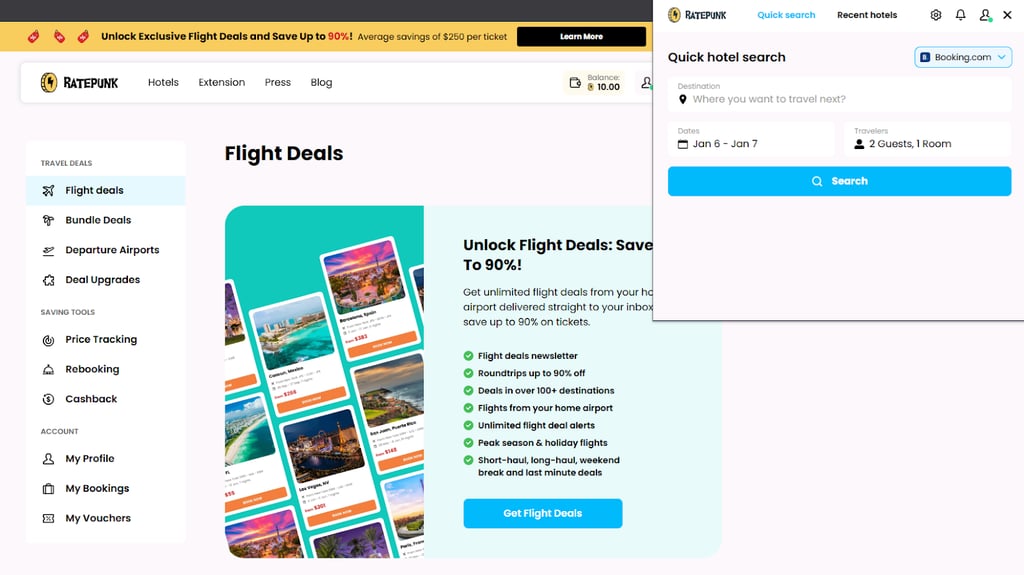
In our review, we mentioned how RatePunk entered the market as a deal-hunting platform that helps travelers save money on flights and hotels. While its primary focus is a subscription service that sends curated flight deals each week, RatePunk offers much more than that.
For instance, its browser extension operates in the background, automatically comparing hotel prices across all popular booking sites as you browse. Pair that with its cashback-style rewards on bookings, and you can immediately see why it has gained so much traction.
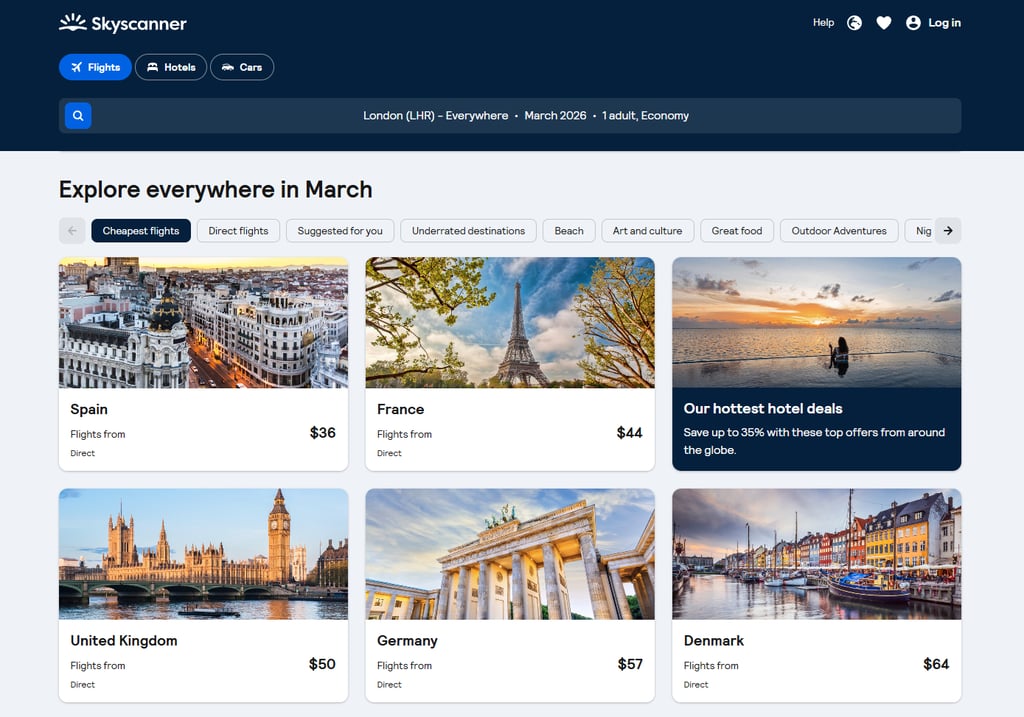
Skyscanner, on the other hand, works as a search engine for flights, hotels, and car rentals. It offers global flight coverage and compares prices across hundreds of airlines and online travel agencies (OTAs) to find the best deals.
What sets Skyscanner apart is its Everywhere tool, which focuses on finding the cheapest outbound flights from your chosen airport. This makes it an excellent choice for travelers who don’t have a clear destination in mind.
RatePunk vs Skyscanner: flight deals
While an affordable flight is the most crucial part of a good travel deal, how these flights are compiled and presented also matters. In that sense, there are a few differences between these two platforms.
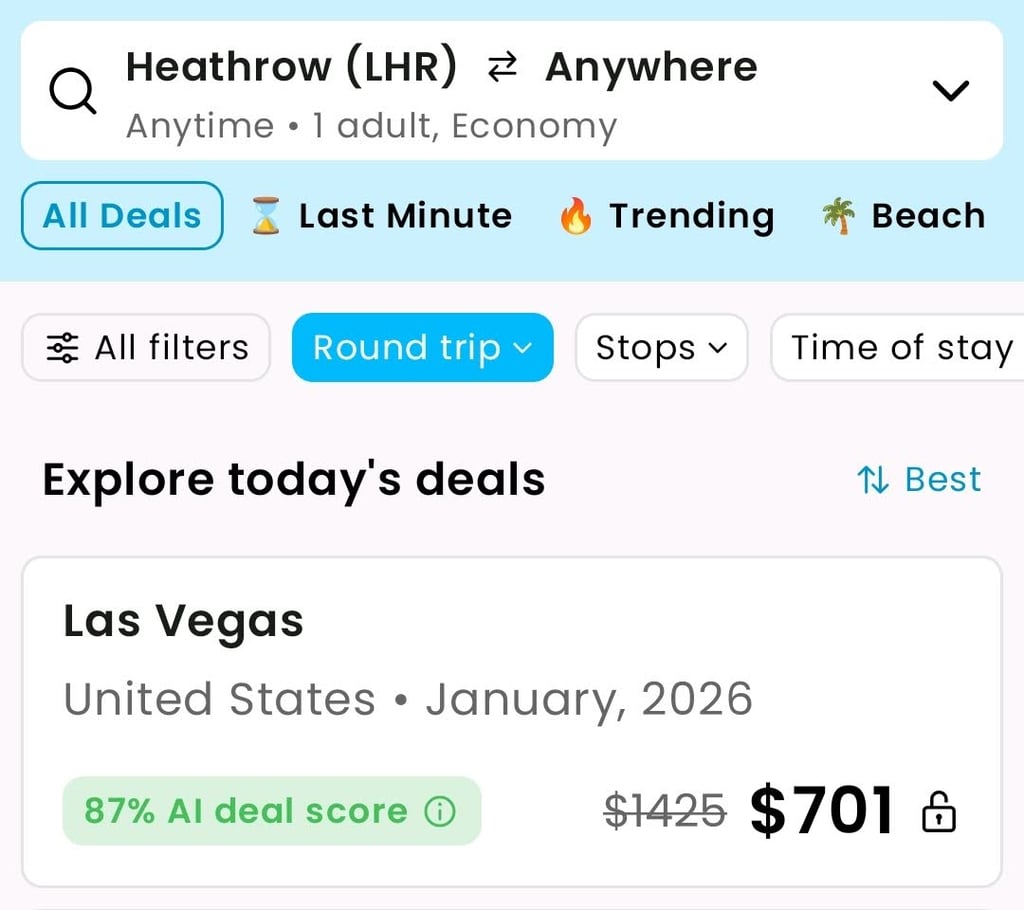
RatePunk uncovers the best options by continuously checking flights and bundle deals across both airlines and OTAs. It then assigns each deal an AI-generated score, allowing you to sort by that score or apply other filters. You also get an instant notification if it’s a really good deal.
Skyscanner also compiles prices from airlines and OTAs, but only displays them in its search interface. You can then view these deals through flexible date grids and sort by cheapest, direct, suggested, and other options.

Skyscanner vs RatePunk: flight alerts
The best flight deals aren’t always available at the exact moment you look. In that sense, staying on top of offers matters just as much as searches, and alerts carry significant weight.
On the one hand, Skyscanner’s alerts are search-focused. That essentially means you can look for a specific flight and leave your email for notifications on any changes. For example, if there’s a price change, the platform will notify you.
RatePunk, on the other hand, uses a deal-based system, with the whole thing built around your general preferences rather than a single search. This translates to smarter notifications, with the platform alerting you to really great deals and substantial changes, not just basic price drops.
RatePunk vs Skyscanner: hotels and rental cars
Traveling abroad takes more than just buying flight tickets; it’s also about where you stay and how you move around. Luckily, both platforms excel at offering a complete travel package.
Besides flight deals, RatePunk also offers a bundle deals subscription that adds hotels to the mix. In fact, the platform has teamed up with several wholesalers, enabling it to provide you with hotel stays at prices lower than most deals you’ll find on your own.
Despite the name, Skyscanner doesn’t just scan the skies for cheap flights. It’s actually an all-in-one travel platform with hotel and car rental deals on top of flights. With it, you can essentially plan an entire trip without ever leaving the Skyscanner page or app.

Skyscanner vs RatePunk: mobile app experience
Speaking of apps, both Skyscanner and RatePunk are available on Android and iOS.
If you’re primarily a phone or tablet user, you’ll love Skyscanner’s apps. Once you’re logged in, you’ll be met with a clean interface with flights, hotels, and car rental options on top, and navigation options at the bottom. Finding your way around will also be a breeze.

The situation is similar on the RatePunk side, as its Android and iOS apps bring the platform’s entire functionality to your phone’s screen. Here, you kick things off by setting your primary departure airport, with more options you can add later. Once you do, you can explore the best deals of the day, adjust filters at the top, or set price alerts and change settings at the bottom.

RatePunk vs Skyscanner: customer support
As a deal-hunting platform and a metasearch engine, neither RatePunk nor Skyscanner provide customer support for bookings through third-party airlines or hotel sites. However, you can get quick help for platform-related issues in both cases.
On the RatePunk side, you can contact the support team via email ([email protected]), with agents responding quickly to travel-, billing-, or app-related questions. Alternatively, you can use the AI-powered live chat agent or find an answer in the FAQ section.
Skyscanner’s help center is just as vast, if not more. It’s also well-thought-out, allowing you to quickly find answers by topic. As for email and live chat support, you won’t find that here, but you can leave a question or a comment by filling out the contact form.
RatePunk vs Skyscanner: data privacy
While data collection powers both of these services, you can rest assured that your personally identifiable information (PII) will be handled safely in both cases.
RatePunk complies with multiple data protection acts, including GDPR, CalOPPA, and FADP. The provider also states it doesn’t sell or transfer your PII to third parties. Its privacy policy further details the data it collects, such as search and browser extension activity. Speaking of the extension, it uses cookies to monitor prices.
Skyscanner’s policy covers a much broader range of points, with well-organized explanations of what data it collects and how. Much like RatePunk, it promises to safeguard your PII and doesn’t sell any of your data or use cookies to inflate trip prices in response to your searches.
RatePunk vs Skyscanner: pricing and subscriptions
One of the biggest differences between these two platforms lies in their revenue models.
RatePunk is a subscription-based service. Here, a 1-year flight deals membership will set you back $23.99. For bundle deals that include hotels and transfers, it’s an extra $4.99. That’s not a lot compared to how much you can save as a frequent traveler. And if you’re not happy with the service for whatever reason, RatePunk also offers a 14-day money-back guarantee.
Skyscanner, on the other hand, is an entirely free tool. That said, the platform does use ads to make money, so your experience won’t be as seamless as with RatePunk, which is something to keep in mind.
RatePunk vs Skyscanner: user reviews
As good as RatePunk and Skyscanner look on paper, how users really feel about these tools matters even more. So, that’s something I evaluated.
In the case of RatePunk, customers are generally satisfied across both review platforms and online forums that I’ve checked. Most positive comments focus on the service’s browser extension and how easy it is to use, with the apps receiving just as much praise. That said, negative feedback is also present, particularly about slowdowns when refreshing deals.
On Skyscanner’s side, things seem even more positive. Most users appreciate the user-friendly interface and the availability of hotels and car rental deals alongside flights. As for negative feedback, most of it seems to be about price discrepancies between Skyscanner and the third-party providers it links you to.
Expert tips for finding the cheapest flight deals using Skyscanner or RatePunk
With the Skyscanner vs RatePunk comparison out of the way, I also wanted to share a few tips to make your next trip a breeze, regardless of the platform you choose:
- Plan your trip at least a month or two earlier. Booking a flight 4 to 8 weeks in advance avoids both last-minute and early bird fees, making it the sweet spot for pricing.
- Try to be as flexible as possible about dates. While work doesn’t always allow for flexibility, searching for flights this way is often the most affordable.
- Take advantage of flight price alerts. Setting up email or app notifications early helps you stay on top of price updates and book flights when they’re least expensive.
- Check out prices for multiple airports and airlines. Mixing and matching airports, or even airlines, can sometimes be much cheaper than sticking to just one of these.
RatePunk vs Skyscanner: which one should you use?
When everything is said and done, both RatePunk and Skyscanner are excellent platforms for finding some great travel deals.
RatePunk is ideal for saving big time on both flights and hotels. It does most of the work for you, with weekly newsletters making it a compelling choice for frequent travelers. And that’s not even mentioning its cashback-like rewards.
Skyscanner, on the other hand, is an excellent choice for users who prioritize global coverage and all-in-one searches for flights, hotels, and transfers. It’s even better when you’re flexible on destinations and dates.
FAQ
Is RatePunk or Skyscanner better for finding cheap flight deals?
Depends on the type of traveler you are. RatePunk works wonders for those who want curated flight deals with as little work as possible. Meanwhile, Skyscanner offers broader coverage, while its Everywhere option is ideal for those who are flexible on destinations.
Does RatePunk work worldwide like Skyscanner?
RatePunk doesn’t cover as many airlines and OTAs as Skyscanner. However, it does support international flight routes and more than 100 of the world’s most popular destinations.
Are flight prices on Skyscanner always accurate?
No, they’re not. The numbers you see on Skyscanner’s website or app aren’t final and can change even in that short window while you’re booking a trip. In fact, price discrepancies between Skyscanner and the third-party providers it links you to are often the subject of negative feedback.
Can I book flights directly through RatePunk or Skyscanner?
No, you can’t, because neither platform sells flights directly. RatePunk and Skyscanner serve as deal-hunting and search platforms, respectively, and both will redirect you to third-party airlines and OTAs to complete bookings.