Keploy
Last updated: June 16, 2026
What is Keploy?
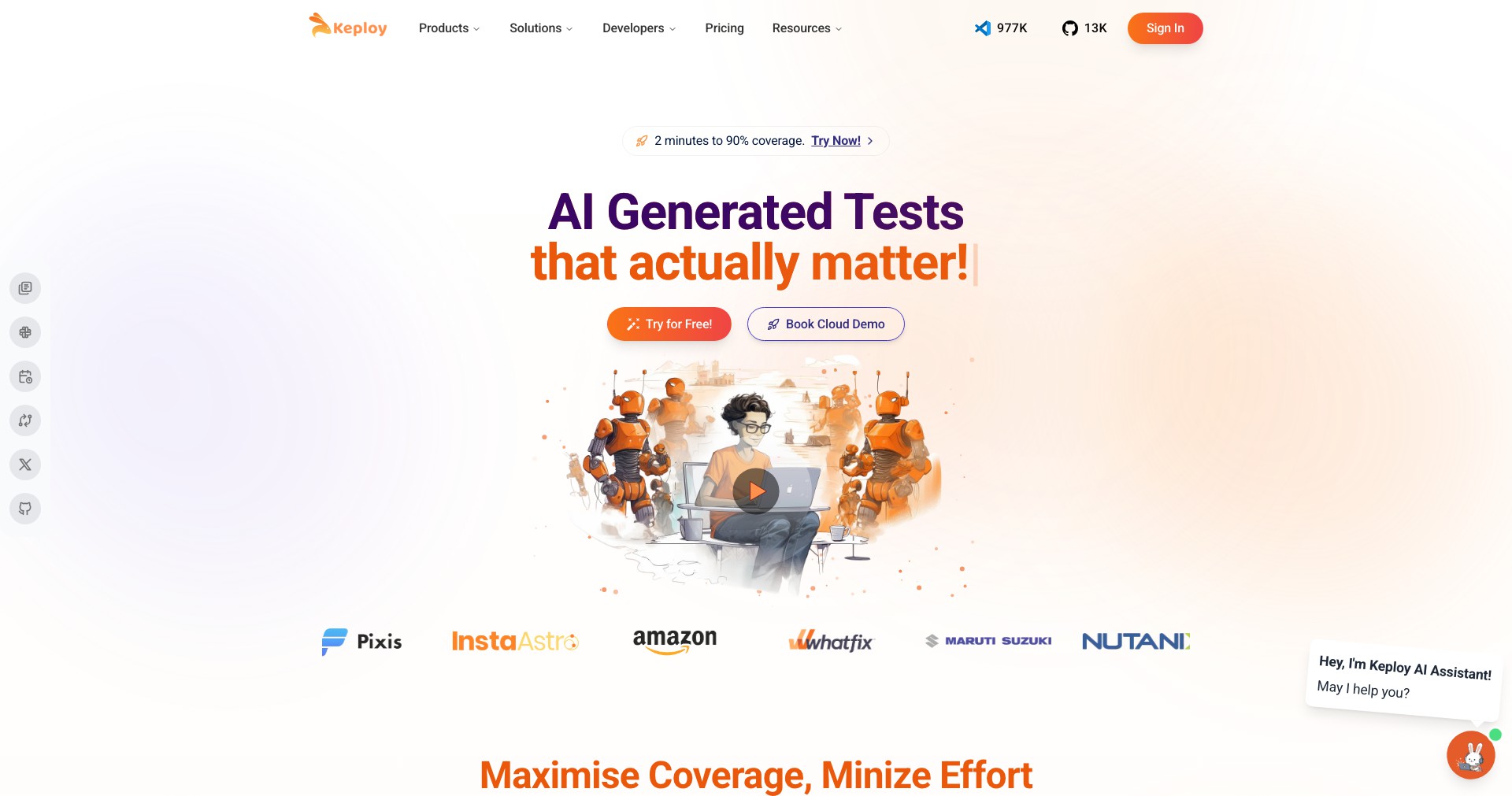
Keploy is a powerful open-source platform specifically crafted for developers and QA professionals seeking to enhance their testing infrastructure. By leveraging real user traffic, Keploy enables the automated creation of test cases and data mocks, making it possible to recreate complex user scenarios quickly and accurately. This results in more reliable testing processes and a significant reduction in manual test writing efforts.
Geared towards teams working on API-driven applications and microservices, Keploy integrates seamlessly within CI/CD pipelines and local development environments. Whether you’re looking to bolster test coverage, improve regression testing, or simplify mocking in your workflow, Keploy offers a dynamic and developer-friendly solution that can be adopted by organizations of all sizes.
Key Features:
-
Automatic Test Generation:
Captures real user traffic from APIs or backend services to automatically generate test cases, drastically reducing manual effort and ensuring realistic test scenarios. -
Data Mocking:
Creates accurate mocks of input/output and dependent services, enabling isolated testing and improving the reliability of test outcomes. -
Seamless CI/CD Integration:
Integrates easily with popular CI/CD tools and custom pipelines, aligning test generation and execution with existing development workflows. -
Support for Multiple Languages:
Supports a variety of programming languages and frameworks, making it flexible for organizations with diverse tech stacks. -
Open Source Flexibility:
Being open source, Keploy benefits from community contributions, transparent development, and the ability to customize or extend its features to suit unique use cases.
What makes Keploy unique?
Keploy distinguishes itself in the market as one of the few open-source tools that combines automatic test case generation with robust data mocking purely from live user traffic. Unlike other solutions that require explicit test definitions or heavy upfront configuration, Keploy’s approach minimizes manual overhead and ensures that tests mirror actual usage patterns.
Additionally, its seamless integration into CI/CD pipelines and strong support for backend and microservices architectures make it especially appealing for modern development teams dealing with complex distributed systems.
Pros and Cons
Who is using Keploy?
Backend Developers: Developers working on backend services and APIs will benefit the most, as Keploy simplifies the creation of thorough test suites using real user data and speeds up debugging and regression testing.
Quality Assurance Teams: QA engineers can automate and enhance their existing testing regimens, ensuring broader coverage while cutting down on repetitive manual test creation.
DevOps and CI/CD Engineers: Engineers responsible for maintaining and optimizing CI/CD workflows can leverage Keploy’s automation to improve the efficiency and reliability of deployments.
Product Evolution
Since its inception, Keploy has evolved from a basic API traffic capture tool to a comprehensive testing platform. Early versions focused on capturing requests and generating basic test cases.
With each update, Keploy introduced new features, such as more sophisticated data mocking, support for additional programming languages and frameworks, and enhanced reporting capabilities.
Today, Keploy continues to be actively developed, with contributions from a growing open-source community driving features like better scalability, integrations with new DevOps tools, and expanding support for different system architectures.
Pricing
| Plan | Price | About |
| Free, Open Source | $0 | Keploy is completely free to use under an open-source license, with no paid tiers or restrictions. |
Verdict
Keploy stands out as a highly capable and innovative open-source solution for back-end and API testing. Its ability to turn real user traffic into accurate tests and mocks offers a huge productivity boost for development and QA teams.
While it is primarily geared towards backend scenarios, the tool’s automation, flexibility, and zero-cost model make it a compelling choice for startups and enterprises alike looking to streamline their testing and CI/CD processes.


