Lintrule
Last updated: June 16, 2026
What is Lintrule?
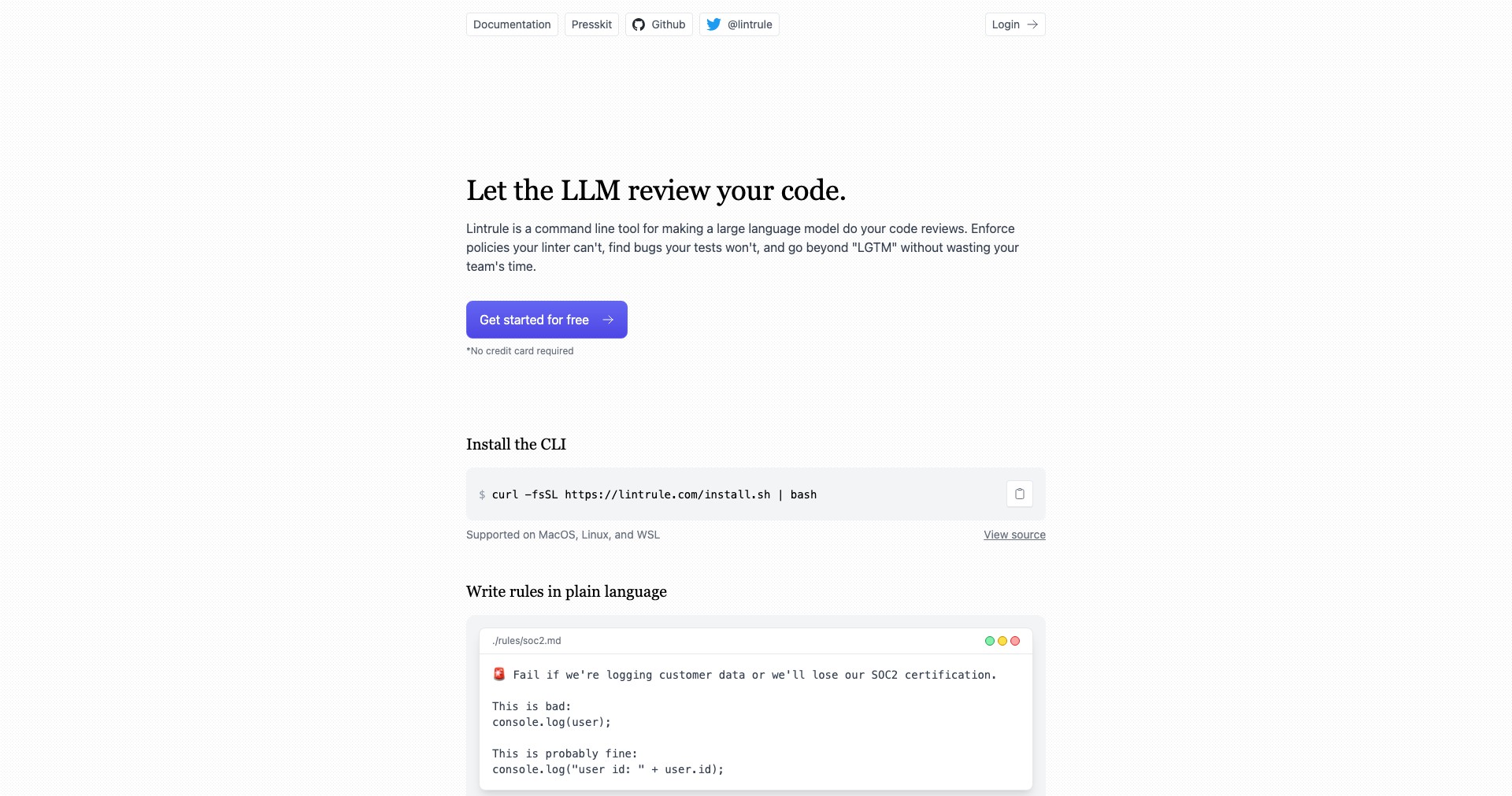
Lintrule is an innovative, open-source platform designed to simplify and supercharge code linting and rule enforcement for developers. Created for both solo programmers and teams, Lintrule leverages AI to help users quickly define, customize, and enforce code quality rules across various projects. By bridging the gap between static analysis and automated best-practice enforcement, it aims to reduce human error, code inconsistencies, and technical debt.
Whether you’re working on a large codebase with frequent contributors or building solo side projects, Lintrule ensures style guides and coding standards are not only enforced, but effortlessly adaptable. Its integration with popular code repositories and CI/CD pipelines makes keeping your codebase healthy a seamless experience.
Key Features:
-
AI-Powered Rule Creation:
Lintrule uses advanced AI to help developers create and customize linting rules with simple language input, making rule definition accessible to all skill levels. -
Multi-Language Support:
Supports popular programming languages such as JavaScript, Python, and more, ensuring consistent code quality across polyglot projects. -
Seamless CI/CD Integration:
Lintrule integrates easily with leading CI/CD platforms, enabling automated code quality checks at every push or merge request. -
Collaborative Rule Management:
Teams can collaboratively define, review, and update coding rules, decreasing friction and aligning best practices across contributors. -
Extensive Rule Library:
Offers a growing library of pre-defined linting rules and style guides, making it easy to get started or adopt industry standards with minimal setup.
What makes Lintrule unique?
Lintrule stands out from traditional linter tools by bringing AI-driven customization and natural language processing into rule creation—lowering barriers for both new developers and teams with unique code standards. Unlike static linters that require manual configuration or knowledge of config syntax, Lintrule empowers users to define and adjust rules intuitively.
Its open-source nature ensures flexibility and rapid community-driven feature development, while its focus on collaborative rule management enables teams to stay aligned as code standards evolve. By integrating with multiple languages and CI/CD platforms, Lintrule positions itself as a universal linting assistant, rather than a single-language solution.
Pros and Cons
Who is using Lintrule?
Software Development Teams: Ideal for teams of all sizes who need consistent enforcement of code styles and best practices across projects, improving long-term codebase maintainability.
Freelance Developers: Freelancers can use Lintrule to quickly adopt, customize, and enforce code standards for personal and client projects, boosting professionalism.
Open Source Project Maintainers: Maintainers benefit from easy-to-use linting enforcement and community-friendly rule management, facilitating clean contributions from diverse participants.
Product Evolution
Lintrule started as a simple linter wrapper with a goal to simplify configuration and enforcement of code quality rules. Early releases focused on supporting JavaScript and Python, with basic integration flows and a nascent rule library.
Since its launch, the platform rapidly expanded its language support and added AI-driven rule creation, dramatically lowering the learning curve for new users and enabling rapid rule adjustments without diving into configuration files.
Recent updates focus on deeper CI/CD integration, collaborative rule editing, and enhanced pre-configured rule sets, reflecting community feedback and positioning Lintrule for wider adoption in both open-source and enterprise settings.
Pricing
| Plan | Price | About |
| Free/Open Source | $0 | Lintrule is available for free as an open-source project under a permissive license, with no subscription fees. |
Verdict
Lintrule is a promising tool for developers and teams seeking an easy, AI-powered approach to maintaining and enforcing code quality standards. Its open-source foundation and intuitive feature set make it accessible for projects of any size, with the added bonus of encouraging best practices through automation.
Though it is still maturing in terms of community and advanced features, Lintrule’s unique approach to rule creation, wide language support, and robust integration capabilities hint at significant long-term value. It is especially appealing for teams and projects eager to cut down on manual code reviews and ensure healthy, maintainable codebases.


