WhisperClip v1.0.38
Last updated: June 16, 2026
What is WhisperClip v1.0.38?
WhisperClip v1.0.38 is a cutting-edge, open-source audio transcription tool leveraging AI models from Whisper to convert voice or spoken audio into accurate text. Whether you’re recording interviews, meetings, lectures, or spontaneous thoughts, WhisperClip ensures your words are captured efficiently and effectively.
Designed for versatility and ease of use, WhisperClip can be operated on various platforms and supports multiple audio file types. Users appreciate its combination of AI-powered accuracy, customizable configuration, and respect for data privacy, making it a favorite among those who need reliable voice-to-text solutions either professionally or personally.
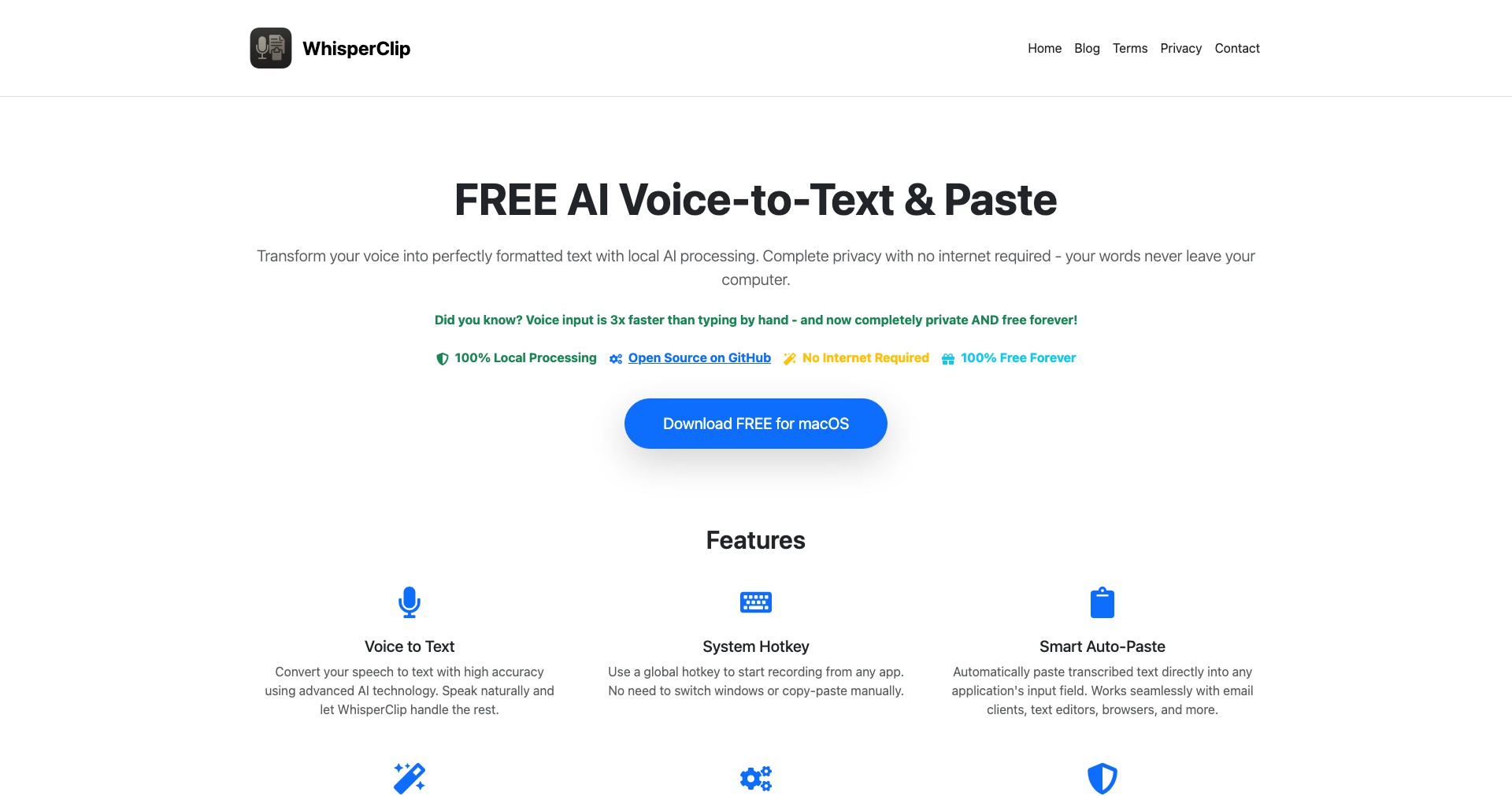
Key Features:
-
State-of-the-art Transcription:
Utilizes advanced AI models from OpenAI’s Whisper project to deliver accurate transcriptions across diverse accents and languages. This ensures reliable conversion for a broad global user base. -
Audio Clipping and Segmentation:
Enables users to easily extract segments from longer recordings and transcribe only the necessary parts, saving time and processing resources. -
Multi-Platform Support:
Works on Windows, macOS, and Linux, allowing flexibility for users on different operating systems without sacrificing functionality or ease. -
Privacy-Focused and Offline Capability:
Processes audio data locally without sending files to external servers, making it suitable for sensitive projects and those concerned about data privacy. -
Customizable Configuration:
Offers advanced settings for selecting transcription models, output formats, and other parameters, empowering users to tailor the experience to their needs.
What makes WhisperClip v1.0.38 unique?
WhisperClip v1.0.38 sets itself apart with a deep commitment to privacy through on-device processing, eliminating the risk of sensitive audio data leaving the user’s machine. This approach contrasts with popular cloud-based competitors that require uploading proprietary or private content to third-party servers.
Beyond privacy, WhisperClip’s open-source model encourages community-driven improvements and adaptability. Users benefit from robust feature development, extended language support, and unique integrations fostered by an engaged ecosystem, all while leveraging the remarkable accuracy of Whisper AI.
Pros and Cons
Who is using WhisperClip v1.0.38?
Journalists and Content Creators: Ideal for professionals who routinely conduct interviews, record podcasts, or produce media. WhisperClip provides accurate, fast transcription without compromising sensitive content privacy.
Academics and Students: Perfect for transcribing lectures, research interviews, or spoken notes, allowing learners and researchers to focus on content rather than manual note-taking.
Developers and Technical Users: Open-source enthusiasts and developers benefit from the tool’s extensibility and local operation, enabling integration into custom workflows or privacy-sensitive environments.
WhisperClip’s Evolution
Initially, WhisperClip emerged as a simple wrapper around the Whisper AI model, offering basic command-line transcription functions for tech-savvy users.
Subsequent updates, including v1.0.38, have introduced a graphical user interface, easier audio clipping, expanded configuration options, and enhanced cross-platform support—a response to growing community feedback and diverse user requirements.
Looking ahead, ongoing development hints at future support for more file formats, enhanced performance for low-end hardware, and richer integrations with productivity apps, maintaining its position at the forefront of open-source voice transcription solutions.
Pricing
| Plan | Price | About |
| Open-Source Free | $0 | WhisperClip v1.0.38 is completely free to use for personal and commercial purposes under its open-source license. |
Verdict
WhisperClip v1.0.38 stands out as one of the most robust and attractive options for offline, AI-powered transcription—especially for privacy-conscious users and those requiring maximum control over their data and workflows.
While it does demand a measure of technical proficiency and offers limited mobile access, its high accuracy, open-source nature, and unwavering focus on privacy make it a valuable tool for journalists, academics, developers, and anyone seeking a flexible transcription solution.


