Who Codes Best?
Last updated: June 16, 2026
What is Who Codes Best??
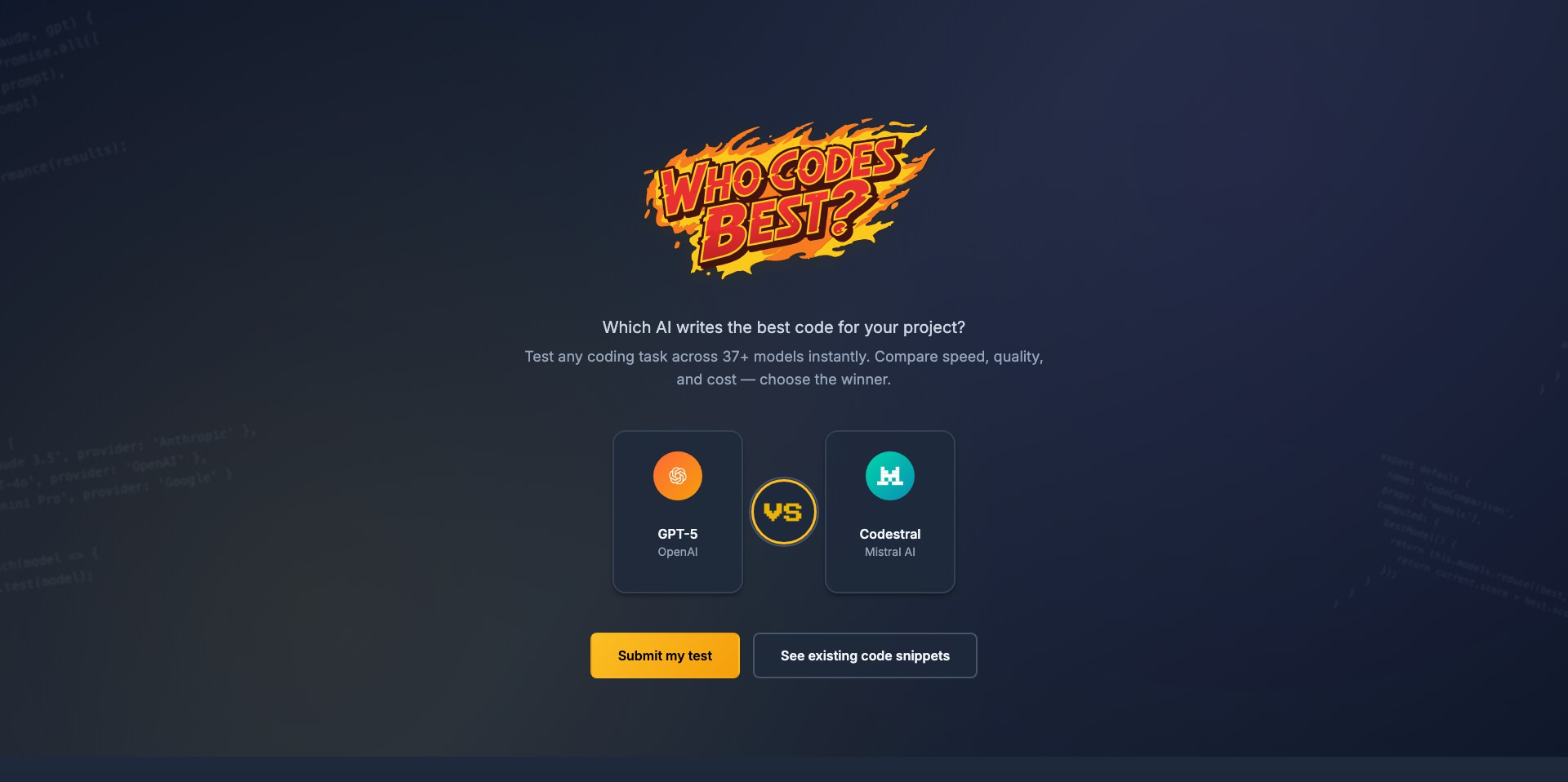
Who Codes Best? is a web-based tool that empowers users to compare how different AI coding models respond to the same programming prompt. It’s designed for anyone interested in evaluating the strengths and weaknesses of popular AI code generators—such as ChatGPT, Gemini, or others—by letting users pit their code-generation abilities against each other in real time.
By making the code output of multiple models easily viewable and testable, Who Codes Best? becomes an invaluable resource for programmers seeking the best solution to their coding problems, as well as educators who want to demonstrate AI capabilities. Its user-friendly interface and focus on transparency help demystify which models are best suited for certain kinds of tasks or programming languages.
Key Features:
-
Side-by-Side Code Comparison:
The platform enables instant comparison of AI-generated code by displaying models’ output side by side, making it easy to spot differences in logic, efficiency, and correctness. -
Custom Code Prompts:
Users can input any coding question or prompt, allowing for comprehensive testing across a variety of languages, tasks, and complexity levels. -
Multiple AI Models Supported:
Who Codes Best? supports several mainstream AI code generators, letting users compare results from models like OpenAI’s Codex, Gemini, and others, all from one interface. -
Community Voting System:
After reviewing the outputs, users can vote on which solution they believe is best, adding a layer of crowdsourced assessment to the evaluation process. -
Clean, User-Friendly Design:
The interface is streamlined for ease of use, with clear formatting and labeling, so both beginners and advanced users can navigate and draw insights without friction.
What makes Who Codes Best? unique?
Unlike singular code-generation tools, Who Codes Best? focuses specifically on comparative benchmarking, allowing users not only to see AI-generated solutions but to actively contrast and rank them based on real, practical outputs. This comparative aspect provides a direct, empirical understanding of each model’s strengths, rather than relying on generalized claims or marketing.
Additionally, the community voting feature brings a social and crowdsourced judgment element, making the evaluation process dynamic and often surfacing best practices or less obvious flaws. Its support for diverse AI models and open-ended prompts further distinguishes it from simple API playgrounds or single-model code AI tools.
Pros and Cons
Who is using Who Codes Best??
Developers & Programmers: Ideal for software engineers and coders who want to quickly benchmark AI code models, compare solutions, or discover which model aligns best with their coding style or requirements.
Educators & Instructors: Provides a live demo and testing ground for teachers and trainers aiming to illustrate the capabilities and quirks of AI coding assistants to students or in workshops.
AI Enthusiasts & Researchers: A valuable tool for tech enthusiasts and researchers curious about AI model performance, strengths, and weaknesses across different programming tasks and languages.
Evolution and Improvements
Who Codes Best? began as a minimalist comparison site focused on just two AI models. Over time, it expanded its range to support more models and additional programming languages, enabling broader comparisons.
The addition of the voting system marked a key milestone, allowing users to collectively judge code quality and surface the most reliable or innovative answers.
Ongoing feedback from early users has influenced updates in interface design and feature sets, with more plans to introduce analytical tools and perhaps automated code evaluation in the future.
Pricing
| Plan | Price | About |
| Free | $0 | All features are currently offered free of charge, making the tool widely accessible without any subscription or payment requirements. |
Verdict
Who Codes Best? excels as a lightweight, accessible tool for anyone wanting to compare leading AI models on their code generation abilities. The simple workflow and community voting system provide unique value for both professionals benchmarking models and newcomers exploring code AI.
Its limitations (such as the lack of in-platform code execution) are balanced by its clear educational use and ease of access. As the platform and its community grow, its value as a comparative AI benchmarking resource will only increase for developers, educators, and AI observers alike.


