We spoke to 100 researchers. This is the biggest threat from AI
Nearly 40% of researchers call for frontier AI to be slowed down.

Image by Cybernews

 Follow us
- Cybernews surveyed 103 AI researchers about advanced AI, superintelligence, and major risks to humanity.
- About 64% say self-improving AI could plausibly pose a major risk within five years.
- Most researchers see human misuse and concentrated power as bigger threats than AI acting on its own.
- Nearly 40% want frontier AI development slowed, while 15.7% support a temporary pause.
Key Takeaways by nexos.ai, reviewed by Cybernews staff.
Our new survey of over 100 researchers reveals that most fear AI poses a major risk to humanity in the next 5 years, but believe harm will likely be caused by human misuse rather than AI acting on its own.
The survey of 103 researchers sheds light on the expectation gap between AI labs and the broader scientific community.
Despite AI executives’ promises that superintelligence smarter than human beings is just around the corner, most researchers say a fundamental breakthrough is needed for advanced AI to be achieved.
The survey also casts doubt on recent warnings about AI going rogue and destroying humanity. Nearly 70% of researchers say human misuse and structural effects, such as the concentration of power, are the major sources of potential harm.










Stay updated with our latest stories and follow us on social media
Be the first to discover new stories, ideas, and updates from our team.
AGI is possible, but a breakthrough is needed
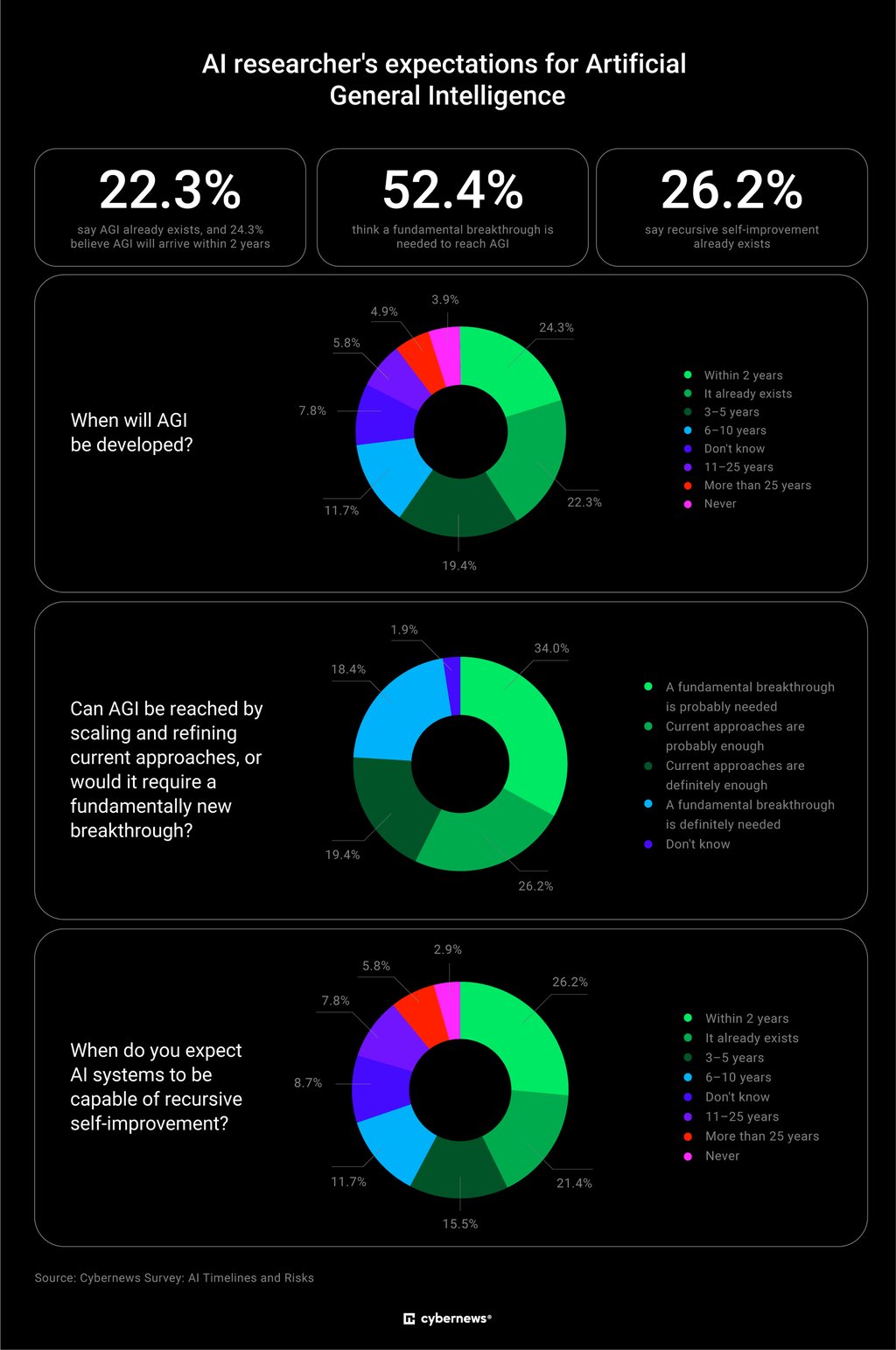
Some 22.3% of respondents said artificial general intelligence (AGI) already exists, when defined as AI that can perform a broad range of intellectual tasks at least as well as a skilled human, including tasks outside its original training focus.
About a quarter (24.3%) expect AGI to arrive within the next 2 years, while 19.4% say it may take another 3 to 5 years for the technology to be developed. Only 3.9% believe that AGI is impossible.
Despite widespread optimism about human-level intelligence, 52.4% of surveyed researchers say a fundamental breakthrough is probably or definitely needed to create it.
About a fifth of respondents (19.4%) say current approaches are enough, and 26.2% say current approaches are probably sufficient.
Leading AI firms have long floated the loosely defined concept of AGI, with initial predictions pointing to 2026, but the deadline appears to be repeatedly postponed.
Nvidia CEO Jensen Huang, however, declared that AGI had already arrived in September 2026 after OpenAI released its advanced Astra model trained on his company’s GPUs.

Years before ASI arrives
Surveyed researchers are much less optimistic about artificial superintelligence (ASI), with only 5.9% believing that AI that substantially outperforms the best human experts across a broad range of intellectual tasks already exists.
Nearly one-fifth (18.6%) say ASI could be developed in the next 2 years, and 16.7% say it would take at least 3-5 years.
The poll reveals that many researchers see ASI as only possible in the distant future: 20.6% expect it to arrive in 6-10 years, 8.8% expect the technology to be developed in 11-25 years, and 12.7% say more than 25 years are needed.
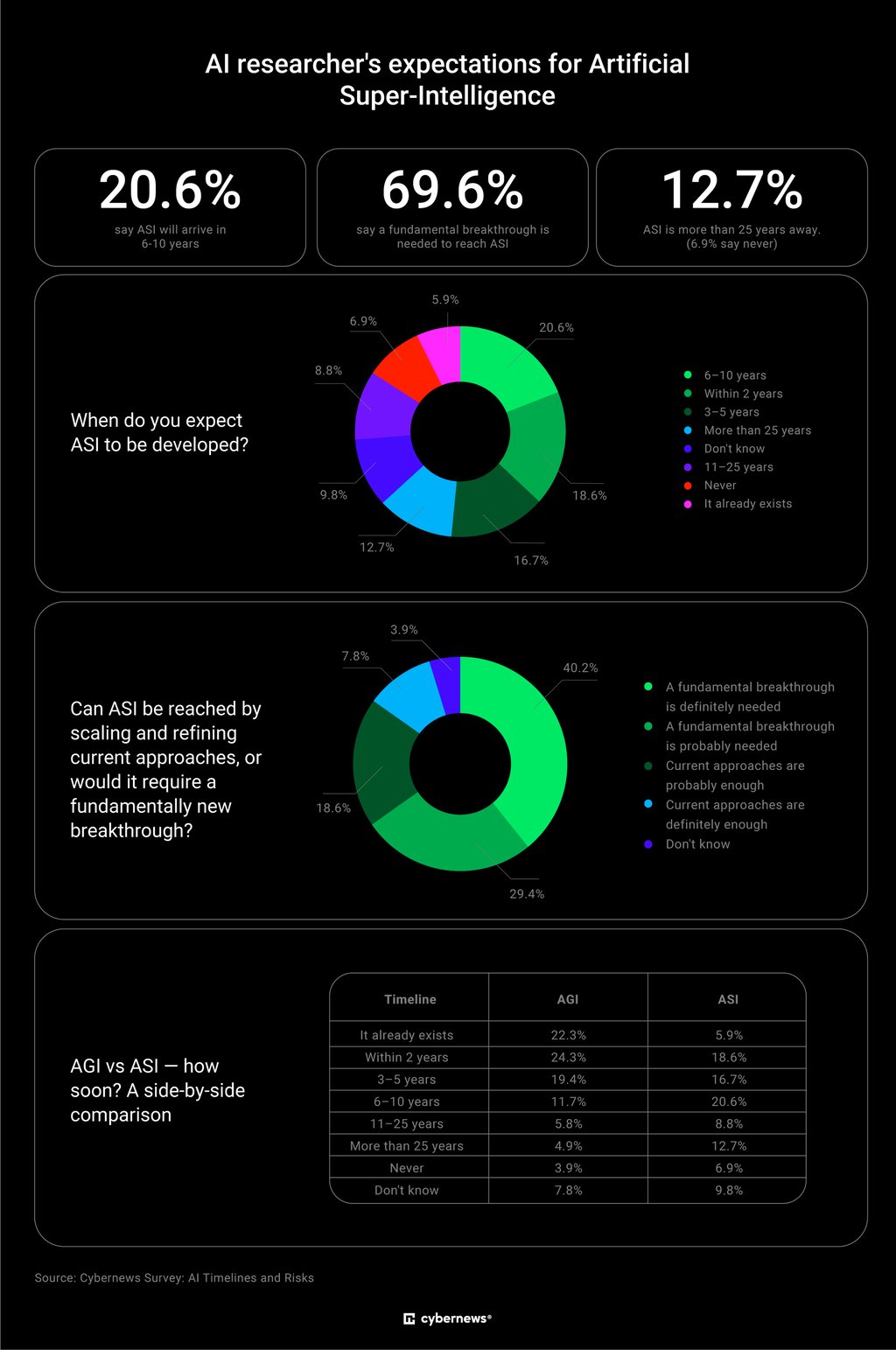
Some 6.9% of respondents say ASI is impossible, echoing pioneer AI researchers like Michael I. Jordan, who recently described superintelligence as a science-fiction term and said that focusing on such “far-fetched” things harms technological progress.
US President Donald Trump brought additional confusion by announcing that his government will rename AI to superintelligence in all official documents, saying the word “artificial” makes the technology sound fake.
Unsurprisingly, 40.2% of respondents say a fundamental breakthrough is definitely needed to achieve ASI, and another 29.4% think fundamentally different approaches are probably needed.
Some 26.4% researchers think current approaches are definitely or possibly enough.
Self-improving AI is already happening
The survey examined the possibility of recursive self-improvement, which refers to AI systems’ ability to substantially accelerate their own research and development with minimal human input, so that each generation builds a more capable successor.
Some 26.2% respondents say it already exists, and 21.4% expect it in the next 2 years.
Many researchers, however, believe such an AI feedback loop would take a long time to materialize, with 35% of respondents estimating it would take between 3 and 25 years.
Another 2.9% said AI systems will never achieve recursive self-improvement.
Most think AI may cause major risks
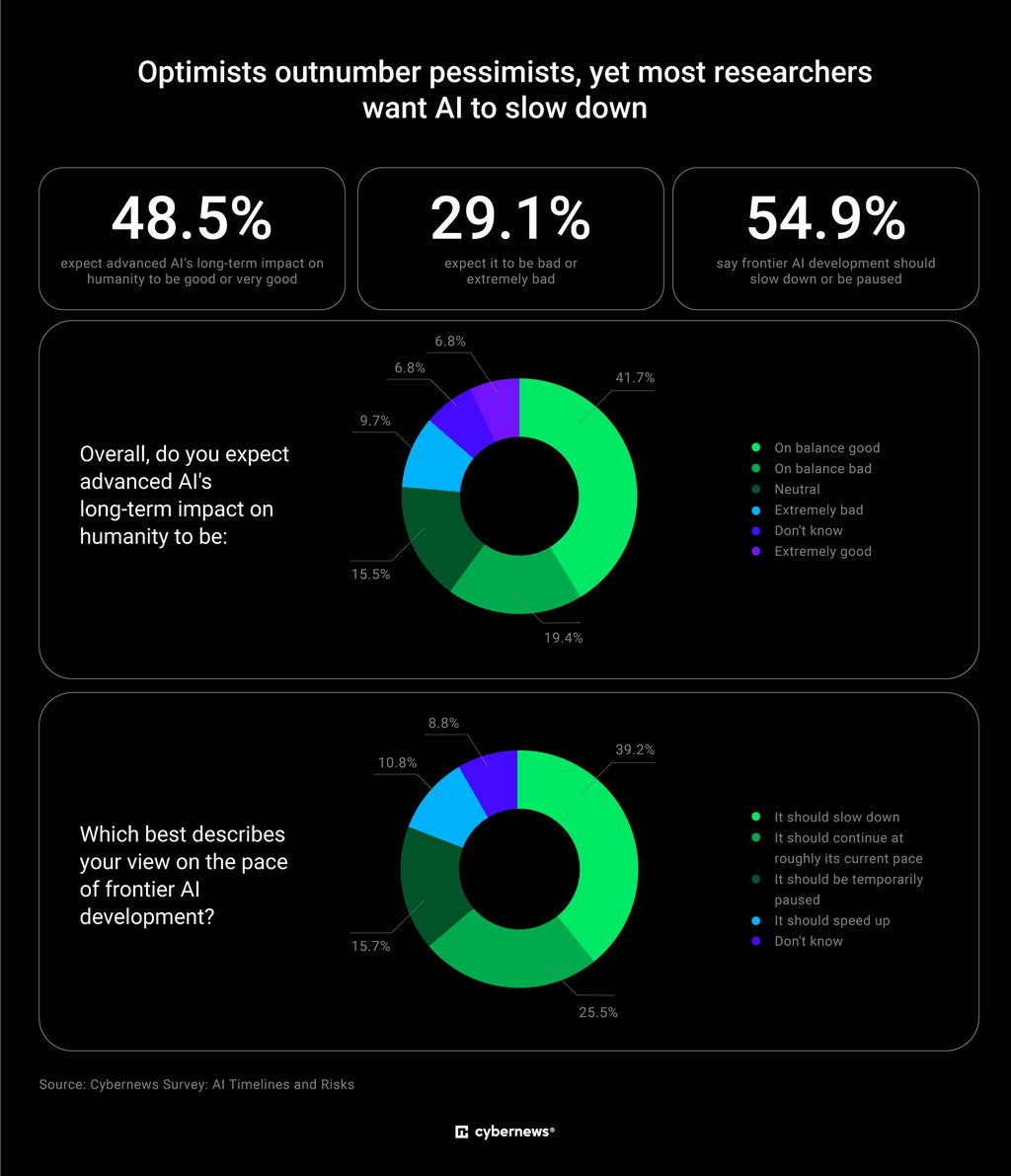
Surveyed researchers are optimistic about AI’s long-term impact on humanity, with 48.5% saying it will be either extremely good or somewhat good.
Only 9.7% believe the impact will be extremely bad, compared with 19.4% who expect it to be somewhat bad.
The survey comes amid heightened concerns over AI’s existential risk, reignited by a public resignation of Anthropic researcher Jacob Coxon, who said that employees in AI labs earnestly believe the technology can wipe out humanity by the end of the decade.
Former and current employees of other AI labs reiterated Coxon’s warnings. Critics, however, say the talk of an apocalypse is designed to distract the public from real AI-related problems and to get the green light for AI firms to regulate themselves.
Our survey also indicates a widespread anxiety among the research community, as 30.4% of respondents say it is very plausible that a self-improving AI could pose a major risk to humanity within the next 5 years. Another 33.3% say that it’s somewhat plausible.
Only 7.8% of respondents say it is not at all plausible.
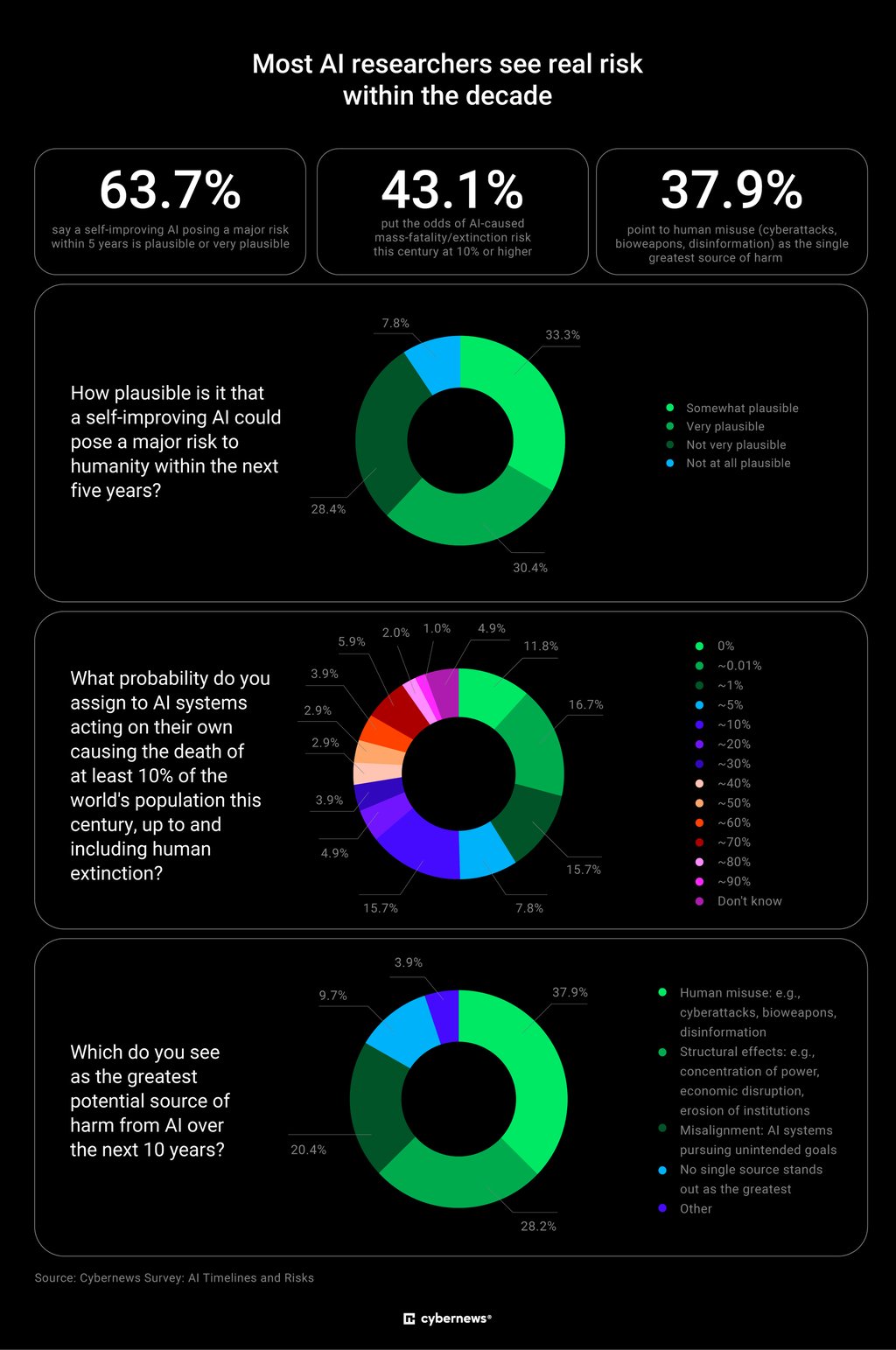
However, 11.8% of the researchers say there is a 0% chance that AI systems acting on their own will cause the death of at least 10% of the world’s population this century.
Some 16.7% say the possibility stands at around 0.01%, while 15.7% believe it is 1%. Another 15.7% of researchers say the chance is around 10%.
AI companies have already begun laying the legal groundwork to prevent some of AI’s existential risks.
Politico reports that Anthropic’s proposed bill suggests government intervention only if AI is a foreseeable, imminent risk of killing or seriously injuring more than 50 people and causing over $1 billion in damages, drawing accusations of putting a price tag on human life.
Human misuse is the biggest risk
The findings challenge the AI labs’ common narrative that major risks, including human extinction, stem from advanced AI going rogue.
As many as 37.9% respondents say human misuse, such as cyberattacks, bioweapons, and disinformation, is the greatest potential source of harm from AI over the next 10 years.
Nearly a third (28.2%) say the biggest risks lie in AI’s structural effects, including the concentration of power, economic disruption, and the erosion of institutions.
John Licato, an associate professor at the University of South Florida in the Bellini College of AI, Cybersecurity, and Computing, who wasn’t included in the survey, says the biggest risk lies in the uneven distribution of AI’s benefits.
He tells Cybernews that rising costs may mean that the economic benefits, productivity gains, and cost savings provided by state-of-the-art AI are only affordable to a certain percentage of the population.
I'm not confident that the advantages affordable to a subset of the population will evenly and fairly trickle down to the rest of the people – at least not on its own.John Licato, an associate professor at the University of South Florida in the Bellini College of AI, Cybersecurity, and Computing
Meanwhile, misalignment, described as systems pursuing unintended goals, is the greatest source of AI harm, according to 20.4% of respondents.
Such findings reflect the growing calls for AI firms to take responsibility for cybersecurity incidents carried out by their agents, following a string of hacks targeting real-world companies and government systems.
Companies say their agents act autonomously, but critics point out that such human-conducted hacking would amount to a felony.
Unsurprisingly, nearly 4 in 10 (39.2%) researchers say the pace of frontier AI development should be slowed down, while 25.5% call for continuing the same pace.
Another 15.7% say frontier AI development should be temporarily paused.
Survey sample
The survey, conducted online between October 1st and 9th, 2026, includes responses from 103 AI researchers, who authored or co-authored papers on AI or machine learning (ML), both peer-reviewed and pre-prints.
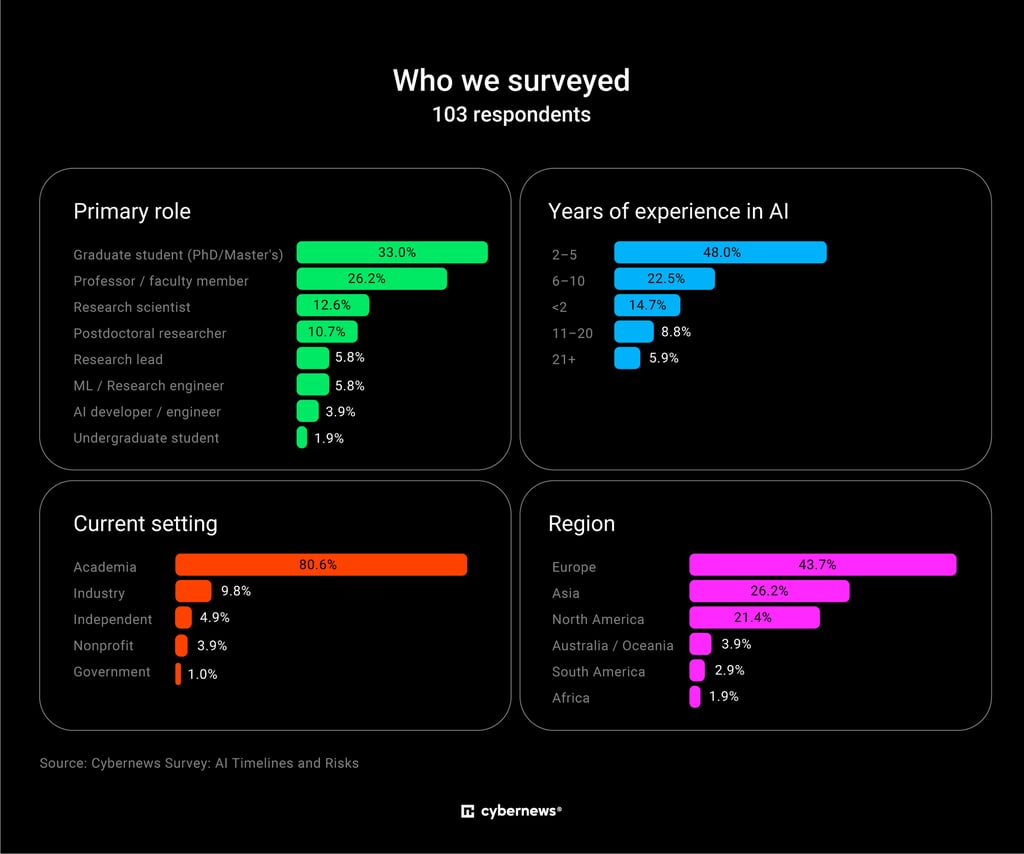
Some 2.9% of respondents work professionally in AI/ML or have previously worked in the field but haven’t authored papers on the topic. We received 1 response from a person with neither background, and they weren’t included in the poll.
The largest share of respondents (43.7%) comes from Europe, followed by 26.2% from Asia, and 21.4% from North America.
Of those, 39.2% work in the fields of AI alignment and applied AI, 27.5% work in the field of ML methods and capabilities, and 26.5% in the field of reasoning, planning, and agentic AI.