Can AI replace journaling? Testing the Amanda Chatbot for relationship support
A new study has found that ChatGPT-4o chatbot Amanda can match evidence-based journaling in easing relationship conflicts. I tested Amanda myself to see if AI therapy really works.

Image by Cybernews

 Follow us
A new study has found that ChatGPT-4o chatbot Amanda can match evidence-based journaling in easing relationship conflicts. I tested Amanda myself to see if AI therapy really works.
When taking on therapy, it’s not uncommon for the counselor to suggest journaling as an added benefit to boost the effectiveness of the sessions.
There has been growing interest in LLM chatbots as therapists, despite the health warnings from experts. But rather than constantly focusing on the negatives, what about the possible benefits they can provide to clients?
In the journal PLOS Mental Health, researcher Dr. Laura Vowels from the University of Lausanne, Switzerland, found that a single session with ChatGPT-4o chatbot Amanda was just as effective as evidence-based journaling.
In a randomized controlled trial, 258 therapy participants were split into two groups. One group discussed their relationship friction (non-abusive) with Amanda in a sequence of at least 20 messages to and from Amanda. The other had to write a journal from the perspective of a third party.






The results were that both interventions were equally effective in helping the participants feel more positive about their predicaments.
The researchers' main limitation was that there was only one session with the Amanda bot, so no long-term benefits could be assessed.

My experience with Amanda
I decided to give the experience a whirl and fictionalize things a bit. Going with a younger version of myself that had unrequited love at university age, I told Amanda that I was afraid of being dumped, as a result of wanting something more.
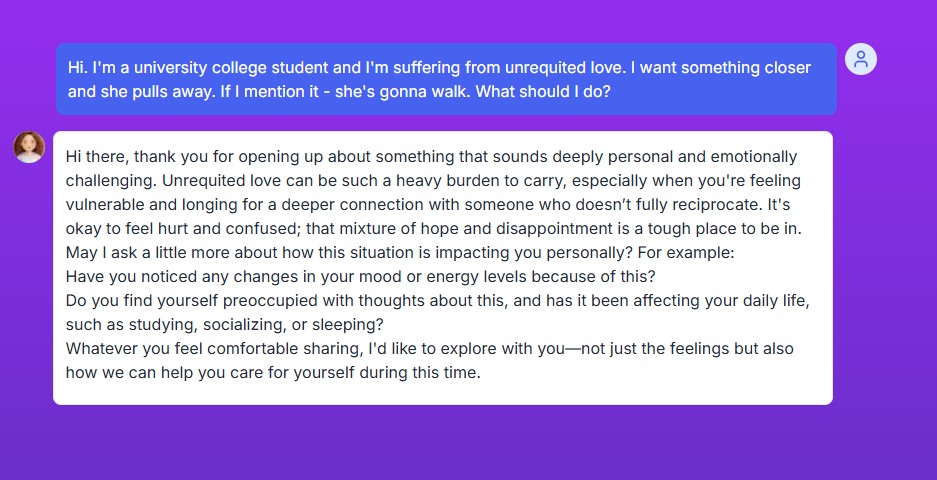
As you can see, there’s a strong sense of empathy from the therabot, which takes a good 30 seconds to get back to you (different from the busted-out churn of ChatGPT), and even though there are a couple of stacked questions, there’s plenty of scope to go under the hood, as you might in a diary.
What was also particularly impressive was the pragmatic manner in which she guided me into slowing down – my younger self had a tendency to ping-pong about somewhat.
Even though the researchers mentioned a lack of longevity with the therapist (as well as the inability to save previous sessions), there’s plenty of follow-up potential.
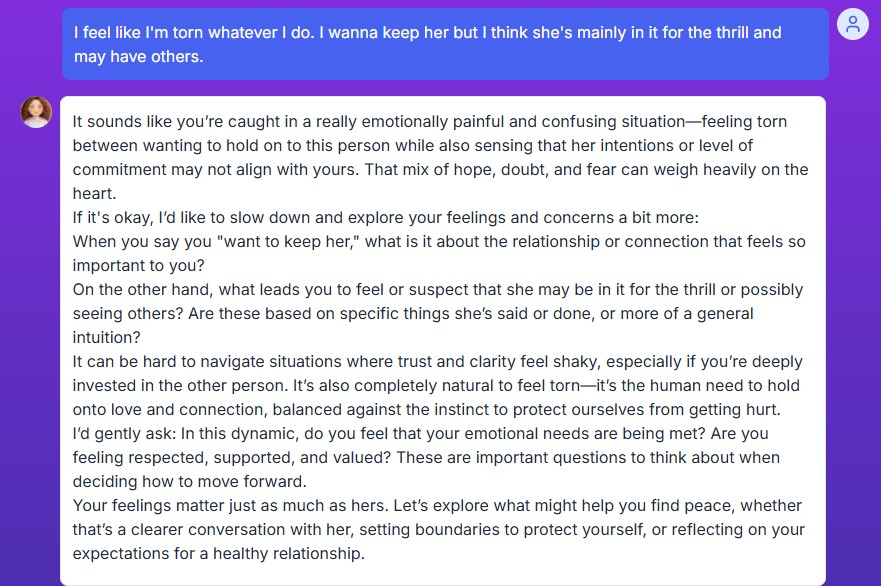
Provided you kept your browser open, you’d be able to talk to her over the long term, and it could prove a decent supplement to receiving human therapy, rather than an outright replacement.






Unlock more exclusive Cybernews content on YouTube.