AI companies based in Asia: Which are the most trustworthy?
The latest Cybernews ranking assessed 92 AI companies based in Asia to determine their trustworthiness.

 Follow us
- The most trustworthy AI companies based in Asia are Paperpal, Easy-peasy.ai, Lilys.ai, Imagekit.io, and Terabox.
- AI companies based in Asia have an average trustworthiness score of 60 out of 100, below the global average of 65 out of 100.
- The top-performing AI category in Asia was Voice Generation & Conversion, with an average score of 68 out of 100, while the lowest was Legal & Finance, with an average score of 49 out of 100.
- 66% of the AI companies based in Asia do not clearly disclose in their privacy policies whether they train AI models on user data.
The AI Trustworthiness Ranking is a new assessment of AI companies worldwide based on publicly available information on security, data privacy, organizational transparency, and public perception.
The ranking comprises 500 companies from 36 countries, 92 of which are based in Asia. Companies based in Asia had an average trustworthiness score of 60 out of 100, compared with 64 out of 100 for European companies and 67 out of 100 for US companies.
Paperpal and Easy-peasy.ai are the most trustworthy AI companies based in Asia
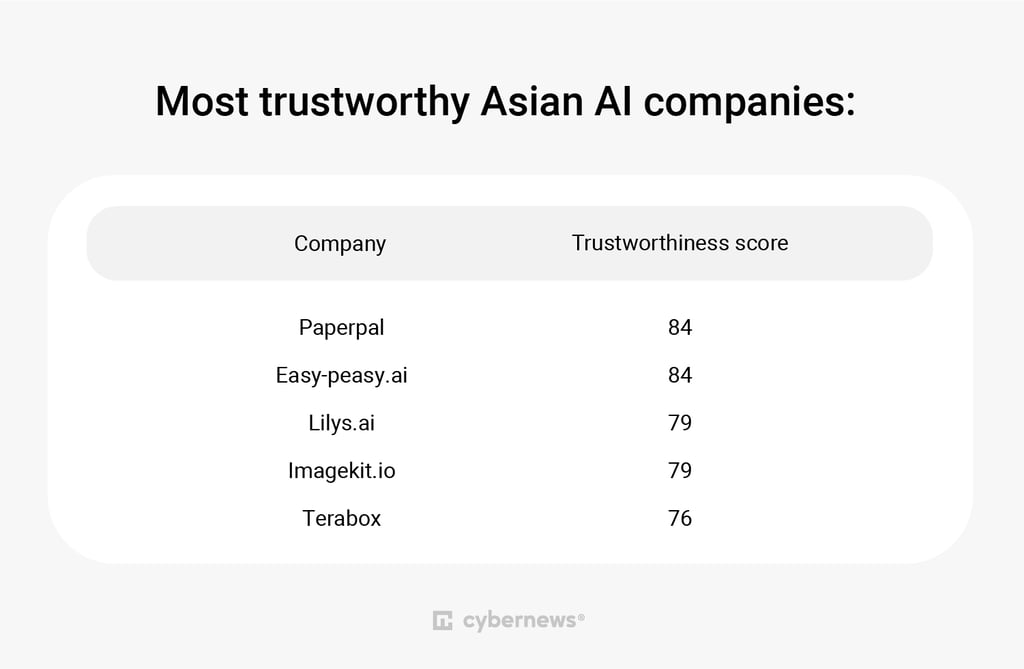






The most trustworthy AI company based in Asia is Paperpal, with a trustworthiness score of 84 out of 100. Easy-Peasy.AI ranks second, also with a score of 84 out of 100. Globally, the companies rank 50th and 51st, respectively.
Lilys.ai, Imagekit.io, and Terabox follow, with trustworthiness scores below 80, placing them even lower on the global list.
The AI Trustworthiness Ranking analyzes 21 AI categories. Among AI companies based in Asia, the best-performing category was Voice Generation & Conversion, with an average trustworthiness score of 68 out of 100. In contrast, the lowest-performing category was Legal & Finance, with an average score of 49 out of 100.
The highest-performing category in the global overall ranking, with a score of 78 out of 100, is Office & Productivity. In contrast, the lowest-performing category, with an average score of 54 out of 100, is Music & Audio.
Above average transparency, below average security
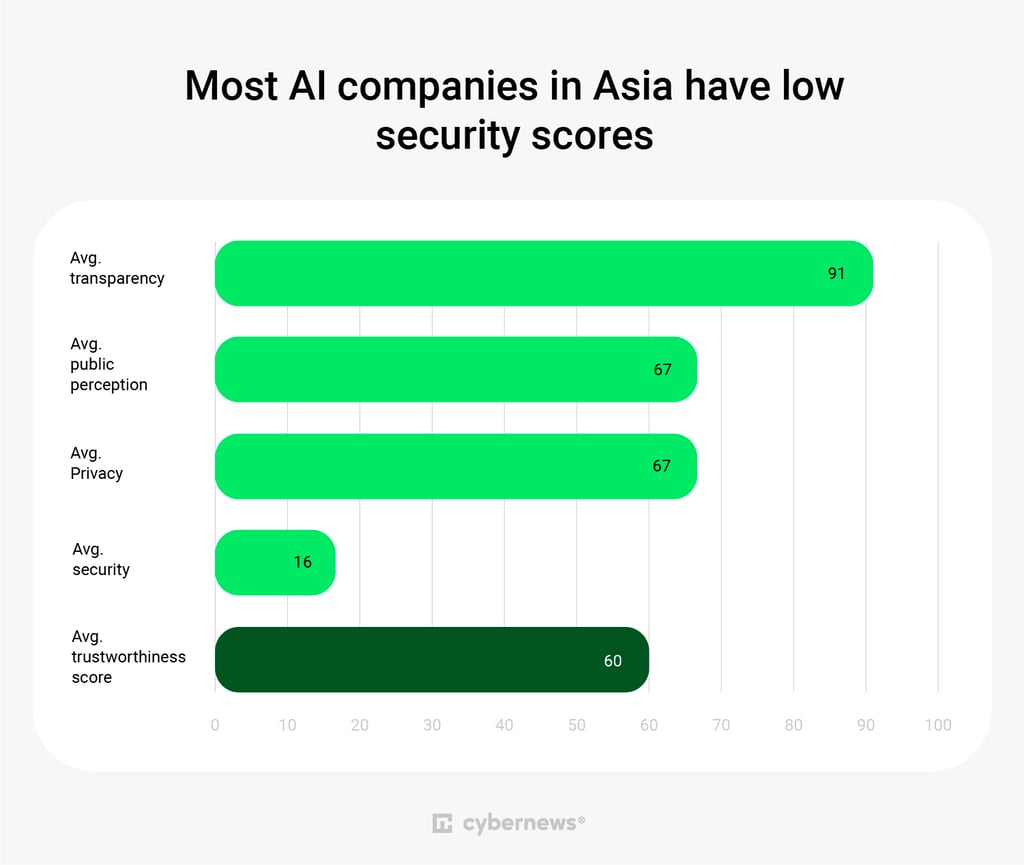
AI companies based in Asia scored above average in the transparency pillar, with 91 out of 100. The global average transparency score was 90 out of 100. The transparency pillar examines whether companies disclose their legal entity, physical address, and working contact channel.
Across the 92 Asian companies, the average security score was only 16 out of 100, compared to the global average of 32. The security pillar evaluates whether companies have a dedicated trust or security page, have a bug bounty or coordinated vulnerability disclosure (CVD) program, and hold ISO/IEC 27001 or SOC 2 Type II certifications. This allows us to assess a company’s security based on publicly available (rather than internal) data, so our view is limited. However, it is still concerning that companies handling some of the most sensitive user data lack these security measures.
66% of the top Asian AI companies don’t disclose whether they train their AI models on user data
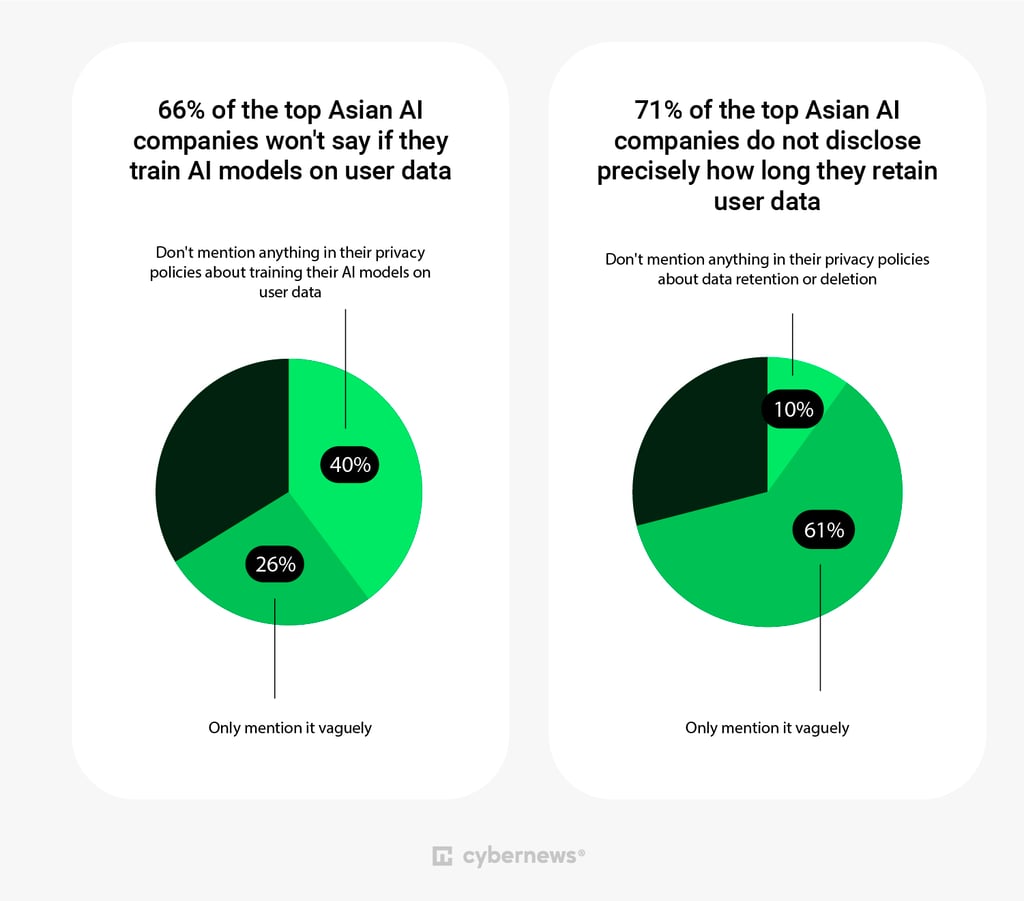
The privacy pillar analyzes whether companies clearly disclose the data they collect, their AI model training practices, third-party data sharing, and their data retention policies.
Cybernews found that 40% of AI companies based in Asia do not mention training their AI models on user data in their privacy policies, while 26% use only vague language when discussing model training, failing to provide a clear, explicit answer.
71% of companies do not disclose precisely how long they retain user data: 10% do not mention retention or deletion at all, while 61% provide only vague statements, without specifying a specific retention period.
Explore the full AI Trustworthiness Ranking and individual company scores here: https://cybernews.com/ai-knowledge-base/ai-trustworthiness-ranking-2026/