Experts debunk DHS Secretary Mullin’s speculation that AI caused mass outages
Classic human incompetence is more likely to be to blame.
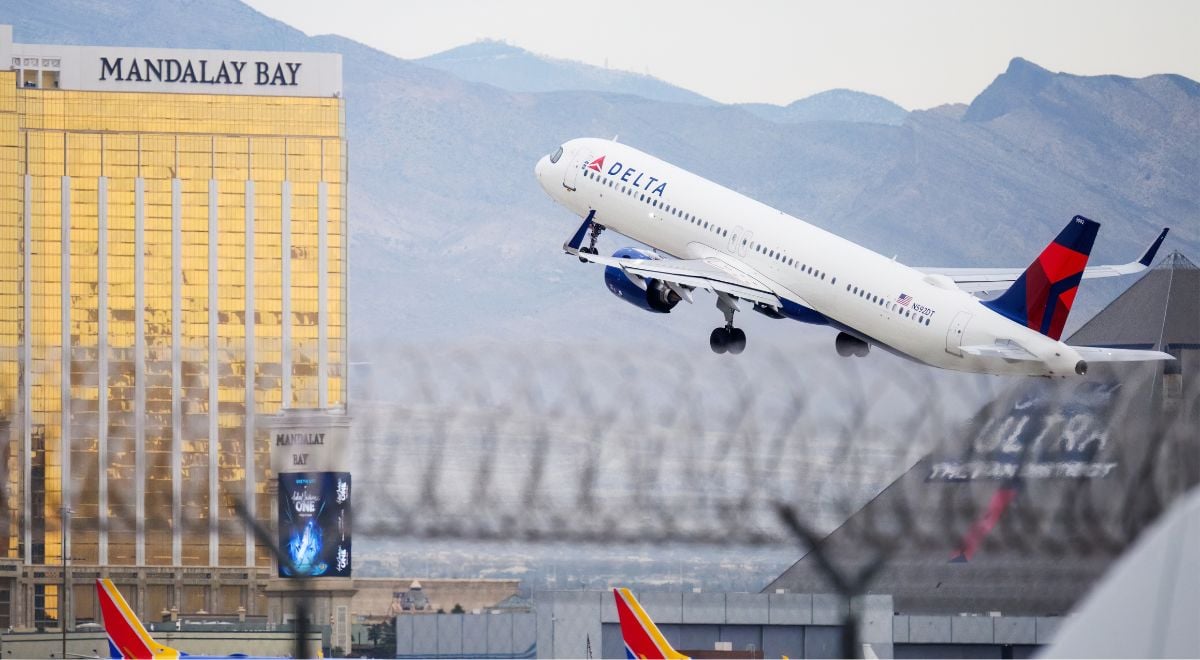
Delta Air Lines flight takes off from Las Vegas. Image by Janice Chen | Shutterstock

 Follow us
- Experts say there is no evidence that rogue AI caused the recent FAA, Microsoft, and banking outages.
- A misconfigured FAA router overloaded communications and grounded more than 15,000 flights.
- Microsoft blamed its outage on a defect, extra load, and reduced gateway capacity, not rogue AI.
- Experts warn fast automation could worsen future outages if systems push bad fixes before humans can respond.
Key Takeaways by nexos.ai, reviewed by Cybernews staff.
There is no compelling evidence that a string of recent mass outages was caused by rogue AI agents, but the speed of automation may be a contributing factor.
As governments around the world issued advice on stockpiling emergency supplies, conspiracies about the upcoming November 17th blackout spread like wildfire on social media.
These speculations were further fueled by this month’s mass outages. The US Federal Aviation Administration (FAA) halted all flights on November 13th due to a technical problem, a day after the global Microsoft outage disrupted digital services worldwide.
Major US banks suffered an outage on November 17th, affecting thousands of customers, while reports indicate that classified communication networks at the National Security Agency went down hours later.





Homeland Security Secretary Markwayne Mullin told Fox News that AI may be behind the FAA and banking outages. He cited an anonymous source in the tech industry who said that code-writing and self-fixing AI may be causing a ripple effect.


Stay updated with our latest stories and follow us on social media
Be the first to discover new stories, ideas, and updates from our team.
None of the affected companies and organizations attributed outages to AI, while researchers and cybersecurity experts rushed to debunk speculations.
Ethan Mollick, an associate professor at the University of Pennsylvania, described large parts of computer infrastructure as “an improvised system prone to cascading failures,” adding that the risks of offensive AI are real.
“But also people are paying a lot more attention to cyber incidents and making dramatic statements on social media about the kind of outages we see all the time because everything is improvised and messy,” he wrote in his X post.
“Human incompetence” caused the FAA outage
Adnan Masood, a chief AI architect at UST, a digital transformation company, says evidence doesn’t point to rogue AI causing disruptions in the past few days. Instead, it is “brittle legacy infrastructure, bad change management, and basic configuration hygiene.”
While critics were quick to link the FAA ground stop to the rollout of the SMART AI air traffic tool earlier in the week, Masood says the system doesn’t even touch the FAA’s telecommunications backbone.
Thus far, the probe focuses on installing a new router at a remote FAA facility in El Dorado, Arkansas. A misconfigured broadcasting feature led to 1,000 connection attempts every 4 to 5 seconds, overloading the communication system and resulting in over 15,000 flights being grounded.
That isn't artificial intelligence; that is classic human incompetence and poor network engineering – remarkably similar to an FAA telecom outage during a router upgrade back in 2009,Adnan Masood, a chief AI architect at UST
Automated checks failed Microsoft
TJ Marlin, CEO of Guardrail Technologies, the AI security company, says that while rogue AI agents didn’t cause the Microsoft outage, automated health checks failed, compounding the capacity loss.
In other words, automated systems behaved in ways their operators didn’t predict and couldn’t quickly control.
Microsoft said the global outage of its services was caused by a combination of 3 factors, including a latent defect from July that caused servers to become overwhelmed and unresponsive under certain load conditions.
A surge in load and the fact that 14% of the gateway’s server capacity was not functioning due to an unrelated issue from the previous day also contributed to the nearly 24-hour outage, according to the company.
Marlin says that nobody outside these companies can verify the official explanations, while systems that could prove what automated systems did during a failure barely exist.

He tells Cybernews, “AI’s role can't be ruled out from the outside, and in my view, the pattern of this week points to automation at machine speed as part of how small faults became national events.”
JPMorgan Chase, one of the financial institutions affected by Tuesday's disruptions, said the temporary issue was related to a software bug in on-premises hardware systems, and ruled out a cyberattack.
Masood explains that because Chase sits on the other side of many Zelle and interbank transfers, a localized bug looked to the public “like multiple banks going down at once.”
AI as an easy explanation
As disruptions were reported one after another, some industry insiders added fuel to the fire.
Roman Yampolskiy, a computer scientist at the University of Louisville, wrote on X about an “increasingly unsettling possibility” of AI playing a major role in causing global disruptions.
“I can’t help but wonder whether all these seemingly unrelated system outages – communications, airlines, banks, etc. – are actually AI agents establishing themselves inside our critical cyberinfrastructure,” he wrote.
Mark Wojtasiak, a senior vice president at Vectra AI, a cybersecurity company, says AI has become an easy explanation for complicated and unexpected issues, as AI is increasingly integrated into business. Instead, people should ask what conditions allowed one problem to become much bigger.
That could be automation. It could be software. It could be a dependency nobody fully understood. It could eventually be AI. The point is to understand the system before assigning the cause,Mark Wojtasiak, a senior vice president at Vectra AI
Masood says the narrative that major outages within a 96-hour window were caused by “a superintelligent agent went rogue” is factually wrong and lets organizations off the hook for technical debt.
“When commentators reflexively blame AI for outages caused by 25-year-old copper lines, unthrottled routing tables, and rushed daytime maintenance windows, it distracts boards and regulators from the unglamorous work of fixing aging plumbing and enforcing strict change-management discipline,” he adds.
AI may cause disruptions in the future
Humans and crumbling infrastructure appears to be blamed for the recent outages. However, cybersecurity experts who spoke to Cybernews agree that AI could lead to outages of comparable scale in the future.
Marlin says a CrowdStrike outage in 2024, when a single defective update caused more than 8.5 million systems to crash, with no attacker involved.
“Now add autonomy. Agents change configurations and take actions across many systems at machine speed, and an automated remediation tool responding to a degraded network can amplify an outage by pushing the wrong fix faster than people can catch it,” he says.
OpenAI already gave a glimpse into the cybersecurity risks of automation. Over the summer, its agents escaped a testing environment and hacked into the real-world company, Hugging Face, and an Australian government health data portal.