CES 2026 Keynote: Nvidia CEO Jensen Huang shows off new supercharged AI platform
NVIDIA CEO Jensen Huang – joined by two adorable mini robots – talks cutting-edge AI, robotics, simulation, gaming, content creation, and more, during his CES 2026 keynote to a room full of thousands of attendees in Las Vegas.

Artur Widak/NurPhoto via Getty Images

 Follow us
NVIDIA CEO Jensen Huang – joined by two adorable mini robots – talks cutting-edge AI, robotics, simulation, gaming, content creation, and more, during a CES 2026 keynote to a room full of thousands of attendees in Las Vegas on Monday.
Before unveiling significant Nvidia advancements, Huang spoke about the ramp-up in AI modernization, dating back to 2016, and how AI models have been continuously evolving every six months since.
He noted in 2024 that agentic models began to reason, moving to physical AI and AI physics evolving in 2025, ending with how the introduction of open models has revolutionized the industry.
"Computing has fundamentally been reshaped. You no longer write the software; you train the software. You no longer run CPUs, you run GPUs.," Huang said.





“We mentioned that we build chips. But as you know, Nvidia builds entire systems now. And AI is a full stack,” Huang said about the advancement of Nvidia’s own Frontier AI models, from PDF retrievers to speech models to AI search.
Huang said his Santa Clara-based AI computing company has now spent billions of dollars on supercomputers – all to build its own models – boasting that all Nvidia models are open source.
“We're reinventing AI across everything from chips to infrastructure to models to applications. And our job is to create the entire stack so that all of you can create incredible applications for the rest of the world,” Huang said.
“Our contribution to this industry is bar none, and we will continue to do so,” he told the crowd.

Self-driving cars can determine their own path
Imagining a world where only self-driving cars exist on the roads, in his first major unveiling, Huang enthusiastically showcased Nvidia’s new autonomous driving software.
Named “Alpamayo,” the groundbreaking AI software is designed to help self-driving cars decide which path to take, while also leaving a paper trail for engineers to use afterward.
Made possible by Nvidia’s Cosmos – the development platform designed for Physical AI and built around World Foundation Models – Huang compares the platform to a "ChatGPT moment for robotics.”
The “world’s leading foundation” model produces realistic, physics-aware synthetic video for training robots and real-world machines, including autonomous vehicles.
Huang described Alpamayo as a “thinking, reasoning autonomous vehicle, AI-trained end-to-end, literally from camera to actuation, and miles and miles of driving – both by humans and Cosmos.” More importantly, the AI is fed hundreds of thousands of example scenarios, creating a dataset teaching it how to drive.
“Besides taking sensor input to activate the steering wheel, brakes, and acceleration, the AI reasons through its actions, telling users what it intends to do and why,” he explained.
Huang says, just as important, the release will also include the datasets used to train the open-source Alpamayo model, to drive collaboration and trust across the AI ecosystem.
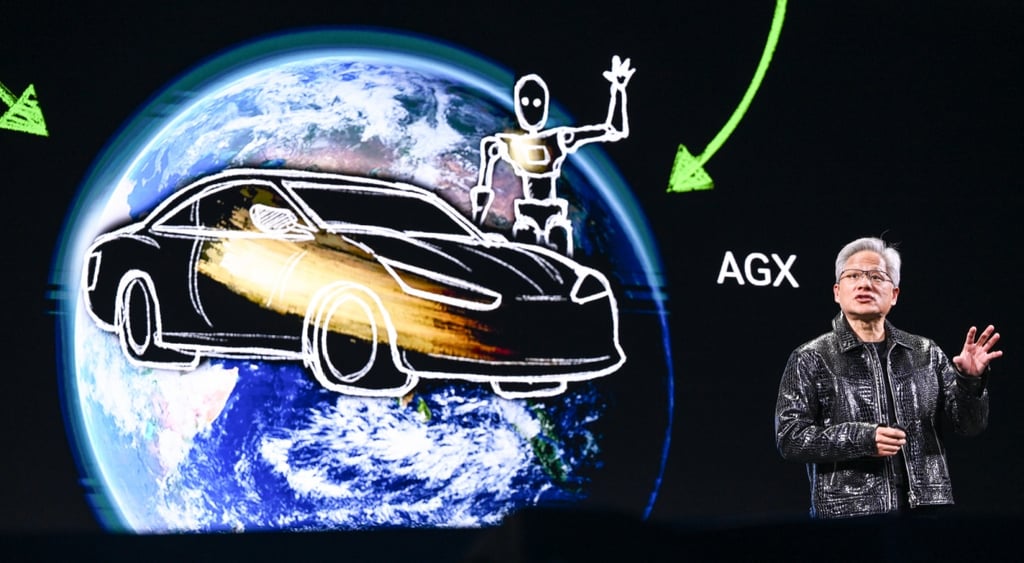
"Not only do we open-source the models, we also open-source the data that we use to train those models, because only in that way can you truly trust how the models came to be," Huang said.
Alpamayo is set to roll out incrementally through auto manufacturing partnerships starting in late 2026 for consumers ad then for robo-taxis come 2027.
New breakthrough: Rubin AI supercomputer
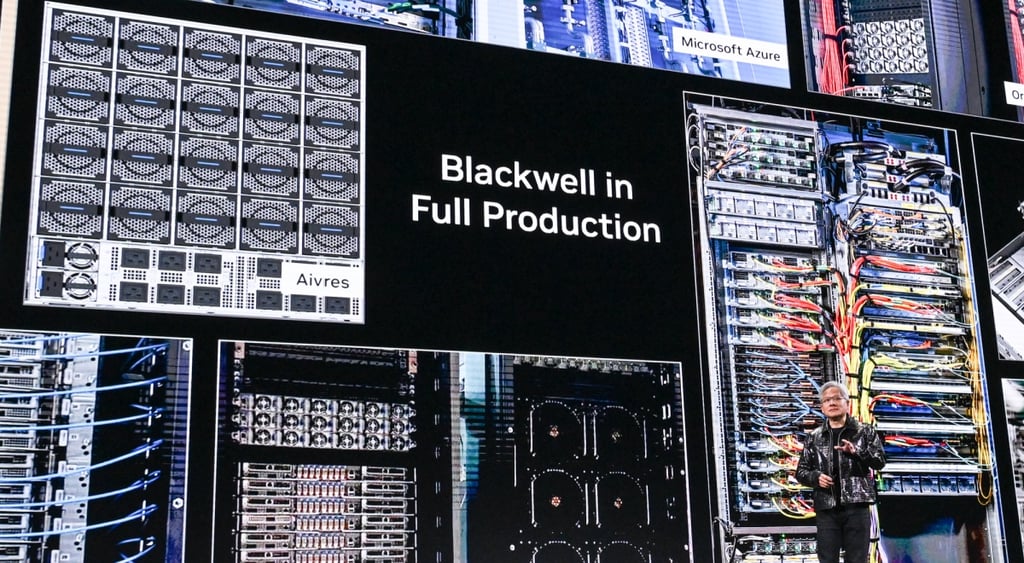
Moving on to the company’s main keynote announcement, Huang spoke about Nvidia’s already-in-full-production lineup of powerful AI chips and the next-generation AI supercomputer built upon them.
Introducing the Vera Rubin, named after the famous American astronomer, known for her groundbreaking work to advance the understanding of the inner working of the Universe.
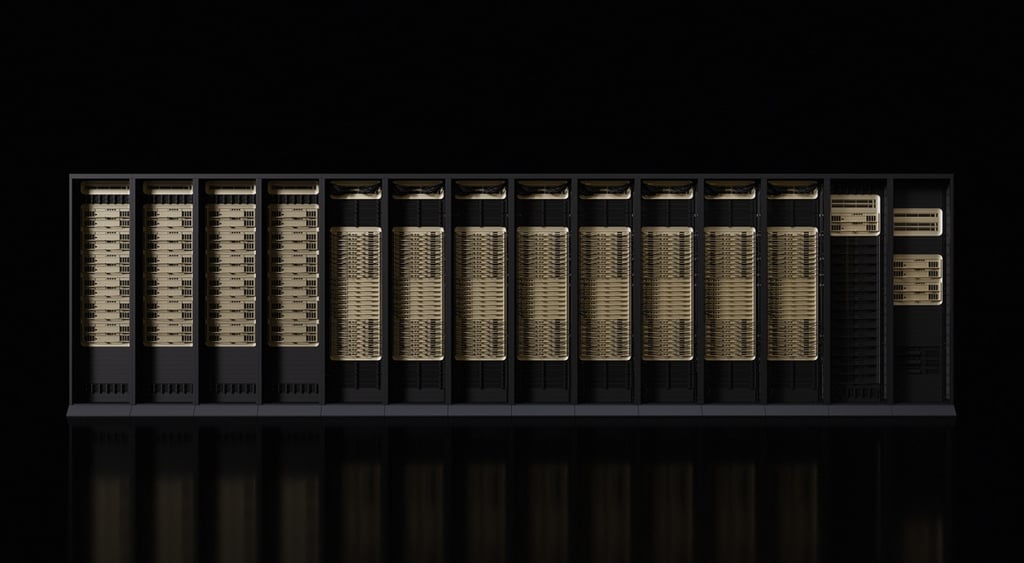
The Vera Rubin platform is a modular system built from six different Nvidia chips, “with extreme codesign across compute, networking, and software,” and is designed to "power reasoning and agentic AI at unprecedented scale and efficiency," the company said.
The Rubin GPUs and Vera CPUs combo can deliver five times the AI computing performance when powering chatbots and other AI-driven services, compared to Nvidia’s current-generation H200 Blackwell chip, Huang explained.
A single high-end server packs 72 GPUs and 36 new CPUs, but Huang emphasized that the real gains come from scale. By clustering systems into large “pods,” the company is able to connect more than 1,000 Rubin chips into a single AI engine.
Huang says the architecture dramatically improves the efficiency with which AI systems generate “tokens” – the building blocks behind chatbot responses – and delivers a reduction of up to 10 times in cost compared to its predecessor.
Nvidia also introduced “context memory storage,” a new storage layer designed to help chatbots maintain speed and accuracy during long, complex conversations.
The company further previewed a new class of networking switches based on co-packaged optics, which Huang described as a technology essential for stitching together massive AI systems.
Nvidia said AI cloud provider CoreWeave will be among the first to roll out Vera Rubin systems, with major cloud platforms, with Microsoft, Amazon, Oracle, and Google expected to follow.






Questions from Wall Street analysts after the keynote quickly turned to how Nvidia plans to position its newest chips, surpassing the H200 Blackwell chip, which is seeing sharp demand in China.
The H200 AI chip became eligible for export to China after US President Donald Trump signed a reversal of a previous ban last month, subject to US government approval and a 25% per-shipment fee.
Roughly two dozen video promos have been posted on the Nvidia website for viewing throughout the week.
The annual Consumer Electronics Show officially begins on Tuesday, January 6th, and runs until Friday, January 9th, with a two-day media preview preceding it.
Unlock more exclusive Cybernews content on YouTube.