82% of Canada's top AI companies won't say how long they keep your data
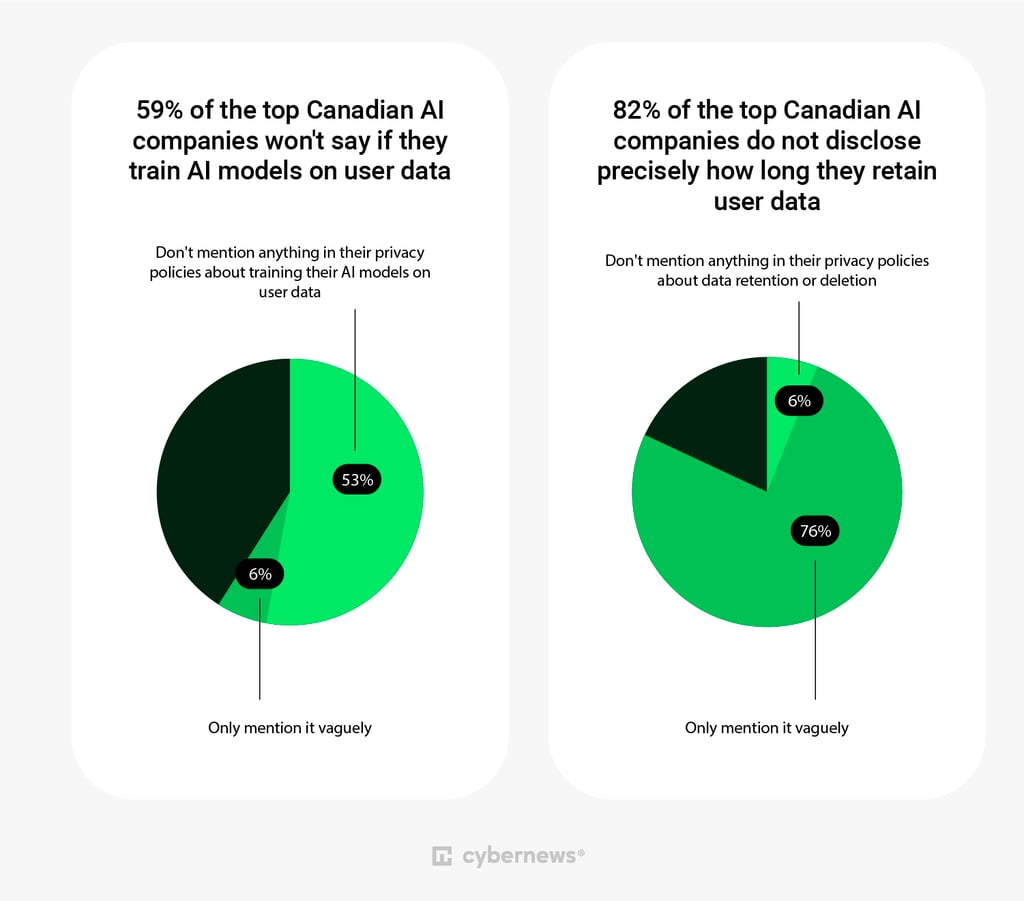
6% of Canada's leading AI firms don't mention retention or deletion, while 76% mention it only vaguely, without any precise retention periods.


 Follow us
- According to the Cybernews AI Trustworthiness Ranking, Canadian AI companies scored an average of 64 out of 100.
- 82% of leading Canadian AI companies do not clearly disclose how long they retain user data.
- 59% of top Canadian AI companies do not clearly disclose whether they use user data to train AI models.
- Transparency was Canada's strongest area, with an average score of 92, while security was the weakest at 28.
- Vidyard ranked first in trustworthiness, followed by Ideogram, Spellbook, LANDR, and Thomson Reuters.
Findings from Cybernews' 2026 AI Trustworthiness Ranking show that 82% of Canada's top AI companies do not clearly disclose how long they retain user data. Of the 17 Canadian AI companies evaluated, the majority use vague language about data retention, failing to specify a precise timeframe.
“Transparency should not be optional when user data is involved. When companies can't or won’t say how long they hold on to customer data, users are left with no way to judge how much control they actually have over their own information,” says Voldemaras Kadys, member of the AI Trustworthiness Ranking Advisory Board and Head of Security and Platform Engineering at Mediatech, the digital publishing house behind Cybernews.
The analysis also found that 59% of Canada's top AI companies do not clearly disclose whether they use customer data to train their AI models. 53% make no mention of AI training in their privacy policies, while 6% describe it only in vague terms.






Transparency scored highest, security scored lowest
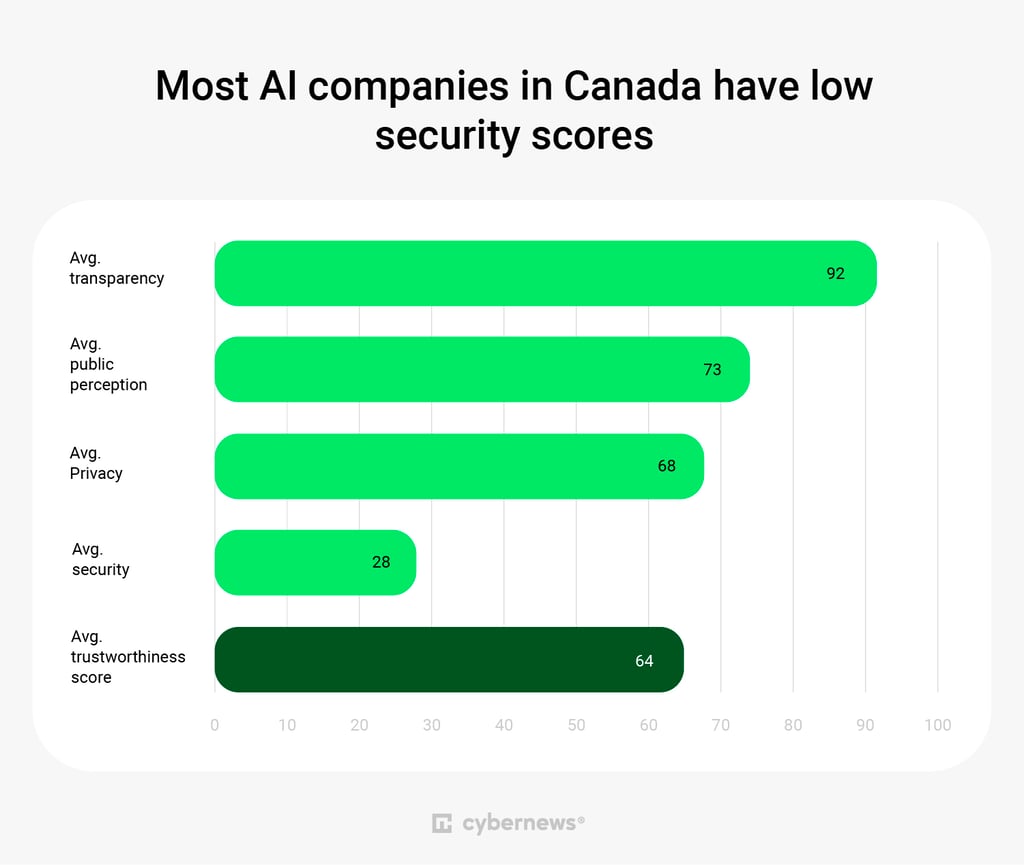
Of the four pillars assessed, security was the weakest area for Canadian AI companies, averaging just 28 out of 100. This pillar evaluates whether a company maintains a dedicated security or trust page, runs a bug bounty program, and holds certifications such as ISO/IEC 27001 or SOC 2.
Organizational transparency was by far the strongest pillar, averaging 92 out of 100. Here, Cybernews assessed whether companies disclose their legal entity, physical address, and a working contact channel.
Public perception, based on company reviews on Trustpilot and G2, averaged 73. Data privacy, the pillar most directly tied to the retention and training disclosures above, scored 68, underscoring the gap between how AI companies present themselves publicly and how clearly they explain their data practices in writing.
Vidyard leads the Canadian AI Trustworthiness Ranking
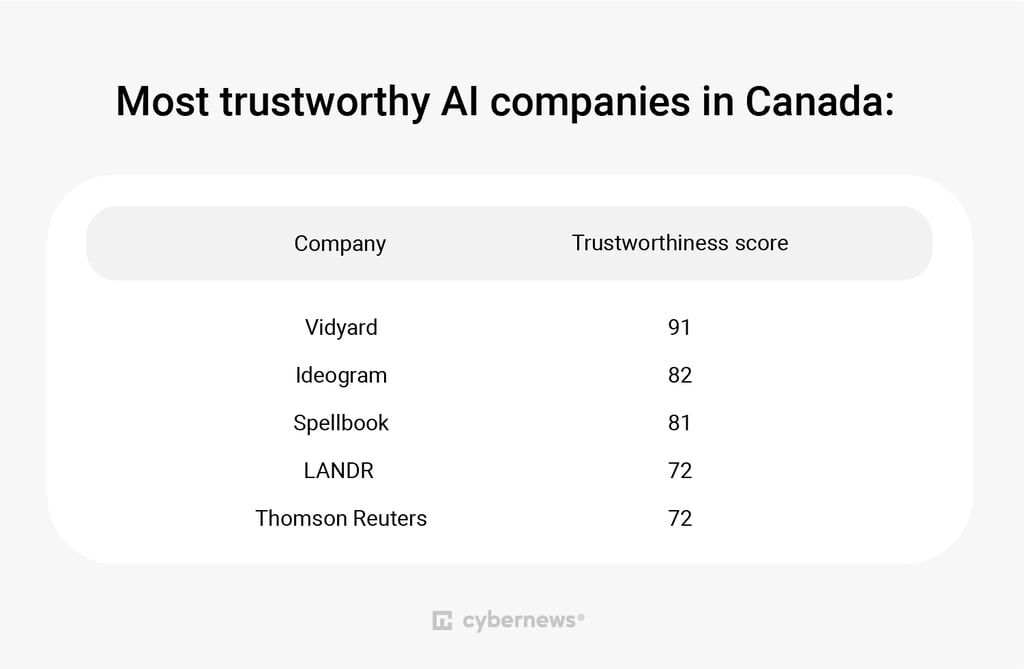
Video platform Vidyard received the highest trustworthiness score among Canadian AI companies, at 91 out of 100. It was followed by Ideogram (82), Spellbook (81), LANDR (72), and Thomson Reuters (72).
Marketing & Advertising was the highest-performing AI category in Canada, with an average trustworthiness score of 91 out of 100. Voice Generation & Conversion ranked lowest, averaging just 44 out of 100.