Expect at least a correction: AI boom threatens financial stability, ECB economists warn
European pension funds aren’t holding the wheel, and US AI euphoria drives with no brakes.

Image by Unsplash / Masood Aslami.

 Follow us
- ECB economists warn a US AI stock correction could spread financial instability across the eurozone.
- Euro-area funds and households hold nearly $1 trillion and $510 billion, respectively, in seven dominant US technology companies.
- US stock valuations approach dot-com-era levels, while policymakers have less room to cushion a severe downturn.
- Even if AI succeeds, economists expect possible corrections and urge preparation; the views do not represent the ECB.
Key Takeaways by nexos.ai, reviewed by Cybernews staff.
Exposure to just seven US companies and market valuations at dot-com bubble levels is ringing financial stability alarms at the European Central Bank (ECB): “US AI fallout would not remain a US problem.”
ECB economists warn of potential AI bubble implosion: an “abrupt and painful setback,” coupled with a sharp stock market correction, could have severe consequences for the eurozone.
Even if everything is fine with the AI boom – technology succeeds, and profits will increase – prepare for a correction, economists at the ECB warn.
“The more severe scenario is not the equity correction on its own but a correction that coincides with broader market instability that policymakers cannot easily calm,” the report reads.






The potential fallout could be even worse than the dot-com bust because policymakers now have fewer easy levers to pull, such as cutting interest rates or using fiscal stimulus as a cushion.



Stay updated with our latest stories and follow us on social media
Be the first to discover new stories, ideas, and updates from our team.
The report compares the current situation to previous technological revolutions, such as railway expansion, electricity, radio, and the dot-com era.
“In each case, a genuinely transformative technology attracted investment, and the stock market valuations of firms that adopted it rose strongly before falling sharply.”
AI becomes a risk that cannot be diversified – as technology adoption spreads, the uncertainty over the it becomes economy-wide
“If something then goes wrong with that technology, the whole economy suffers.”
And if confidence fades, prices can fall just as irrationally as they’ve risen.

Massive exposure to seven companies
Europeans are both directly and indirectly overexposed to the Magnificent Seven (Mag7) stocks: Alphabet, Amazon, Apple, Tesla, Meta Platforms, Microsoft, and Nvidia.
Pension and other investment funds often track global indices and hold Mag7 both directly and indirectly, through exchange-traded funds (ETFs).
Euro-area investment funds have poured nearly a trillion dollars into Mag7. Households are also increasingly channeling their funds to Mag7 through low-cost ETFs – the exposure is estimated at around €440 billion ($510 billion).
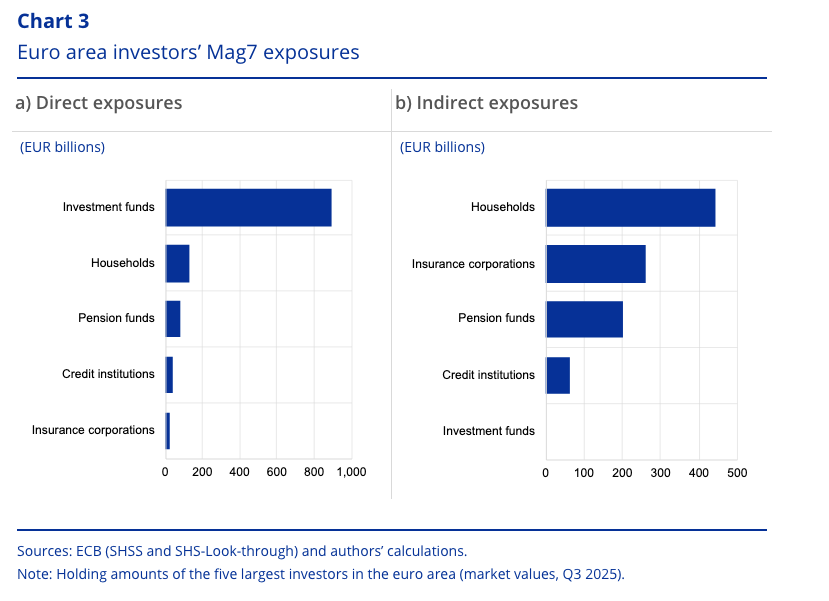
People might not even be aware of the associated concentration risk, ECB experts warn. Insurance companies, pension funds – all hold significant exposures to the Mag7.
The massive capital investments and general optimism pushed the US stock market to one of its most expensive levels historically, as measured by CAPE.
CAPE is the cyclically adjusted price-to-earnings ratio, which shows how expensive stocks are relative to their long-term, inflation-adjusted profits.
In the US, the CAPE is around 40, meaning investors are paying $40 for $1 of annual earnings – it would take 40 years of current earnings to equal the price paid for the stock.
This corresponds to an earnings yield of just 2.5%. Some long-term US bonds are already yielding over 5%.
The Euro area stock market itself is “overexuberant,” but to a lesser extent. The valuation metrics remain considerably lower compared to the US – CAPE is around 24. The market is dominated by “old economy” stocks, nearly untouched by the AI hype. AI transformation here is chugging at a “steady if unspectacular” pace.
“The euro area macroeconomic environment in the information and communication technology sector currently appears resilient compared with the times of the dot-com bubble,” the ECB economists say.
But this doesn’t mean the eurozone is a safe haven – a US AI fallout would spill over.
Households, insurers, and pension funds have significant exposures through global index trackers, and US equity stress has historically also had an impact on euro area stock markets,ECB economists concluded.
“Households, insurers, and pension funds have significant exposures through global index trackers, and US equity stress has historically also had an impact on euro area stock markets,” ECB economists repeat in the conclusion.
The disclaimer alerts that the views are those of the authors and do not represent the views of the ECB and the Eurosystem.
The economists also warned that their views don’t mean that today’s prices represent a ceiling.
Markets can go both ways. If AI proves to be transformative enough, valuations can still go much higher in the future, “even after a correction.”
“The case for expecting a correction is not dependent on whether today’s prices are rational or irrational. We should be aware of that and prepare.”