Developer unleashes GPT-6 to smash Balatro poker's hardest mode
AI holds the cards.
Split screen of GPT6 logo and a game of Balatro poker. Image by Cybernews.

 Follow us
- A GPT-6 Astra-powered bot achieved two verified wins on Balatro’s Black Deck at Gold Stake.
- The bot uses Python tools to calculate scores while Astra chooses moves from that information.
- Black Deck at Gold Stake is unforgiving because it reduces hands and adds strict Joker penalties.
- The result shows AI can make game decisions under uncertainty, not just follow fixed move sequences.
Key Takeaways by nexos.ai, reviewed by Cybernews staff.
An AI enthusiast has built a bot using GPT-6 Astra that has repeatedly beaten Balatro, including two verified wins on the game's punishing Black Deck at Gold Stake.
Balatro looks like poker on first impression, but is actually a notoriously tricky strategy game where players lay cards of powerful scores, making combinations with Jokers in the process.
There is a particularly difficult, unlockable edition named Black Deck, which makes it super challenging for players to manipulate their cards, as there are frequent penalties involved.
The challenge becomes particularly nasty on Black Deck because the player gets an extra Joker slot but loses one hand every round, cutting down the opportunities to score, build their economy, and manipulate their deck.






Additional restrictions are piled on in the “Gold Stake” highest difficulty level, with many trials and tribulations experienced when concerning the Joker cards.
That makes Black Deck at Gold Stake a particularly unforgiving combination, with Balatro players describing the early game as the biggest hurdle because one bad start can leave the player unable to build enough money or scoring power.
The developer behind the bot, Reddit user Atol8, whose real name is Jacopo Attolini, originally described it as reliably beating Balatro before clarifying that “reliably” was probably too strong a word.
I wouldn’t claim it beats the game reliably yet: full runs take a while, and there were losses during development, so we don’t have a proper win-rate estimate,Jacopo Attolini, the developer behind the Balatro-winning bot.
How the GPT-6 Astra Balatro bot works
The bot doesn’t rely on GPT-6 Astra alone to perform every calculation, because asking a language model to manually crunch thousands of possible card combinations would be an inefficient way to play the game.
Instead, Astra acts as the decision-making layer while Python-based numerical tools calculate scores and evaluate possible plays, giving the model precise information to work with.
In simple terms, the AI can look at the current game state, use external calculations to work out what different moves would produce, and then decide which move appears most useful.
That matters because Balatro constantly asks the player to make decisions about which cards to play, which cards to discard, which Jokers to buy, and how to construct a combination capable of surviving the next round.
A human player can often make those decisions using experience and intuition, but the bot can turn at least some of them into a much more explicit “calculate the consequences, then choose” process.
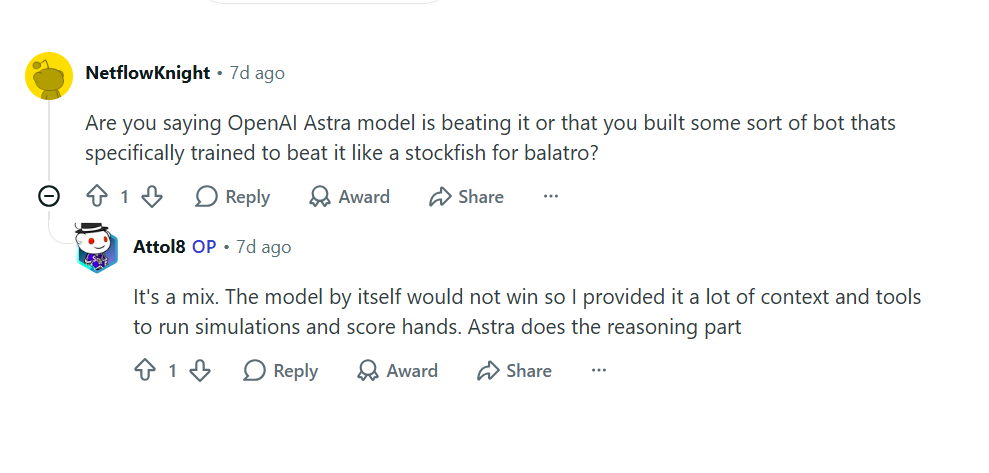
Another Redditor asked whether it was purely Astra that was beating Balatro, and it was explained that there were extra simulation tools involved in the process.
Why beating Balatro is an interesting AI test
There is no single fixed sequence of moves that guarantees victory, with a huge flux of random cards, Jokers, and modifiers constantly changing the available options.
Therefore, the AI is primed to make decisions under uncertainty, as opposed to memorising a winning sequence, as in a game of chess, for example.
The Black Deck makes that problem even harder because losing one hand per round gives the bot fewer opportunities to recover from a bad draw, while Gold Stake adds further restrictions, including Jokers that can become temporary or more expensive to keep.
And when AI makes headlines for the wrong reasons, perhaps here reason can stand with ethical gain.