AI got the US midterms terribly wrong, but voters listened anyway
AI Chatbots invented fake candidates for US voters.
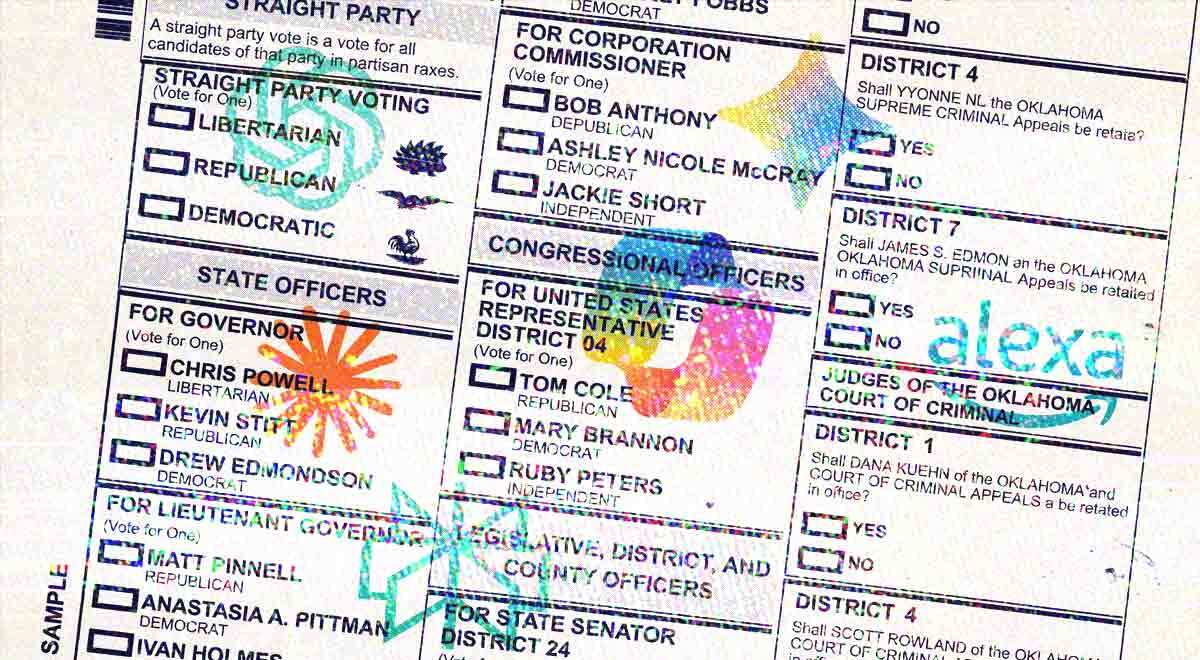
A ballot containing disinformation and big tech logos. Image by Cybernews.

 Follow us
- A Washington Post test of six AI chatbots found false 2026 election guidance, including invented races and misplaced candidates.
- Chatbots gave the wrong congressional district for an address in 48% of responses.
- Some errors came from questionable sources, including an AI site that guessed districts from ZIP codes.
- A Pew survey found 8% of US adults used AI chatbots for 2026 election information.
Key Takeaways by nexos.ai, reviewed by Cybernews staff.
AI chatbots are giving US voters false election information, from fake candidates to incorrect congressional districts. Despite these errors, Americans are increasingly turning to tools like ChatGPT for guidance on the 2026 midterm elections.
When it’s election time, and we’re not sure which statistics to trust, it is very tempting to reach for a chatbot.
An investigation carried out by The Washington Post put six chatbots to the test, asking them to create voter guides for randomly selected addresses across the US.
The researchers analyzed 3,000 responses, and the results revealed some inaccuracies.





Some chatbots even outperformed others because they refused to provide an answer. ChatGPT, Google AI Mode, and Perplexity scored higher in the district accuracy rankings simply because they refused to provide any specific addresses.
ChatGPT invented a Missouri Senate race that wasn't on the 2026 ballot, while Claude presented Wyoming politicians running for state-level offices as candidates for federal office.
Chatbots failed to identify the correct congressional district for an address in 48% of responses, while answers that actually named a district were wrong 22% of the time.


Stay updated with our latest stories and follow us on social media
Be the first to discover new stories, ideas, and updates from our team.
AI scraping AI sites
One reason for the fabricated information is that the AI chatbots cited questionable political sites. The Ballot Brief, an AI-powered election information website, reportedly used ZIP codes to determine congressional districts, despite it being a weak correlation.
The report also explained that the chatbots often contained biographically accurate information about candidates and subsequently produced inaccuracies, making them more camouflaged.
And because chatbots link to official political sites, they would likely gain voters' trust, despite the thorny information contained in their output.
A Pew Research Center survey of 5,273 US adults found that 8% had used AI chatbots for information about the 2026 elections.
That might sound like a minority, but if a chatbot creates a fake candidate out of nowhere, then there could be consequences such as a swayed vote and inaccurate fact-checking.
Plus, AI-generated falsehoods can be repeated and cited elsewhere, as word-of-mouth spreads quickly during voting.