Exclusive: Political deepfakes target Democrats more than Republicans ahead of midterms
Republicans follow President Donald Trump in embracing deepfakes.
Image by Lev Radin via Shutterstock/Illustration by Cybernews

 Follow us
- Cybernews researchers examined 104 political deepfakes reported from early 2025 to October 2026.
- Democrats appeared negatively in 49 deepfakes, compared with 28 negative deepfakes about Republicans.
- Trump posted 20 analyzed deepfakes, while Republican groups shared 22, and Democratic-linked sources shared 7.
- Studies suggest deepfakes may erode trust even when they do not persuade voters more than other misinformation.
Key Takeaways by nexos.ai, reviewed by Cybernews staff.
From a talking raccoon to a mayor beloved by criminals, our exclusive analysis takes a deep dive into how Republicans and Democrats use bizarre deepfakes to target their political opponents within and outside their parties.
A raccoon deepfake became one of the major highlights of the 2026 Republican primary runoff for lieutenant governor of Alabama.
Candidate Wes Allen attacked his rival, John Wahl, with an AI-generated video of a raccoon pet, accusing Wahl of not voting for President Donald Trump, celebrating Ramadan in a mosque, and sharing a bed with the wild animal.





This bizarre AI-generated video is one of the many political deepfakes that are increasingly used by politicians and foreign actors to influence elections, as the rise of generative AI tools has opened new possibilities for spreading political misinformation and manipulating voters.
With Americans getting ready to cast their ballots on November 3rd, 2026, our team examined 104 reported political deepfakes from the Resemble AI database from early 2025 to October 13th, 2026.
We found that Trump and Republicans are responsible for over 40% of all reported political deepfakes since early 2025, while the sources of nearly 45% synthetic media aren’t politically affiliated or known.
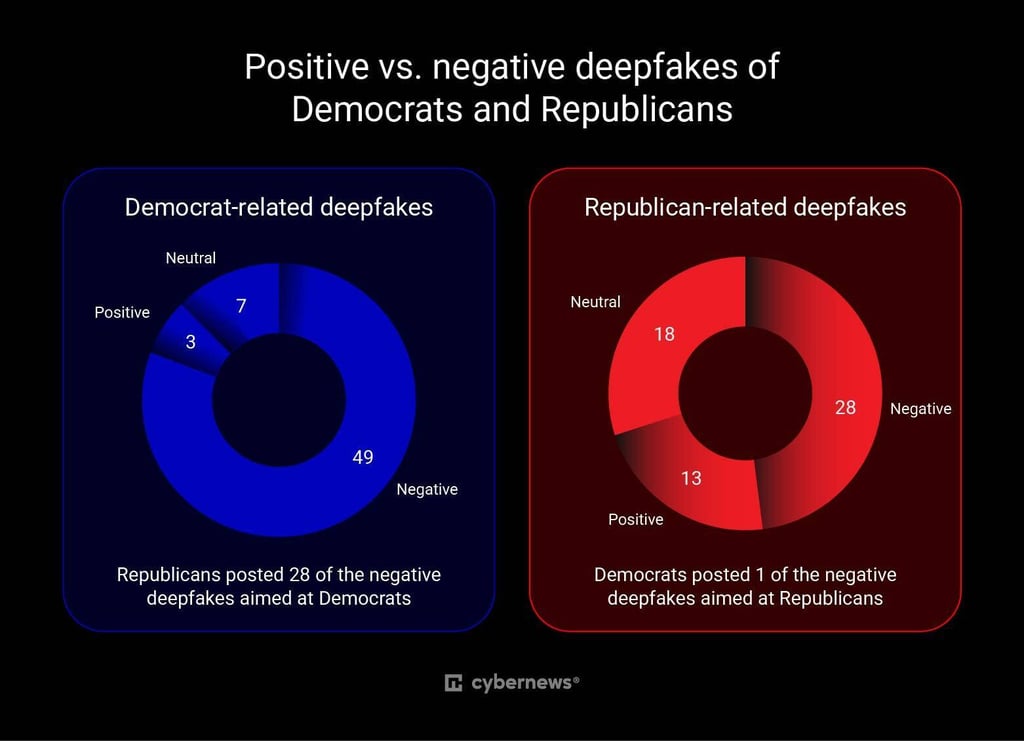
Democrats were much more frequently than Republicans depicted in deepfakes that paint the party in a negative light, 49 versus 28 deepfakes, respectively.




Stay updated with our latest stories and follow us on social media
Be the first to discover new stories, ideas, and updates from our team.
Only 3 analyzed deepfakes targeting Democrats were positive, while 7 were neutral.
In comparison, 13 Republican-related deepfakes were positive, and 18 portrayed the GOP in a neutral light.
Deepfakes are coming from the White House
Our analysis suggests that the spread of political deepfakes isn’t limited to shady foreign-funded bot farms – the parties themselves use AI to target their opponents.
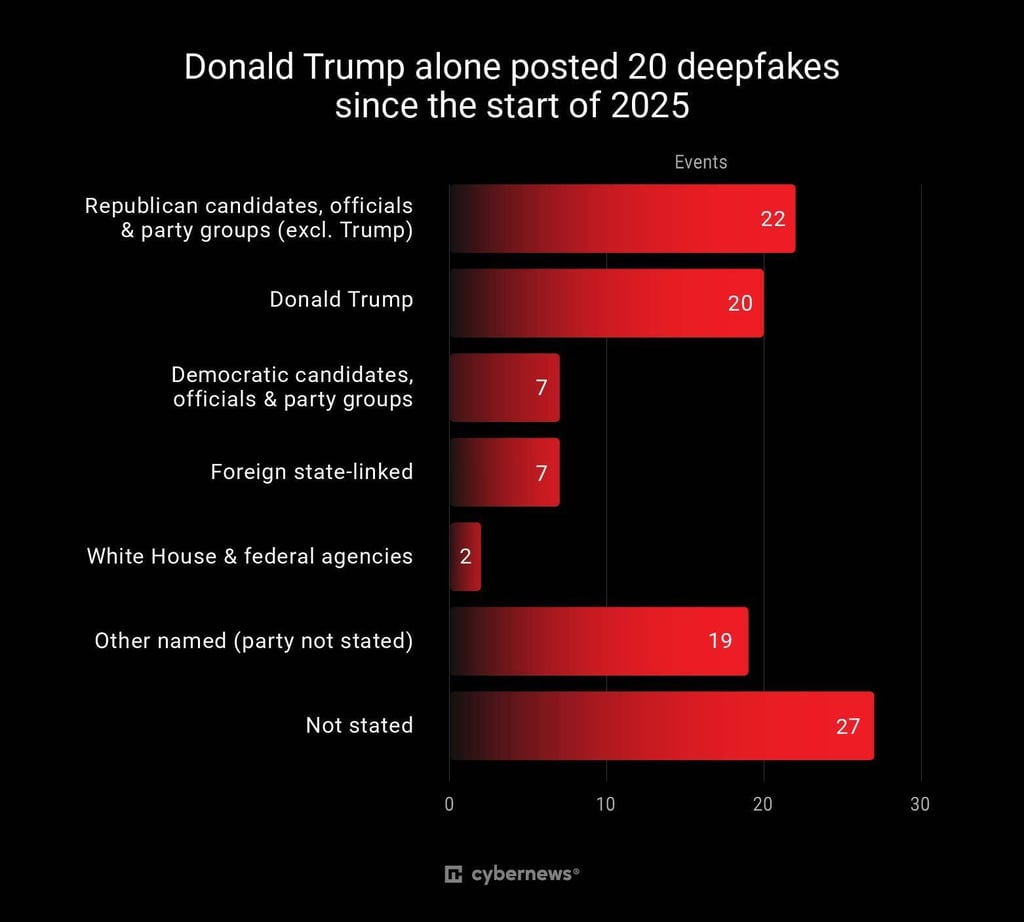
We found that Trump posted 20 of the 104 deepfakes included in the analysis.
For instance, in 2026, POTUS shared an AI-generated photo mocking the weight of Illinois’ Democratic governor, JB Pritzker, suggesting he cannot ensure Chicago’s safety because he is “too busy” eating.
The president also faced fierce backlash for sharing a deepfake that depicts former Democratic president Barack Obama and his wife Michelle, as monkeys, which he removed following racism accusations.
Republican candidates, officials, and party groups shared 22 deepfakes, compared to 7 linked to Democrats.
Official accounts of White House and federal agencies posted 2 deepfakes.
The White House reposted an AI-generated image from Trump, depicting POTUS in papal attire, soon after the death of Pope Francis, sparking criticism from Catholic organizations and groups.
Seven analyzed deepfakes were traced back to foreign state actors, including countries like Russia, Iran, and China. Not all of them, however, cast the US government or its politicians in a bad light.
Russian state media released a deepfake in 2025 showing European leaders, including French President Emmanuel Macron and the European Commission President Ursula von der Leyen, nervously waiting for Trump with their heads down.
In contrast, groups affiliated with the Islamic Republic of Iran released a lego-style deepfake campaign mocking Trump and its government amid the height of the US and Israel war against Iran.
Nearly half of political deepfakes – 46 of 104 – were posted by sources that aren’t clearly affiliated with any party or have sources that are unknown.
AI used to attack opponents within the party
When deepfakes come from US parties, they often target their political rivals – both within and outside the party.
For instance, 60% of deepfakes posted by Republicans present Democrats unfavorably, and none of them portray rivals positively.
Only 18% of GOP-linked synthetic media cast a positive light on their own party, and the same proportion of Republican-shared deepfakes are negative towards the GOP.
Some 67% of Democrat-posted AI-generated material portrays their own party positively, and only 6% are negative.
One of the most notable examples is the 2025 New York City mayoral election campaign, where Andrew Cuomo, a Democrat who ran as an independent, attacked his Democratic rival, Zohran Mamdani, using a series of deepfakes.
These AI-generated videos suggested that criminals support Mamdani over his lax policies, or that he will rob New Yorkers of their money by raising taxes.
Foreign state-affiliated groups accounted for 18% of negative deepfakes portraying the Republican party, as well as 18% of the positive ones.
In comparison, 11% of negative and 11% of positive Democratic-related deepfakes can be traced back to foreign actors.
Foreign actors may be using American software to interfere in US politics. In early October, San Francisco-based OpenAI banned Russian and Iranian accounts using its chatbot for covert influence operations.
The Iranian operation generated batches of social media comments, generally on topics related to the US-Iran war, alongside other measures, according to the company.
Deepfakes don’t always change people’s minds
Deepfakes started rising in popularity in late 2022, with the arrival of OpenAI’s chatbot ChatGPT. As the phenomenon is relatively new, the evidence on its impact on voting behavior is mixed.
A 2026 analysis of 25 studies suggests that political deepfakes don’t have a higher inherent persuasive effect on audiences than other misinformation, but they cause destabilization and erode trust.
Researchers suggest that people post deepfakes to signal their identity and partisan alignment, and don’t necessarily believe that they’re true. Meanwhile, measures against deepfakes, such as warnings, can backfire and further increase distrust.
An experiment conducted in the US and the Netherlands suggests that exposure to realistic political deepfakes delegitimized the targeted political actor and reduced support for them, especially among initial supporters of that actor.
Participants rated deepfakes as “substantially less credible” than authentic videos. However, although fact-checks lowered the credibility of AI-generated media, “the delegitimizing impact of deepfakes was resilient to corrections.”A 2026 study
Some experts argue that deepfakes are changing how we perceive political messaging.
Iran’s Lego-style videos mark a departure from traditional war propaganda to “culturally fluent, algorithmically savvy, social media content” that’s first perceived as entertainment and only later as political messaging, analyst Jessica Brandt writes for the Council on Foreign Affairs.
Methodology
Our team used data from Resemble.ai, an AI-generated media detection company that tracks political deepfakes reported in the media.
We examined the descriptions of deepfake incidents to determine how many of them showed Democratic and Republican parties in a good, bad, or neutral light.
In addition, we looked into who made the deepfake if information was available.
The analysis examines 104 unique political deepfakes reported since the beginning of 2025.
However, the Resemble.ai database includes a larger number of incidents because several media outlets reported the same deepfake events.