Researchers put AI behind the wheel of a Toyota Corolla. It did not go well
AI takes the wheel.

 Follow us
- Researchers tested frontier AI models by letting them control a Toyota Corolla on a slow parking-lot course.
- GPT-6 Astra was the only model to finish, completing the route on its second attempt.
- Most models failed near the first corner, even after researchers let them review mistakes and try again.
- The benchmark suggests general AI models may start moving from software tasks into physical-world control.
Key Takeaways by nexos.ai, reviewed by Cybernews staff.
In a new benchmark, researchers gave frontier AI models control of a Toyota Corolla to test their ability to handle the demands of driving in the physical world. Most failed to make it past the first corner, except for GPT-6 Astra, which completed the entire course.
The test, called DrivingBench, used a 2022 Toyota Corolla fitted with Comma 4 and openpilot hardware. The models received 3 MCP tools: 1 to see the car's camera feeds and telemetry, 1 to control steering and speed, and another to stop the car. A human operator remained behind the wheel with a foot over the brake throughout the tests.
The course ran through a large parking lot and included straight sections, bends, left and right turns, and a marked finish area. The researchers capped the car's speed at between 0.5 and 3.5 meters per second, or roughly 1 to 8mph, to keep the tests under control.
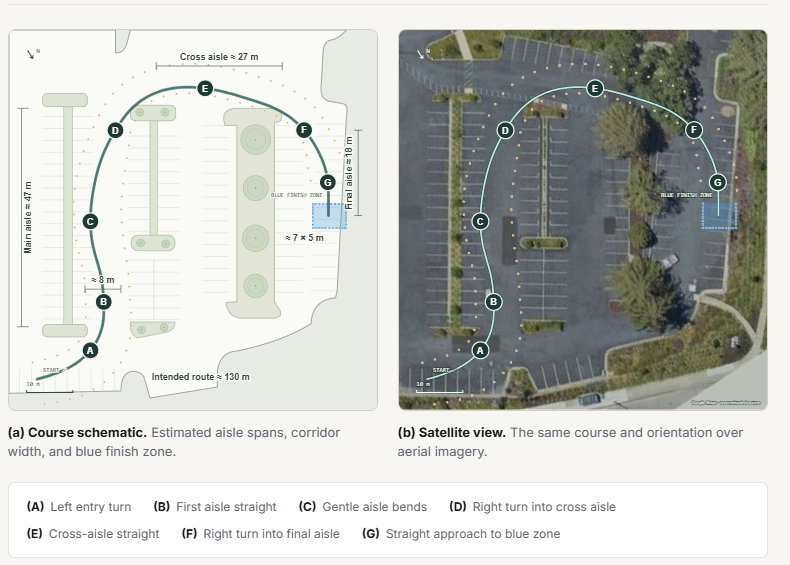




GPT-6 Astra completed the course on its 2nd attempt in about 5 minutes. Claude Fable 5.1 got around halfway on its 3rd attempt, while the other models failed to get beyond the 1st corner.
The benchmark also tested whether models could learn from their mistakes. After each failed attempt, researchers gave the models a chance to reflect before trying again.
“I picked the wrong side of the boundary again. The diagonal cone line was the lane's left edge, not its right edge,”reflected Fable.
Grok also discovered that the camera's view could make the car appear narrower than it really was.
“The car is wider than the camera makes it look,” the model said after its first attempt.
“Straight ahead was not a clear lane – it pointed at the planter, the wall, or the near red cone.”
Astra changed its driving strategy after its 1st run, slowing down around bends and obstacles. On its successful 2nd attempt, it stayed below 0.8m/s and relied heavily on full steering commands.
The researchers expected the course to be difficult and said they were “surprised any model was able to finish it.”
From computer screens to the physical world
DrivingBench arrives as the AI industry pushes toward a broader idea known as physical AI. These are systems that can understand their surroundings and act on real-world scenarios.
Nvidia insists physical AI is the next step beyond AI agents. The idea encompasses robots, autonomous vehicles, drones, and other machines that must handle movement, space, objects, and real-world physics.
At CES 2026, CEO Jensen Huang showcased Alpamayo, an autonomous driving system designed to think and reason through driving decisions.



Stay updated with our latest stories and follow us on social media
Be the first to discover new stories, ideas, and updates from our team.
That same push is playing out across the robotics industry. Alibaba has released RynnBrain, an open-source model designed to help robots understand their surroundings, plan tasks, and carry them out. It showed a RynnBrain-powered robot fetching milk from the fridge, identifying fruits, and putting them in a basket.
The car benchmark offers a simple demonstration of that shift, though it differs in an important aspect. Unlike models from Nvidia and Alibaba, which were built specifically to help machines understand and act in the physical world, DrivingBench puts general-purpose frontier models in the driving seat.
That makes Astra's successful run even more notable, demonstrating that the transition from software AI to physical AI may not always require a new model built from scratch.