nexos.ai vs PortkeyAI: detailed comparison of features, capabilities, and value
Being behind major reports like The Mother of All Breaches and RockYou2024, our in-house cybersecurity experts and journalists provide unbiased, real-world testing and in-depth analysis.
We maintain complete transparency by openly sharing our testing methodologies with our audience.
Learn more

Using AI at scale is no longer about picking the best LLM. It now hinges on managing multiple models, optimizing their performance, and ensuring security. That's where LLM gateways like nexos.ai and PortkeyAI come in. With top-tier LLM orchestration, they can help you streamline your workflows, monitor AI performance, and adhere to company policies.
nexos.ai and PortkeyAI provide tools for prompt management, load balancing, AI observability, and keeping your security up to par. They offer a similar service but differ in areas like integration or scalability.
In this nexos.ai vs PortkeyAi comparison, I discuss their features, security, support, and capabilities. Keep reading to find out which platform works better for you.
Company overview and platform background
Before delving into core features, integration, and differences between nexos.ai and PortkeyAI, I'll provide some context and corporate background. Here's a brief historical outline and the main idea behind both platforms.
About nexos.ai: company background and core offerings
nexos.ai is an AI orchestration platform founded in 2024 by Tomas Okmanas and Eimantas Sabaliauskas, co-founders of Nord Security, Oxylabs, and other successful businesses. The main goal was to allow enterprises to integrate, manage, and optimize the use of multiple AI models. In January 2025, it secured $8 million in funding, with Index Ventures as the lead investor.
nexos.ai simplifies large-scale AI management by giving access to 200+ models from providers like OpenAI, Anthropic, Google, and Meta. It achieves its primary focus with features like smart routing, intelligent caching, robust security, generous customization, and tracking options. Finally, nexos.ai is primarily designed for enterprise-level tasks.
Introducing PortkeyAi: background, philosophy, and offerings
PortkeyAI was founded in 2023 after securing $3 million in funding led by Lightspeed Venture Partners. Similar to nexos.ai, the platform acts as a control panel for AI applications, providing full observability, prompt management, automated model selection, and security compliance.
It provides safe and reliable routing to 250+ AI models and allows you to monitor 40+ factors, manage costs, and maintain output security. You can also set distinct budgets, rate limits, and access controls for various teams and environments. Unlike nexos.ai, PortkeyAI has plans for both individuals and enterprises.
Primary features and capabilities
nexos.ai and PortkeyAI are both LLM orchestration platforms designed to connect you to hundreds of AI models and pick the best one for each prompt. Here's my detailed overview of their core features.
Introducing nexos.ai: capabilities and innovations
nexos.ai focuses on flexibility, security, and adaptability in enterprise-grade settings through two core products: AI Gateway and AI Workspace.
AI Gateway acts as the secure backbone for managing and optimizing access to multiple LLMs. Its primary features include:
- Adaptive LLM routing and load balancing. Dynamically selects the best LLM for each task, optimizing both performance and cost.
- Intelligent caching. Uses exact and semantic caching to reduce latency and costs for repeated or similar prompts.
- Enterprise-grade security and compliance. Ensures all LLM interactions meet high regulatory and data protection standards.
- Tracking features. Monitors key aspects like usage, performance, cost, and potential system errors or bugs.
- API-first architecture. Easily integrates with existing workflows and applications.
AI Workspace is the centralized interface for teams to interact with and compare LLMs in a secure environment. Key features include:
- Comparing prompt quality. Provides tools to assess and compare outputs from different models in response to similar prompts.
- Customization. Lets users fine-tune AI responses using private datasets, including customizing tone or enforcing compliance settings.
- Unified access. Gives employees a single platform to experiment with, chat, and collaborate with various LLMs from a web browser, all within the organization’s security policies.
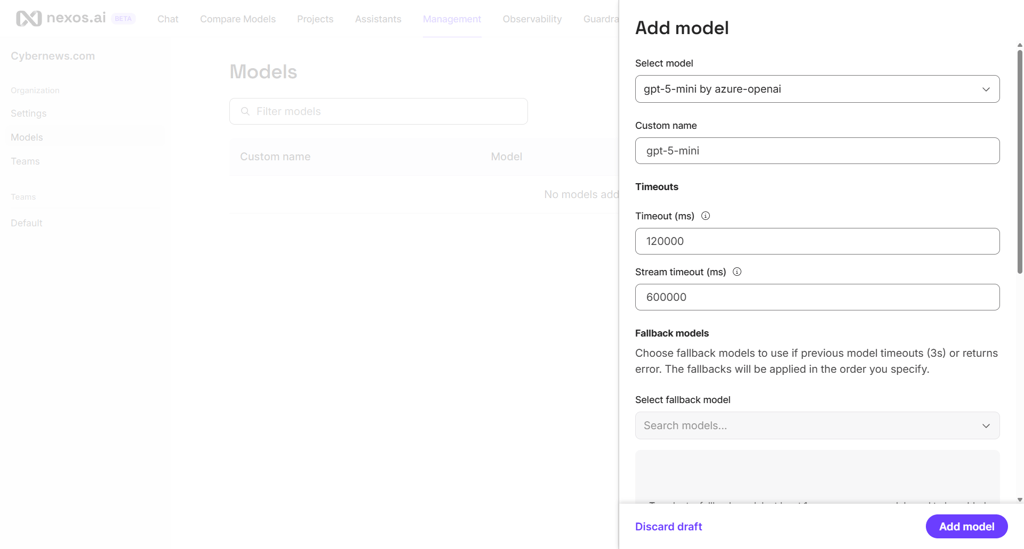
By combining AI Gateway’s robust backend management with AI Workspace’s user-friendly front end, nexos.ai enables enterprises to securely orchestrate, scale, and collaborate with AI technologies across teams.
Introducing PortkeyAI: features and core strengths
Similar to nexos.ai, Portkey is an efficient tool for managing AI models and tracking numerous parameters. It acts as a control panel for AI applications, gives you access to 250+ models, and maintains security and observability. Here's an overview of Portkey's core features:
- Automated load balancing and failover mechanisms. Portkey distributes AI requests across multiple models to prevent bottlenecks and boost stability.
- Conditional routing. Enables dynamic switching between AI models based on task requirements, costs, or performance metrics.
- Observability and monitoring. Provides real-time tracking, logging, and analytics to better evaluate AI model behavior and efficiency.
- Prompt management tools. The platform allows you to structure, test, and deploy prompts across multiple models for optimized AI outputs.
- Security and compliance guardrails. Portkey ensures governance over AI outputs by introducing compliance rules, constraints, and safety measures.
- Caching and cost optimization. Caching reduces redundancy and optimizes resource usage.
- Seamless API compatibility. Guarantees easy integration with any existing system with minimal friction.
System integration and workflow compatibility
The effectiveness of AI orchestration platforms starts with seamless integration with your existing systems and workflows. nexos.ai and Portkey adopt a structured, APIs-driven approach that allows you to incorporate them with minimal friction.
How nexos.ai integrates AI models: capabilities and flexibility
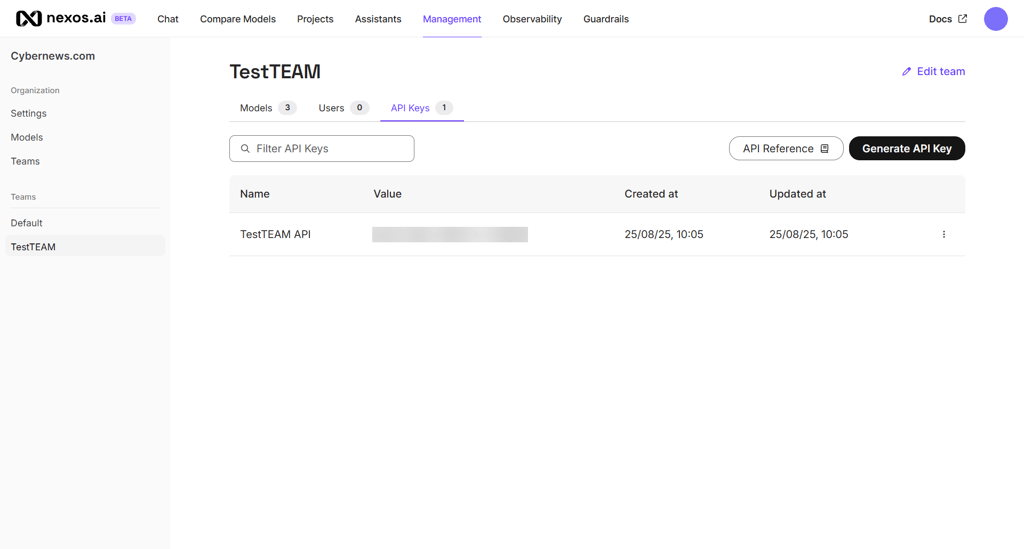
nexos.ai adopts an API-first infrastructure, which guarantees seamless integration with your existing stack. Its integration features include:
- Unified API access. A single endpoint for routing AI requests across multiple AI models.
- Plug-and-play compatibility. You can integrate the platform quickly and focus on deeper customization when needed.
- Private dataset integration. Incorporating proprietary data sources will boost AI performance.
- Load balancing and optimization. Dynamic distribution of AI requests improves efficiency and reduces costs.
- Security and compliance controls. The platform seamlessly integrates with security frameworks while maintaining regulatory compliance.
How PortkeyAI fits into existing workflows
Portkey follows a similar API-driven integration model. Like nexos.ai, it offers unified API access, plug-and-play convenience, integration with private datasets, load balancing, and security and compliance guardrails.
Apart from API-based integration, the platform also supports various AI agent frameworks like Autogen, CrewAI, Langchain Agents, Llama Agents, PhiData, ControlFlow, and LangGraph. This allows you to build AI applications using familiar frameworks without extensive reconfiguration.
Scalability: which platform excels for enterprise AI deployments?
When scaling your AI applications, you want to optimize performance, maintain reliability, and avoid excessive complexity or cost. Both nexos.ai and Portkey can handle large-scale AI operations by optimizing the processing and routing of AI requests. In other words, they scale by adapting to the increasing demands and more complex AI workflows.
nexos.ai scales by dynamically routing requests across multiple AI models and providers. Thanks to its adaptive load balancing, it can process AI queries efficiently to minimize bottlenecks and optimize costs. Intelligent caching further boosts scalability by eliminating redundant requests and excessive computational overhead.
PortkeyAI adopts a similar approach, offering smart request routing that distributes workloads effectively across its network of 250+ models. Like nexos.ai, it allows you to scale your AI operation without being tied to any single provider. Its integration with agent frameworks like Langchain Agents, Autogen, and CrewAI helps you automate complex workflows at scale and maintain efficient orchestration as your AI usage grows.
Both platforms focus on efficient AI orchestration rather than raw computational scaling. This makes them ideal if your business wants to expand its AI capabilities without managing infrastructure directly.
Security, compliance, and data privacy
When looking for the best AI orchestration platform for your business, you should pay close attention to their approaches to security and privacy protection. Here's how nexos.ai and PortkeyAI address these critical factors.
How nexos.ai handles security and data privacy
At the moment, we don't have detailed insight into nexos.ai's privacy and security setup. The official website states that the company adheres to industry standards and regulations to ensure responsible and secure data handling. That said, the reputation of its founders guarantees a focus on maintaining high security and compliance standards.
Data encryption, compliance, and privacy measures in PortkeyAI
PortkeyAI employs robust encryption ciphers to protect your data integrity and privacy. Data in transit is encrypted via TLS 1.2 or higher and at rest with AES-256 cipher. PortkeyAI also complies with several industry-recognized standards, including ISO 27001, SOC 2, GDPR, and HIPAA.
The platform offers isolated storage infrastructure, which means your data will remain segregated and protected. Finally, it automatically removes sensitive data from requests to prevent exposure.
Performance optimization, load balancing, and caching mechanisms
Both platforms boost performance with advanced load balancing and caching mechanisms. While specific benchmarks aren't publicly available, their features indicate a strong focus on efficient and reliable AI deployments.
Load balancing and performance optimization in nexos.ai
nexos.ai offers several features that can boost your performance and load management:
- Load balancing, retries, and fallbacks. The platform routes tasks to different AI providers to maintain smooth operation. It also provides automatic backups and priority routing to handle high traffic and potential disruptions.
- Intelligent caching. These mechanisms reduce costs associated with similar and repeated queries. They also minimize redundant processing, which boosts response times.
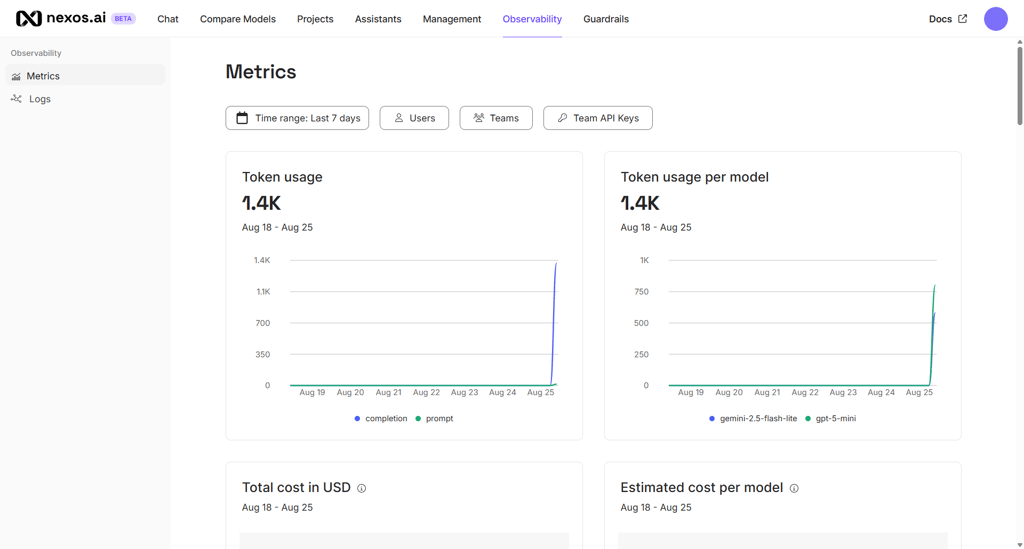
- Observability. nexos.ai has real-time monitoring of usage, spending, and performance. It also lets you check for potential bugs in the system.
Portkey performance: how it manages load balancing and caching
Portkey also adopts efficient mechanisms for load balancing and caching. Here's a quick overview:
- AI gateway with load balancing. PortkeyAI provides an AI gateway that routes your requests to 250+ models. It supports load balancing, retries, and even canary tests.
- Caching mechanisms. The platform incorporates intelligent caching to boost performance and reduce latency.
- Observability suite. You can monitor over 40 metrics with detailed logs and traces. With such robust monitoring, you'll be able to identify bottlenecks and get the most out of your AI operations.
Reliability, uptime, and community integrations
Reliability, uptime, and seamless integration with third-party tools are essential for AI orchestration platforms. Below, I discuss how nexos.ai and PortkeyAI deal with these problems.
Reliability and uptime guarantees: nexos.ai's approach to service continuity
nexos.ai was designed with stability and resilience in mind. Here's how it guarantees these must-haves:
- Multi-provider support. You can route your requests to 200+ AI models, which takes reliance on a single provider out of the equation. This approach also minimizes downtime risks.
- Failover mechanisms. nexos.ai always chooses the best model for the job. However, if the primary pick fails or experiences high latency, you'll be redirected to alternative models.
- Enterprise-grade infrastructure. nexos.ai was built for large-scale operations. It can handle high traffic and adapt to fluctuating workloads without any interruptions.
Currently, nexos.ai still hasn't disclosed specific uptime guarantees or SLAs.
Community and third-party integrations: how PortkeyAI expands its capabilities
PortkeyAI offers extensive integration options and community support:
- AI gateway with broad model access. Like nexos.ai, Portkey supports 250+ LLMs through a unified API to allow seamless switching between providers.
- Agent framework compatibility. The platform is compatible with major AI agent frameworks like Langchain, CrewAI, and Autogen.
- Multi-environment collaboration. PortkeyAI includes tools for collaborative prompt engineering, versioning, and controlled access.
As mentioned, the platform ensures reliability via load balancing, retries, and automated failovers. Similar to nexos.ai, Portkey didn't publicly outline specific uptime SLAs.
Prompt management, observability, and monitoring
nexos.ai and PortkeyAI offer tools for prompt optimization, real-time observability, and automated compliance control. They both focus on prompt comparison, centralized AI control, and automated guardrails. These options will help you refine your outputs and track AI performance.
Optimizing prompt management: nexos.ai's solutions
nexos.ai provides advanced prompt management tools that allow you to refine AI interactions and maintain consistency across different models. Here are some of the most important prompt management options:
- Prompt comparison and evaluation. This feature lets you compare model responses to similar prompts and gauge the best LLM for any given task.
- Prompt-to-API conversion. Automatically transforms AI models and their prompts into RESTful APIs.
- Automated guardrails. You can use this feature to dynamically enforce compliance rules and content policies.
- Customizable outputs. nexos.ai allows integration with private datasets for more tailored responses.
- Adaptive response tuning. You can make sure your AI content aligns with your corporate guidelines.
- Intelligent caching. The platform uses exact and semantic caching to reduce redundant API calls and lower costs for similar and repeated prompts.
In terms of observability in AI platforms, nexos.ai lets you monitor numerous parameters like performance, usage, and bugs. These main branches can include metrics like LLM latency, overall efficiency, API calls, costs, model utilization, and others.
Observability and monitoring: what PortkeyAI brings to the table
Portkeys AI gateway also provides solid prompt management options, focusing on seamless AI interaction and compliance-driven automation. Its main prompt management features include:
- Version control. This feature allows you to access the history of prompt iterations to track changes or revert to previous versions.
- Prompt templates. You can create and manage reusable prompt templates to maintain consistent usage across applications.
- Automated guardrails. The platform offers more than 50 automated guardrails that enforce your policies and compliance rules.
- Adaptive response tuning. This feature lets you fine-tune AI responses to match specific needs and projects.
- Intelligent caching. Portkey uses smart caching to reduce latency and optimize the reuse of your prompts.
Portkey also provides comprehensive analytics and logs with model performance and usage tracking. You can use these metrics to prioritize models with lower latency and better performance, gauge response accuracy, or optimize your AI workloads based on demand.
Which platform is right for you? Comparing nexos.ai and PortkeyAI for SMEs vs large corporations
nexos.ai was designed to handle massive AI workflows. This approach makes it ideal for large enterprises. However, SMEs can also use it to integrate AI into their operations. That said, since we still don't have the official pricing for nexos.ai, it's still unclear whether its package will be cost-effective for smaller companies. However, you can visit nexos.ai website to get a free 14-day trial and customized pricing for your company.
PortkeyAI, on the other hand, can work for anyone from individual developers to large organizations with strict compliance and custom infrastructure. Its free plan is an excellent tool for small projects that need a free starter option. Its Production package is best suited for startups and SMEs that need commercial-grade usage and monitoring.
Conclusion and recommendations
nexos.ai and PortkeyAI are solid AI orchestration platforms that can help you integrate and manage hundreds of AI models. They share key strengths like multi-model access, solid security measures, and API-based integration. They also offer optimization tools, prompt management, and observability features to boost AI performance.
Choosing between them will depend on the specific requirements of your business. These can include security needs or various preferences regarding model routing, integration, prompt management, and other relevant factors.
At the moment, I recommend nexos.ai to large enterprises that want to manage multiple AI models at scale while controlling costs and ensuring reliable performance. Although Portkey can cover the same ground as nexos.ai, I'd primarily recommend it to SMEs due to its flexible pricing plans and support for AI developers.
FAQ
What are the primary features of nexos.ai and PortkeyAI?
nexos.ai and PortkeyAi are both AI orchestration platforms that offer multi-model support, prompt management, monitoring, and enterprise-grade security. Portkey also supports AI agent frameworks and structured observability tools.
How do nexos.ai and PortkeyAI differ in terms of AI model integration capabilities?
nexos.ai and PortkeyAI provide seamless AI model integration through API-first architectures. They support hundreds of AI models, which translates to flexibility and plenty of room for effective prompt management. PortkeyAI is also compatible with various agent frameworks like Autogen, CrewAI, and LangGraph.
How do nexos.ai and PortkeyAI handle security and compliance, particularly data encryption and privacy?
nexos.ai hasn't publicly disclosed any details about its security measures yet, but the provider states that it prioritizes enterprise-grade security, regulatory compliance, and data privacy. PortkeyAI encrypts data in transit and at rest (TLS 1.2+ and AES-256, respectively). It also offers integration with KMS and complies with standards like ISO 27001, SOC 2, HIPAA, and GDPR.
How do nexos.ai and PortkeyAI manage load balancing and performance optimization?
Both platforms offer smart model routing and load balancing. Simply put, they'll find the best AI model for your prompt, which optimizes performance and cost. They also automatically retry failed requests to boost reliability and use intelligent caching to reduce cost and latency for similar and repeated prompts.
Can nexos.ai and PortkeyAI be customized to fit specific organizational needs?
Yes, both nexos.ai and PortkeyAI offer customization options to fit specific organizational needs. They provide customizable AI model routing, custom API integrations, and configurable compliance controls.
How do they approach prompt management and optimization?
Both platforms offer solid tools for refining AI interactions, improving consistency, and optimizing costs. nexos.ai provides prompt comparison and evaluation, prompt-to-API conversion, intelligent caching, and automated guardrails. PortkeyAI has a prompt management toolkit, prompt templates, version control, and intelligent caching.
Which platform is more suitable for small to medium-sized enterprises versus large corporations?
Both platforms can support businesses of all sizes. That said, I'd recommend nexos.ai to large enterprises since we're still not familiar with its final pricing model. PortkeyAI is an excellent choice for solo developers, startups, and small-to-medium businesses due to its flexible subscription packages.