Cherry Servers review 2026
Our in-house experts conduct internal independent, hands-on testing and transparent reviews of web hosting providers by using custom-built tools or utilizing industry-recognized tools and methods to ensure impartial and evidence-based assessments.
Using the same criteria for all services, we share our detailed methodologies and practices to help customers make informed hosting decisions.
Learn more

Founded in 2001, Cherry Servers provides specialized cloud infrastructure – dedicated and virtual servers – aimed at developers and small-to-medium businesses. Positioned as an alternative to large hosting providers, Cherry Servers stands out with its workload-specific bare metal servers, relatively cheap VPS pricing, excellent ease of use, and great customer support.
In this Cherry Servers review, I evaluated its pricing and plans on offer, security, ease of use, and customer support. Using the cloud VPS server, the Cybernews research team and I also tested its performance, conducting rigorous stress testing and uptime monitoring. Read on to find out everything you need to know – and decide whether Cherry Servers is the right provider for your virtual and dedicated hosting needs.
| ⭐ Rating: | |
| 💵 Price: | From $3.51/month |
| 📈 Uptime guarantee: | 99.97% |
| ⚙️ Hosting types: | Virtual servers, dedicated servers |
| 🌎 Server locations: | Lithuania, the US, the Netherlands, Germany, Sweden, Singapore, Japan |
| 🧑💻 24/7 live support: | Yes (responds in 45 seconds) |
Pros and cons
Short on time to read the whole review? Here are my main takeaways – summed up as pros and cons:
Cherry Servers plans and pricing
The main Cherry Servers solution is the bare metal dedicated servers with a promise of 24/7 human support. Besides the dedicated servers, Cherry also includes options for virtual servers (shared or dedicated), and network solutions, such as floating IPs and load balancers. The table below shows a rough starting price comparison for each of the three solutions:
| Plans | Price | Best for |
| Virtual Servers | From $0.018/hour or from $3.51/month | Developers, growing web projects |
| Dedicated Servers | From $0.298/hour or from $158.13/month (with annual plan) | Large SaaS projects and startups in need of dedicated resources |
| Network solutions | From $0.002/hour | Server addons such as floating IPs and load balancers |
All Cherry Servers solutions pricing is hourly or fixed-term (monthly and annual). Some users might view hourly pricing as a disadvantage, especially when budgeting long-term costs. However, for dedicated server and virtual server usage, hourly pricing is actually quite nice to have – you only end up paying for the time that you actually use the server. On the other hand, monthly and yearly plans help estimate how much you will spend on your server in a year and save money in the long-run.
Overall, Cherry Servers’ dedicated server prices appear to be on the higher end of the market pricing spectrum. However, if we compare the offered servers to, for example, IONOS, Cherry Servers’ dedicated servers are enterprise-grade, such as the AMD EPYC 7313P for $158.13/month with an annual plan, while IONOS’ AMD EPYC 4344P for $138.00/month is more of an entry-level dedicated server. In this sense, Cherry Server’s dedicated servers pricing is adequate both in comparison to cheap providers like IONOS and in terms of the offer itself.
On the other hand, the virtual server price is average, compared to top VPS providers on the market. Hostinger’s cheapest KVM1 plan starts at $6.49/month for 1vCPU, 4GB RAM, and 50GB NVMe storage. Cherry Servers’ Cloud VPS 2 (GEN 2) plan includes 2vCPU cores, 2GB RAM, and 40GB SSD storage for $7.02/month. At first glance, this plan is more expensive than Hostinger’s with a little fewer resources. However, while Hostinger includes 1vCPU, Cherry Servers offers 2. Additionally, this is the monthly Cherry Servers price, even with an annual plan, and there are no renewal price increases. Meanwhile, Hostinger’s $6.49/month price is only available with a 2-year subscription and renews at a higher cost.
Cherry Servers performance
Performance, perhaps even more than ease of use, is crucial when considering which dedicated or VPS hosting provider to go for. With this in mind, the Cybernews research team and I conducted uptime monitoring and stress testing – the two most important tests for VPS. For testing, the team set up a shared Cloud VPS with 4 vCPU cores, 4GB RAM, 80GB SSD storage, and 1TB egress traffic. The server ran Ubuntu 24.04 64bit and was configured in Amsterdam, the Netherlands. For testing purposes, the team connected to the server remotely via Termius.
Server locations
Cherry Servers offer seven server locations worldwide, including the US, four locations in Europe, and Singapore and Japan. The overall server network seems logically distributed, though some locations, such as Lithuania, where Cherry Servers is based, have more servers than others (for example, Japan or Singapore).
Here are all the server locations of Cherry Servers:
- Lithuania
- The Netherlands (Amsterdam)
- The US (Chicago)
- Singapore
- Sweden (Stockholm)
- Germany (Frankfurt)
- Japan (Tokyo)
Uptime results
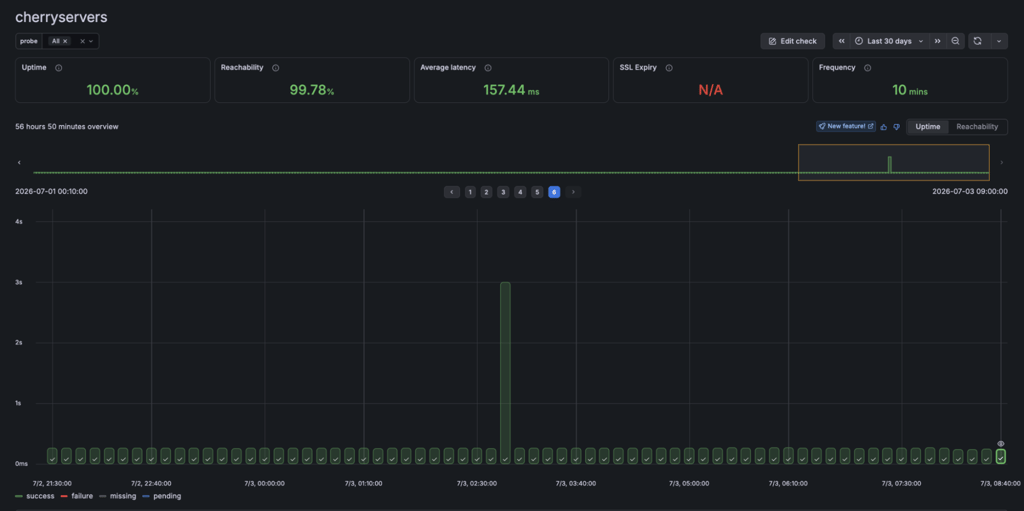
We monitored the uptime of our server for two consecutive weeks. The overall result was really good with 100% uptime. However, reachability was around 99.78%.
Stress testing
For the stress test, we ran one for 5 minutes. We sent 50 virtual users simultaneously to our server, which resulted in 13,700 requests in total. The server handled all of the requests with a rate of 46rps, with a peak of 50rps. There were no failures or errors, and 95% of all requests were responded to in under 95ms.
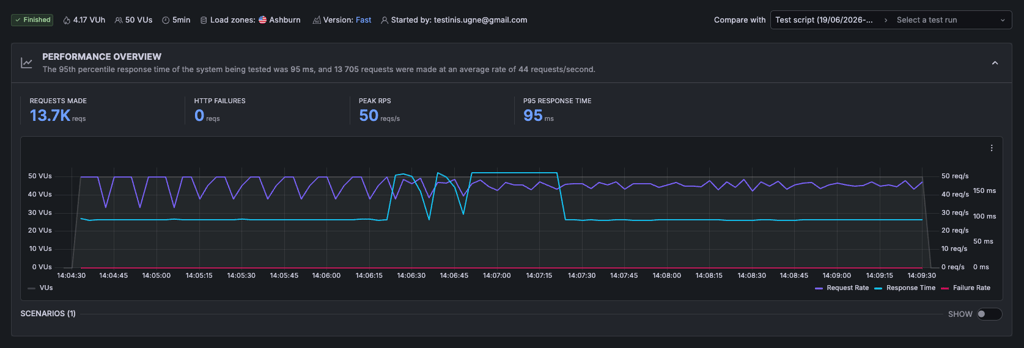
The stress testing results show that the server is fast, stable, and completely able to handle real-world high traffic loads without any additional load balancers. This is an excellent result.
Server management: are Cherry Servers easy to use?
Setting up a Cherry Servers Cloud VPS was an easy process. I had a lot of options to choose from, which might be overwhelming for someone who does not necessarily know what they need. However, I find that the abundance of choices allows for relatively granular configuration – even though you do need to know what resources your project requires. The server deployment took 2 minutes.
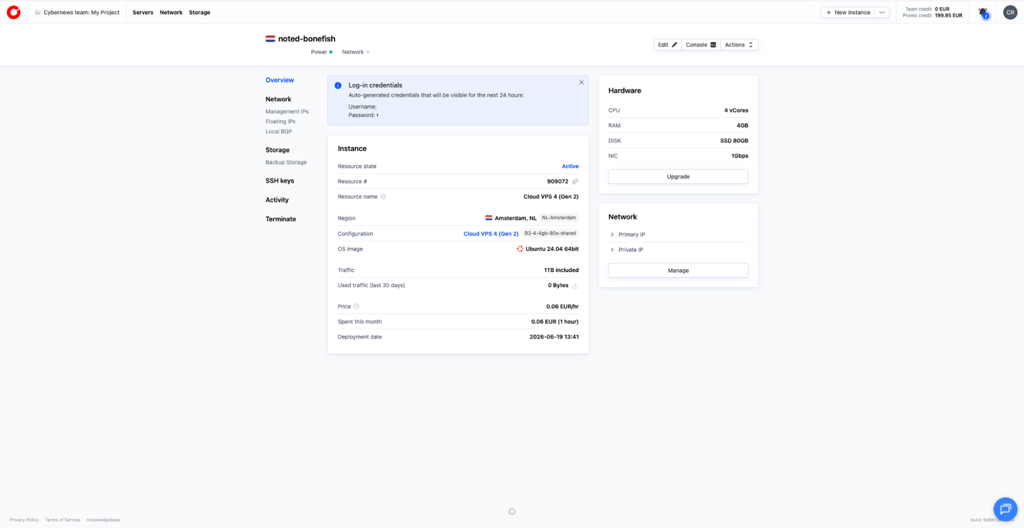
The Cherry Servers client portal is organized around three core dashboards: Servers, Network, and Storage. Each dashboard is accessible via the top navigation bar. Each dashboard displays different information and serves a different purpose. My overall impression was that the interface is clean, minimal, and relatively easy to navigate. Of course, for a beginner user not used to managing VPS hosting, it might take some time to get used to. However, I appreciated the simplicity and sound logic of the dashboards.
The portal has a floating project overview visible from any dashboard, providing status information of all my servers. By clicking on any active deployment, I could view detailed information, such as hardware, configuration, storage, and networking information. There was also an access button to the direct server console.
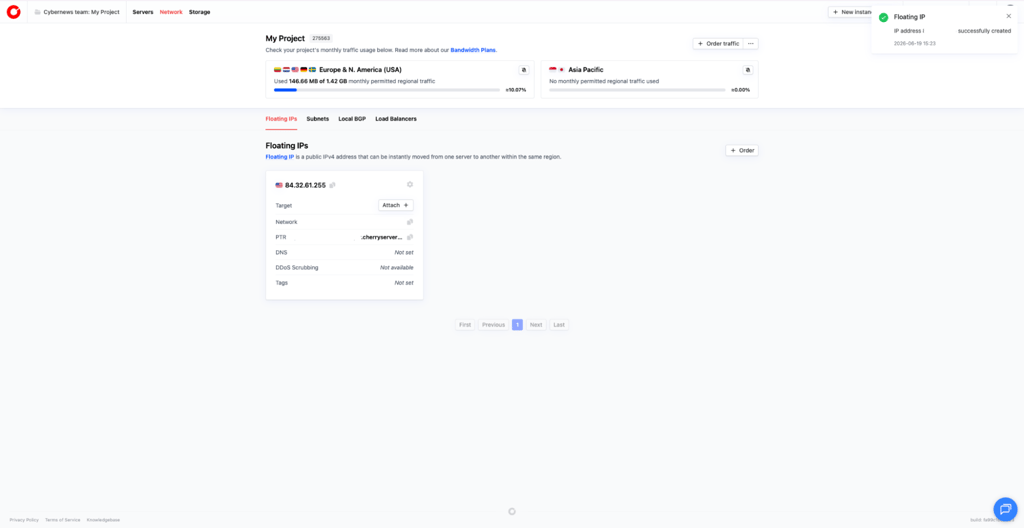
By switching between projects or teams, or creating new ones via the top-left project button, I could easily manage multiple workloads at the same time without any confusing overlap. Ordering and deploying new instances or managing add-ons is centralized via the top-right Instance button. If I needed to, I could easily deploy a new server and handle networking and storage right from there.
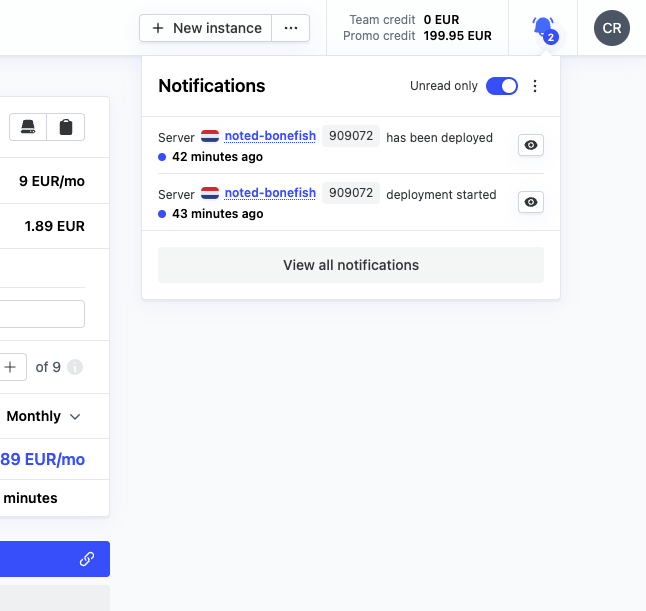
Finally, I liked the fact that the portal provides live notifications for service launches, cancellations, and balance changes. That way, I can stay up to date with everything that is happening with my projects and my account. Plus, you can customize notifications to get the information most relevant to you personally.
Overall, Cherry Servers’ client portal is one of the best I’ve tried in a long time. The simple and logical interface makes managing and deploying my servers easy.
How secure is Cherry Servers?
Every Cherry Servers deployment is equipped with DDoS protection by default, for free. Besides automated traffic monitoring, Cherry Servers also employs network engineers to respond to any attacks or unusual network activity 24/7. However, an unusual approach is null routing, where, rather than filtering bad traffic in case abnormalities are detected, Cherry Servers blocks all traffic altogether. While its benefits as a DDoS protection strategy are debatable, null routing can interfere with some use cases due to forced downtime and zero availability.
Besides DDoS protection, Cherry Servers does not include any additional security measures. In fact, the provider urges its users to implement additional DDoS protection, such as that from Cloudflare. For virtual servers, the provider also recommends other security measures to guard against potential vulnerabilities. This may include backing up your system and data, configuring internal and network firewalls, creating users with restricted rights, and so on.
Cherry Servers support
Cherry Servers’ support channels include a 24/7 live chat with support agents and an extensive knowledge base. I find the fact that the live chat is operated by humans quite important, since more and more hosting providers, such as Hostinger, rely on fully AI-powered support. This shift has arguably worsened experiences for many users, myself included, especially when it comes to solving complex technical issues. Thus, ensuring actual human interaction is an advantage point for Cherry Servers.
My personal experience with Cherry Servers support was nothing short of fast and professional. The support engineer got back to me in under a minute and proposed a working solution to an authentication issue I had within minutes.
The knowledge base includes product, API, and integration documentation, as well as an FAQ section and information on brand assets. The guides for initial setups, server management, networking overviews, guides for managing your usage and billing, and more are all easy to understand and follow.
User reviews
Cherry Servers users have quite mixed opinions and experience. On one hand, they praise the server portal design and the granular networking tools on offer. Further, the users generally praise the fast and helpful human support, appreciating the fact that it is not hidden behind any paywalls and provides genuinely useful advice and solutions. In terms of pricing, some users note the cheap bandwidth pricing, and express appreciation for the payment system which accepts over 20 payment methods, including cryptocurrencies.
However, there are some common issues that users also note. Firstly, some users call out performance throttling with virtual servers under heavy load. Other common complaints include expensive dedicated server pricing compared to other providers, occasional stock shortages for custom setups, and the network management – particularly the null routing approach to DDoS protection. Some users also remark on the limited choice of global data center locations.
Cherry Servers review: final verdict
Cherry Servers is a reliable dedicated and VPS hosting provider best suited for developers and small-to-medium businesses that prioritize stable performance and responsive support. Its highlights include fast, helpful, and human customer support, excellent performance during testing, and easy to use interface. While the default DDoS security might not suit some users’ needs, Cherry Servers stands out with its extensive list of server and networking solutions and enterprise-grade bare metal servers for adequate prices.
| Cherry Servers | Review | |
| Pricing | 5/5 | Cherry Servers’ virtual and dedicated server pricing reflects the market average pricing, placing the provider on the same level (or cheaper) as providers like IONOS and Hostinger. |
| Ease of use | 5/5 | Cherry Servers’ server portal is clean, logically designed, and easy to navigate. Deploying and managing servers and projects is really simple. |
| Performance | 5/5 | In our tests, Cherry Servers showed good performance with 100% uptime and a stress test with zero failures. |
| Security | 3.5/5 | Cherry Servers provides null routing DDoS protection with all deployments. However, the null routing approach can hurt some use cases and businesses, and additional security measures need to be implemented by the user. |
| Support | 5/5 | Cherry Servers provides excellent 24/7 live chat support with human agents, and an extensive knowledge base with guides covering every relevant topic. |