Ahead of Silo Season 3 Episode 10 finale: What Silo understands about AI and surveillance (contains spoilers)
One interesting thing Silo is saying about technology.
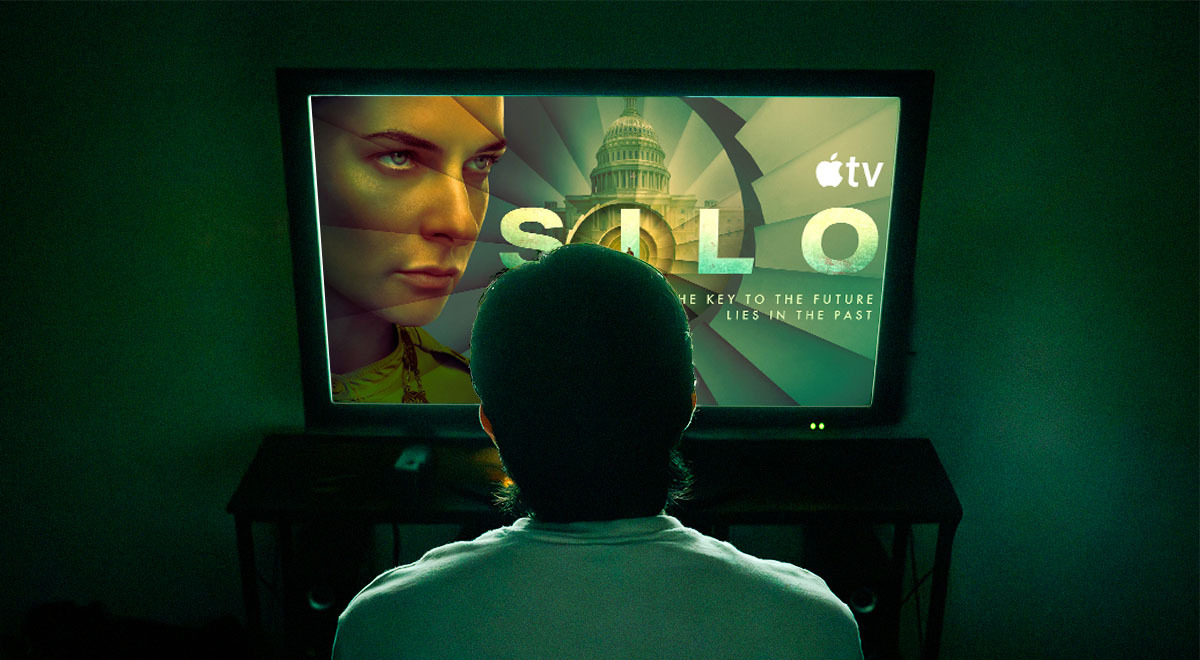
Silo. By Apple/Unsplash

 Follow us
- Silo shows surveillance arriving as convenience, safety, and efficiency before it becomes institutional control.
- Season 3 reveals AI drafted much of the Pact, which later governs silo life.
- The show warns that systems can outlive creators and keep enforcing forgotten decisions.
- Silo contrasts abundant data with lost context, showing artifacts can survive after meaning disappears.
Key Takeaways by nexos.ai, reviewed by Cybernews staff.
The penultimate episode of Silo's third season included a scene that initially looked like elaborate fan service. But if you thought Peter Gabriel appearing as himself at the ceremonial opening of the Silo project, rehearsing Here Comes the Flood, was a bit random, then you haven’t been paying attention.
Given what happens next, the song choice is almost comically on the nose, but it also brings together several ideas that Silo has been developing quietly for years.
Gabriel's music has appeared before. Remember when Juliette is sleeping in a nearby apartment in Silo Season 2, Episode 3, only to be rudely awakened by Solo blasting Peter Gabriel's "Red Rain" from inside the vault? Season 3 featured Come Talk to Me. His in-person appearance: real-life Gabriel and his family have been assigned to Silo 17.
Whether or not the series ever draws a direct genealogical line between him and any future inhabitant is largely beside the point. What matters is that a piece of music heard hundreds of years later in the same Silo suddenly has a history that its listeners can no longer understand.





When information survives but context disappears
The idea of information surviving while context disappears may be the most interesting thing Silo is currently saying about technology. The series has always been about controlled knowledge. Its inhabitants live in a society where access to history is restricted, relics are dangerous, and institutional authority depends heavily on ensuring that people do not understand how their world came to be.
Season 3 has now shown us the technological environment that preceded the underground society, and what is striking is how familiar much of it looks.
During a tour of Silo 18, Helen watches a guide use augmented reality glasses to identify visitors. The glasses initially rely on RFID credentials, but when Helen asks what happens if someone is wearing another person's badge, the guide explains that facial recognition provides another layer of verification. The guide regards the technology as useful. This is precisely why the scene works.
Most surveillance infrastructure does not arrive announcing itself as surveillance. It arrives as convenience, safety, efficiency, or personalization. Identification makes access easier. Cameras improve security, algorithms reduce friction, and AI makes sense of the information. Each component can be defended on its own merits, but together they gradually create capabilities that once seemed extraordinary.
The comparison with today's smart glasses is obvious. The difficulty begins when systems move from understanding objects to identifying people. Researchers have already demonstrated how commercially available smart glasses can be combined with facial recognition systems and publicly accessible databases to identify strangers and retrieve information about them.
Facial recognition is not a standard capability of Meta's consumer glasses. But we are waking up to the wider problem that technology policy often struggles to keep up with. The most consequential risks do not always come from a single product. They emerge when several legitimate technologies combine in ways their original creators may not have anticipated.
Silo understands this very well. The glasses in the episode are not presented as an evil invention. They are simply one more layer in an increasingly data-rich society that has become comfortable with machines knowing who people are.
AI wrote the Pact
The episode then introduces a second idea that is arguably even more relevant to the current technology industry. We learn that AI wrote most of the Pact, the governing document that eventually regulates almost every aspect of life inside the silos. Victor and Anna apparently edited its output, but much of the original text was machine-generated.
On one level, this is a good joke about contemporary AI. On the other hand, it raises a serious question about institutional memory. The inhabitants treat the Pact as an authoritative body of rules without knowing that much of it originated in an AI system. The people who approved it are dead, the conditions under which it was created have been forgotten, and the document has acquired an authority far greater than its authors could have imagined.
We are given a much more plausible concern about artificial intelligence than the familiar science fiction scenario in which a sentient machine suddenly decides to seize control. The danger is not necessarily that AI becomes autonomous. It is that organizations become dependent on systems whose recommendations slowly become embedded in institutional structures, while the reasoning behind those recommendations is lost.
Anyone who has worked inside a large organization will recognize the pattern. A process exists because somebody made a decision years ago. That person has left. The original business problem has changed. Nobody can find the documentation, but the process continues because changing it feels risky. Eventually, "this is how we do things" becomes the only explanation anyone can offer.
A society that remembers everything except its past
An interesting contradiction runs through the episode. Before humanity moves underground, the technology shown is extraordinarily good at identification. RFID tags identify visitors. Facial recognition verifies them, AI helps create rules, and data is abundant. But the society built from those technologies ultimately becomes one in which historical memory has been almost completely erased.
One of the show's more sophisticated observations is that collecting "relics" and preserving knowledge are not the same thing. We live in an era in which more information is generated than at any previous point in human history.
If we’re honest, we entrust our personal and cultural memory to platforms we do not own. Photographs sit inside cloud services, and our conversations and documents largely remain in a subscription service.
A piece of music remains in Silo 17 long after almost every meaningful detail about the civilization that created it has been stripped away. The people hearing Red Rain centuries later may have no idea who Gabriel was, where the song came from, or what cultural world produced it. The artifact remains while the explanation disappears.
The distinction matters because human societies have always preserved themselves through more than official records. Songs, stories, myths, and names can survive extraordinary historical disruption, sometimes long after their original meanings have changed.
Helen, Troy, and the weight of history
Readers of Hugh Howey's books will immediately recognize that the name has another significance within the wider Silo story, so there is little value in spoiling that connection here. But in the television series, it is hard not to notice that Helen has been placed at the center of the story just before an episode named Troy.
The Helen of Troy reference may prove to be little more than an additional literary layer. Helen is pregnant. She and Daniel have discovered information they were never supposed to possess. They arrive at the Silo believing they are witnessing the opening of a remarkable project designed to protect humanity, only to become trapped inside the event that destroys the world they know.
For a series preoccupied with lost history, names drawn from ancient history are especially appropriate. We understand references to Helen and Troy because stories have transmitted them across thousands of years. The inhabitants of the silos have been denied precisely that kind of cultural continuity.
They inherit rules without knowing their origins, technology without understanding its purpose, and fragments of culture without the context that once gave them meaning.



Stay updated with our latest stories and follow us on social media
Be the first to discover new stories, ideas, and updates from our team.
The real warning is institutional memory
Silo is not really arguing that technology destroys civilization. Its more interesting argument is that systems outlive the people who create them. Decisions become processes, processes become institutions, and institutions can continue operating long after the reasons behind them have disappeared.
Every company adopting AI is currently deciding what should be automated, what should be recorded, what systems should be trusted, and where human judgment should remain. Most of those decisions will appear perfectly rational in the moment.
The harder question is what happens when the people making them are no longer in the room. Silo imagines the answer hundreds of years later. The machines still know the rules, and the institutions still enforce them. But the people no longer understand why.
One last round of Easter eggs
Despite the shock ending everyone is talking about online, Silo had a few more pop culture nods. Per Stensen, Colin Hanks' Musk-like tech billionaire casually plays Chopsticks on the keyboard, a clear wink to his father Tom Hanks performing the same piece on the giant piano in Big.
There was also time for one final Peter Gabriel joke waiting in plain sight. After rehearsing Here Comes the Flood, Gabriel turns to the crew and says, “That'll do,” a geeky reference to That'll Do, the Academy Award-nominated Randy Newman song Gabriel performed for Babe: Pig in the City.
Before we get too distracted by the Easter eggs, maybe the bigger mystery is whether Peter Gabriel's music survives, and how he gets from Silo 1 to Silo 17.