This giant black triangle is watching everyone
The surveillance piece is evocative of Orwell’s 1984.
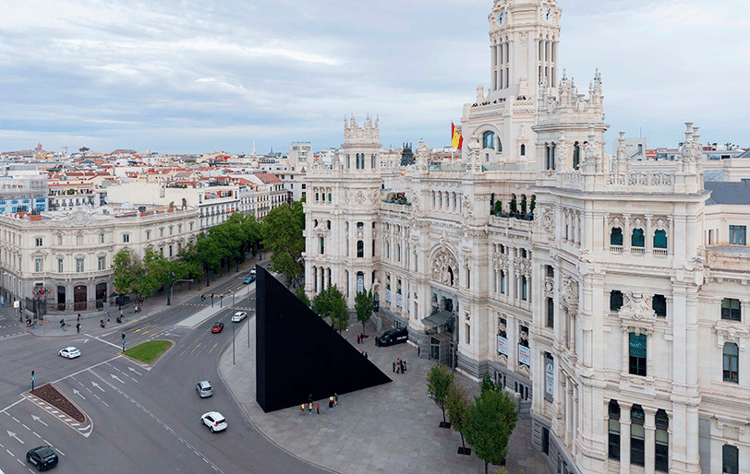
Black triangle art installation in Madrid. Image by Ruben PBescos.

 Follow us
- A 20-meter black triangle appeared in Madrid’s Plaza de Cibeles for four days.
- The PANOPTICON installation used cameras to show live views of people and traffic outside.
- Visitors could watch passers-by without being seen, reversing the usual surveillance experience.
- Artist SpY drew on Jeremy Bentham’s panopticon to question everyday public monitoring.
Key Takeaways by nexos.ai, reviewed by Cybernews staff.
A huge, 20-meter-per-side black triangular structure, resembling a UFO, appeared in Madrid's Plaza de Cibeles, directly opposite the historic Palacio de Cibeles.
Called PANOPTICON, the temporary public art installation was created by Spanish urban artist SpY and ran for four days in late October.
The striking visual intervention was monolithic in its appearance, reminding many of triangular-shaped UFOs. The shape contrasted with the ornate architecture surrounding the city square.
It was a thought-provoking piece, designed to make people question how much they are observed in everyday public environments.






How could the public spy on others?
There were small, discreet viewing sections within the exhibit so that pedestrians could enter and take a look for themselves.
Fragmented views of streetgoers, passing traffic, and nearby buildings could be observed in an elevated live feed. This is thanks to the CCTV cameras connected to the upper rim and apex of the structure.
This effectively allowed visitors to observe the public space they had just walked through. An ordinary member of the public could become the surveyor, able to look directly at passers-by without being seen themselves.
The fact that onlookers see a piece of modern art, yet remain unaware of people inside spying on them, adds to the eeriness.


Stay updated with our latest stories and follow us on social media
Be the first to discover new stories, ideas, and updates from our team.
What was the inspiration behind the art?
The geometric silhouette is influenced by the panopticon concept conceived in the 18th century by philosopher Jeremy Bentham.
Within a multi-tiered prison structure, an observation section was located in the center, where an inspector could monitor inmates without their knowledge.
Back in the days before cameras, this was down to the building's asymmetric structure, which allowed the observer to look directly in from their position. Though it lacked today's high-tech, it laid the foundations for surveillance as we know it.
As CCTV networks, digital tracking, and other monitoring technologies have made surveillance an increasingly ordinary part of public life, the piece brought an ominous sense of Orwellian dread to the Spanish capital.