Can Claude Code really detect hidden cameras in hotel rooms?
Viral posts promise a quick, user-friendly way to de-snoop your room. But do they work?
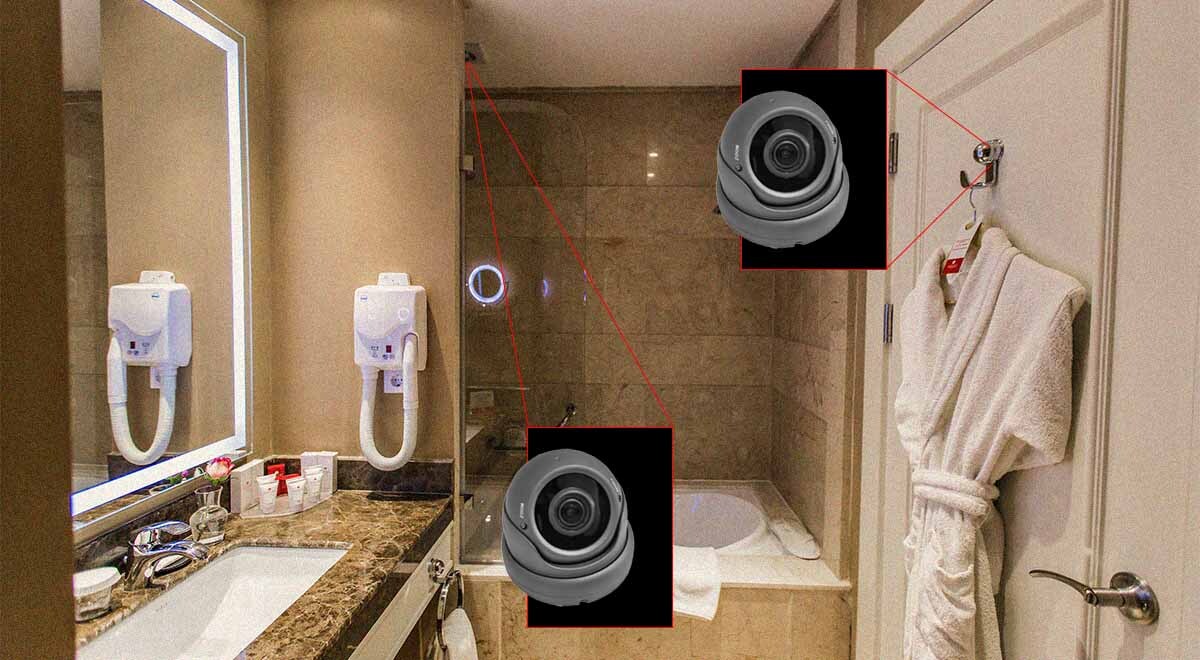
image by Cybernews

 Follow us
- Viral posts claim Claude Code can find hidden hotel cameras or hack door locks, but experts question those claims.
- Experts say the scans use real tools, but AI mainly explains results and connects steps.
- Hidden cameras that record locally or use mobile connections may not appear in WiFi or Bluetooth scans.
- A physical inspection of mirrors, vents, chargers, TVs, and anything facing the bed still matters.
Key Takeaways by nexos.ai, reviewed by Cybernews staff.
A hotel guest. A bathroom mirror. A hidden camera, spotted by AI in 90 seconds. That's one of several claims going viral on X right now – but do they actually work? We asked some security experts.
You may have read the story on an X post, or one similar to it, created by self-styled AI evangelists, sometimes promoting themselves as AI security or privacy maxxers.
Others promise to help you make money or create business efficiencies with AI. You might already be familiar with the hook: “I’m sorry, Claude can do what?!?”
One recent claim comes from @Damir_Akaza, who says his friend used Anthropic’s AI coding assistant to uncover a hidden camera after checking into a hotel with his girlfriend.





The post describes a 5-stage security sweep that travelers can run from their laptops before unpacking in a hotel room or Airbnb.
“I’m sorry, Claude can do what?!?”
The sweep starts by asking Claude Code to scan the hotel’s WiFi network using tools such as Nmap – an open-source Linux tool – to identify connected devices, their manufacturers, and the network ports associated with video streaming.
Next, it uses Bluetooth scanning software to detect tracking devices such as AirTags, then checks a phone for signs of spyware using Amnesty International’s Mobile Verification Toolkit.
If the network scan proves inconclusive, Claude Code guides users through a physical inspection of mirrors, vents, and other possible hiding places using a good old-fashioned torch.
Finally, it produces a report that ranks suspicious findings and recommends next steps, potentially including requesting another room or contacting the police.
A similar post by @Starmexx claims Claude Code reverse-engineered a hotel door lock in 90 seconds, identifying outdated encryption and a connection to a smoke detector.
This account also promotes “10 Claude Code security prompts,” including checks for hidden cameras and compromised hotel equipment, before directing readers to DigiShield, an app advertised at the princely sum of $39.99 for the full package.
Can AI deliver on these promises?
Samuel Hassine, CEO and co-founder of French cybersecurity company Filigran, told Cybernews that the techniques mentioned in the post are legitimate, but their limitations are substantial.
The techniques in these posts are real and old: a network scan, a Bluetooth listen, and Amnesty's phone forensics toolkit,says Samuel Hassine, CEO and co-founder at security firm Filigran.
“The AI only glues them together and explains the output in plain English, which is genuinely useful.”
However, cameras that record locally or use separate connections would not be visible, including many cheap cameras that save footage to an SD card and are often used for this kind of covert activity.
“Your phone's built-in alerts do that job better,” Hassine adds.
And as for @Starmexx’s claim of unlocking a hotel room door from the bed with a single prompt, Hassine maintains that “this is a claim nobody has demonstrated.”

Brian Higgins, a security specialist at Comparitech, was skeptical about the need for any type of AI in such a search.
“It’s reasonable to assume that anyone concerned enough to run these types of checks is already up to speed on their functionality and effectiveness, so adding a layer of ‘Claude Code’ seems redundant…”
Using AI to spot flaws on your home network
According to Christiaan Beek, VP of Rapid7 Intelligence, AI can uncover vulnerabilities within a home network.
While running an open model with no internet connection, Beek asked it to examine his own IoT network for weaknesses.
“Within about 20 minutes, it flagged a device I hadn't realized was so vulnerable – the vendor had skipped some basic hardware security. When I told the model to compromise it, it did so in minutes, then wrote a complete vulnerability report I could submit to the vendor.”
However, Beek adds that a concealed hotel camera presents a different challenge.
“I’m not skeptical about capability, but what I question is where it’s pointed...notice whether the thread ends with a link to buy something,”says Christiaan Beek, VP of Rapid7 Intelligence.
“That device was on my home network, reachable, and badly built. A hidden camera in a hotel room is designed to avoid exactly that. It typically records to a memory card or uses its own mobile connection, so no model can analyze a signal it never receives,” Beek adds.
Desperately seeking followers
In sharing these posts some creators, like @Damir_Akaza, may simply be seeking followers, while others use dramatic demonstrations to steer readers towards paid apps.
Sai Molige, senior manager of threat hunting at Forescout warns that such lures risk repeating the fake-app era, but now with prompts, skills and repositories that users copy and run with their own privileges.
“That could expose users to malicious skills, hidden entry points and trojanized copies. A “find hidden cameras” skill is a particularly effective lure because a user may readily grant it network and Bluetooth access in the belief that it is helping protect them," he says.
As Raghu Nandakumara, VP of Industry Strategy at Illumio, says, there’s nothing new in the underlying techniques set out in these posts.
“Strip Claude Code out of this prompt, and what’s left is a network scan, a Bluetooth listener, an open-source spyware check, and a torch.”
AI makes these tools more accessible to non-technical users, but a clean scan is no guarantee of safety.



Stay updated with our latest stories and follow us on social media
Be the first to discover new stories, ideas, and updates from our team.
Molige adds that using some of these technologies as an unofficial check-in security assistant may be against hotel rules.
Many guest WiFi agreements explicitly prohibit activities such as port scans, vulnerability scans and other information gathering...whatever the user’s motive,"warns Sai Molige, senior manager of threat hunting at Forescout.
If you still fear a hidden camera is recording you in a hotel room or Airbnb, you can respectfully, and without damaging any property, do a quick physical sweep – checking mirrors, air vents, shower heads, smoke alarms, TVs, and, of course, anything pointing at the bed.