NASA, Russian space agency hold rare meeting to discuss lunar program, International Space Station
NASA's new temporary administrator, Sean Duffy, on Thursday held a rare face-to-face meeting in Florida with the chief of Russia's space agency, Dmitry Bakanov, where they discussed cooperation on the moon and maintaining the two space powers' longstanding relationship on the International Space Station, Roscosmos said.

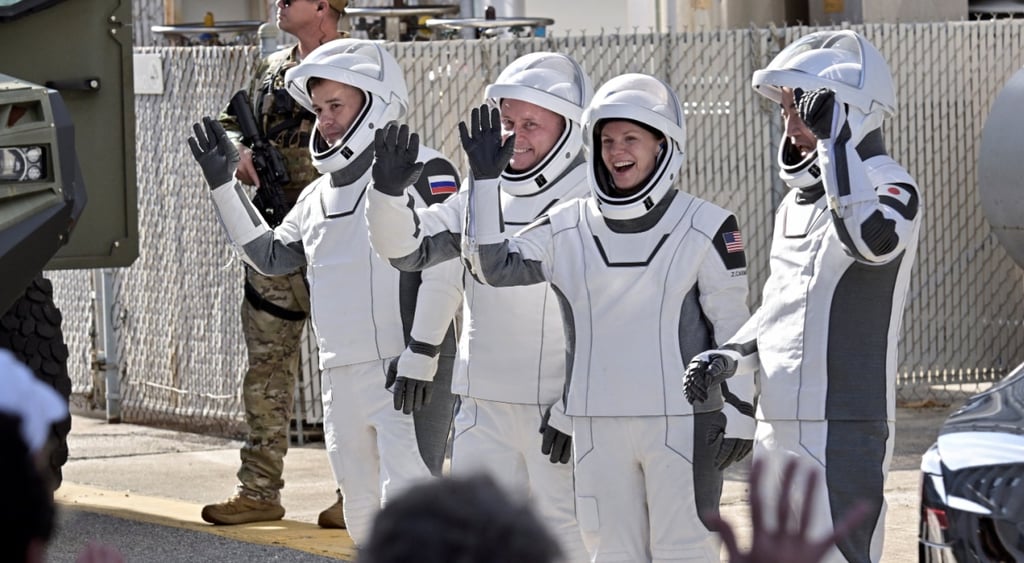
NASA Crew-11 mission to ISS. Steve Nesius/Reuters
 Follow us
NASA's new temporary administrator, Sean Duffy, on Thursday held a rare face-to-face meeting in Florida with the chief of Russia's space agency, Dmitry Bakanov, where they discussed cooperation on the moon and maintaining the two space powers' longstanding relationship on the International Space Station, Roscosmos said.
The talks at the US space agency's Kennedy Space Center were the first in-person meeting between the heads of NASA and Russia's space agency, Roscosmos, since 2018. NASA has not shared any information on the meeting or responded to questions about it.
The meeting, coinciding with an attempt to launch a joint astronaut crew from Florida to the ISS, was a significant moment for Washington's sometimes bumpy space relations with Russia - especially for Duffy, an acting NASA administrator who was assigned to the role just this month while also overseeing the Department of Transportation.
Roscosmos showed on Telegram a video of the meeting between Duffy and Bakanov, each flanked by staff, and other events where Bakanov and his delegation can be seen mingling with US officials.





The Russian space agency said "the parties discussed further work on the ISS, cooperation on lunar programs, joint exploration of deep space, continued interaction on other space projects."
Roscosmos and NASA did not respond to questions about the nature of the lunar program or deep space discussions. Such talks could signal thawing relations between the two countries' civil space programs and represent a shift in global space relations.
Russia had plans to participate in NASA's flagship Artemis moon program until it invaded Ukraine in February 2022. It became a partner on China's moon program, the International Lunar Research Station, a direct rival to the US Artemis program.
The war has led to a vastly isolated Russian space program, which has since boosted investments in military space efforts while nearly all of its joint space exploration projects with the West collapsed.
The Russian delegation visited NASA's Johnson Space Center in Houston on Wednesday and on Thursday was poised to watch the launch of Crew-11, a routine mission to the ISS featuring two US astronauts, a Russian cosmonaut, and a Japanese astronaut. But bad weather pushed the launch to Friday morning, SpaceX said.
Today’s launch attempt has been scrubbed due to weather. Our next Crew-11 launch attempt will be at 11:43am ET (1543 UTC) Friday, Aug. 1. Our coverage will begin at 7:35am ET (1135 UTC).
undefined NASA (@NASA) July 31, 2025
While US-Russian tensions over the war in Ukraine have limited contact between NASA and Roscosmos, they have continued to share astronaut flights and cooperate on the ISS, a 25-year-old totem of scientific diplomacy crucial to maintaining the two space powers' storied human spaceflight capabilities.
Amity on the $100 billion ISS is buoyed primarily by a technical interdependency: the Russian segment relies on power generated by American solar panels, while the task of maintaining the station's altitude is assigned to Russia's thrusters. Multiple other countries depend on the ISS for microgravity research, prominently the European Space Agency, Canada and Japan.
Bakanov and Duffy were expected to discuss extending the two countries' astronaut seat exchange agreement - in which US astronauts fly on Russian Soyuz capsules in exchange for Russian astronauts flying on US capsules - and the planned disposal of the ISS in 2030, according to the Russian news agency TASS.