Scientists make quantum systems run backward in time
No, it’s not quite Back to the Future, but the implications are still huge.
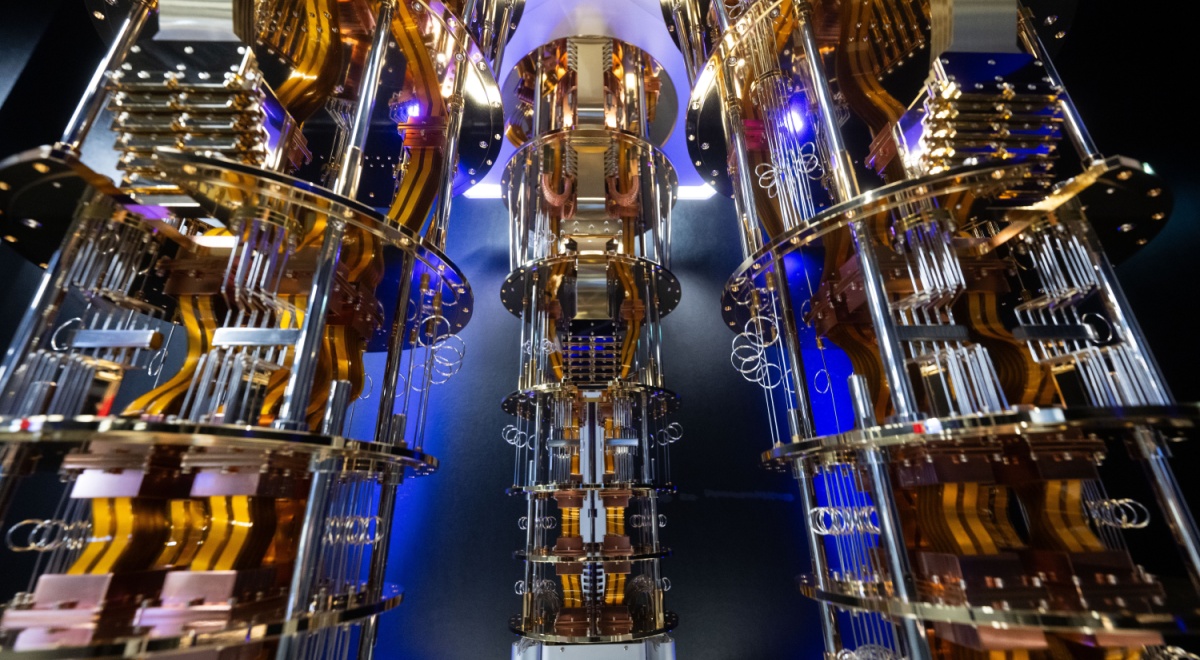
Quantum chip. Picture Alliance via Getty Images.

 Follow us
- Scientists made a quantum system appear to run backward in time by manipulating its arrow of time.
- The technique could help power future quantum computers and quantum batteries using quantum measurements.
- The breakthrough builds on Maxwell's demon, turning a famous thought experiment into practical quantum technology.
Key Takeaways by nexos.ai, reviewed by Cybernews staff.
Time travel is still science fiction, but scientists have managed to make quantum systems appear to run backward in time. The breakthrough could pave the way for smarter quantum computers and entirely new ways of extracting energy.
Time moves only in one direction in everyday life. Eggs break but never unbreak, smoke disperses but never returns to the fire, and we remember yesterday, not tomorrow.
Physicists call this one-way direction the arrow of time, and it's normally tied to entropy, the tendency for disorder to increase.
If you zoom in close to the quantum level, the fascinating element is that the laws of physics are symmetrical. In simple terms, it means the same equations are answerable whether time is running forward or backward.






Researchers at Los Alamos National Laboratory have now developed a way to make a quantum system behave as though its arrow of time has been reversed.
It’s not that the researchers were able to rewind the universe. Instead, they simulated how a quantum system responded to measurements as if it were a movie playing in reverse.
"The tools we've constructed can manipulate the perceived arrow of time,"said physicist Luis Pedro García-Pintos.
They allow researchers to control quantum systems in entirely new ways. It might feel counterintuitive that time isn’t following a straight arrow, as humans prefer, but nature's equations don't have to follow that linear school of thought.
Maxwell’s demon
It can be difficult to wrap one's head around quantum mechanics, but the energy can essentially be harvested from the act of measuring the quantum process itself.
By checking in on the process (like opening the door to see if the lights are on), the scientists could capture the tiny energy disturbance caused by that observation and put it to work.
There was a 19th-century scientific concept called Maxwell's Demon, a thought experiment in which an imaginary being (the demon) used information to steer particles in a way that appeared to reduce disorder in a system.
Quantum scientists have been using models based on Maxwell's Demon for the last couple of decades, but it’s only now that time has been flipped, as in this experiment.
The conversation on this topic is live. Join in the discussion.
The team observed that thermodynamics could be a useful resource for powering quantum computers.
"The equations work just as well if you reverse time," García-Pintos explained, illustrating why quantum systems offer opportunities unavailable in classical physics.
Faster, more reliable quantum computers could eventually benefit from the team's ability to precisely manipulate how quantum systems evolve over time.
The study doesn't mean scientists have invented time travel, but it does reveal that time itself is more flexible in the quantum world than our everyday intuition suggests.