Forget the hype – why Avi Loeb thinks we’re hunting UAPs all wrong
Forget the Hollywood hype and social media clout-chasers – the real battle for the cosmos belongs to raw data. With the Pentagon unable to explain 40% of its active UAP cases, we’re running out of time to spot the ultimate threat.
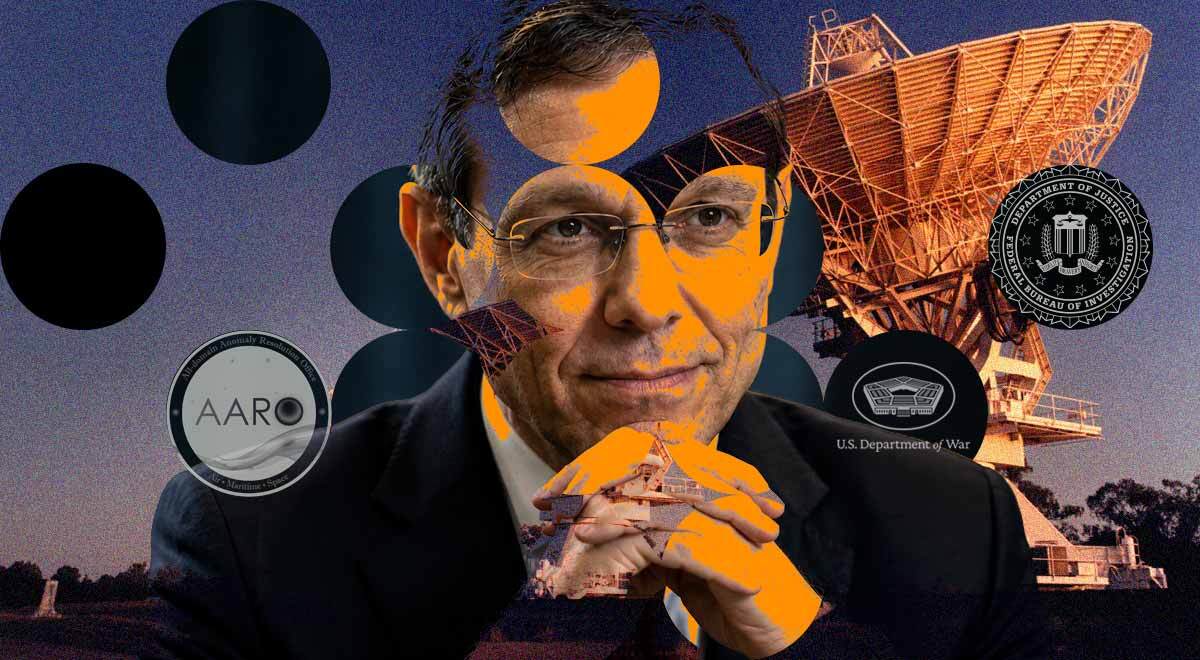
Avi Loeb, and orbs. Image by Cybernews.

 Follow us
Forget the Hollywood hype and social media clout-chasers – the real battle for the cosmos belongs to raw data. With the Pentagon unable to explain 40% of its active UAP cases, we’re running out of time to spot the ultimate threat.
- According to Avi Loeb, true cosmic discovery relies on rigorous, open scientific evidence and observation, not loud social media hype.
- The Pentagon's All-domain Anomaly Resolution Office faces a massive 40% unexplained caseload, highlighting an urgent need for higher scientific tracking standards.
- Rather than just listening for fleeting radio signals (like waiting for a phone call), humanity should hunt for physical interstellar objects left in our solar system's "mailbox."
- The universe is under no obligation to fit human narratives or cinematic lore; real breakthrough discoveries come from confronting cold data and "unknown unknowns."
Key Takeaways by nexos.ai, reviewed by Cybernews staff.
On the quest for aliens, there are both keen scientists gathering data and attention-craving figures who say outrageous things simply to get attention.
Avi Loeb, the former type, who has been tasked by the White House with overseeing UAP investigations, was eager to reduce human ego when considering space.
"Science makes progress by identifying signals relative to the noise,” Loeb explained to Cybernews. “The tool is science to collect data that will guide us,” he affirmed.


Chasing ghosts for likes
As some stooge-like figures brandish commandeering rhetoric like “bring out the alien” in order to sell new books, Loeb defines them as “what I call the Kardashians of science.”
As we orbit the topic of extraterrestrial territory, Loeb uses several sporting analogies, quite timely given various sporting events happening at the moment. He speaks about keeping one's eye on the ball, as well as those sell-out experts who can stay on the subs bench.
By prioritizing the social media spectacle, Loeb warns that these figures are actively derailing real progress.
“If you were to live your life attending to noise,” he points out, “you may be chasing ghosts and wasting your time.”
With Earthlings always needing validation, we got our planet's exact essentials quite late in the day, so to speak.
“The sun will not move around the Earth just because the Vatican said it does,” clarified Loeb, citing the 4.56 billion years that came before then.
In keeping with the past, Loeb is more enthused by the period of the astronomer Galileo than by becoming embroiled in Cold War failings or ambiguity.
On a cosmological blind date
On an institutional level, the Pentagon hasn’t exactly been firing on all cylinders when it comes to keeping the public, never mind its employees, informed about its probe into potential alien tech.
With that said, however, Loeb pulls up recent form Pentagon’s own All-domain Anomaly Resolution Office, which asserted in October 2023 that “there were orbs giving birth to smaller orbs” and that it remains an unresolved anomaly.
Loeb points to a sizable 40% unexplained caseload (or a 60% success rate) on the Pentagon's behalf, so there’s a need to raise the standards somewhat.
And in the name of evidence, Loeb's team only wants to court the best on the block.
“When you go on a blind date, you want to aim high, not low. You want to look for someone more intelligent than you are, rather than for the most mediocre dating partner."
The search for extraterrestrial intelligence even has a committee (SETI), and Loeb can pinpoint where they’ve been going wrong all these years: they've been “searching for electromagnetic signals – that's just like waiting for a phone call.”
Much better, in his opinion, is to “check your mailbox to see if there are any packages in it.”
A contract with reality
The word on everyone's lips will change, but for the moment, it’s Spielberg’s new movie Disclosure Day.
When I mentioned this, Loeb immediately pivoted to popular podcast The Diary of a CEO, in which a recent guest identified 4 alien types.
Such a hallucination can be met with defiant opposition, “And I told them, look, you have to address it from a scientific point of view,” countered Loeb, dubbing select members of the popular community “crackpots.”
For Loeb, we need physical data over cinematic storytelling because the universe doesn't care about our feelings.
“Reality is under no contract to make you happy,” he notes, drawing a line between rigorous science and cheap escapism.
Human ignorance, coupled with scientific blind spots, is what hampers the progress of the scientific community.
Imagine that there are unknown unknowns. There are things that we don't even know that we don't know. These are the most disruptive discoveries that can happen in science.
And by insisting on science, it doesn’t mean that the celestial can’t have a place at the table. By quoting King Solomon from the Old Testament, “there is nothing new under the Sun,” Loeb points out, “this is not true because the sun will die in 7.6 billion years,” injecting a stark dose of cosmic reality.
At least we still have time for some form of disclosure then. By looking at the raw data in front of us, instead of chasing internet ghost stories, we might just catch the ultimate threat before time runs out.





