Scientists rewrite first-contact rules: "We do not shout alien"
The International Academy of Astronautics (IAA) has overhauled the protocols for what a scientist should do if they receive a signal from aliens.
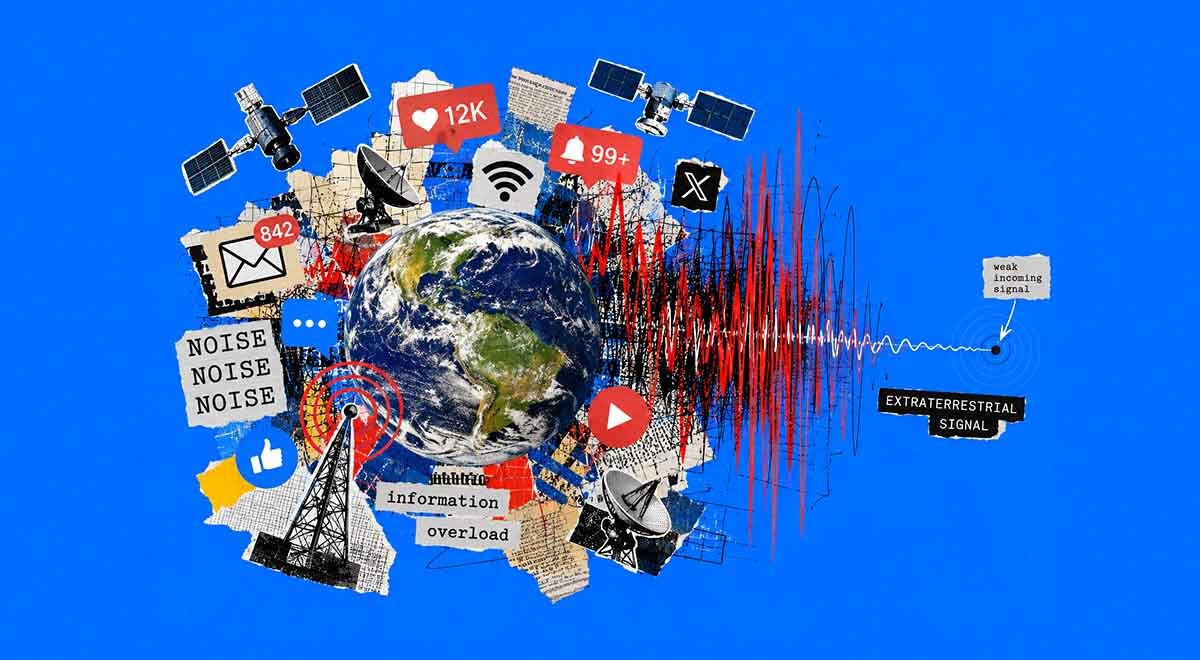
Signal overload. Image by Cybernews.

 Follow us
The International Academy of Astronautics (IAA) has overhauled the protocols for what a scientist should do if they receive a signal from aliens.
- Scientists must prioritize rigorous evidence and community consensus over premature public announcements.
- Independent verification with different instruments is required, and mundane explanations (e.g., equipment glitches, terrestrial interference) must be ruled out.
- The 2010 rules didn’t account for instant global reach or AI-generated misinformation, which could trigger panic
- Responding to aliens is a decision for all humanity, but once a signal is confirmed, data and methods must be shared openly.
The updated protocols, led by University of Manchester astronomer Michael Garret, place greater emphasis on verification rather than mere hype.
The document champions scientific consensus within the community rather than jumping the gun and making a big public announcement, an approach favored by some pundits and politicians.
"We do not shout ‘alien’ the moment we see a strange blip,” stated Garret, channeling a more methodical school of thought to that of UFO whistleblowing.



The revised protocols double down on the idea that extraordinary claims require extraordinary evidence, with researchers expected to challenge their own findings before making announcements.
There’s also a push for scientists to stop relying on compromised evidence, such as equipment failures or terrestrial interference (e.g., satellite noise or household appliances).
Why the rules had to change
The previous protocols were adopted in 2010, in a vastly different digital world from the one we face now. Back then, there were no deepfakes or generative AI, and the social media sharing ecosystem wasn’t as hyperconnected as it is in 2026.
That means that if a potentially world-changing discovery were to happen, scientists worry that an unverified claim could proliferate across social networks before a grounded explanation is offered.
"In an era of deepfakes, automated misinformation, and instant global connectivity, a single unverified claim could trigger confusion or panic," explained Garret.
The Cybernews community is talking about this. Be a part of the conversation.
As fabricated evidence is rife, even among public institutions, the devil is certainly in the details, and especially so for scientists.
Protecting scientists from harassment and doxxing is a key objective. Also, being under intense personal scrutiny is the reality we live in now. And in exchange for this protection, raising the bar of scientific rigor feels like a fair trade-off.
"These new protocols ensure that scientists maintain the highest standards of evidence before making announcements to the world," said Garret.
And if a signal is real?
Once a detection is verified, the protocols call for transparency rather than secrecy. It then becomes the scientist's responsibility to ensure that the data, software, and analysis methods are made publicly available.
A wide range of clues, from radio transmissions and laser emissions to unusual heat signatures, could all point to advanced alien technology.
There is a golden rule at play in the declaration, too: scientists are not to reply immediately if they receive a signal from extraterrestrials.
Think of it like a cosmic version of due diligence and ethical obligation, which matters mostly because it’s far from being an issue of whistleblowers and politicians, who take up most of the headlines.
“The Declaration reaffirms the enduring principle that transmitting a response to an extraterrestrial intelligence is a decision that belongs to all of humanity," reaffirmed Garret.





