AI satellite thinks for itself, Japan's asteroid flyby, and a new habitable planet
Is there anybody out there?
Satellite. Image by Cybernews.

 Follow us
- An AI-powered satellite can now identify what it sees from orbit without waiting for humans on Earth.
- Japan's Hayabusa2 spacecraft is attempting one of the closest asteroid flybys ever, passing within just one kilometre of Torifune.
- Astronomers have identified GJ 3378b as a nearby potentially habitable super-Earth just 25 light-years away.
Key Takeaways by nexos.ai, reviewed by Cybernews staff.
This week, The Cosmic Report rounds up a trio of scientific space stories featuring a leap in AI space tech, an asteroid with mythological proportions, and an exoplanet we could call home that’s just 25 light years away.
Usually, when a satellite scans what it sees on Earth while in orbit, it sends the images back to Earth, where a human gives them the once-over and completes verification checks.
NASA's Jet Propulsion Laboratory (JPL) and satellite company Loft Orbital has developed an AI system that lets satellites recognise what they're looking at before sending information back to Earth
Much like how a standard LLM functions, the satellite can be prompted with a command like “find me a beach that curves like a crescent moon” instead of having to upload new software for each separate project.

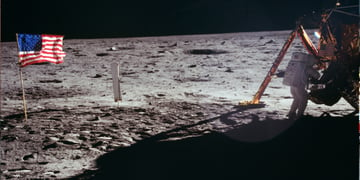




During a testing process for 8000 images, the AI successfully identified almost 90% of the images correctly, including beaches, farmland, and residential areas.
And, as Science Alert reported, researchers say the same technology could eventually monitor ports, coastlines, and borders continuously, only reporting back when something important happens.
The much-improved AI space tech might raise further concerns about surveillance, but the reliability and autonomous decision-making have certainly been improved.
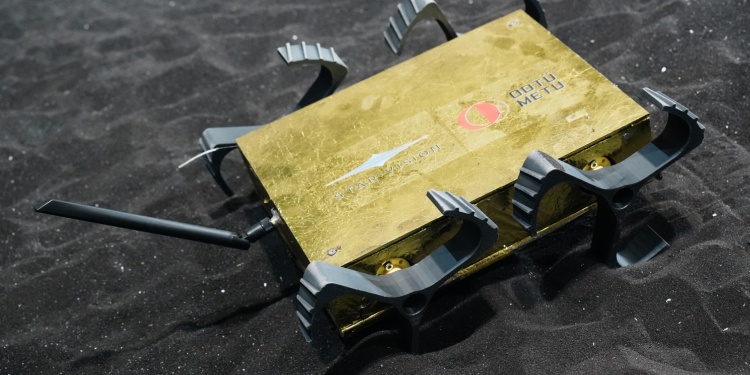
Japan’s asteroid flyby
There’s an asteroid that’s been orbiting the Sun for billions of years that goes by the name of Torifune. Torifune in Japanese mythology means “heavenly boat bird,” and now the nation is gearing up for a mission full of bravura.
Japan's Hayabusa2 spacecraft is preparing for an extraordinarily risky flyby that will take it as close as one kilometre above asteroid Torifune on July 5th.
Travelling at roughly 5.3 kilometres per second, the spacecraft will have only moments to capture images and scientific data during the encounter. The flyby is part of Hayabusa2's extended mission after successfully collecting samples from asteroid Ryugu and returning them to Earth in 2020.
Scientists know surprisingly little about Torifune, and some suspect it could even be a contact binary made from two joined asteroids.
"This is one of the closest asteroid encounters ever attempted by a mission of this class," Japan Aerospace Exploration Agency (JAXA) scientist Satoshi Tanaka told Space.com.
"We're going to discover another beast to put in the zoo of asteroids," added European Space Agency (ESA) scientist Patrick Michel ahead of the encounter.
Torifune is thought to be a fragment of a much larger asteroid shattered by an ancient collision, preserving clues about the early Solar System's violent history.
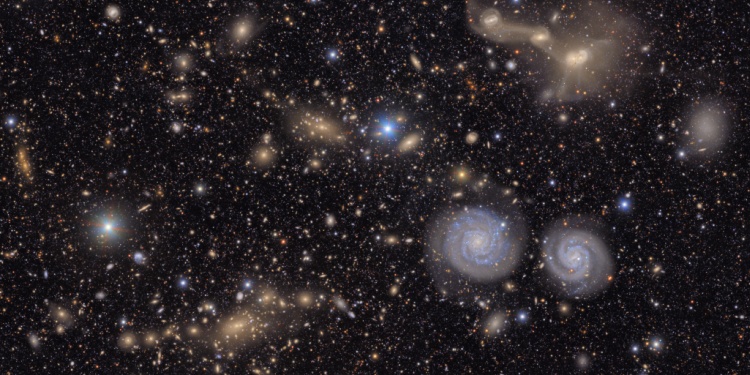
Next home just light years away?
Have you ever heard of the term “terrestrial planet?” They are also sometimes known as “rocky planets.” There’s a particular contender named GJ 3378 (quite common to have code-sounding names).
At just 25 light-years away, the planet is one of our relatively close cosmic neighbours and an attractive future target in the search for life.
New measurements suggest the world has about 2.3 times Earth's mass and receives roughly 90% of the sunlight Earth receives from the Sun.
Those conditions place the planet comfortably inside its star's habitable zone, where liquid water could potentially exist if an atmosphere is present.
"This one's exciting," said astronomer Paul Robertson, describing the planet as one of our "next-door neighbours."
The biggest unanswered question is whether radiation from its active red dwarf star has stripped away any atmosphere the planet once possessed. Because GJ 3378b does not pass in front of its star from Earth's perspective, today's telescopes cannot easily determine whether it has an atmosphere.
Scientists hope NASA's planned Habitable Worlds Observatory, expected in the 2040s, will finally reveal whether this nearby world could support life.